The marabou stork species is a single species, Leptoptilos crumenifer, a huge bare-headed scavenger of sub-Saharan Africa with one of the largest wingspans of any land bird. If you are asking how many marabou stork species there are, the answer is one, a monotypic stork with no recognised subspecies, and it is as much a cleaner of the savanna as it is a bird.
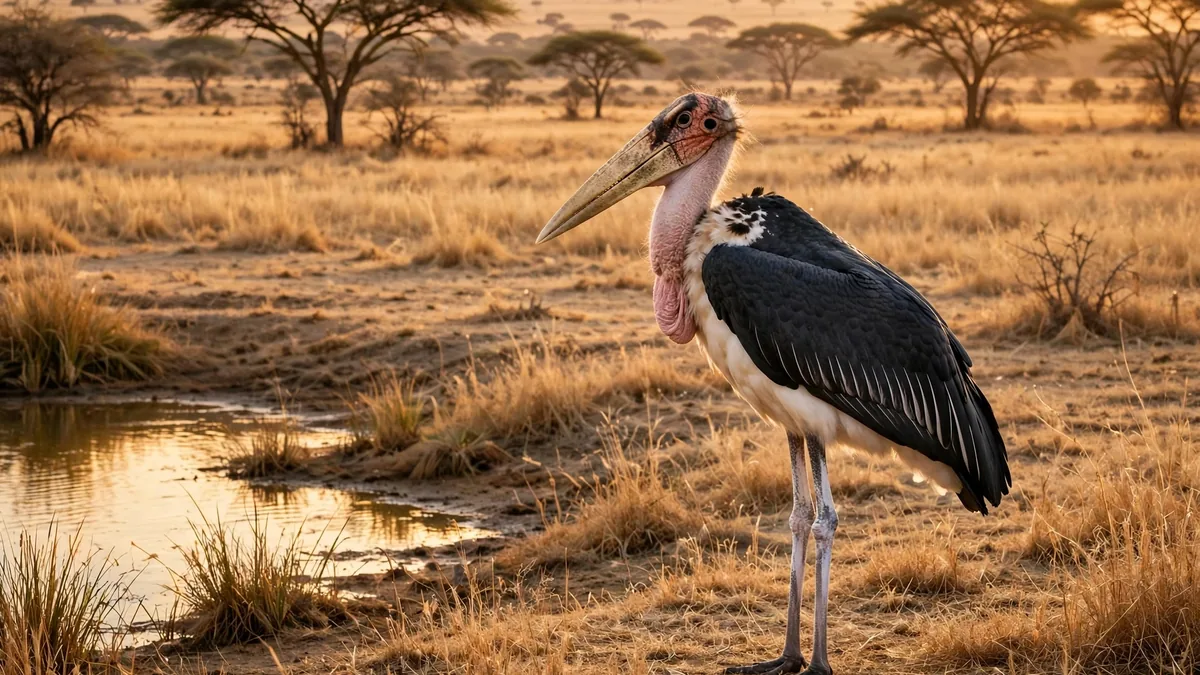
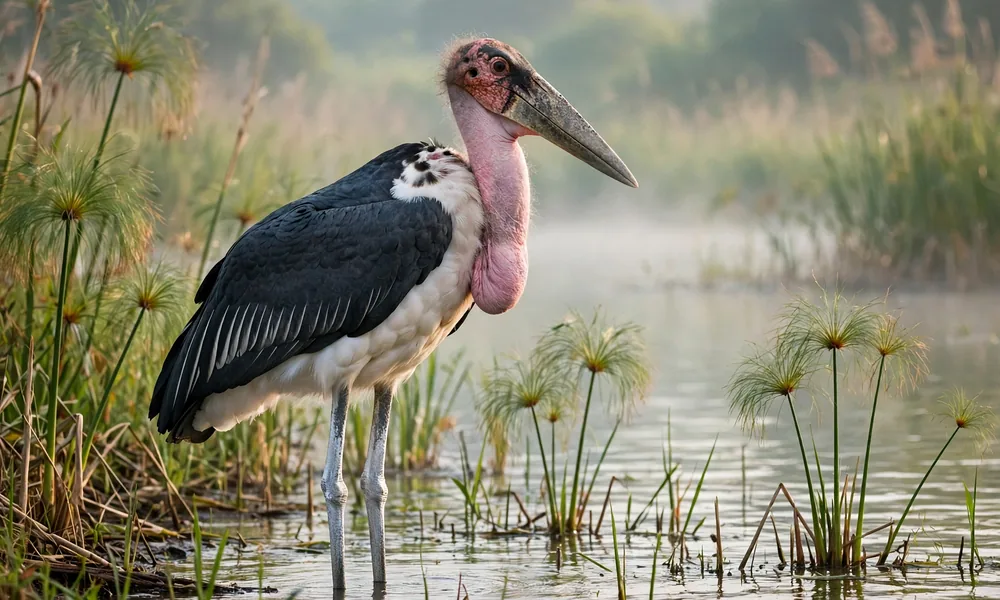
On a dry African morning you can see a marabou standing hunched beside a waterhole, a great black-and-white bird with a bald pink head, a massive bill and a pink pouch hanging from its throat — a bird built for a job, and the job is cleaning up the dead.
Key takeaways
- The marabou stork species is Leptoptilos crumenifer, a single monotypic species with no recognised subspecies, named for the pouch hanging from its throat.
- Adults stand up to about 152 centimetres tall, weigh 4.5 to 9 kilogrammes, and have a wingspan of 225 to 287 centimetres, among the largest of any land bird.
- It has a bare pink head and neck, a huge bill, a pink gular sac, a black back and white underparts, and long grey legs.
- Marabous eat mainly carrion, scraps and waste, but they also hunt live prey, including fish, frogs, insects, eggs and small mammals, and they breed in colonies in the dry season.
- Listed as Least Concern, with a very large and increasing population, and a familiar bird of African towns and rubbish dumps as well as the wild savanna.
What makes a marabou stork a marabou stork
A marabou stork is a massive bird: large specimens reach a height of 152 centimetres and a weight of 9 kilogrammes, with a typical weight of 4.5 to 8 kilogrammes and a length of 120 to 130 centimetres. Its wingspan, typically 225 to 287 centimetres, is the headline feature, with exceptional birds reported at up to 3.2 metres. It is often credited with the largest wingspan of any land bird, though the average marabou spans about 30 centimetres less than the average Andean condor.
The head and neck are bare, pink and blotched, the bill is huge and wedge-shaped, reaching about 34 centimetres long, and a pink gular sac, a throat pouch, hangs from the neck, giving the bird its scientific name: crumenifer means carrier of a pouch for money, because the pouch looks like a purse. The back and wings are black, the underparts white, with a white neck ruff and long grey legs. Young birds are browner, with smaller bills.
The marabou stork species and their relatives
The marabou stork belongs to Leptoptilos, a small genus of very large tropical storks in the family Ciconiidae, and it is monotypic, with no recognised subspecies. It was described in 1831 by the French naturalist Rene Lesson, who named the genus Leptoptilos, Greek for thin-feathered. Older books spell the name Leptoptilos crumeniferus, but the modern spelling is crumenifer.
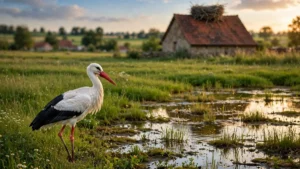
Its closest relatives are the two Asian adjutants, the greater adjutant, Leptoptilos dubius, and the lesser adjutant, Leptoptilos javanicus, both huge scavenging storks of South and South-East Asia. The wider family holds the white stork of European rooftops, the saddle-billed stork of African wetlands and the yellow-billed stork of African lakes, though none lives so much by carrion as the marabou.
| Type | Animal | Where it lives | Best-known food | Length or Weight |
|---|---|---|---|---|
| Family | Storks (Ciconiidae) | Worldwide, mostly tropics | Fish, frogs, insects and carrion | About 75 to 150 cm tall |
| Genus | Adjutants and marabou (Leptoptilos) | Africa and Asia | Carrion and small animals | About 110 to 150 cm tall |
| Species | Marabou stork (Leptoptilos crumenifer) | Sub-Saharan Africa | Carrion and small animals | 120 to 130 cm, 4.5 to 9 kg |
| Species | White stork (Ciconia ciconia) | Europe, Africa and Asia | Frogs, insects and small mammals | 100 to 115 cm, 2.3 to 4.4 kg |
| Species | Greater adjutant (Leptoptilos dubius) | India and South-East Asia | Carrion and small animals | About 145 to 150 cm, 8 to 9 kg |
| Species | Saddle-billed stork (Ephippiorhynchus senegalensis) | Sub-Saharan Africa | Fish, frogs and crabs | About 130 to 150 cm, 5 to 7 kg |
How marabou storks live
Marabous are scavengers first and hunters second. They eat mainly carrion, scraps and waste, and they will swallow almost any animal matter they can get down, including dead fish, birds and mammals, and, around towns, human garbage. The naked head and long neck are adaptations to this life, just as they are in vultures: a feathered head would quickly become clotted with blood inside a carcass, while a bare head is easy to keep clean. Marabous often follow vultures to a carcass, since vultures find the dead first and open the body, and a marabou may wait for them to finish, steal a piece, or pick up what they cast aside.
They also hunt live prey, and in the breeding season they scale back on carrion and take mostly small live animals, because nestlings need fresh food to grow. Common prey at that time includes fish, frogs, insects, eggs, small mammals and reptiles such as crocodile hatchlings, lizards and snakes, and marabous have been known to take other birds, including quelea nestlings, pigeons and even flamingos. They feed by day, soaring on thermals and wading in shallow water, where a touch on the bill makes it snap shut.
Marabous breed in colonies in the dry season, when shrinking pools concentrate fish and frogs. The nest is a small platform of sticks built in a tree, often in a colony of ten to a hundred pairs, and the female lays two to three eggs, which hatch after about 30 days of incubation by both parents. The chicks fledge at 13 to 15 weeks and stay with their parents for about another four months. Marabous are mostly silent, but they clatter their bills and croak with the throat sac during courtship, and they can live for 25 years in the wild and 43 years in captivity.
Where marabou storks live
Marabous live across sub-Saharan Africa, from Senegal and Gambia in the west, east to Ethiopia and Somalia, and south to South Africa, in open dry savanna, grassland, riverbanks, lakeshores and swamps. They gather near lakes and rivers, often standing hunched at a waterhole or soaring above the plain. In recent decades they have expanded across Central and Southern Africa and moved into towns, where hundreds gather around rubbish dumps and abattoirs.
They are birds of the open country, most at home where large animals gather and die, on the great savannas of East and Southern Africa. Like the white stork, the marabou is a bird of wetlands and open ground, but unlike its elegant cousin it has made a home of the rubbish dump as well as the marsh, and like the vulture it does the hard work of cleaning up the dead.
The marabou stork is listed as Least Concern on the IUCN Red List, because its range is extremely large and its population is very large and increasing, helped by towns and rubbish dumps and by the decline of lions, which prey on marabous. It is one of the safari world’s Ugly Five, animals celebrated not for beauty but for character.
Best seasons for marabou stork watching
Marabous can be watched all year across their range, but the dry season is the best time. As pools shrink, fish, frogs and carrion are concentrated in smaller areas, the birds gather in larger numbers around waterholes and riverbanks, and the breeding colonies are busy in the trees. In East Africa breeding begins around October and November, and in Southern Africa from July to September, so a dry-season safari in the Serengeti, the Masai Mara or the Kruger is the surest way to see them well.
Staying safe around marabou storks
A marabou stork is not a bird to approach closely. It is huge, it carries a bill like a spear, and it can defend itself if cornered, so watch from a distance with binoculars and never try to feed one or touch one. At a carcass, keep well back: lions, hyenas and jackals may be nearby, drawn by the same smell. Stay in your vehicle at a kill site and follow your guide.
Do not approach a breeding colony closely, since disturbed birds may abandon their nests, and keep your distance from birds at rubbish dumps, where the ground is full of waste and disease. Like the white stork, the marabou is a wild bird that should be watched, not handled, and washing your hands after time around scavengers is simple common sense.
Marabou stork watching checklist
A little preparation turns a dry-season safari into a real chance of seeing marabous at their best.
- A visit in the dry season, when the birds gather around shrinking pools.
- A safari in East or Southern Africa, such as the Serengeti, the Masai Mara or the Kruger.
- Binoculars, since a marabou soaring on a thermal or standing at a distant waterhole is hard to study.
- An eye for the bare pink head, the huge bill and the pink throat pouch, the marks that separate it from every other stork.
- A scan of waterholes, riverbanks and carcasses, where marabous gather with vultures to feed.
- Patience and a wide sky, because marabous may circle for minutes on a thermal before dropping down to land.
- Respect for carcasses and colonies, keeping your distance and staying in the vehicle at a kill site.
Frequently asked questions
How many marabou stork species are there?
There is one marabou stork species, Leptoptilos crumenifer, and it is monotypic, with no recognised subspecies. Older books sometimes spell it Leptoptilos crumeniferus, but the modern spelling is crumenifer.
What is the pouch on a marabou stork for?
The pink pouch is a gular sac, inflated during courtship display, when the bird also croaks with it, and it can store food. The name crumenifer means carrier of a pouch for money, because the sac looks like a purse.
What does a marabou stork eat?
A marabou eats mainly carrion, scraps and waste, but also hunts live prey, including fish, frogs, insects, eggs, small mammals and reptiles, taking mostly live prey in the breeding season, because nestlings need fresh food.
Why is the marabou stork called the undertaker bird?
The marabou is called the undertaker bird because of its appearance and its work: it stands hunched in a black cloak with a bald head, like a figure at a funeral, and it feeds on the dead. It is also one of the safari world’s Ugly Five.
Are marabou storks endangered?
Not officially. The marabou stork is listed as Least Concern on the IUCN Red List, with a very large range and a population that appears to be increasing, helped by towns and rubbish dumps. It faces local threats, including hunting, but is not at immediate risk.
How is this guide different from the mallard duck guide?
This guide covers the marabou stork, a huge bare-headed scavenger of the African savanna that cleans up carcasses and soars on thermals, while our mallard duck species guide covers the mallard, a dabbling duck of northern wetlands. One is the undertaker of the savanna; the other is the duck of the village pond.
Conclusion
The marabou stork species needs no introduction once you have seen it: one species, Leptoptilos crumenifer, a huge black-and-white bird with a bald pink head, a massive bill and a throat pouch, standing hunched beside a waterhole on the African savanna.
If you go looking for one, go in the dry season, go early, and watch the waterholes and the wide sky for one circling on a thermal or standing guard over a carcass.