The northern cardinal species is a single species, Cardinalis cardinalis, the bright red songbird of North American gardens and woodland edges. If you are asking how many northern cardinal species there are, the answer is one, a crested bird with about 19 recognised subspecies and a clear, whistled song that carries through the trees all year round.
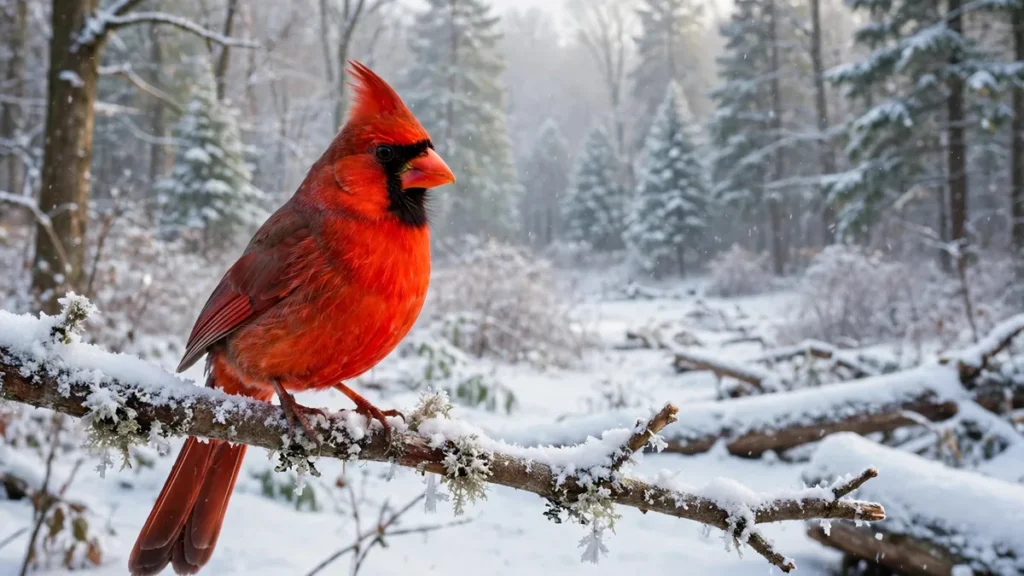
On a cold winter morning, when most birds have gone quiet or flown south, a male northern cardinal can still be seen on a bare branch, a flash of red against the snow. For many people in the eastern United States it is the bird that makes winter bearable.
Key takeaways
- The northern cardinal species is Cardinalis cardinalis, a single species with about 19 recognised subspecies, although some authorities count 18.
- Males are bright red with a crest and a black face mask, while females are warm olive-brown with red tinges on the wings, tail and crest.
- It lives in woodland edges, thickets, gardens and parks across eastern North America, from south-eastern Canada through Mexico to northern Guatemala and Belize.
- Northern cardinals eat mainly seeds and fruit, with insects in summer, nest in dense shrubs, and sing a clear whistled song in every season.
- Listed as Least Concern, with a population of about 100 million birds, and it is the state bird of seven states, more than any other bird.
What makes a northern cardinal a northern cardinal
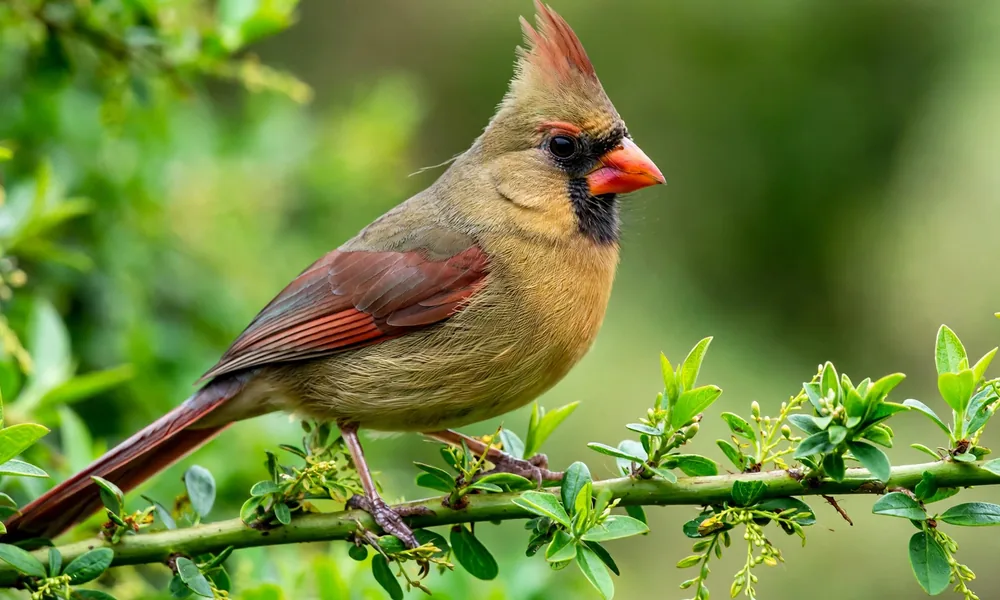
A northern cardinal is a medium-sized songbird, about 21 to 23 centimetres long, with a wingspan of about 25 to 31 centimetres and a weight of about 34 to 65 grammes. The male is unmistakable: bright red all over, with a tall crest, a black mask around the eyes and throat, and a thick, cone-shaped orange-red bill built for cracking seeds. The female wears the same shape in softer colours, warm olive-brown with red tinges on the wings, tail and crest, and the same black mask and red bill.
The song is the other way to know one. A northern cardinal sings a series of clear, loud whistles, often described as cheer, cheer, cheer, or birdie, birdie, birdie, repeated several times before it moves on to a new phrase. Both sexes sing, which is unusual among songbirds, and the female often sings from the nest while the male brings her food.
The northern cardinal species and their relatives
The northern cardinal belongs to Cardinalis, a small genus of three species in the cardinal family Cardinalidae, and it is a single species with about 19 recognised subspecies. The count varies by authority: most lists give 19, but some give 18, because a few of the Mexican and Central American forms are so similar that experts draw the lines between them differently. The nominate race, C. c. cardinalis, is the bird of the eastern United States and south-eastern Canada, while the other races live through Mexico and Central America, differing mainly in the shade of red, the size of the bill and the darkness of the back.
Its closest relatives are the other two members of the genus, the pyrrhuloxia, Cardinalis sinuatus, a grey desert bird of the south-western United States and Mexico with a red face and a stout yellow bill, and the vermilion cardinal, Cardinalis phoeniceus, a scarlet bird of the dry scrub of Colombia and Venezuela. The wider family holds the grosbeaks, buntings and tanagers, including the scarlet tanager, all strong-billed, brightly coloured birds of woodland and scrub.
| Type | Animal | Where it lives | Best-known food | Length or Weight |
|---|---|---|---|---|
| Family | Cardinals and allies (Cardinalidae) | North, Central and South America | Seeds, fruit and insects | About 12 to 25 cm long |
| Genus | Cardinals (Cardinalis) | North America to northern South America | Seeds, fruit and insects | About 19 to 24 cm long |
| Species | Northern cardinal (Cardinalis cardinalis) | Eastern North America to Belize | Seeds, fruit and insects | About 21 to 23 cm, 34 to 65 g |
| Species | Pyrrhuloxia (Cardinalis sinuatus) | South-western United States and Mexico | Seeds and insects | About 19 to 22 cm, 24 to 43 g |
| Species | Vermilion cardinal (Cardinalis phoeniceus) | Colombia and Venezuela | Seeds and insects | About 19 cm, about 24 g |
| Species | Scarlet tanager (Piranga olivacea) | Eastern North America | Insects and fruit | About 16 to 19 cm, 23 to 38 g |
How northern cardinals live
Northern cardinals feed mostly on the ground and in low shrubs, hopping along the leaf litter and picking up seeds, and they visit garden feeders regularly, where sunflower and safflower seeds are favourites. In summer they add insects to the menu, including beetles, caterpillars, grasshoppers and ants, and they feed these protein-rich foods to their chicks.
They are diurnal, active in daylight, and they are one of the few songbirds that do not migrate, staying on the same territory all year. In winter they gather in loose flocks of up to 60 or 70 birds, feeding together and roosting in dense evergreens, their red plumage standing out against the snow. The male sings through the year, not just in spring, to hold his territory and keep in touch with his mate, and pairs often stay together all year.
Breeding birds nest in dense shrubs or low trees, usually one to three metres above the ground, in a neat open cup built by the female from twigs, grass and bark, lined with fine grass and hair. The female lays three to four eggs, sometimes as few as one or as many as five, whitish with brown, purple and grey blotches, and incubates them alone for 12 to 13 days while the male brings her food. The chicks hatch naked and helpless, are fed by both parents, and leave the nest after nine to 11 days. A pair usually raises two or three broods a year, rarely four, the male caring for the first brood while the female starts the next nest.
Where northern cardinals live
Northern cardinals live across eastern North America, from south-eastern Canada through the eastern United States, from Maine to Minnesota and south to Texas, and through Mexico to the Isthmus of Tehuantepec, northern Guatemala and northern Belize. They favour woodland edges, thickets, hedgerows, gardens, parks and shrubland, anywhere with dense cover to nest in and open ground to feed on, and they have spread steadily northwards over the past century. They were also introduced to Hawaii in 1929 and to Bermuda, where they are now common. Like the blue jay and the American robin, it is a bird that thrives where people live.
They are the state bird of seven states, Illinois, Indiana, Kentucky, North Carolina, Ohio, Virginia and West Virginia, more than any other bird. The name comes from the red robes of cardinals in the Catholic Church, whose colour the male bird matches so well.
The northern cardinal is listed as Least Concern on the IUCN Red List, with a population estimated at about 100 million birds and a stable trend. It has done well out of human settlement, because gardens, hedgerows and feeders suit it, although window strikes and cats kill many birds each year.
Best seasons for northern cardinal watching
Northern cardinals are easy to watch all year, because they do not migrate and visit garden feeders in every season. Winter is often the best time, when bare trees make the red male easy to spot against the snow and the birds gather at feeders in the morning. Spring is the best time for song, when the males sing from the tops of shrubs.
Staying safe around northern cardinals
A northern cardinal is a gentle, harmless bird, and the main risk is to the bird rather than to you. Never approach a nest closely, since the female may abandon it if flushed too often, and keep your distance from singing males. Watch from a distance with binoculars, and stay on paths rather than pushing through the shrubs where they nest. Like the scarlet tanager and the red-tailed hawk, the northern cardinal is protected by law in the United States under the Migratory Bird Treaty Act.
Keep cats indoors during the nesting season, because cardinals nest low in shrubs and are easy prey. If a male cardinal keeps attacking a window or a car mirror, it is fighting its own reflection, thinking it is a rival: cover the glass for a few days and it will move on.
Northern cardinal watching checklist
A little preparation turns a winter morning in the garden into a real chance of seeing a northern cardinal.
- A visit at any time of year, since cardinals do not migrate and stay on their territories through winter.
- An early-morning start, when the birds come to feeders and the males sing from the tops of shrubs.
- Binoculars, since a cardinal in dense cover is often heard before it is seen.
- A garden feeder stocked with sunflower or safflower seeds, which cardinals love.
- A scan of bare branches and evergreen roosts in winter, where the red male stands out against the snow.
- An ear for the clear, whistled cheer, cheer, cheer, which gives the bird away even in thick cover.
- Respect for nests and territories, keeping to paths and never approaching a shrub where a bird is nesting.
Frequently asked questions
How many northern cardinal species are there?
There is one northern cardinal species, Cardinalis cardinalis, with about 19 recognised subspecies. Some authorities count 18 rather than 19, because a few of the Mexican and Central American forms are so similar that experts draw the lines between them differently.
What is the difference between a male and a female northern cardinal?
Male northern cardinals are bright red all over, with a black face mask and a red bill, while females are warm olive-brown with red tinges on the wings, tail and crest, and the same black mask and red bill.
What does a northern cardinal eat?
A northern cardinal eats mainly seeds and fruit, including sunflower and safflower seeds at feeders and wild grape, dogwood and sumac berries, and it adds insects such as beetles, caterpillars and grasshoppers in summer, especially when feeding its chicks.
Why is the northern cardinal the state bird of seven states?
The northern cardinal is the state bird of Illinois, Indiana, Kentucky, North Carolina, Ohio, Virginia and West Virginia, because it is the most familiar bird of the eastern United States in all of them. Its bright red plumage and year-round song made it a natural choice.
Are northern cardinals endangered?
Not officially. The northern cardinal is listed as Least Concern on the IUCN Red List, with a population estimated at about 100 million birds and a stable trend. Window strikes and cats are the main dangers to individual birds, not a threat to the species as a whole.
How is this guide different from the marabou stork guide?
This guide covers the northern cardinal, a small, bright red songbird of North American gardens that sings a clear whistle all year round, while our marabou stork species guide covers a huge African scavenger, a stork with a wingspan of up to three metres that soars over the savanna and feeds on carrion. One brightens a winter garden; the other cleans up the African plains.
Conclusion
The northern cardinal species needs no introduction once you have seen it: one species, Cardinalis cardinalis, a crested red songbird with a black mask and a whistled song, and the state bird of seven states.
If you go looking for one, go on a winter morning, go early, and listen first. Find one singing from a bare branch above the snow, and you will see why this bird is loved across a continent.