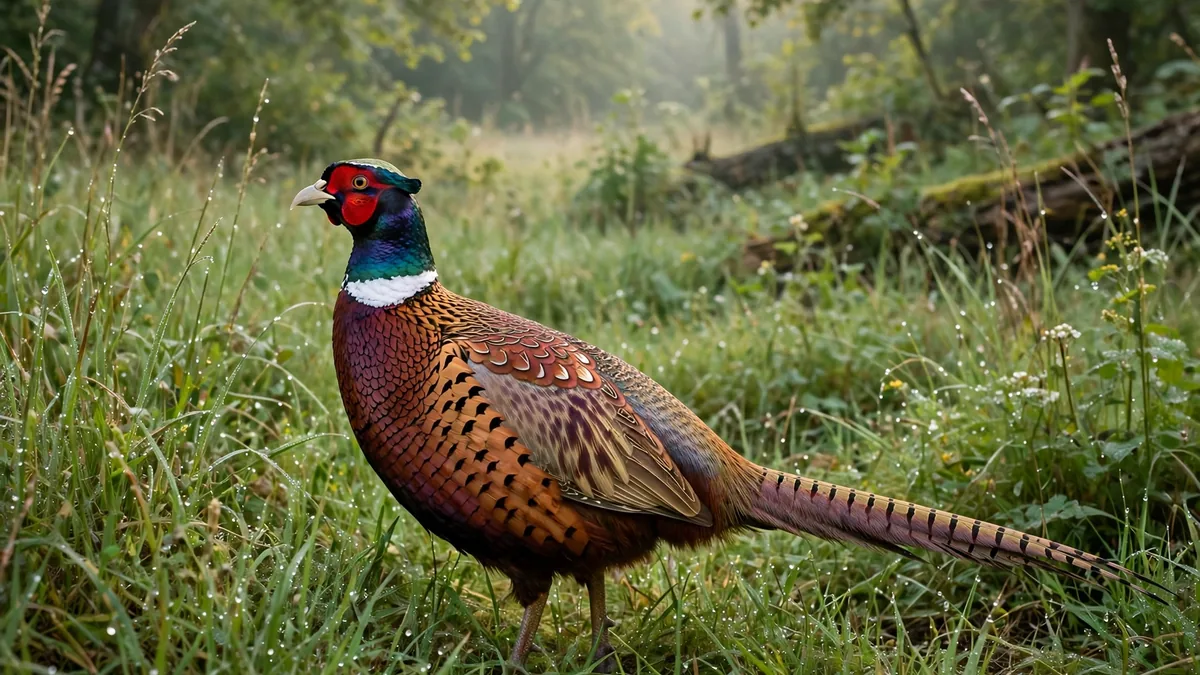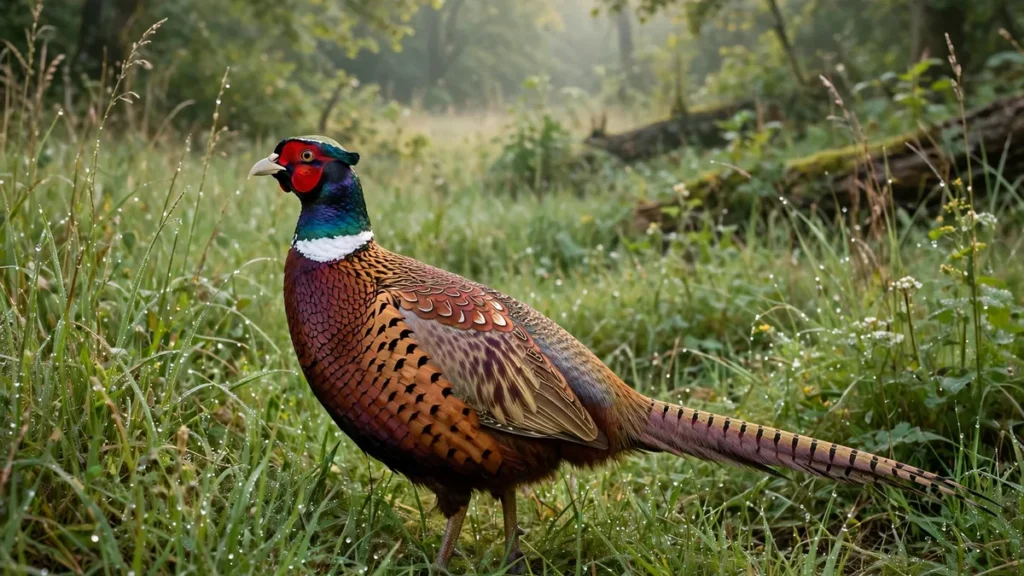
The pheasant species of the world are long-tailed game birds in the family Phasianidae, led by the common pheasant, Phasianus colchicus. If you are asking how many pheasant species there are, the honest answer is that it depends on where you draw the line: the true pheasants number around two dozen species in six genera, while the wider group called pheasants is larger still.
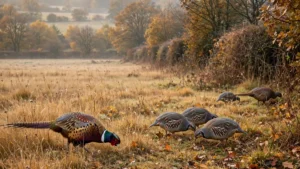
Watch a male pheasant cross a field edge at dawn and you will see why they are famous: an iridescent green head, a white neck ring, a copper body and a tail longer than the bird itself. This guide covers the whole group, from the common pheasant of farms and field edges to the golden, Lady Amherst’s and Reeves’s pheasants.
Key takeaways
- The true pheasants are around two dozen species in six genera, in the tribe Phasianini of the family Phasianidae.
- The best-known species is the common pheasant, Phasianus colchicus, native to Asia and introduced worldwide.
- Male pheasants are brightly coloured with long tails, while females are mottled brown for camouflage on the nest.
- Pheasants are ground birds that feed on seeds, grain, berries and insects, scratching in the soil.
- Several pheasant species are threatened, including the Critically Endangered Edward’s pheasant and the Vulnerable Reeves’s pheasant.
What makes a pheasant a pheasant
A pheasant is a long-tailed game bird of the family Phasianidae, in the order Galliformes, the same order as grouse, partridges, quail and turkeys. Pheasants are ground birds with strong legs for scratching and running, short rounded wings, and a short, strong bill. The males of most species are among the most colourful of all game birds, with iridescent plumage, long tails and bare red skin around the eye, while the females are mottled brown and tan.
Size varies widely across the group. A male common pheasant is 60 to 89 centimetres long, including a tail of about 50 centimetres, and weighs about 1.2 kilogrammes, while the female is 50 to 63 centimetres long with a tail of about 20 centimetres and weighs 0.9 kilogrammes. At the other extreme, a male Reeves’s pheasant typically measures up to 210 centimetres from beak to tail tip, and the longest tail feather on record reached 2.4 metres. Pheasants are native to Asia, living on the ground in grassland, farmland edges, scrub and woodland edges, and roosting in trees at night.
The pheasant species and their relatives
The word pheasant covers more than one tidy group. Birds called pheasants are spread across several genera in the family Phasianidae, and the name is paraphyletic: the birds called pheasants do not form a single branch of the family tree, and some are more closely related to grouse, partridges and turkeys than to other pheasants. The core of the group, the true pheasants, form the tribe Phasianini, with six genera and around two dozen species.
The six genera are the long-tailed pheasants (Syrmaticus, five species), the ruffed pheasants (Chrysolophus, the golden and Lady Amherst’s), the typical pheasants (Phasianus, the common and green), the cheer pheasant (Catreus, one species), the eared pheasants (Crossoptilon, four species) and the gallopheasants (Lophura, about a dozen species).
The common pheasant, Phasianus colchicus, is the best-known species by far, native to Asia and introduced to Europe in ancient times and to North America in the 1880s, where it is called the ring-necked pheasant. About 30 subspecies are recognised. The green pheasant, Phasianus versicolor, is the national bird of Japan, and whether it is a species in its own right or a subspecies of the common pheasant is still disputed. The golden pheasant, Chrysolophus pictus, is the flame-coloured bird of central China, and Lady Amherst’s pheasant, Chrysolophus amherstiae, lives in the highlands of south-western China and Myanmar. Pheasants are close relations of the peafowl, partridges, junglefowl and quail, and like the Indian peafowl, they belong to the family Phasianidae.
| Type | Animal | Where it lives | Best-known food | Length or Weight |
|---|---|---|---|---|
| Group | True pheasants, tribe Phasianini (around two dozen species) | Asia | Seeds, grain and insects | Up to 2.1 m including tail |
| Group | Typical pheasants, genus Phasianus (2 species) | Asia, introduced worldwide | Seeds, grain, berries, insects | 50 to 89 cm |
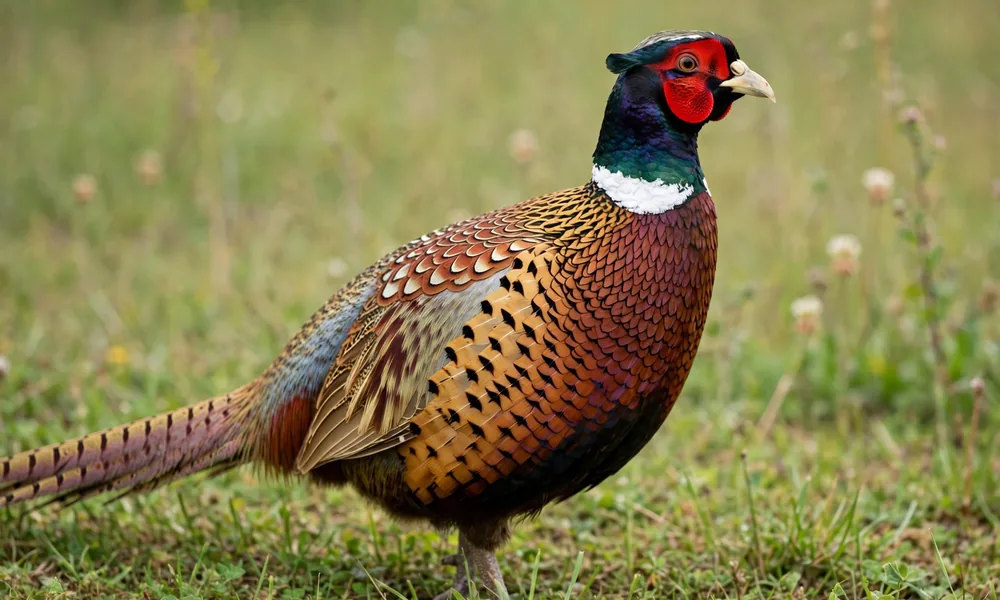
| Species | Common pheasant (Phasianus colchicus) | Asia, introduced to Europe and North America | Seeds, grain, insects | Male 60 to 89 cm, about 1.2 kg |
| Species | Golden pheasant (Chrysolophus pictus) | Central China | Seeds, berries, insects | 90 to 105 cm |
| Species | Reeves’s pheasant (Syrmaticus reevesii) | Central and eastern China | Seeds, fruit, tubers, insects | Male up to 210 cm including tail |
| Species | Edward’s pheasant (Lophura edwardsi) | Central Vietnam | Seeds, fruit, insects | 58 to 65 cm |
How pheasants live
Pheasants are omnivores that feed on the ground. They scratch in the soil with their strong feet, taking seeds, grain, berries, roots and shoots, and they pick up insects and other small invertebrates, which are especially important for chicks. The common pheasant feeds in open fields, along hedgerows and at woodland edges, and often visits farmyards and gardens. Like farmyard hens, pheasants dust-bathe, fluffing dry soil through their feathers to keep them clean.
Pheasants are strong runners and reluctant fliers. When startled, a pheasant usually runs first, and only when pressed does it burst into the air with a loud whirr of wings, flying fast and low before gliding down to cover. At night the birds roost in trees, safe from ground predators. In spring the males display and crow, a harsh call given at dawn, and a male common pheasant holds a territory with a harem of several females, defending it against rivals with wing-beating displays and short fights.
Breeding takes place on the ground. The female scrapes a shallow hollow in grass or under a hedge, lines it with leaves and grass, then lays 8 to 12 eggs, which she incubates alone for 23 to 28 days. The chicks are precocial: they hatch covered in down, leave the nest within a day, and can fly short distances at about two weeks old. Few wild common pheasants live beyond three years, with predators, hunting and hard winters taking most of them.
Where pheasants live
Pheasants are native to Asia, their original home running from the forests of China and the Himalayas to the grasslands of Central Asia and the islands of Japan. The common pheasant is the great traveller of the group: it was carried west into Europe in ancient times and introduced to North America in the 1880s, and it now lives across Europe, North America, New Zealand and Hawaii, wherever farmland, grassland and woodland edge meet. Like the western meadowlark, the common pheasant is a bird of open grassland and field edges.
Most other pheasants have much smaller ranges. The golden pheasant lives in the mountain forests of central China, Lady Amherst’s pheasant in the highlands of south-western China and Myanmar at 2,000 to 3,500 metres, and the Reeves’s pheasant in the forests of central and eastern China. The Mikado pheasant lives only in the mountains of Taiwan, and Edward’s pheasant only in the lowland forests of central Vietnam. Pheasants avoid deep, unbroken forest and open water, and they need cover close to feeding ground: a hedgerow or a wood edge to run to when danger appears.
The conservation picture is uneven. The common and golden pheasants are abundant and assessed as Least Concern, but several forest species are in trouble. Edward’s pheasant is Critically Endangered, its lowland forest home in Vietnam largely cleared, and the Reeves’s pheasant is Vulnerable, with only around 2,000 birds thought to remain in the wild, hunted for food and for its long tail plumes. The cheer pheasant is also Vulnerable. Habitat loss is the main threat across the group, and several of the rarest species now survive largely in aviaries.
Best seasons for pheasant watching
Pheasants are easiest to watch in spring, when the males display and crow at dawn, and in autumn, when family groups feed along field edges and hedgerows. In the northern hemisphere, look for them from March to May and again from September to November, in the early morning and late afternoon.
Staying safe around pheasants
A pheasant is a shy, ground-loving bird, and the main risk is to the bird rather than to you. Never approach a nest, since a flushed hen may not return, and keep dogs on a lead near hedgerows and field edges in the breeding season. Watch from a path or a field edge rather than walking into cover.
Take care on country roads, because pheasants are slow to take off and are often killed by cars, especially at dawn and dusk. If you find a pheasant that looks sick or injured, call a wildlife rescue service. A cornered cock bird can strike with its spurs.
Pheasant watching checklist
A little preparation turns a walk along a field edge into a real chance of watching them.
- A visit in spring or autumn, when the birds are displaying or feeding in family groups.
- An early-morning start, when the males are crowing and the birds are out in the open.
- Binoculars, since a pheasant feeding far across a field is hard to watch unaided.
- A scan of hedgerows, field edges and woodland margins, where pheasants feed.
- A listen for the male’s harsh crow at dawn, and for the whirr of wings when a bird flushes.
- An eye for the male’s green head, white neck ring and long barred tail.
- Respect for nests, hens and feeding birds, keeping your distance and dogs on a lead.
Frequently asked questions
How many pheasant species are there?
The true pheasants number around two dozen species in six genera, in the tribe Phasianini of the family Phasianidae. The wider group called pheasants is larger, and the exact count varies with taxonomy.
What is the best-known pheasant?
The common pheasant, Phasianus colchicus, also called the ring-necked pheasant, is the best-known species by far. Native to Asia, it was introduced to Europe in ancient times and to North America in the 1880s, and it now lives across Europe, North America, New Zealand and Hawaii.
What do pheasants eat?
Pheasants are omnivores that feed on the ground. They eat seeds, grain, berries, roots and shoots, and they pick up insects and other small invertebrates. Insects are especially important for chicks, which need the protein to grow.
Why are male pheasants so colourful?
Male pheasants are brightly coloured to attract females and to warn off rival males, while the females are mottled brown for camouflage. A male common pheasant has an iridescent green head, a white neck ring, a copper body and a long barred tail, while the hen is brown and tan all over.
Are pheasants endangered?
Some are. The common and golden pheasants are abundant and assessed as Least Concern, but Edward’s pheasant is Critically Endangered, the Reeves’s and cheer pheasants are Vulnerable, and several other forest species are threatened by habitat loss.
How is this guide different from the pelican guide?
This guide covers pheasants as a group, from the common pheasant to the golden, Lady Amherst’s and Reeves’s pheasants, while our pelican species guide covers all eight pelican species. It also differs from our game-birds guide, which gives an overview of all the hunted ground birds: here the whole guide is given over to pheasants alone.
Conclusion
The pheasant species of the world are around two dozen true pheasants, and every one of them is built for life on the ground: strong legs for scratching, a long tail for balance, and plumage ranging from the hen’s quiet brown to the cock’s blaze of green, copper and gold.
If you go looking for one, go to a field edge at dawn, go quietly, and listen. Hear the harsh crow from the hedgerow, watch the green head rise above the grass, and you will see the best-known game bird in the world at home.