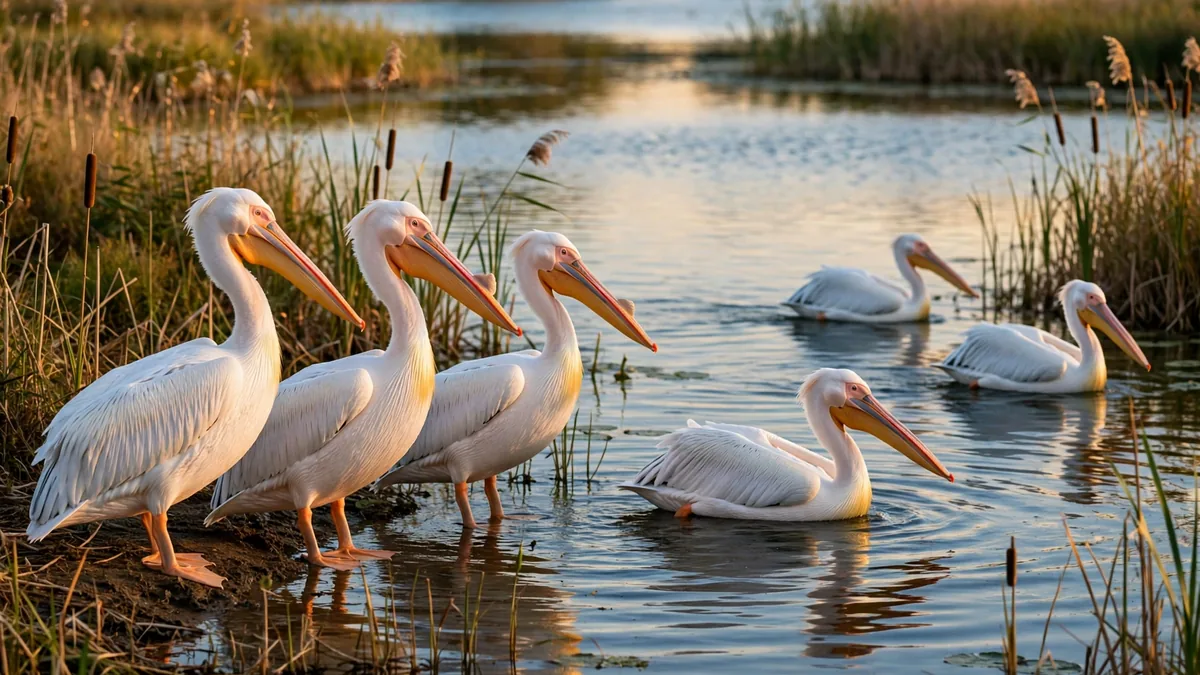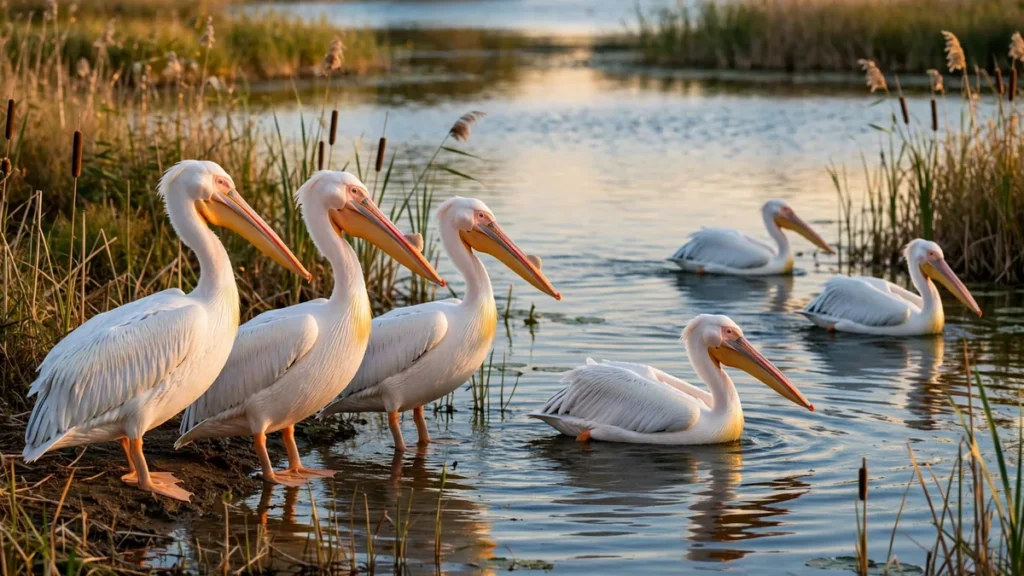
The pelican species of the world number eight, all of them members of a single genus, Pelecanus, in the family Pelecanidae. If you are asking how many pelican species there are, the answer is eight living species, and every one of them carries the same unmistakable tool: a long bill with a stretchy pouch slung beneath it.
Watch a pelican on a lake at dawn and you will see a bird built entirely around the water, scooping fish with a net carried on its own face. This guide covers the whole group, all eight species, from the great white pelican of Europe and Africa to the brown pelican of the American coasts.
Key takeaways
- There are eight pelican species in the world, all in the single genus Pelecanus of the family Pelecanidae.
- The pouch beneath the bill can hold about 13 litres of water and fish, far more than the bird’s stomach.
- Brown and Peruvian pelicans plunge-dive, while the other six scoop fish while swimming, often fishing together in lines.
- Pelicans live on every continent except Antarctica, on coasts, lakes, rivers, estuaries and lagoons.
- Five of the eight species are Least Concern, while the Dalmatian, spot-billed and Peruvian pelicans are Near Threatened.
What makes a pelican a pelican
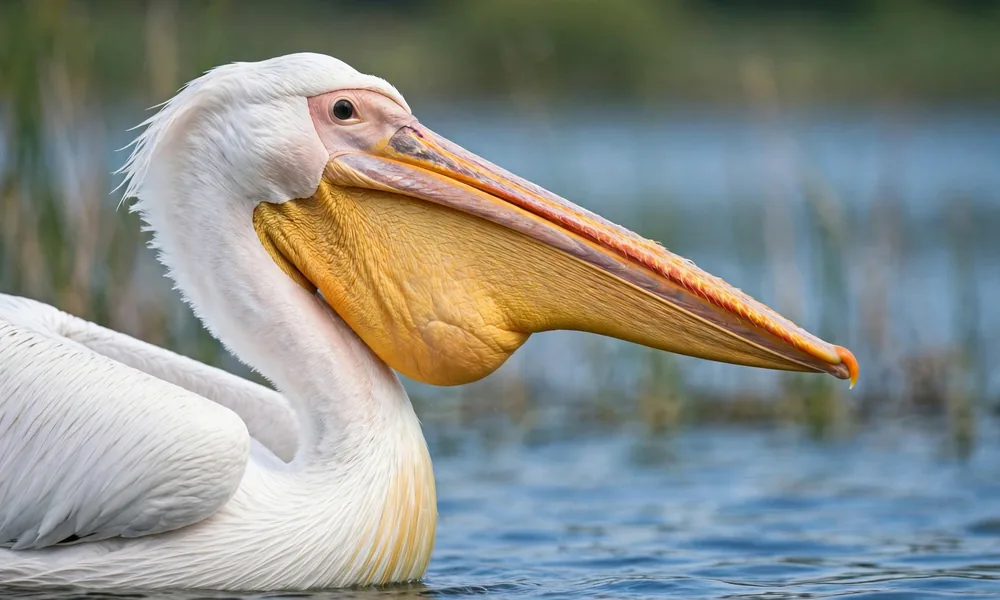
A pelican is a large water bird with a long, straight bill and a bare, expandable pouch of skin hanging from the lower bill. The pouch works like a fishing net: the bird scoops up water and fish, lets the water drain away, and then swallows the catch. It is not a storage bag. The Australian pelican holds the record for the longest bill of any living bird, up to about 50 centimetres.
Pelicans range from the brown pelican, up to 1.4 metres long with a wingspan of 2 to 2.3 metres, to the Dalmatian pelican, 1.6 to 1.8 metres long with a wingspan of 2.7 to 3.2 metres and a weight of 10 to 12 kilogrammes. Four species are mostly white and four are grey or brown, and all four toes are joined by webbing, which makes them strong swimmers. Like the mute swan, a pelican looks clumsy on land and perfectly at home in the water.
The pelican species and their relatives
The eight pelican species divide into two groups by ancestry. Genetic studies place five species in an Old World clade: the great white, Dalmatian, spot-billed, pink-backed and Australian pelicans. The other three form a New World clade: the American white, brown and Peruvian pelicans. Pelicans are thought to have evolved in the Old World, and fossils show birds very like them existed more than 30 million years ago.
An older grouping sorts them by plumage and nesting. Four species are mainly white and nest on the ground: the Australian, Dalmatian, great white and American white pelicans. The other four are grey or brown and nest in trees or on rocks: the pink-backed and spot-billed pelicans in trees, the brown pelican in trees and bushes, and the Peruvian pelican on sea rocks.
The great white pelican, Pelecanus onocrotalus, is the best known, and the Dalmatian pelican, Pelecanus crispus, is the largest, recognised by its curly nape feathers. The brown pelican, Pelecanus occidentalis, is the smallest and the only regular plunge-diver, while the Peruvian pelican, Pelecanus thagus, was long treated as its subspecies. Pelicans have few close relatives: their nearest living relations are the shoebill and the hamerkop, and together they make up the order Pelecaniformes. Like the white stork, pelicans are large, long-billed water birds, but the stork belongs to a different order.
| Type | Animal | Where it lives | Best-known food | Length or Weight |
|---|---|---|---|---|
| Group | White-plumaged ground nesters (4 species) | Europe, Africa, Asia, Australia, North America | Fish, scooped while swimming | Up to 1.9 m, up to 12 kg |
| Group | Grey- and brown-plumaged tree and rock nesters (4 species) | Africa, Asia, the Americas | Fish, scooped or plunge-dived | Up to 1.52 m, up to 7 kg |
| Species | Great white pelican (Pelecanus onocrotalus) | South-eastern Europe, Africa, Asia | Fish, caught by cooperative scooping | 1.4 to 1.75 m, 10 to 11 kg |
| Species | Dalmatian pelican (Pelecanus crispus) | South-eastern Europe to India and China | Fish, caught in lakes and deltas | 1.6 to 1.8 m, 10 to 12 kg |
| Species | American white pelican (Pelecanus erythrorhynchos) | Inland Canada and United States | Fish, caught by cooperative herding | 1.3 to 1.8 m, 5 to 9 kg |
| Species | Brown pelican (Pelecanus occidentalis) | Coasts of North, Central and northern South America | Fish, caught by plunge-diving | Up to 1.4 m, 3.6 to 4.5 kg |
How pelicans live
Pelicans eat mainly fish, and a single bird can take a kilogramme or more in a day. Most species feed by swimming slowly along the surface and dipping the bill in to scoop up fish, sometimes working together in a line to herd fish into shallow water. The American white pelican is famous for this cooperative fishing, with a dozen or more birds advancing in step and scooping in turn, and great white pelicans fish the same way.
The brown and Peruvian pelicans feed differently. They fly above the sea, spot a shoal of fish from the air, fold their wings and plunge headfirst into the water from as high as 20 metres, stunning the fish with the impact and scooping them up as they surface. Air sacs under their skin cushion the shock, and pelicans also take crustaceans and amphibians when fish are scarce. Like the bald eagle, a pelican can lose a catch to a pirate, and eagles and gulls sometimes snatch fish from a pelican as it surfaces.
Pelicans breed in colonies, sometimes of thousands of pairs, on islands, in reed beds, in trees or on cliffs. Most species lay one to three eggs, usually two, incubated for about 30 to 36 days by both parents. The chicks hatch naked and helpless and are fed on regurgitated fish, fledging at around ten to twelve weeks. Wild pelicans commonly live for 15 to 25 years.
Where pelicans live
Pelicans live on every continent except Antarctica, from the tropics to the temperate zone, and they are absent from the open ocean, the polar regions and the interior of South America. They need shallow, fish-rich water, so they gather on coasts, estuaries, lagoons, lakes and slow rivers. Like the flamingo, several species favour shallow lagoons and salt pans, where fish are concentrated and easy to scoop.
The great white pelican breeds from south-eastern Europe across Africa to Central Asia, the Dalmatian pelican from south-eastern Europe to India and China, and the Australian pelican across Australia and New Guinea, wandering widely after rain. The pink-backed pelican lives across sub-Saharan Africa, the spot-billed pelican in southern Asia, the American white pelican on inland lakes in Canada and the United States, the brown pelican along the coasts of the Americas, and the Peruvian pelican along the Pacific coast from Ecuador to Chile. Some migrate and some do not: the American white and great white pelicans travel long distances, while the brown, pink-backed and Peruvian pelicans stay in the same region all year.
Five of the eight species are Least Concern, and three are Near Threatened: the Dalmatian, spot-billed and Peruvian pelicans. The Dalmatian pelican was estimated at between 11,400 and 13,400 birds and the spot-billed at between 8,700 and 12,000. The brown pelican is the great recovery story: nearly wiped out in the United States by the pesticide DDT, it recovered so well that it was removed from the endangered species list in 2009.
Best seasons for pelican watching
Pelicans are easiest to watch in spring and summer, when breeding colonies are active and the birds are fishing hard for their chicks. In the northern hemisphere, look for them from March to September, and in the southern hemisphere from September to March. Early morning and late afternoon are the best times of day.
Staying safe around pelicans
A pelican is a large bird with a powerful bill, but it is not aggressive towards people, and the main risk is to the bird rather than to you. Never approach a breeding colony closely, since a startled pelican may abandon its nest, and keep your distance from birds feeding young. Watch from a hide or from the far side of the water.
Never feed a pelican. Handouts teach the birds to beg around harbours and fishing boats, where they are at risk from hooks, fishing line and propellers, and discarded line is one of the commonest causes of injury, tangling wings and bills. If you find a pelican tangled in line or with a hook in its bill, call a wildlife rescue service rather than trying to free it yourself.
Pelican watching checklist
A little preparation turns a morning by the water into a real chance of watching pelicans.
- A visit in spring or summer in the north, or at any time of year in the tropics, when the colonies are active.
- An early-morning start, when the birds are fishing and the light is low over the water.
- Binoculars, since a pelican fishing far out on a lake is hard to watch unaided.
- A scan of sandbanks, jetties and harbour walls, where pelicans rest between fishing trips.
- A watch for a line of birds herding fish together, or a brown pelican folding its wings to plunge-dive.
- An eye on the sky at midday, when pelicans soar on thermals in loose lines.
- Respect for colonies, nests and feeding birds, keeping your distance and never offering food.
Frequently asked questions
How many pelican species are there?
There are eight living pelican species, all in the single genus Pelecanus of the family Pelecanidae: the great white, Dalmatian, Australian, American white, brown, Peruvian, pink-backed and spot-billed.
What do pelicans eat?
Pelicans eat mainly fish, and a single bird can take a kilogramme or more in a day. They also take crustaceans and amphibians when fish are scarce, though fish remain the staple of every species.
How much can a pelican’s pouch hold?
The pouch can hold about 13 litres of water and fish, far more than the bird’s stomach. The pouch is a net, not a store: the pelican scoops up water and fish, lets the water drain out, and swallows the catch before it flies on.
Do pelicans store fish in their pouch?
No. The pouch is used to catch fish, not to carry them. A pelican scoops up water and fish, drains the water away, and swallows the fish straight away. The old story that pelicans carry food in their pouch is a myth, and an even older legend held that the bird fed its young with its own blood.
Are pelicans endangered?
Five of the eight species are Least Concern, and three are Near Threatened: the Dalmatian, spot-billed and Peruvian pelicans. The brown pelican is the great recovery story: nearly wiped out in the United States by the pesticide DDT, it recovered so well that it was removed from the endangered species list in 2009.
How is this guide different from the northern mockingbird guide?
This guide covers all eight pelican species as a group, from the Dalmatian pelican of Europe to the brown pelican of the Americas, while our northern mockingbird species guide covers just one species, Mimus polyglottos, the grey songbird of North America that copies the songs of other birds.
Conclusion
The pelican species of the world are eight strong, and every one of them is built around the same idea: a net carried on the face, a body made for the water, and wings made for the open sky.
If you go looking for one, go to the water at dawn, go quietly, and watch the surface. Find a white shape floating high on a still lake, or a brown bird folding its wings above the sea, and you will see one of the oldest fishing birds on Earth at work.