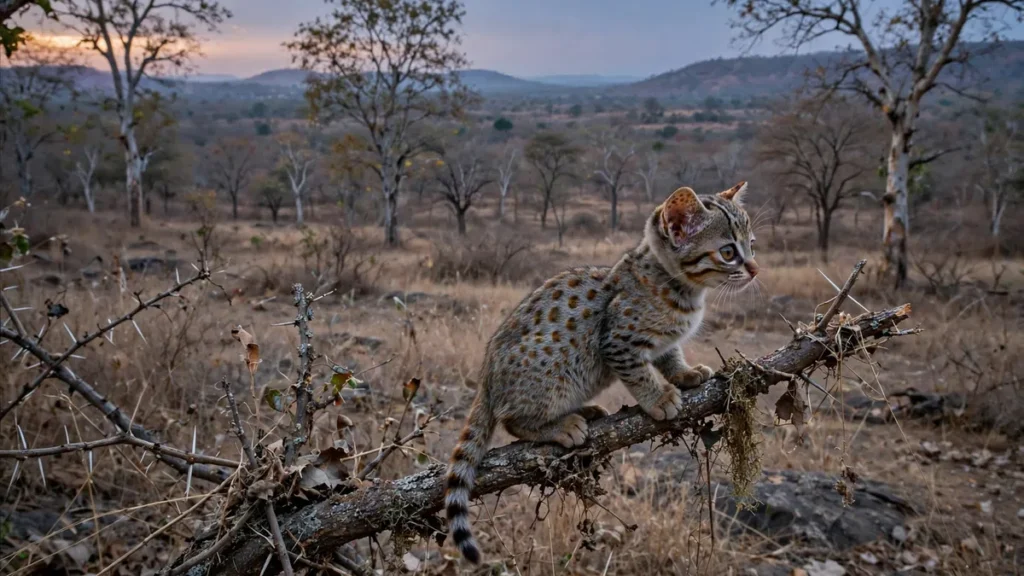
The rusty-spotted cat species is a single species, Prionailurus rubiginosus, a tiny grey cat with rusty-brown spots that lives in India and Sri Lanka. If you are asking how many rusty-spotted cat species there are, the answer is one.
It is the smallest cat of Asia, and one of the smallest cats in the world, weighing only about one to two kilogrammes. It hunts at night, climbs trees with ease, and is so small and shy that most people living beside it never see one.
Key takeaways
- There is only one rusty-spotted cat species, Prionailurus rubiginosus.
- It is the smallest cat of Asia, usually weighing between 0.9 and 1.6 kilogrammes, with a head and body of about 35 to 48 centimetres.
- Its grey coat is marked with rusty-brown spots, and its large eyes suit hunting at night.
- Rusty-spotted cats live in India and Sri Lanka, in dry forest, scrub and grassland, and climb well.
- The rusty-spotted cat is listed as Near Threatened, and its numbers are falling as wild land is lost.
What makes a rusty-spotted cat a rusty-spotted cat
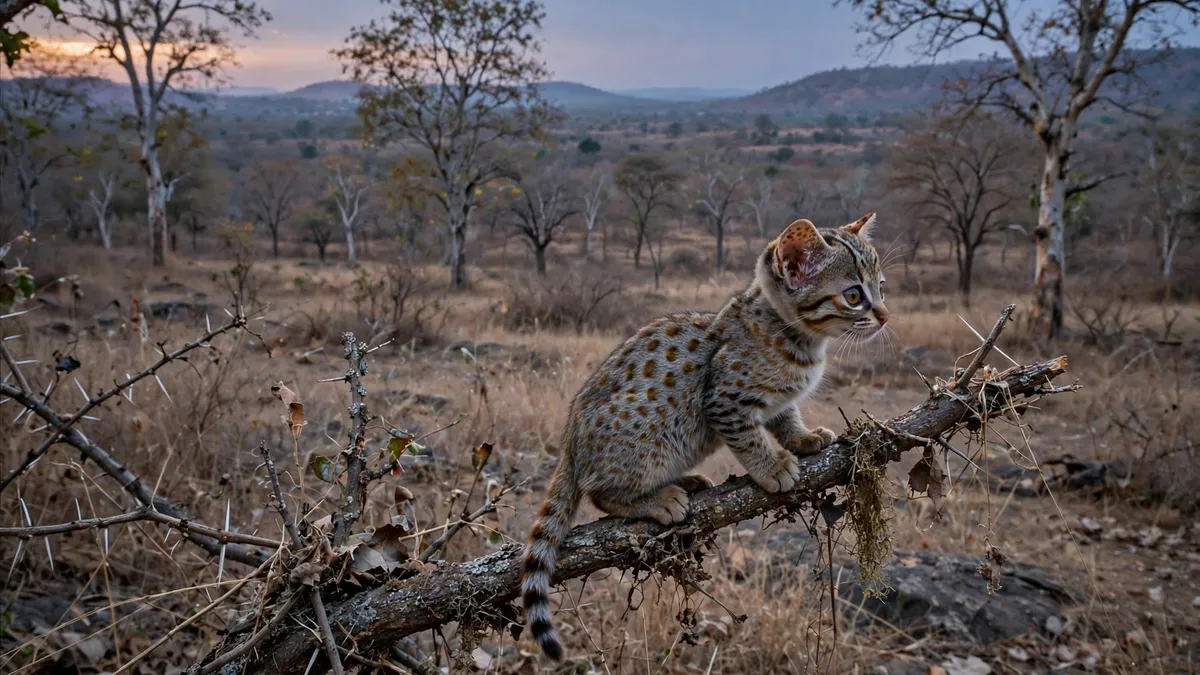
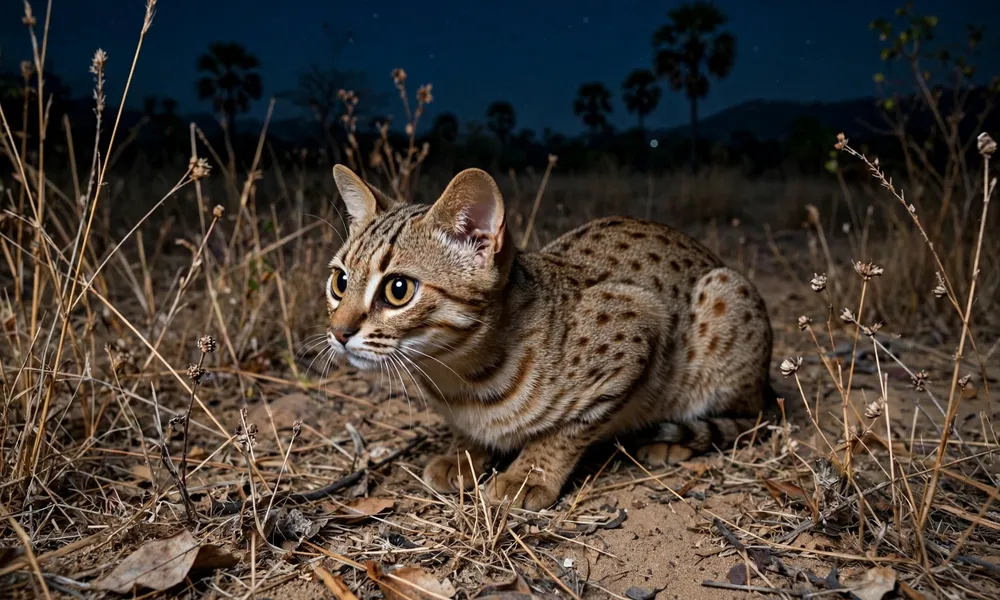
A rusty-spotted cat is a very small cat with a grey coat covered in rusty-brown spots, a pale belly, and faint dark lines running back from its eyes. Its head is short and rounded, its ears are small and set wide apart, and its eyes are large for its size. The head and body measure about 35 to 48 centimetres, the tail adds another 15 to 30 centimetres, and most adults weigh between 0.9 and 1.6 kilogrammes.
The spots are the field mark that gives the cat its name. They are rusty brown rather than black, and they are smaller and closer together on the back and flanks, fading to faint marks on the belly and legs. The tail is short, with a dark tip and faint rings. In poor light the cat can look almost plain grey, and it is easy to mistake for a young domestic cat until its size and its rusty spots give it away.
What sets the rusty-spotted cat apart is how small it is. An adult weighs about the same as a large domestic kitten, yet it is a fully grown wild hunter. Its size lets it slip through dense thorn scrub and climb into small trees, places where bigger cats cannot follow.
The rusty-spotted cat species and its relatives
Prionailurus rubiginosus is the only rusty-spotted cat species, and it sits in the genus Prionailurus alongside the leopard cat and the fishing cat. Two forms have been described, one in India and one in Sri Lanka, but they are the same species, not separate species. It belongs to the cat family, Felidae.
The leopard cat is its closest lookalike, but it is larger, bolder-marked and found across a much wider part of Asia. The fishing cat is bigger still and hunts in wetlands, while the flat-headed cat hunts in the swamps of South-east Asia. The jungle cat shares its Indian range but is larger, and the domestic cat, the black-footed cat and the sand cat are small relatives from elsewhere.
| Type | Animal | Where it lives | Best-known food | Length |
|---|---|---|---|---|
| Species | Rusty-spotted cat (Prionailurus rubiginosus) | India and Sri Lanka | Rodents, birds and lizards | 35 to 48 cm body |
| Close relative | Leopard cat | Forests across Asia | Rodents, birds and frogs | 45 to 67 cm body |
| Close relative | Fishing cat | Wetlands of South and South-east Asia | Fish, frogs and water birds | 57 to 78 cm body |
| Close relative | Flat-headed cat | Wetlands of South-east Asia | Fish and frogs | 41 to 50 cm body |
| Close relative | Jungle cat | Asia, from Egypt to South-east Asia | Rodents, birds and hares | 59 to 76 cm body |
| Close relative | Domestic cat | Worldwide, near people | Rodents, birds and insects | 46 to 51 cm body |
| Close relative | Black-footed cat | Dry grassland of southern Africa | Rodents and small birds | 35 to 52 cm body |
| Close relative | Sand cat | Deserts of North Africa and South-west and Central Asia | Rodents, lizards and snakes | 39 to 52 cm body |
How rusty-spotted cats live
Rusty-spotted cats are solitary cats. Each adult holds a small home range, marked with scent and defended against other cats of the same sex. They are active mostly at night, resting through the heat of the day in a hollow tree or thick scrub, and like other nocturnal animals, they use the dark for cover while they hunt.
Small rodents are the main prey, and a rusty-spotted cat will also take birds, lizards, frogs and large insects. It hunts on the ground and in the trees, moving in short, careful rushes and pouncing from close range. Its hearing picks up the rustle of a mouse in dry leaves.
Breeding can happen at any time of year, and after a gestation of about 65 to 70 days the female gives birth to one or two kittens in a sheltered den. The kittens are born with their spots already showing, open their eyes at about ten days, and start hunting with their mother at three or four months old.
Where rusty-spotted cats live
The rusty-spotted cat lives only in India and Sri Lanka, and nowhere else in the world. In India it is found across much of the south and centre of the country, while in Sri Lanka it is found in dry lowland forest, scrub and grassland. It is a cat of dry country, at home in open woodland and thorn scrub, and one of the hardiest forest animals of the dry zone, able to live close to farmland.
Within that range the rusty-spotted cat avoids the wettest places and the highest ground. It is rare in true rainforest and in cold mountain forest, preferring open ground with cover nearby, where it can hunt rodents and climb trees to rest or escape danger.
The species is listed as Near Threatened, which means it is close to becoming threatened with extinction. The main pressure is the loss of wild land to farming, roads and settlement, and in some areas it is killed by dogs or caught for the pet trade.
Best seasons for rusty-spotted cat watching
Rusty-spotted cats are active all year, so there is no closed season, but the dry season is usually the best time to look for them. Water is scarce, so rodents gather near the remaining water, and the cats come to hunt there. The grass is shorter and thinner too, which makes a small grey cat a little easier to spot.
The wet season has its own rewards. There is more prey about, and cats are often bolder near villages and fields, but tall grass hides them well, and rain can cut a night walk short. The best hours are the first two after dark, when the cats leave shelter to hunt, and the last hour before dawn.
Good places to try include the dry forest reserves of southern and central India and the dry zone national parks of Sri Lanka, such as Yala and Wilpattu. A local guide makes a real difference, because rusty-spotted cats are quiet, tiny and quick to vanish, and a guide who knows their tracks is worth more than luck.
Staying safe around rusty-spotted cats
A rusty-spotted cat is a wild cat with sharp teeth and claws, and although it is far too small to be a danger to people, it should always be treated with respect. Keep your distance, never approach one on foot, and never try to touch or feed it, because a cornered cat can bite hard for its size. If one comes close, stay still and let it move away.
Rusty-spotted cats are sometimes seen near farms and villages, where they hunt rats and mice, and farmers in some areas trap or kill them, mistaking them for a threat to poultry. Keep small pets indoors at night near farms and reserve boundaries. Any bite or scratch should be washed at once and checked by a doctor without delay.
The other safety issue is the pet trade. Rusty-spotted cats are sometimes caught and sold as exotic pets, but they make poor ones: they are active, shy and restless, need room to climb and hunt, and suffer badly in captivity. Keeping one is illegal in India and Sri Lanka.
Rusty-spotted cat watching checklist
A little preparation turns a night walk into a real chance of seeing one, so pack for dry country, darkness and long, quiet waits.
- Binoculars with good low-light performance, for picking a small grey cat out of dry grass at night.
- A red-filtered torch or headlamp, which lets you see without blinding a night-hunting cat.
- Neutral-coloured clothing in tan, khaki or olive, which blends into dry scrub and grassland.
- Water, insect repellent and a hat, because this country is hot and dry by day.
- A booked local guide who knows the dry forest tracks and the cat territories.
- A plan to be out after dark, when rusty-spotted cats leave cover to hunt.
- Patience and silence, because rusty-spotted cats are tiny, shy animals and a noisy group will send them away.
Frequently asked questions
How many rusty-spotted cat species are there?
There is one rusty-spotted cat species, Prionailurus rubiginosus. Two forms have been described, one in India and one in Sri Lanka, but they are the same species. No second rusty-spotted cat species is recognised.
Is the rusty-spotted cat the smallest cat in the world?
It is the smallest cat of Asia, and one of the smallest cats in the world, but it shares that honour with the black-footed cat of southern Africa, which is about the same size. Most rusty-spotted cats weigh between 0.9 and 1.6 kilogrammes.
What do rusty-spotted cats eat?
Rusty-spotted cats eat small rodents above all, and they also take birds, lizards, frogs and large insects. They hunt on the ground and in the trees, pouncing from close range, and they climb trees to catch roosting birds and escape danger.
Where do rusty-spotted cats live?
Rusty-spotted cats live only in India and Sri Lanka, in dry forest, scrub and grassland. In India they are found across much of the south and centre of the country, and in Sri Lanka they live in the dry lowlands, often near villages and farmland.
How is this guide different from the leopard cat species guide?
This guide covers the single rusty-spotted cat species, the smallest cat of Asia, a tiny grey cat with rusty spots that hunts rodents at night in India and Sri Lanka, while our leopard cat species guide covers the leopard cat, a larger, bolder-spotted cat found across the forests of Asia. The two are close relatives, but the rusty-spotted cat is much smaller and lives in a far smaller range.
Are rusty-spotted cats endangered?
Rusty-spotted cats are listed as Near Threatened, so they are not classed as endangered, but they are close to it. Their numbers are falling as dry forest and scrub are cleared for farming and settlement, and in some areas they are killed by dogs, trapped, or caught for the pet trade.
Conclusion
The rusty-spotted cat species shows how much wildness one tiny cat can hold: Prionailurus rubiginosus, with its grey coat and rusty spots and its large night eyes, a hunter built for the dry forests and scrub of India and Sri Lanka. It weighs about as much as a bag of sugar, yet it climbs trees and catches birds.
If you go looking for one, go after dark, go with a guide, and go quietly. Watch a rusty-spotted cat moving through the grass at night, small and grey, and you will understand why the smallest cat of Asia has earned its place in the dry forest, and why keeping its wild, open country standing matters most.