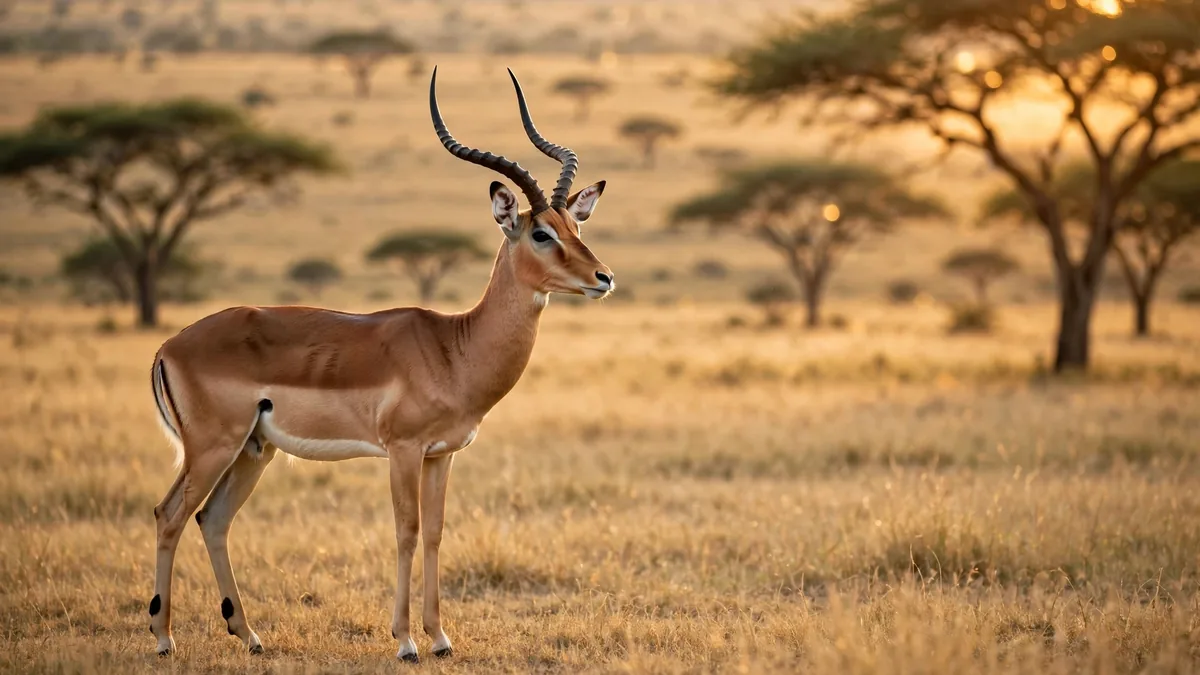
The impala species is a single species, Aepyceros melampus, a medium-sized antelope of eastern and southern Africa. If you are asking how many impala species there are, the answer is one, though it has two subspecies, the common impala and the black-faced impala, and the common impala numbers about two million animals.
Impalas live in the woodlands and savannas of eastern and southern Africa, from Kenya to South Africa, and they are famous for their spectacular leaps, springing up to three metres high and ten metres long to escape predators. They are slender, reddish-tan antelopes with white bellies, black markings on their rumps and legs, and long lyre-shaped horns in the males.
Key takeaways
- The impala is a single species, Aepyceros melampus, with two subspecies, the common impala and the black-faced impala.
- Impalas stand about 70 to 92 centimetres at the shoulder and weigh roughly 40 to 76 kilograms, with males larger than females.
- An impala can leap up to three metres high and ten metres long, and run at about 80 kilometres per hour.
- Impalas are mixed feeders that graze on grass and browse on leaves, shoots, fruit and acacia pods.
- The impala is listed as Least Concern, with about two million common impala, but the black-faced impala is Vulnerable, with fewer than 1,000 left in the wild as of 2008.
What makes an impala an impala
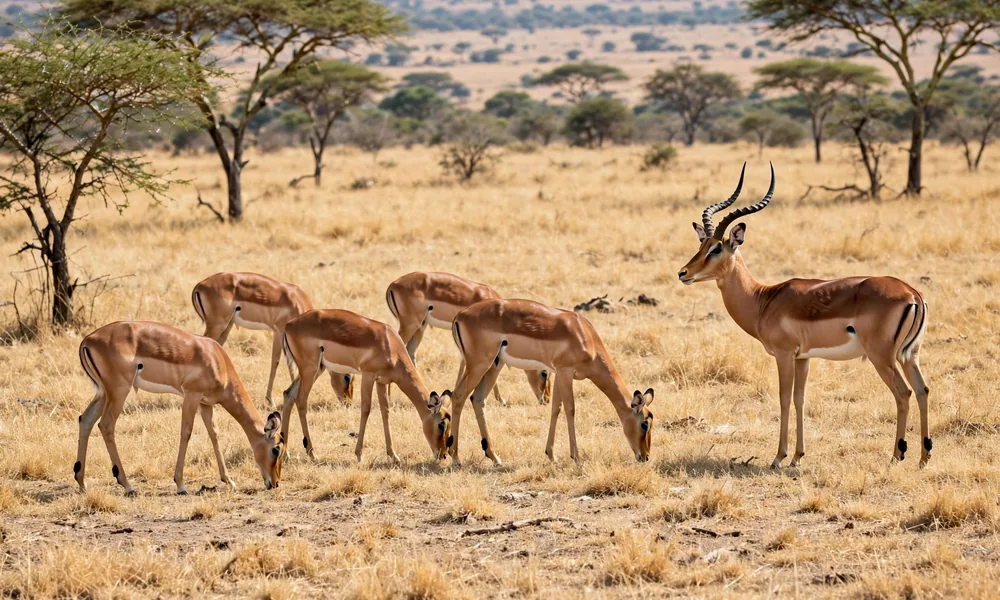
An impala is built for speed, with a slender body, long thin legs, a small head and large eyes and ears. The coat is a warm reddish-tan on the back and sides, fading to white on the belly, and the animal carries bold black marks: a dark stripe down the rump, a black tip to the tail, black-tipped ears and a black tuft above each hoof. Males are larger and heavier, and only the males carry horns.
The horns are the impala’s most striking feature. They rise in a graceful lyre shape, curving back, out and then up, ringed along their length, and they can reach about 45 to 90 centimetres long. The impala’s other great gift is its leap, which comes in two forms: a high, springing jump that clears bushes and a long, flat leap that carries it far across open ground. Like the gazelle, another swift antelope of the open plains, an impala depends on speed and agility rather than strength to stay alive.
The impala species and their relatives
The impala is the only living species in the genus Aepyceros, and the only member of the tribe Aepycerotini, which means it has no close living relatives among the antelopes. Up to six subspecies have been described, but genetic work generally recognises only two: the widespread common impala, Aepyceros melampus melampus, and the larger, darker black-faced impala, Aepyceros melampus petersi, of north-western Namibia and south-western Angola.
The common impala ranges from central Kenya south through Tanzania, Zambia, Zimbabwe, Botswana and Mozambique to South Africa, and it has also been reintroduced in Gabon and in parts of southern Africa where it had died out. The black-faced impala is confined to the arid scrubland of Kaokoland in north-western Namibia and south-western Angola, and it is darker than the common impala, with a dark blaze down its face. Like the wildebeest, the impala gathers in great herds when the dry season concentrates animals around water, but where wildebeest migrate in their thousands, impalas stay close to the woodland edge.
| Type | Animal | Where it lives | Best-known food | Length or Weight |
|---|---|---|---|---|
| Genus | Impala (genus Aepyceros) | Eastern and southern Africa | Grass, leaves and shoots | About 70 to 92 cm at the shoulder |
| Subspecies | Common impala (Aepyceros melampus melampus) | Kenya to South Africa | Grass, leaves and fruit | About 40 to 76 kg |
| Subspecies | Black-faced impala (Aepyceros melampus petersi) | Namibia and Angola | Grass and browse | Slightly larger and darker |
| Relative | Grant’s gazelle (Nanger granti) | Eastern Africa | Grass, leaves and herbs | About 40 to 67 kg |
| Relative | Blue wildebeest (Connochaetes taurinus) | Eastern and southern Africa | Short grass | About 140 to 290 kg |
| Relative | Common eland (Taurotragus oryx) | Eastern and southern Africa | Leaves, shoots and fruit | About 400 to 940 kg |
How impalas live
Impalas are mixed feeders, which means they switch between grazing and browsing as the seasons change. In the wet season they graze on the open plains, and in the dry season, when the grass turns brown and tough, they browse on leaves, shoots, flowers, fruit and acacia pods. They need to drink regularly, so they stay close to water and are most active in the morning and late afternoon, resting in the shade at midday.
Impalas are highly social, and their herds change with the season. Females and their young form herds of about 15 to 20 animals that can number well over 100 when food and water are scarce, and young males gather in bachelor herds. In the breeding season in May and June in southern Africa, adult males become territorial, defending a patch of ground with roaring grunts and clashing horns, and a male may hold his territory for only a few weeks before another takes it. Impalas are a staple prey for lions, leopards, cheetahs, wild dogs and hyenas, and their defence is vigilance: many eyes watch in every direction, and at the first alarm the herd explodes into leaps.
Female impalas give birth to a single calf after a pregnancy of about 194 to 200 days, and the calf weighs only about 4 to 5 kilograms at birth. The mother hides her newborn in long grass for the first days, visiting it to suckle, and then the calf joins a nursery group while the mothers feed. Calves are weaned at about four to six months, females reach breeding age at about one to two years, and males rarely win a territory before about four years of age. Impalas typically live about 12 to 15 years in the wild and up to about 17 years in captivity. Like the eland, the largest antelope of the savanna, an impala is a creature of the woodland edge, but where the eland is huge and slow, the impala is light, quick and built to leap.
Where impalas live
Impalas live across eastern and southern Africa, from central Kenya and Uganda to South Africa, and west into Angola, and they are one of the most common antelopes in the region. They favour the edge between woodland and open savanna, where they can feed in the open and dart into cover when danger appears, and they are rarely found far from water.
In the Masai Mara and the Serengeti, impalas graze the open plains beside acacia woodland, in the Okavango Delta of Botswana they feed along the edges of the floodplains, and in Kruger National Park they are one of the first animals a visitor sees, standing in the shade of the mopane trees. The black-faced impala, by contrast, lives in the dry scrubland of Kaokoland, where water is scarce and the bush is thin, and it has adapted to a harsher, drier life than its common cousin.
The conservation picture for the impala is strong but not without worry. The species as a whole is listed as Least Concern, with about two million animals, and about a quarter of them live in protected areas such as the Okavango Delta, the Masai Mara and Kruger National Park. The black-faced impala is a different story: it is listed as Vulnerable, with fewer than 1,000 animals estimated in the wild as of 2008, and it is threatened by poaching, habitat loss and cross-breeding with common impalas moved into its range.
Best seasons for impala watching
The best time to watch impalas is in the dry season, from about May to October, when the grass is short, the herds gather around waterholes and are easy to see. In southern Africa the May and June breeding season is especially rewarding, because territorial males roar and clash horns in full view, and the early morning and late afternoon are the best hours, when the herds feed in the open.
Staying safe around impalas
An impala is a shy, nervous animal that will run long before a person gets close, so the best way to watch one is from a vehicle or a hide, quietly and at a distance. Never approach a calf lying alone in the grass, because its mother is almost certainly watching from nearby, and a frightened herd can stampede. A territorial male in the breeding season may charge if cornered, so give him plenty of room.
Impala watching checklist
A little preparation turns a morning drive into a real chance of seeing impalas leap.
- A dry-season morning or late afternoon, when impala herds feed in the open near water.
- A savanna reserve with acacia woodland and open grassland, such as Kruger or the Masai Mara.
- Binoculars, for picking out a slender tan antelope among the grass and trees.
- Quiet feet and patience, because a nervous herd will bolt at the first sudden movement.
- A field guide to the antelopes of Africa, for telling an impala from a gazelle.
- Sun protection, a hat and water, because the best viewing hours are hot and bright.
- A safari vehicle or hide, for watching a herd without disturbing it.
Frequently asked questions
How many impala species are there?
There is one impala species, Aepyceros melampus, with two subspecies: the common impala, which ranges across eastern and southern Africa, and the black-faced impala, which lives only in north-western Namibia and south-western Angola.
How high can an impala jump?
An impala can leap up to three metres high and ten metres long in a single bound, about three times its own height. It uses high jumps to clear bushes and long, flat leaps to cover open ground when fleeing.
What does an impala eat?
Impalas are mixed feeders that graze on grass in the wet season and browse on leaves, shoots, flowers, fruit and acacia pods in the dry season. They drink regularly, so they stay close to water.
Do female impalas have horns?
No. Only male impalas carry horns, which grow in a lyre shape and can reach about 45 to 90 centimetres long. Females are smaller, lighter and hornless, so the sexes are easy to tell apart at a glance.
How is this guide different from the howler monkey species guide?
This guide covers the impala, a single species of swift, leaping antelope from the savannas of eastern and southern Africa that lives in herds and escapes predators by jumping, while our howler monkey species guide covers the howler monkey, about 15 species of large, leaf-eating monkeys from the rainforests of Central and South America that roar at dawn and live in the trees. Impalas run and leap across open grassland, and howler monkeys call through the canopy.
Are impalas endangered?
No, not as a species. The impala is listed as Least Concern, with about two million common impala, but the black-faced impala subspecies is listed as Vulnerable, with fewer than 1,000 animals estimated in the wild as of 2008.
Conclusion
The impala species shows how much grace can fit into one antelope: a single species, Aepyceros melampus, with two subspecies, from the two million common impala of the eastern and southern savannas to the rare black-faced impala of the Namibian scrub, all sharing the same slender build, the same lyre-shaped horns and the same leap.
If you go looking for one, go in the dry season, go early, and watch the edge of the woodland where the grass meets the trees. Watch a herd feed in the golden light, and when something startles them, watch them spring into the air — that is why the impala is called the most graceful antelope in Africa.