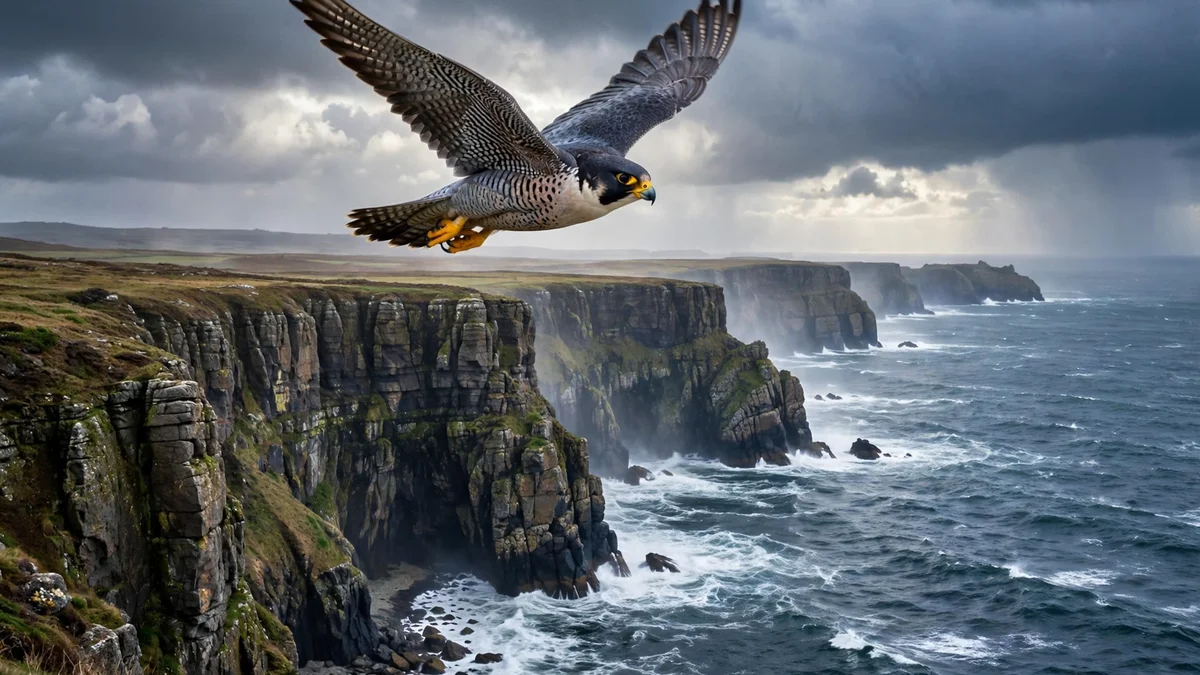
The peregrine falcon species is a single species, Falco peregrinus, the fastest animal on Earth, a hunter that dives at more than 320 kilometres per hour and catches other birds in mid-air. If you are asking how many peregrine falcon species there are, the answer is one: there is only one peregrine falcon species in the world, and every peregrine alive today belongs to it.
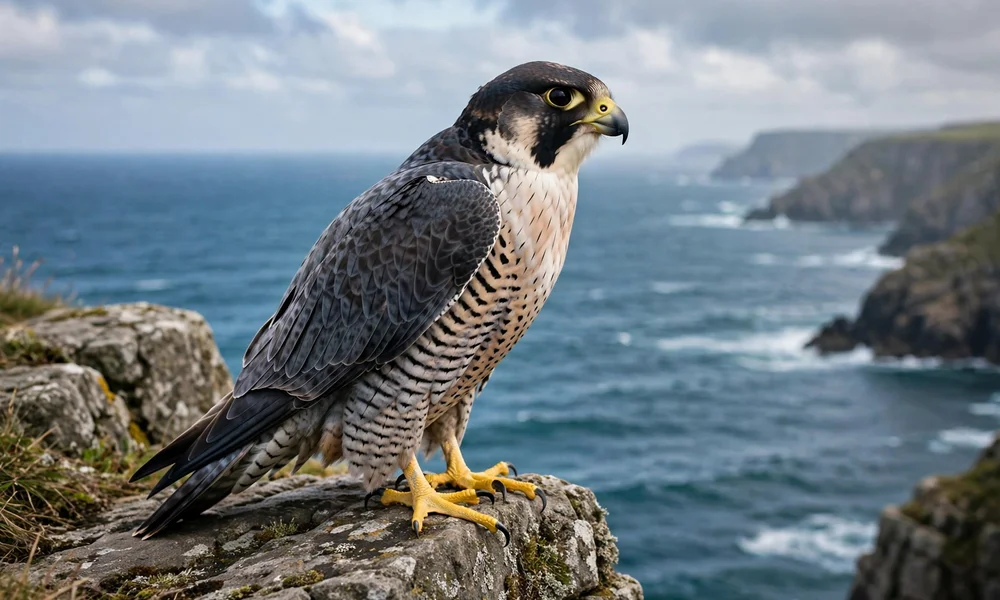
The peregrine falcon belongs to the falcon family, Falconidae, and it lives on every continent except Antarctica, from Arctic tundra to tropical forests and the tops of city skyscrapers. Its blue-grey back, its barred white belly and its black moustache marks make it one of the most recognisable birds of prey on Earth.
Key takeaways
- There is only one peregrine falcon species, Falco peregrinus, with about 19 recognised subspecies around the world.
- Peregrines are the fastest animals on Earth, diving at more than 320 kilometres per hour in a hunting stoop.
- Peregrines hunt other birds in mid-air, striking them with a closed foot and catching them as they fall.
- The pesticide DDT nearly wiped peregrines out in the 1960s, but bans and reintroduction brought them back.
- Peregrines are listed as Least Concern, with an estimated 100,000 to 500,000 birds in the world.
What makes a peregrine falcon a peregrine falcon
A peregrine falcon is a crow-sized bird of prey with a blue-grey back, a pale barred belly, a black head and a black moustache stripe below each eye, and it measures roughly 34 to 58 centimetres long with a wingspan of 74 to 120 centimetres. The female is larger than the male, weighing up to 1.5 kilogrammes, while the male weighs 600 to 800 grammes.
The speed defines the peregrine: in a hunting dive, called a stoop, it folds its wings and falls at more than 320 kilometres per hour, the fastest of any animal, with a recorded dive of 389 kilometres per hour. Its nostrils have small cones that slow the air rushing in at that speed, and its eyes have a third eyelid that keeps them moist. Like other falcons, it has a notched beak, called a tomial tooth, which it uses to break the neck of its prey, and it kills in the air, striking its victim with a clenched foot and catching it as it falls.
The peregrine falcon species and its relatives
Falco peregrinus is the only peregrine falcon species, and it is split into about 19 recognised subspecies, which differ in size and colour across its huge range. The nominate subspecies lives in Europe, the tundra subspecies breeds in the Arctic and migrates to South America, and the Australian subspecies lives in the dry outback, but they are all the same species, and the birds interbreed where their ranges meet.
The gyrfalcon is the peregrine’s largest relative, a powerful Arctic hunter that lives in the far north and takes ptarmigan and seabirds, while the saker falcon is a large falcon of the steppes of Central Asia. The merlin is a small fast falcon that hunts small birds over moorland, the kestrel is a small falcon that hovers over fields looking for voles, and the hobby is a swift falcon that catches dragonflies and swallows in the air. The bald eagle is a much larger bird of prey that shares the peregrine’s cliffs and coasts, and the golden eagle is a huge hunter of mountains and open country.
| Type | Animal | Where it lives | Best-known food | Length or Weight |
|---|---|---|---|---|
| Species | Peregrine falcon (Falco peregrinus) | Worldwide except Antarctica | Birds caught in mid-air | 34 to 58 cm, 600 g to 1.5 kg |
| Close relative | Gyrfalcon | Arctic tundra | Ptarmigan and seabirds | 48 to 65 cm, 1 to 2 kg |
| Close relative | Saker falcon | Central Asian steppes | Rodents and birds | 45 to 57 cm, 700 g to 1.3 kg |
| Close relative | Merlin | Northern moorlands and tundra | Small birds and insects | 24 to 32 cm, 150 to 250 g |
| Close relative | Common kestrel | Europe, Asia and Africa | Voles and mice | 32 to 39 cm, 150 to 250 g |
| Close relative | Bald eagle | North American coasts and lakes | Fish and water birds | 70 to 102 cm, 3 to 6 kg |
| Close relative | Golden eagle | Northern mountains and open country | Rabbits, hares and grouse | 66 to 100 cm, 3 to 7 kg |
How peregrine falcons live
Peregrine falcons are creatures of high open places. A peregrine lives alone or in a pair, holding a territory around a cliff or a tall building, and it comes together with others only to breed in spring. Like other North American animals, it follows the seasons, with northern birds migrating thousands of kilometres south in winter and returning north to breed in spring.
Other birds make up most of the diet, from pigeons and starlings to ducks and shorebirds, and a peregrine hunts by climbing high above its prey, then folding its wings and stooping at more than 320 kilometres per hour, striking the victim with a closed foot and catching it as it tumbles through the air. It eats on the wing or carries its catch to a perch, plucking the feathers before feeding, and it can take prey as large as a duck or as small as a sparrow.
Breeding happens in spring, and the pair scrapes a shallow hollow in gravel or soil on a cliff ledge or a building, laying 3 to 4 eggs, which both parents incubate for about 30 days. The chicks are born covered in white down, and they fledge after about 40 days, though the parents feed them for weeks more. Peregrines live for around 13 to 15 years in the wild, and up to 20 years in the best cases.
Where peregrine falcons live
The peregrine falcon lives on every continent except Antarctica, breeding in the Arctic tundra, on sea cliffs, in mountains, in deserts and in cities, from Alaska and Greenland to Australia and South Africa. It is most common where cliffs and tall buildings meet open hunting grounds, and it has spread into cities all over the world, with pairs nesting on skyscrapers in New York, London and Sydney.
High perches are the key requirement. A peregrine needs a cliff, a tall tree or a building to nest on and to hunt from, so it follows the high places as the seasons change, and when the cliffs are disturbed the birds move on.
The species is listed as Least Concern, and its numbers have recovered strongly. The main pressure in the past was the pesticide DDT, which thinned the birds’ eggshells and nearly wiped the peregrine out in North America and Europe in the 1960s, when only a few hundred pairs remained. DDT was banned in the 1970s, captive-bred birds were released from city rooftops, and the population recovered, with the peregrine removed from the United States endangered list in 1999. An estimated 100,000 to 500,000 birds now live in the world.
Best seasons for peregrine falcon watching
There is no closed season, because peregrines are active all year, but the best time to look for them depends on where you go. In Britain the best months are often March to July, when the birds are breeding on the cliffs and bringing food to their chicks. In North America the best months are often September to November, when the migrating birds pass along the coasts.
Staying safe around peregrine falcons
A peregrine falcon is a wild bird with sharp talons and a hooked beak, and it can hurt a person, though peregrines almost never attack people. Keep your distance, never approach a nest, and never climb to a cliff ledge where peregrines are breeding, because a frightened pair may dive at an intruder and the chicks may fall. If you see peregrines hunting, stay still and watch from a path, because a peregrine that is disturbed may abandon its hunt.
Peregrine falcon watching checklist
A little preparation turns a cliff walk into a real chance of seeing a peregrine falcon, so pack for wind, height and long quiet hours.
- Binoculars with good low-light performance, for picking a fast falcon out of the sky.
- A telescope on a tripod, because peregrines should always be watched from a distance.
- Warm layers and a waterproof jacket, because the best watching is on windy cliffs.
- Water and snacks for long days, because the best sightings come after hours of searching.
- A field guide to birds of prey, for telling a peregrine from a hobby at a glance.
- A plan to be out in spring, when the birds are breeding and bringing food to the nest.
- Patience and silence, because peregrines are shy birds and a noisy group will send them away.
Frequently asked questions
How many peregrine falcon species are there?
There is one peregrine falcon species, Falco peregrinus. It is split into about 19 recognised subspecies, which differ in size and colour across its huge range, but they are all the same species. No second peregrine falcon species is recognised.
How fast can a peregrine falcon dive?
A peregrine falcon dives at more than 320 kilometres per hour in a hunting stoop, and the fastest dive ever recorded was 389 kilometres per hour. That makes the peregrine the fastest animal on Earth, faster than any other bird, fish or land animal.
Why did peregrines nearly disappear?
Peregrines nearly disappeared because the pesticide DDT thinned their eggshells, so the eggs broke before they could hatch. DDT was banned in the 1970s, captive-bred peregrines were released from city rooftops, and the population recovered, with the bird removed from the United States endangered list in 1999.
Can you keep a peregrine falcon as a pet?
No. A peregrine falcon is a wild bird that needs open sky, hunts other birds in mid-air, and is fully protected by law in every country where it lives. Falconers keep peregrines under licence, with years of training and huge aviaries, and they are not pets.
How is this guide different from the hammerhead shark species guide?
This guide covers the single peregrine falcon species, the fastest animal on Earth, which hunts other birds in mid-air, while our hammerhead shark species guide covers ten hammerhead shark species, hunters with hammer-shaped heads that pin stingrays to the seabed. The peregrine dives through the sky at 320 kilometres per hour, and the hammerhead swims through the sea sensing electric fields.
Are peregrine falcons endangered?
Peregrine falcons are listed as Least Concern, so they are not classed as endangered. An estimated 100,000 to 500,000 birds live in the world, and the population has recovered strongly since DDT was banned.
Conclusion
The peregrine falcon species shows how much speed one bird can hold: a single species, with a stoop faster than a racing car, a notched beak for breaking necks, and a life spent hunting other birds in the open sky. It is the fastest animal on Earth, and it has lived on every continent except Antarctica for thousands of years.
If you go looking for one, go in spring to a sea cliff or in autumn to a coastal hawk watch, go quietly, and go with patience. Watch a peregrine stoop on a flock of starlings and you will understand why it has earned its place as the fastest hunter in the sky, and why keeping its cliffs and its clean air matters most.