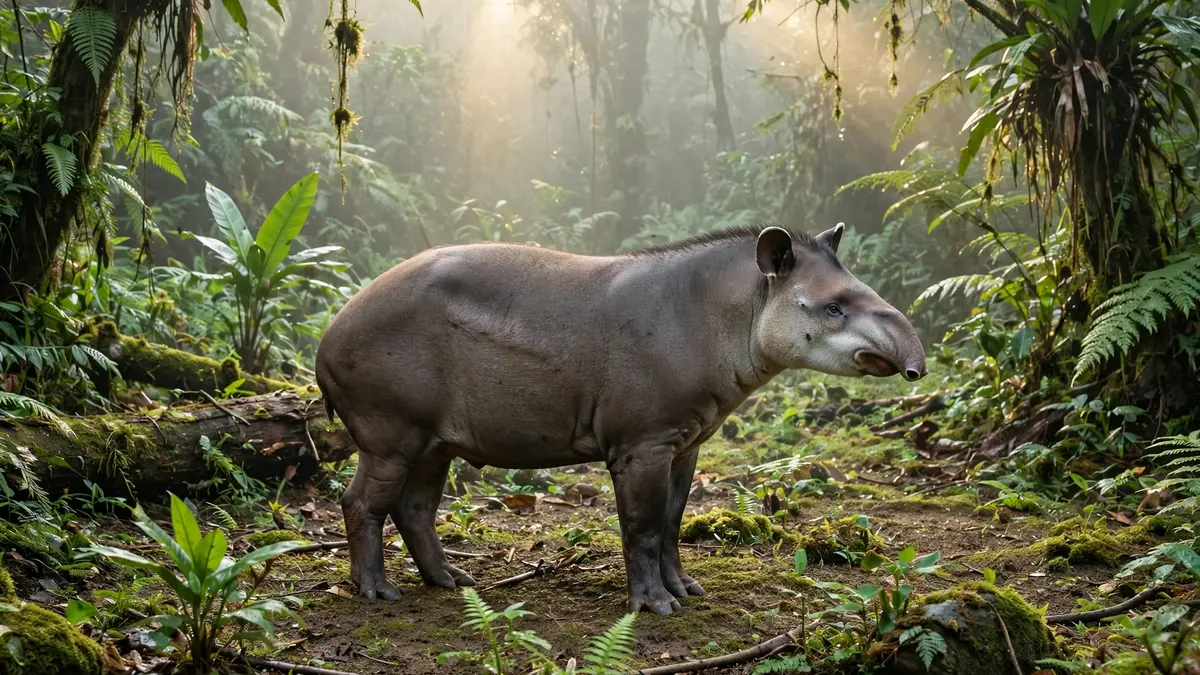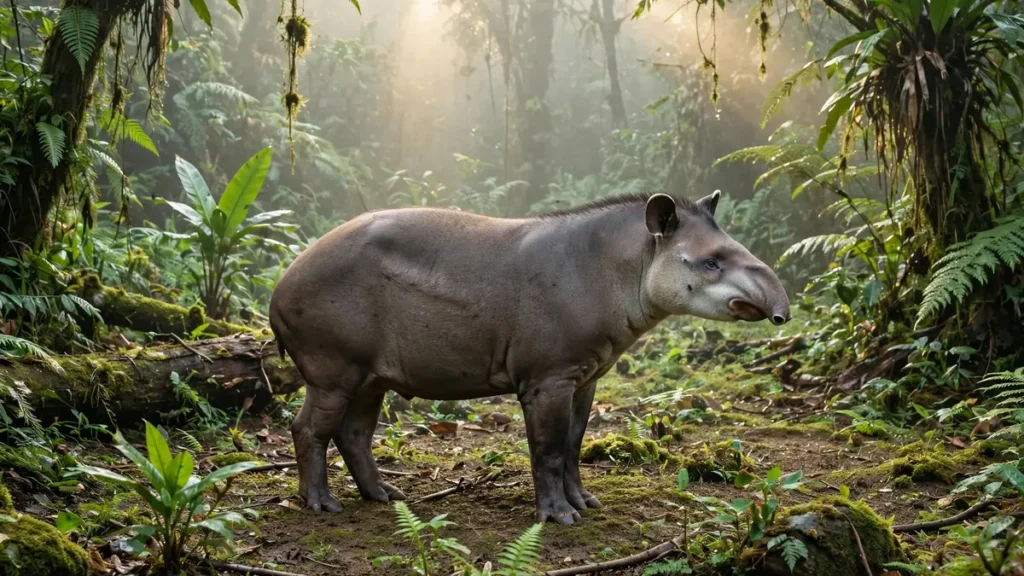
The tapir species number four, shy forest animals with a short trunk-like snout, and they are the gardeners of the rainforest, carrying seeds for kilometres in their dung and planting the next generation of trees. If you are asking how many tapir species there are, the answer is four: the Brazilian tapir, the Baird’s tapir, the Malayan tapir and the mountain tapir, and every tapir alive today belongs to one of them.
The tapir belongs to the order Perissodactyla, the odd-toed ungulates, along with its closest relatives the rhinoceroses and the horses, and it lives only in the rainforests of Central and South America and Southeast Asia. Its grey or brown body, its short flexible snout and its striped or spotted calf make it one of the most recognisable animals of the forest floor.
Key takeaways
- There are four tapir species, and the Brazilian tapir is the largest land mammal in South America.
- Tapirs are shy herbivores that eat leaves, twigs, fruit and water plants, and they spread seeds across the forest.
- Tapir calves are born with white spots and stripes that fade as they grow, hiding them in the dappled forest light.
- Three of the four tapir species are listed as Endangered, and the Brazilian tapir is listed as Vulnerable.
- Only about 2,500 mountain tapirs are thought to remain in the wild, in the high Andes of Colombia, Ecuador and Peru.
What makes a tapir a tapir
A tapir is a large forest mammal with a heavy grey or brown body, short legs, a small tail and a short flexible snout that works like a tiny trunk, and it has four toes on its front feet and three on its back feet. An adult Brazilian tapir measures roughly 1.8 to 2.5 metres long and usually weighs between 150 and 320 kilogrammes, with large males reaching more than 300 kilogrammes.
The snout defines the tapir: a short trunk formed from its nose and upper lip, which it uses to grab leaves, pull down branches and sniff out fruit on the forest floor. Its body is built for pushing through dense undergrowth, with a short mane along its neck and a tough hide that protects it from thorns, and its ears are oval and upright, always turning towards sounds in the forest. Like other rhinoceroses, the tapir is an odd-toed ungulate, and it walks on the tips of its toes, with its weight carried on the middle toe.
The tapir species and its relatives
There are four tapir species. The Brazilian tapir lives in the rainforests and grasslands of South America, from Venezuela and Colombia to Argentina, and it is the largest and most widespread of the four. The Baird’s tapir lives in the forests of Central America and north-western South America, the Malayan tapir lives in the rainforests of Southeast Asia, and the mountain tapir lives high in the Andes. A fifth species, the kabomani tapir, was proposed in 2013, but most scientists do not accept it as a separate species.
The Malayan tapir is the easiest to recognise, with a black head and legs and a grey saddle across its back, while the mountain tapir is the smallest and woolliest, with a thick coat for the cold high Andes. The Baird’s tapir is the largest of the American tapirs, with a pale face and a crest along its neck. The white rhinoceros is the tapir’s closest large relative in Africa, and the horse is a more distant cousin in the same order, while the Indian rhinoceros lives in the same Asian forests as the Malayan tapir.

| Type | Animal | Where it lives | Best-known food | Length or Weight |
|---|---|---|---|---|
| Species | Brazilian tapir (Tapirus terrestris) | South American forests and grasslands | Leaves, fruit and twigs | 1.8 to 2.5 m, 150 to 320 kg |
| Close relative | Baird’s tapir | Central American forests | Leaves, fruit and water plants | 1.8 to 2.5 m, 150 to 300 kg |
| Close relative | Malayan tapir | Southeast Asian rainforests | Leaves, shoots and fruit | 1.8 to 2.5 m, 250 to 320 kg |
| Close relative | Mountain tapir | High Andes of South America | Leaves, bromeliads and grasses | 1.8 m, 150 to 200 kg |
| Close relative | White rhinoceros | African grasslands | Grass | 3.4 to 4 m, 1,400 to 2,300 kg |
| Close relative | Indian rhinoceros | North Indian grasslands | Grass and water plants | 3 to 3.8 m, 1,800 to 2,700 kg |
| Close relative | Domestic horse | Worldwide | Grass and hay | 2.4 m, 400 to 600 kg |
How tapirs live
Tapirs are creatures of the forest floor. A tapir lives alone, moving quietly through dense undergrowth by day and night, and it comes together with others only to breed. Like other South American animals, it follows the fruiting seasons, moving through the forest as different trees come into fruit.
Leaves make up most of the diet, along with twigs, fruit, buds and water plants, and a tapir can eat up to 40 kilogrammes of vegetation in a single day. It uses its snout to pull down branches and strip leaves, and it swallows seeds whole, carrying them for kilometres before dropping them in its dung, which makes the tapir one of the most important seed spreaders in the rainforest.
Breeding happens all year round, and after a gestation of about 13 months the female gives birth to a single calf, usually in dense cover, where the calf can hide. The calf is born with a reddish-brown coat covered in white spots and stripes, which fades after about six months, and it stays with its mother for 12 to 18 months, learning where the fruit trees and water holes are. Tapirs live for around 25 to 30 years in the wild.
Where tapirs live
The Brazilian tapir lives across South America, from Venezuela and Colombia through Brazil and Peru to Paraguay and northern Argentina, and it is most common in the Amazon rainforest and the Pantanal wetlands. The Baird’s tapir lives from southern Mexico through Central America to Colombia and Ecuador, the Malayan tapir lives in the rainforests of Sumatra, Borneo, the Malay Peninsula and Myanmar, and the mountain tapir lives high in the Andes of Colombia, Ecuador and Peru, between 2,000 and 4,000 metres above sea level.
Forest is the key requirement. A tapir needs dense cover to hide in and water to bathe in, so it follows the rivers and streams through the forest, and when the forest is cleared the tapir has nowhere to live. The mountain tapir needs cold cloud forest, and it is the most threatened of all, with only about 2,500 animals left in the wild.
Three of the four species are listed as Endangered, and the Brazilian tapir is listed as Vulnerable. The main pressures are the loss of forest to farming, ranching and logging, hunting for meat, and road deaths, as tapirs cross roads at night and are hit by vehicles. In Brazil the tapir is the largest land mammal in South America, and it is protected by law, but the forest keeps shrinking around it.
Best seasons for tapir watching
There is no closed season, because tapirs are active all year, but the best time to look for them depends on where you go. In the Amazon the best months are often the dry season, from about June to October, when the water is low and the tapirs come to the rivers and clay licks to feed. In the Pantanal the best months are often July to September, when the animals are easy to spot on the open grassland.
Staying safe around tapirs
A tapir is a wild animal with great weight and sharp teeth, and it can hurt a person, though tapirs are shy and almost never aggressive. Keep your distance, never approach a tapir, and never get between a mother and her calf, because a frightened mother can charge. If you see a tapir, stay still, back away slowly, and let it leave, because a tapir would rather flee than fight. In tapir country, watch from a hide and use your eyes.
Tapir watching checklist
A little preparation turns a Pantanal visit into a real chance of seeing a tapir, so pack for heat, mud and long quiet hours.
- Binoculars with good low-light performance, for picking a grey shape out of the forest at dusk.
- A camera with a long lens, because tapirs should always be watched from a distance.
- Sturdy boots and long trousers, because the forest floor is muddy and full of thorns.
- Water and snacks for long days, because the best sightings come after hours of waiting.
- A licensed local guide who knows the forest, the tapirs and the safe routes.
- A plan to be out at dusk, when the tapirs come to the water holes to feed.
- Patience and silence, because tapirs are shy animals and a noisy group will send them away.
Frequently asked questions
How many tapir species are there?
There are four tapir species: the Brazilian tapir, the Baird’s tapir, the Malayan tapir and the mountain tapir. A fifth species, the kabomani tapir, was proposed in 2013, but most scientists do not accept it as a separate species.
Are tapirs related to elephants?
No, though their snouts look alike. Tapirs are odd-toed ungulates, and their closest relatives are rhinoceroses and horses. The snout is a short trunk formed from the nose and upper lip, but it evolved separately from the elephant’s trunk.
Why are baby tapirs striped?
Baby tapirs are born with white spots and stripes that break up their shape in the dappled light of the forest floor, hiding them from jaguars and other predators. The markings fade after about six months, when the calf is big enough to run from danger.
Can you keep a tapir as a pet?
No. A tapir is a wild animal that needs rainforest, eats up to 40 kilogrammes of vegetation a day, and is fully protected by law in every country where it lives. Tapirs in zoos need huge enclosures with pools and forest, and they are not pets.
How is this guide different from the dugong species guide?
This guide covers four tapir species, shy forest animals that spread seeds through the rainforest of South America and Southeast Asia, while our dugong species guide covers the single dugong species, a grey sea cow that grazes on seagrass in the warm shallows of the Indo-Pacific. The tapir lives on the forest floor and eats leaves, and the dugong lives in the sea and eats grass.
Are tapirs endangered?
Three of the four tapir species are listed as Endangered: the Baird’s tapir, the Malayan tapir and the mountain tapir. The Brazilian tapir is listed as Vulnerable. Only about 2,500 mountain tapirs remain in the wild.
Conclusion
The tapir species show how much quiet work one animal can do: four species of forest gardener, with snouts like tiny trunks, calves in spotted coats, and lives spent carrying seeds across the rainforest in their dung. They are among the shyest large mammals on Earth, and they have lived in the forests of South America and Southeast Asia for millions of years.
If you go looking for one, go in the dry season to the Pantanal or the forests of Costa Rica, go with a guide, and go quietly. Watch a tapir wading into a river at dusk and you will understand why it has earned its place as the gardener of the rainforest, and why keeping its forest matters most.