The dugong species is a single species, Dugong dugon, a grey sea cow of the warm shallow waters of the Indo-Pacific, and the only sirenian that lives entirely in the sea, never entering fresh water. If you are asking how many dugong species there are, the answer is one: there is only one dugong species in the world, and every dugong alive today belongs to it.
The dugong belongs to the order Sirenia, the sea cows, along with its closest relatives the manatees, and it lives only in warm coastal waters, where seagrass grows in sunny shallows. Its round grey body, its fluked tail like a whale’s and its downturned snout make it one of the most recognisable animals of the tropical seas.
Key takeaways
- There is only one dugong species, Dugong dugon, and it is the only sirenian that never enters fresh water.
- Dugongs are slow herbivores that eat up to 30 kilogrammes of seagrass every day, uprooting whole plants with their snouts.
- Dugongs need warm shallow water and seagrass beds, and they suffer when the grass is lost to storms, dredging or pollution.
- The largest dugong population lives in Australian waters, with about 85,000 animals, most of them in Queensland.
- Dugongs are listed as Vulnerable, and boat strikes, fishing nets and the loss of seagrass are the main threats to their future.
What makes a dugong a dugong
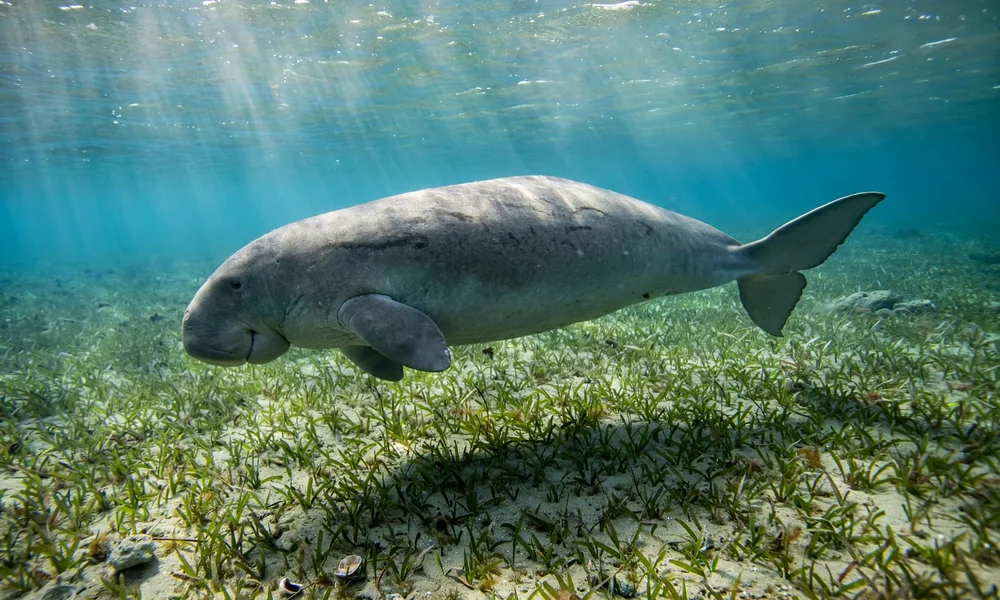
A dugong is a large grey marine mammal with a rounded body, a short blunt snout turned downwards, two front flippers and a fluked tail like a whale’s, and it has no hind limbs at all. An adult dugong measures roughly 2.4 to 3 metres long and usually weighs between 230 and 400 kilogrammes, with large animals reaching more than 500 kilogrammes.
The tail defines the dugong: unlike a manatee, which has a flat paddle-shaped tail, the dugong has a fluked tail with two pointed lobes, like a whale or a dolphin, which gives it its other name, the sea pig. Its snout is covered in whiskers and bends sharply downwards, which suits a life spent grazing on the seabed, and its flippers carry small nails, a reminder of the land mammal it once was. Like other whales, the dugong breathes air through nostrils on top of its snout, and it can stay underwater for up to 12 minutes on a single breath.
The dugong species and its relatives
Dugong dugon is the only dugong species, and it is not split into formally recognised subspecies. Dugongs in different parts of the Indo-Pacific form separate populations, from East Africa to Australia, but they are all the same species, and the animals move slowly along the coast following the seagrass.
The West Indian manatee is the dugong’s closest living relative in the Atlantic, being the best-known member of its order, but it lives in the Caribbean and Florida, has a paddle tail and often swims up rivers into fresh water. The Amazonian manatee lives only in the fresh waters of the Amazon, while the African manatee lives along the west coast of Africa, and both are smaller than the dugong. The Steller’s sea cow was a much larger relative that lived in the cold North Pacific and was hunted to extinction within 27 years of its discovery, in 1768. The dugong’s nearest land relatives are elephants, and the two groups share a distant ancestor.
| Type | Animal | Where it lives | Best-known food | Length or Weight |
|---|---|---|---|---|
| Species | Dugong (Dugong dugon) | Indo-Pacific coastal waters | Seagrass | 2.4 to 3 m, 230 to 400 kg |
| Close relative | West Indian manatee | Florida, Caribbean and Gulf of Mexico | Seagrass and water plants | 2.5 to 4 m, 400 to 600 kg |
| Close relative | Amazonian manatee | Amazon river system | Water plants and floating vegetation | 2.5 to 3 m |
| Close relative | African manatee | West coast of Africa | Seagrass and mangrove leaves | 3 to 4 m |
| Close relative | Steller’s sea cow | North Pacific, extinct 1768 | Kelp | Up to 9 m |
| Close relative | Beluga whale | Arctic and sub-Arctic coasts | Fish, squid and crustaceans | 3 to 5 m |
| Close relative | Humpback whale | Oceans worldwide | Krill and small fish | 12 to 16 m |
How dugongs live
Dugongs are creatures of warm shallow water. A dugong lives alone or in small loose groups, drifting slowly over seagrass beds, bays and coastal lagoons, and mothers and calves stay close together for a year or more. Like other ocean animals, it follows the seasons, moving to deeper water in winter and spreading out to feed in summer.
Seagrass makes up almost the whole diet, and a large dugong can eat up to 30 kilogrammes of grass in a single day. It grazes for hours at a time, using its downturned snout to root out whole plants, roots and all, leaving long feeding trails in the sand that can be seen from the air, and it swims slowly, at about 5 to 10 kilometres per hour, though it can burst faster when startled.
Breeding happens all year round, and after a gestation of about 13 to 14 months the female gives birth to a single calf, usually in quiet shallow water, where the calf can reach the surface easily. The calf is born about 1 metre long, weighing around 25 to 30 kilogrammes, and it stays with its mother for 18 months or more, learning where the seagrass beds are. A female breeds only once every three to seven years, which makes the dugong one of the slowest-breeding marine mammals, and dugongs live for around 50 to 70 years in the wild.
Where dugongs live
The dugong lives in the warm coastal waters of the Indian and Pacific Oceans, from the east coast of Africa and the Red Sea, through Southeast Asia and northern Australia, to the islands of the western Pacific. It is most common in Australia, where about 85,000 animals live, most of them in Queensland, in Shark Bay and Moreton Bay, and it is scarcer elsewhere, with small populations in the Arabian Gulf, India, Malaysia, Indonesia and Papua New Guinea.
Seagrass is the key requirement. A dugong needs shallow water, usually less than 10 metres deep, where seagrass grows in the sun, so it follows the grass beds as they grow and die back with the seasons, and when the grass is lost to storms, dredging or pollution the dugongs starve. It depends on the water staying warm and clear, like the fish and turtles that share its shallows, and when the water is muddied the grass cannot grow.
The species is listed as Vulnerable, and its numbers are falling in most regions outside Australia. The main pressures are boat strikes, which kill dugongs in busy coastal waters, entanglement in fishing nets and shark nets, the loss of seagrass beds, and hunting for meat in some countries. Dugongs were once thought to be the origin of mermaid stories told by sailors, who saw a mother dugong holding her calf at the surface.
Best seasons for dugong watching
There is no closed season, because dugongs are active all year, but the best time to look for them depends on where you go. In Australia the best months are often the dry season, from about May to October, when the sea is calm and clear and the dugongs feed in the shallows of Shark Bay and Moreton Bay. In the Arabian Gulf the best months are often the cooler winter, when the animals come into the bays.
Staying safe around dugongs
A dugong is a wild animal with great weight and strength, and it can hurt a person by accident, though dugongs are gentle and almost never aggressive. Keep your distance, never chase a dugong, and never try to touch, feed or ride one, because a dugong that learns to approach people is more likely to be hit by a boat. If you see dugongs from a boat, keep the engine slow, watch for their backs breaking the surface, and stay in marked channels.
Dugong watching checklist
A little preparation turns a Shark Bay visit into a real chance of seeing a dugong, so pack for sun, calm water and long quiet hours.
- Binoculars with good low-light performance, for picking a grey back out of the water.
- A camera with a zoom lens, because dugongs should always be watched from a distance.
- Sun cream and a hat, because the best watching is in the bright midday sun.
- A booked boat tour with a guide who knows the dugong rules and the safe routes.
- A plan to be out in the dry season, when the sea is calm and the water is clear.
- Patience and silence, because dugongs are shy animals and a noisy group will send them away.
- A polarised pair of sunglasses, for cutting the glare and seeing into the water.
Frequently asked questions
How many dugong species are there?
There is one dugong species, Dugong dugon. Dugongs in different parts of the Indo-Pacific form separate populations, from East Africa to Australia, but they are all the same species. No second dugong species is recognised.
Are dugongs related to manatees?
Yes, closely. Dugongs and manatees are the only living members of the order Sirenia, the sea cows, and they share a common ancestor that lived tens of millions of years ago. The dugong differs in its fluked tail, like a whale’s, and in living only in salt water, while manatees have paddle tails and often swim up rivers.
Why are dugongs called sea cows?
Dugongs are called sea cows because they graze on seagrass like cattle graze on grass, moving slowly through the shallows and eating for hours at a time. Sailors once mistook dugongs for mermaids, which is how the mermaid legend may have begun.
Can you keep a dugong as a pet?
No. A dugong is a wild animal that needs warm shallow seawater, eats up to 30 kilogrammes of seagrass a day, and is fully protected by law in every country where it lives. Dugongs in rescue centres are there to recover from injury, and they are not pets.
How is this guide different from the gibbon species guide?
This guide covers the single dugong species, a grey sea cow that grazes on seagrass in the warm shallows of the Indo-Pacific, while our gibbon species guide covers twenty gibbon species, small singing apes that swing through the rainforest canopy of Southeast Asia. The dugong lives in the sea and eats grass, and the gibbon lives in trees and eats fruit.
Are dugongs endangered?
Dugongs are listed as Vulnerable, so they are not classed as endangered, but their numbers are falling in most regions outside Australia. About 85,000 dugongs remain in Australian waters, and boat strikes and the loss of seagrass are the main threats.
Conclusion
The dugong species shows how much gentleness one animal can hold: a single species of sea cow, with a fluked tail like a whale’s, a snout bent down for grazing, and a life spent drifting through warm shallow water eating seagrass. It is the only sirenian that never leaves the sea, and it has lived in the tropical waters of the Indo-Pacific for millions of years.
If you go looking for one, go in the dry season to Shark Bay or Moreton Bay, go with a guide, and go quietly. Watch a dugong surface slowly among the seagrass and you will understand why it has earned its place as the gentle grazer of the shallows, and why keeping its warm water and its seagrass matters most.