Jackal species are the slender, sharp-eared wild dogs of Africa and Asia, and there are three jackal species in the world: the golden jackal, the black-backed jackal and the side-striped jackal. If you are wondering how many jackal species there are, the answer is three, and all three are medium-sized canids that hunt small prey, scavenge what larger predators leave, and call to each other at night.
Key takeaways
- There are three jackal species: the golden jackal, the black-backed jackal and the side-striped jackal.
- Jackals are medium-sized canids, smaller than wolves, that hunt small prey and scavenge carcasses left by larger predators.
- The golden jackal lives across Africa and Asia, while the black-backed and side-striped jackals live only in Africa.
- Jackals live in pairs or small family groups, and they call at night with yelps and wailing cries.
- The African golden wolf was once thought to be a golden jackal, but it is now a separate species, not one of the three jackals.
What makes a jackal a jackal
A jackal is a slender, long-legged wild dog built for trotting across open ground at dusk and by night. Its body is about 70 to 105 centimetres long from nose to tail, with a bushy tail, large pointed ears, a narrow muzzle and grizzled gold, grey or reddish-brown fur. It weighs about 7 to 15 kilograms, much smaller than a wolf and closer in size to a large fox, though its legs are longer and its build is more dog-like.
Jackals are clever, watchful animals, and their voices are tuned for the night. They give high yelps, short barks and long wailing howls that carry across the savanna after dark, and pairs often call together from different parts of their territory. They eat almost anything they can catch or find, small mammals, birds, reptiles, insects, fruit and carrion, and they follow lions, leopards and hyenas at a safe distance to feed on what those hunters leave behind. Among the predator animals of Africa and Asia, jackals are the opportunists, taking small prey and leftovers that bigger hunters ignore.
The three jackal species of the world
The golden jackal is the most widespread jackal, living across northern and eastern Africa and through the Middle East and southern Asia, from Turkey to India and south-east Asia. It is about 70 to 105 centimetres long, weighs 8 to 15 kilograms, and has a pale golden coat, a darker saddle and a bushy tail with a dark tip. Golden jackals live in open grassland, scrub, farmland and village edges, and in recent years they have spread into parts of southern and eastern Europe.
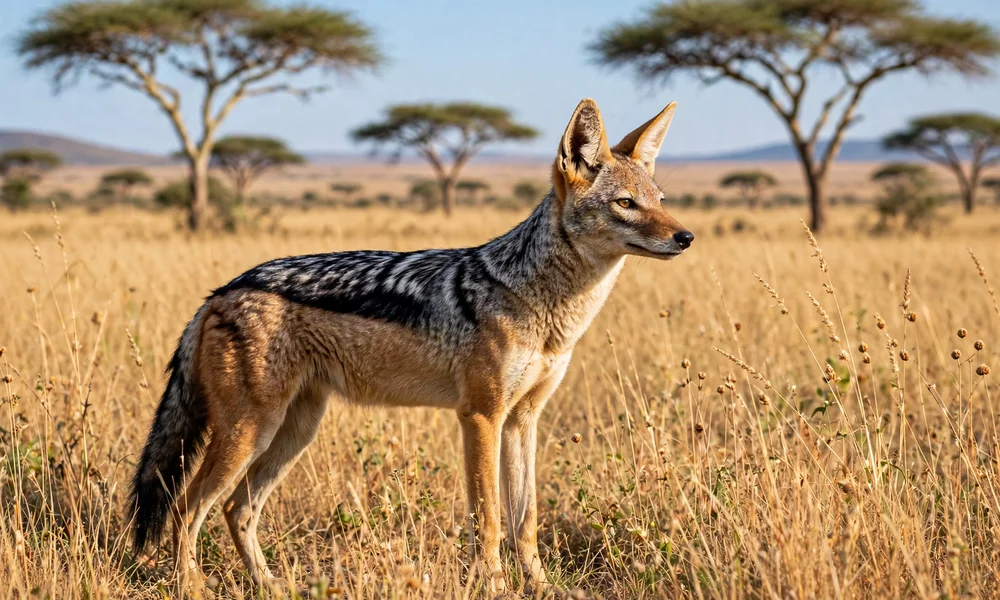
The black-backed jackal is the best-known jackal of southern and eastern Africa, living in South Africa, Namibia, Botswana, Zimbabwe, Kenya and Tanzania. It is about 70 to 95 centimetres long, weighs 6 to 13 kilograms, and has a reddish-brown coat and a broad black saddle, flecked with silver, running from its neck to the base of its tail. Black-backed jackals live in open savanna, dry grassland and scrub, and they are often the first scavengers at a carcass, slipping in among vultures and hyenas.
The side-striped jackal is the quietest and least-seen of the three, living across central and southern Africa, from Senegal and the Congo basin to Angola, Zambia and South Africa. It is about 70 to 105 centimetres long, weighs 7 to 14 kilograms, and has a greyish-brown coat, pale stripes along its flanks and a dark stripe down its back. Side-striped jackals prefer woodland, marsh edges and thick bush, and they eat more fruit and insects than the other two species, often feeding alone at night.
One name causes confusion, and it is worth clearing up early. The golden jackal was once thought to be one species across Africa and Asia, but the African animals are now recognised as a separate species, the African golden wolf, and the true golden jackal is the Asian animal, with a smaller range in northern Africa. That change does not alter the count: there are still three jackal species, and the African golden wolf is a close relative, not a fourth jackal.
How jackals live: pairs, calls and scavenging
A jackal lives in a pair or a small family group, usually a breeding pair and their grown young from the previous year, holding a territory the pair marks with scent and defends with calls. The pair stays together for life, and older young often stay to help raise the next litter, bringing food to the den and standing guard. The den is usually an old burrow dug by another animal, a hole among rocks or a hollow under thick bush, and the pups are born there after about two months.
Jackals hunt mainly at dawn, dusk and through the night, trotting alone or in pairs across open ground, stopping often to listen with their large ears. They catch mice, rats, hares, ground birds and lizards, and sometimes young antelope, but most of their food is small. They also eat fruit, especially figs and wild berries, and they are quick to find a carcass, using their sharp sense of smell to locate a dead animal from far away.
Where jackals live
Jackals live across Africa and Asia, in open grassland, savanna, scrub, desert edges and farmland, wherever there is open ground to hunt on and cover to hide in. The golden jackal ranges widest, from northern Africa through the Middle East to India and south-east Asia, while the black-backed jackal lives in the dry savannas of southern and eastern Africa and the side-striped jackal in the wetter woodlands of central and southern Africa. The desert animals of the dry lands include golden and black-backed jackals, hunting along desert edges where rodents and lizards are plentiful.
Where two jackals meet, they divide the ground between them: in eastern Africa golden jackals favour open plains and farmland while black-backed jackals take drier savanna, and in southern Africa the side-striped jackal keeps to wooded valleys while the black-backed jackal works open grassland. Golden jackals have also spread north into Europe, reaching the Balkans, Hungary, Austria and Italy, the only jackal living outside Africa and Asia.
| Name | Type | Range | Food | Length |
|---|---|---|---|---|
| Golden jackal | Species | Northern and eastern Africa, Middle East, Asia | Small mammals, birds, fruit, carrion | 0.70–1.05 metres |
| Black-backed jackal | Species | Southern and eastern Africa | Small mammals, birds, carrion | 0.70–0.95 metres |
| Side-striped jackal | Species | Central and southern Africa | Fruit, insects, small mammals, carrion | 0.70–1.05 metres |
| African golden wolf | Close relative | Northern and eastern Africa | Small mammals, birds, carrion | 0.70–1.05 metres |
| Ethiopian wolf | Close relative | Highlands of Ethiopia | Rodents, especially giant mole-rats | 0.85–1.05 metres |
| African wild dog | Close relative | Sub-Saharan Africa | Antelopes and medium-sized prey | 0.85–1.10 metres |
| Red fox | Close relative | Europe, Asia, North America, North Africa | Small mammals, birds, fruit, insects | 0.60–0.90 metres |
| Grey wolf | Close relative | Northern Europe, Asia and North America | Deer, elk, moose and other large prey | 1.05–1.60 metres |
Best seasons for jackal watching
The dry season is the finest time for jackal watching, when the grass is short, animals come to waterholes, and jackals follow the herds. In southern and eastern Africa, the dry months from May to October give the clearest views, with jackals trotting across open ground at dawn and dusk and gathering at carcasses.
The wet season is also rewarding, though tall grass hides the animals and tracks are harder to follow. This is the season when jackal pups leave the den and play near the burrow, and a patient watcher sitting quietly near a known den at dawn may see the whole family. In Asia, the cooler months from November to March are best for golden jackals, when the heat eases and the animals stay active longer in the morning and evening.
Staying safe around jackals
Jackals are wild animals, and they deserve respect. Never try to touch a jackal, feed one by hand, or corner one in a den or a fenced yard. A jackal is small, but it has sharp teeth and can bite if it feels trapped. Keep dogs on a lead where jackals live, because jackals and dogs can fight, and jackals may carry diseases that pass to pets. Leave a young jackal alone, because its mother is almost certainly nearby.
Jackals can carry rabies in some areas, so treat any jackal that acts strangely, or any bite or scratch, with care. Do not touch a dead jackal or handle a sick animal, and wash your hands after touching anything a jackal may have touched. Keep a sensible distance from dens and carcasses, use binoculars to watch up close, and store food and rubbish in sealed containers at campsites so jackals are not drawn in at night.
Jackal watching checklist
- Look for jackal tracks and droppings on sandy paths and dry riverbeds at dawn.
- Watch in the early morning or late evening, when jackals trot across open ground and call.
- Listen for high yelps and wailing howls after dark, the night calls that give them away.
- Use binoculars to watch from a distance, and never block the path to a den.
- Keep dogs on a lead, do not feed jackals, and keep food and rubbish sealed at camp.
- Leave no trace: take your rubbish home and keep to marked paths.
Frequently asked questions
How many jackal species are there?
There are three jackal species: the golden jackal, the black-backed jackal and the side-striped jackal. The African golden wolf was once thought to be a golden jackal, but it is now a separate species, so it is not counted among the three.
How is this guide different from the wolf species guide?
This guide covers only the three jackal species, small to medium-sized canids that live mostly in Africa and Asia, scavenge carcasses and hunt small prey alone or in pairs. The wolf species guide covers wolves, much larger pack hunters of the north that bring down deer, elk and moose together.
Are jackals dangerous to people?
Jackals are not normally dangerous to people, and they usually run away. They can bite if cornered or sick, and in some areas they can carry rabies, so keep your distance, never feed them by hand, and treat any bite with care.
What do jackals eat?
Jackals eat small mammals, birds, reptiles, insects, fruit and carrion. They hunt mice, rats, hares and ground birds, eat figs and wild berries in season, and scavenge carcasses left by lions, leopards and hyenas.
Where is the best place to see a jackal?
The best place to see a jackal is open savanna in southern or eastern Africa in the dry season, at dawn or dusk, when black-backed jackals trot across the grass. Golden jackals are also easy to see in India, in grassland and farmland at first light.
Do jackals live in packs like wolves?
No, jackals do not live in large packs like wolves. They live in pairs or small family groups, usually a breeding pair and their grown young, and they hunt alone or in pairs rather than bringing down large prey together. The fox species guide covers another canid that lives in a similar way.
Conclusion
Jackal species, all three of them, are the clever opportunists of Africa and Asia: golden jackals spreading from Africa to Asia and into Europe, black-backed jackals with silver-flecked saddles on the dry savanna, and side-striped jackals slipping quietly through the woodlands of central Africa.
The next step is to sit quietly at the edge of the savanna at dusk, listen for the high yelps and wailing howls that rise after dark, and remember the animal calling is one of only three jackals in the world, a small hunter living by its wits, its ears and its nose.