Pangolin species are a short list with a long story, because there are only eight pangolin species in the world, four in Africa and four in Asia, and every one of them is a scaled, toothless, ant-eating mammal unlike any other animal alive. If you are wondering how many pangolin species there are, the answer is eight, and all eight are threatened by poaching and trafficking, which makes the pangolin the most trafficked mammal on Earth.
Key takeaways
- There are eight pangolin species: four African and four Asian.
- Pangolins are the only mammals covered in scales, made of keratin, like human fingernails.
- Every pangolin eats ants and termites with a long, sticky tongue, and no pangolin has teeth.
- When threatened, a pangolin rolls into a tight ball, protected by its scales.
- All eight species are threatened, and three Asian species are critically endangered.
What makes a pangolin a pangolin
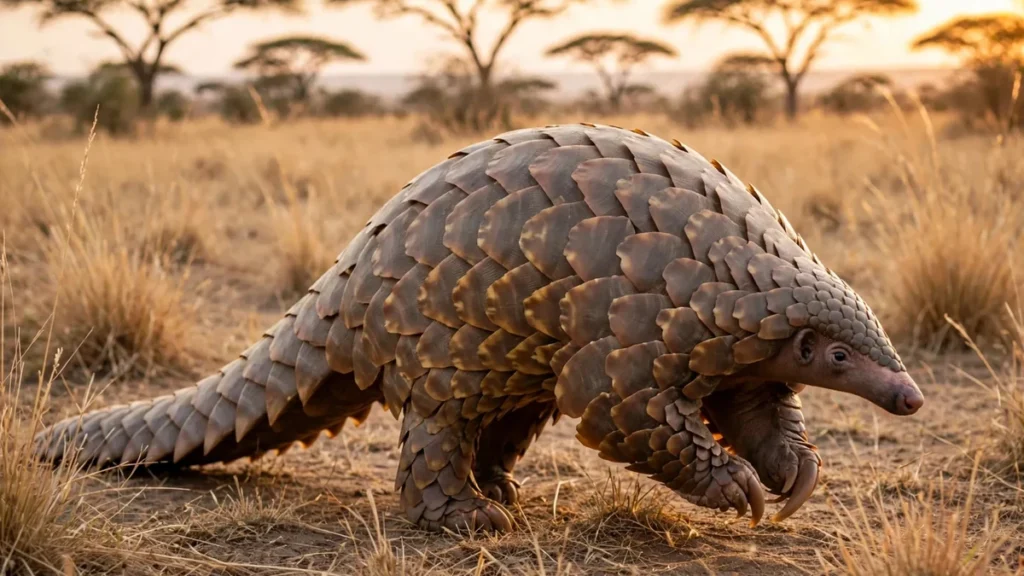
A pangolin is a shy, slow-moving mammal covered from head to tail in large, overlapping scales, with a small head, a long snout and strong digging claws. The scales are made of keratin, like human fingernails, and when danger comes close the animal rolls into a ball so tight that a lion cannot get in.
Pangolins have no teeth at all. Instead they eat with a tongue up to 40 centimetres long, flicked into ant nests and termite mounds to pick up insects. They swallow small stones and sand with their food, and the grit grinds the insects in the stomach.
Pangolins are mostly active at night, which puts them among the nocturnal animals of the forests and savannas where they live. They are solitary and so well hidden that many neighbours have never seen one.
The four African pangolin species
Africa is home to four pangolin species, two ground-living and two tree-living. The giant ground pangolin is the largest of all eight, weighing 25 to 35 kilograms, and it lives in the forests and savannas of Central and West Africa, tearing open termite mounds with huge front claws.
The second ground species is Temminck’s ground pangolin, also called the Cape pangolin, which lives across eastern and southern Africa, from Chad and Ethiopia to South Africa. It weighs 5 to 18 kilograms and is the pangolin most often seen on safari, walking slowly through dry grassland and the desert animals country of the Kalahari at night.

The two African tree pangolins are much smaller. The white-bellied pangolin, also called the tree pangolin, weighs only 1.6 to 3.5 kilograms and lives in the rainforests of Central and West Africa, climbing with a long tail that grips branches. The black-bellied pangolin, also called the long-tailed pangolin, has a tail longer than its body and spends almost its whole life in the canopy.
All four African species are threatened: the giant ground pangolin, the white-bellied pangolin and the black-bellied pangolin are listed as endangered, and Temminck’s ground pangolin as vulnerable. The main danger is the same for all: poaching for scales and meat, and the loss of their forests and savannas.
The four Asian pangolin species
Asia is home to the other four pangolin species, and three of them are critically endangered, the highest level of threat before extinction in the wild. The Indian pangolin is the largest Asian species, weighing 10 to 16 kilograms, and it lives across the Indian subcontinent, in forests, grasslands and farmland.
The Chinese pangolin lives in the forests and grasslands of southern China, northern India, Nepal and Southeast Asia, and it weighs only 2 to 7 kilograms. It is critically endangered after decades of heavy poaching for its scales, wrongly believed in some traditional medicines to cure illness, although they are made of keratin and have no medicinal value.
The Sunda pangolin, also called the Malayan pangolin, lives across Southeast Asia, from Myanmar and Thailand through Malaysia and Indonesia to Borneo, Sumatra and Java. It weighs 4 to 10 kilograms and is a good climber, at home in the trees of the rainforest animals of the region, and it is one of the most seized animals in the illegal wildlife trade anywhere.
The Philippine pangolin lives only in the Palawan island group of the Philippines, nowhere else on Earth, and it is the smallest of the Asian species, weighing 2 to 5 kilograms. Because its whole range is a handful of islands, it is especially at risk, and critically endangered too.
How pangolins eat: ants, termites and a tongue longer than their body
A pangolin eats little else but ants and termites, and a single animal can eat tens of thousands of insects in one night. It finds a nest by smell, tears it open with its front claws, and flicks its long, sticky tongue in and out, sometimes a hundred times a minute.
The tongue is extraordinary. It is not attached to the skull like the tongue of most mammals, but to the chest, and when not in use it rests in a sheath inside the body. Fully extended it can reach 40 centimetres, longer than the whole head and body in the smallest species.
Pangolins have no teeth, so they swallow their food whole, along with small stones and sand, and the grit grinds the insects in the stomach. Their stomachs are lined with tough skin that protects them from the bites and stings of the ants and termites.
Where pangolins live
Pangolins live across a huge band of the tropics, from West Africa to southern Africa, and from India and Nepal through China and Southeast Asia to Indonesia and the Philippines. The African species live in rainforests, savannas and dry grasslands, and the Asian species in forests, grasslands and farmland, and every species needs plenty of ants and termites, and somewhere safe to sleep.
Ground pangolins sleep in burrows, dug with their strong claws or taken over from aardvarks, and a burrow can be several metres long, with a sleeping chamber at the end. Tree pangolins sleep in hollow trees or dense vegetation high in the canopy, curled into a ball with their scales facing out.
Pangolin numbers have fallen sharply, hunted for meat and scales. More than a million were taken from the wild in the last decade, and all eight species are protected by international law, yet the trade continues in secret.
| Type | Animal | Where it lives | Best-known food | Length |
|---|---|---|---|---|
| Species | Giant ground pangolin | Central and West Africa | Ants and termites | Up to 1.40 metres |
| Species | Temminck’s ground pangolin | Eastern and southern Africa | Ants and termites | 0.50 to 1.00 metres |
| Species | White-bellied pangolin | Central and West Africa | Ants and termites | 0.30 to 0.45 metres |
| Species | Black-bellied pangolin | Central Africa | Ants and termites | 0.30 to 0.40 metres |
| Species | Indian pangolin | Indian subcontinent | Ants and termites | 0.45 to 0.75 metres |
| Species | Chinese pangolin | China and Southeast Asia | Ants and termites | 0.40 to 0.58 metres |
| Species | Sunda pangolin | Southeast Asia | Ants and termites | 0.40 to 0.65 metres |
| Species | Philippine pangolin | Palawan, Philippines | Ants and termites | 0.30 to 0.40 metres |
Best seasons for pangolin watching
The dry season is the best time to look for pangolins, because the grass is short and the ground is dry. In southern and eastern Africa, the dry months from May to October are best for Temminck’s ground pangolin, when the nights are cool and the animals walk slowly over open ground.
In the rainforests, the drier months are best too, when the trails are passable and tree pangolins come down to feed on the forest floor. In the wet season the forests are thick, and a pangolin can pass a few metres away unseen.
Whatever the season, watch at night, in the first hours after dark, when pangolins leave their burrows and trees to feed. A red torch disturbs the animal less than a white one, so move slowly, stay quiet, and be patient.
Staying safe around pangolins
Pangolins are wild animals, and they deserve respect. Never try to catch a pangolin, never put your hand into a burrow, and never handle one with bare hands. A frightened pangolin will roll into a tight ball, and it should be left alone to unroll in its own time.
Keep dogs on a lead, because dogs can kill pangolins on the ground. Keep a sensible distance, sit still, and use binoculars or a red torch to watch. Do not feed pangolins, because human food can make them ill.
If you find an injured pangolin, or one in a trap, do not try to free it yourself. Call a wildlife rescue group or the local wildlife authority. Pangolins are protected by law everywhere they live, and buying or selling one, or its scales, is illegal.
Pangolin watching checklist
- Look for dry ground with ant nests and termite mounds, and trees with hollows.
- Watch at night, in the first hours after dark, and use a red torch.
- Look for a slow, shuffling shape on the ground, or a curled ball of scales in a tree.
- Look for neat, three-toed tracks in dust, and fresh holes at termite mounds.
- Move slowly, stay quiet, and keep a sensible distance from the animal.
- Keep dogs on a lead, and do not touch pangolins, burrows or nests.
- Leave no trace: take your rubbish home.
Frequently asked questions
How many pangolin species are there?
There are eight pangolin species: four in Africa, the giant ground, Temminck’s ground, white-bellied and black-bellied pangolins, and four in Asia, the Indian, Chinese, Sunda and Philippine pangolins.
How is this guide different from the armadillo species guide?
This guide covers the eight pangolin species of Africa and Asia, the only scaled mammals in the world, while the armadillo species guide covers the armadillos of the Americas, a different group altogether. Pangolins and armadillos both wear armour and roll into a ball, but pangolins live in Africa and Asia and wear keratin scales, while armadillos live in the Americas and wear bony plates.
Why do pangolins roll into a ball?
Pangolins roll into a ball to protect themselves, because their overlapping scales form a hard shell that a lion or a leopard cannot bite through. The animal tucks its head under its tail, pulls its legs in tight, and waits for the danger to pass.
What do pangolins eat?
Pangolins eat ants and termites, and almost nothing else. They tear open nests with their front claws and lick up the insects with a long, sticky tongue that can reach 40 centimetres, and a single pangolin can eat tens of thousands in one night. They have no teeth, and they swallow small stones and sand to grind their food.
Are pangolins really the most trafficked mammals in the world?
Yes, pangolins are the most trafficked mammals in the world. More than a million were taken from the wild in the last decade, hunted for meat and scales, and all eight species are now threatened. The trade is banned under international law, but it continues in secret.
Where is the best place to see a pangolin?
The best place to see a pangolin is a dry savanna in southern or eastern Africa at night, looking for Temminck’s ground pangolin, or a Southeast Asian rainforest, looking for a Sunda pangolin. Go in the dry season, in the first hours after dark, move slowly with a red torch, and be patient.
Conclusion
Pangolin species, all eight of them, are a reminder that the animal kingdom still holds surprises: the only scaled mammals in the world, toothless ant-eaters with tongues longer than their bodies, rolling into armoured balls in the forests and savannas of Africa and Asia.
The next step is to learn the eight names, the four African and the four Asian, and to remember that every one of them is threatened, so the next time a pangolin is in the news, you will know exactly what is at stake.