The killer whale species is a single species, Orcinus orca, the largest dolphin in the world and an apex predator of every ocean, a black and white hunter that lives in close family pods. If you are asking how many killer whale species there are, the answer is one: there is only one killer whale species in the world, and every killer whale alive today belongs to it.
The killer whale belongs to the dolphin family, Delphinidae, and despite its name it is the largest member of the dolphin family. It is also known as the orca, and it is one of the most widely spread mammals on Earth.
Key takeaways
- There is only one killer whale species, Orcinus orca, and it is the largest dolphin in the world.
- Killer whales are apex predators, at the top of the ocean food chain.
- Killer whales live in distinct ecotypes — resident, transient and offshore — that eat different prey.
- Killer whales live in close, matrilineal pods led by the oldest females.
- Killer whales are listed as Data Deficient by the IUCN, because too little is known about their population.
What makes a killer whale a killer whale
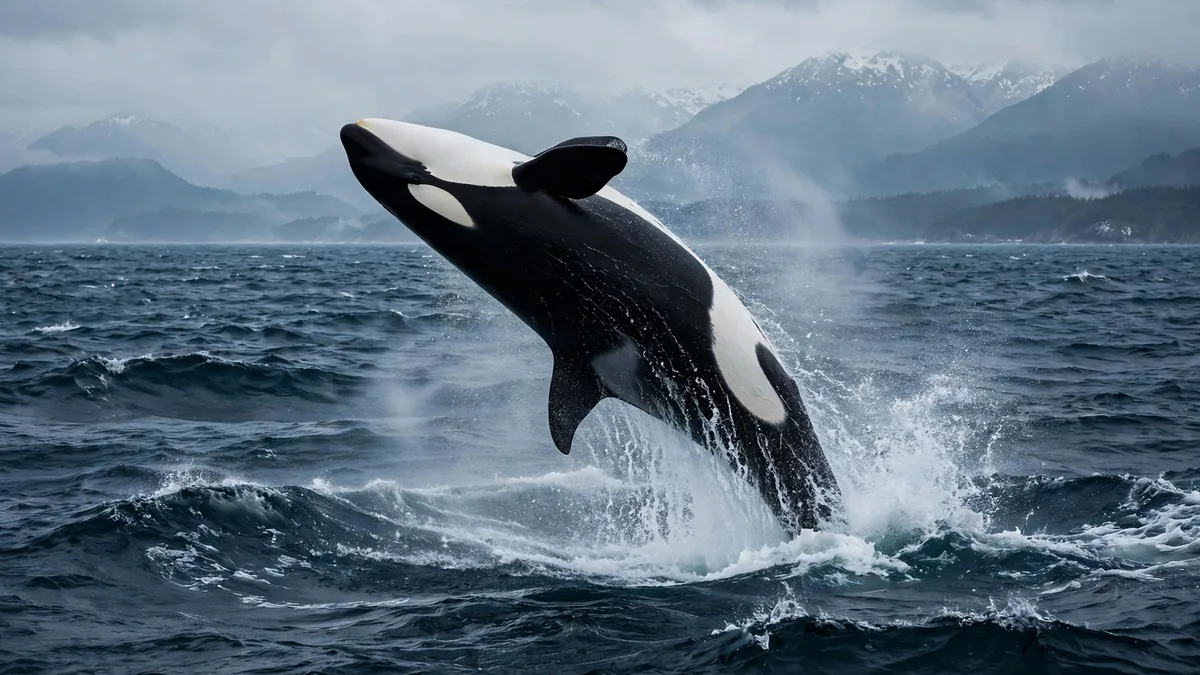
A killer whale is a large black and white dolphin with a white patch above and behind each eye, a white lower jaw and belly, and a tall, upright dorsal fin, which in adult males can reach about 1.8 metres tall. Its body measures roughly 5 to 9 metres long, with males larger than females, and it usually weighs between 3 and 6 tonnes.
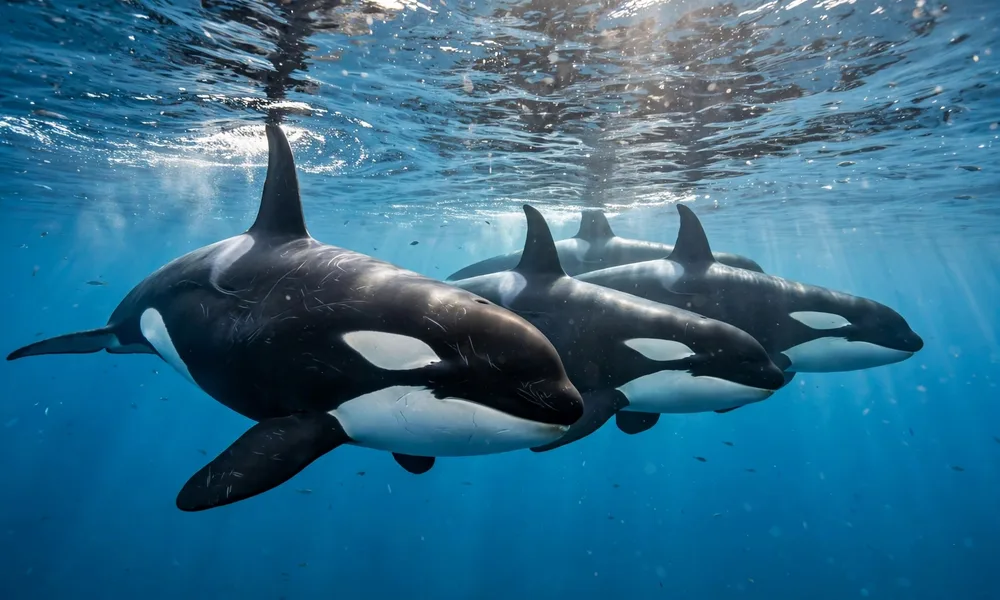
The hunting defines the killer whale: powerful jaws with about 40 to 56 large, cone-shaped teeth, a body built for speed that can reach around 55 kilometres an hour in a short burst, and a brain that supports complex social life and cooperation. Killer whales hunt together, herding fish into tight balls and working as a team to wear down much larger prey. They are one of the few animals, besides humans, known to have distinct cultures that are passed down through the generations.
The killer whale species and its relatives
Orcinus orca is the only killer whale species, not split into formally recognised subspecies. Instead, scientists recognise distinct ecotypes, populations that live differently and rarely mix. Resident killer whales live in large, stable pods, eat mainly fish such as salmon, and stay in the same coastal waters. Transient killer whales, also called Bigg’s killer whales, live in smaller pods, eat marine mammals such as seals, sea lions and other dolphins, and roam widely. Offshore killer whales live far out at sea, travel in large groups, and eat mainly sharks and fish, including sleeper sharks.
The bottlenose dolphin is the killer whale’s closest relative in fame, being the best known dolphin of all, but it is far smaller, at 2 to 4 metres, and it eats mainly fish and squid in shallow coastal waters. The long-finned pilot whale is a dark, round-headed dolphin that also lives in close family pods, but it is smaller than the killer whale and eats mainly squid. The false killer whale looks much like a small killer whale, but it is slimmer, darker and less boldly marked.
| Type | Animal | Where it lives | Best-known food | Length |
|---|---|---|---|---|
| Species | Killer whale (Orcinus orca) | Oceans worldwide | Fish, seals and squid | 5 to 9 m |
| Ecotype | Resident killer whale | Coastal North Pacific | Salmon and other fish | 5 to 9 m |
| Ecotype | Transient killer whale | Coastal North Pacific | Seals, sea lions and dolphins | 5 to 9 m |
| Ecotype | Offshore killer whale | Open North Pacific | Sharks and fish | 5 to 9 m |
| Close relative | Bottlenose dolphin | Coastal seas worldwide | Fish and squid | 2 to 4 m |
| Close relative | Long-finned pilot whale | Cool oceans worldwide | Squid and fish | 4 to 6 m |
| Close relative | False killer whale | Warm oceans worldwide | Fish and squid | 4 to 6 m |
How killer whales live
Killer whales are creatures of the pod. A killer whale lives in a close family group led by the oldest female, and the pod may stay together for life, with sons and daughters remaining beside their mother. Like other ocean animals, the killer whale spends its whole life at sea, surfacing to breathe through the blowhole on top of its head.
The diet depends on the ecotype: the killer whale eats fish, squid, seals, sea lions, dolphins, porpoises and sharks, with each population specialising in its own prey. Resident pods eat mainly salmon, herding the fish into tight balls before taking them one by one, while transient pods hunt seals and sea lions in silence. Some pods have even learned to hunt large whales, working as a team.
Breeding can happen at any time of year, and after a gestation of about 15 to 18 months the female gives birth to a single calf, about 2 to 2.5 metres long and weighing around 180 kilogrammes. The calf stays close to its mother for years, and females may live for 50 to 80 years or more, with some reaching 90, while males live for around 30 to 50 years. After breeding age, older females continue to lead their pods and help their daughters raise calves.
Where killer whales live
The killer whale’s range covers every ocean on Earth, from the Arctic to the Antarctic, and it is one of the most widely spread mammals in the world. It lives in coastal waters and the open ocean, and it is most common where its prey is plentiful, in the cold coastal waters of the North Pacific, the North Atlantic and the Southern Ocean. It is one of the characteristic whale species of the Norwegian coast, where killer whales follow the herring into the fjords of Troms and Lofoten in winter.
Rich, prey-filled water is the key requirement. A killer whale needs plenty of fish or marine mammals, so it follows the seasons and the migrations of its prey, from the salmon runs of the North Pacific to the herring shoals of northern Norway. It depends on the ocean staying rich in prey, like the Antarctic animals that share its Southern Ocean hunting grounds.
The species is listed as Data Deficient by the IUCN, which means too little is known to judge its world population or its trend with confidence. Some populations are well studied and appear stable, while others, such as the southern resident killer whales of the North Pacific, are endangered, with only about 75 animals left. The main pressures are falling prey, especially salmon, and pollution from chemicals that build up in their blubber.
Best seasons for killer whale watching
There is no single season, because killer whales are found in different oceans at different times of year, but the feeding season in each place is usually the best time to look for them. In northern Norway the best months are often November to January, when the herring gather in the fjords, and off British Columbia from May to October.
The winter has its own rewards in Norway: the whales are in the dark, still fjords, feeding on herring in large numbers, and the northern lights may appear above the water. The trade-off is short daylight, cold weather and rough seas. Whichever season you choose, the best hours are the morning, when the sea is usually calmest, and a sighting is never guaranteed, because killer whales roam widely and may be far from shore on any given day.
Good places to try include Troms and Andenes in northern Norway, where boats follow the herring into the fjords in winter, Husavik in Iceland, and the waters around Vancouver Island in British Columbia, where resident pods are well known.
Staying safe around killer whales
A killer whale is a wild animal many times larger than a person, with powerful jaws and sharp teeth, and it can hurt a person, though wild killer whales have almost never attacked people in the sea. Keep your distance, never swim with one, and never get between a mother and her calf. If you are on a boat, follow your captain’s instructions and stay seated when the boat is moving.
Any contact with a stranded whale should be left to trained rescuers. Admire from a distance, and avoid flash photography, because a bright flash can startle a whale at the surface and disturb its hunting.
Killer whale watching checklist
A little preparation turns a whale watching trip into a real chance of seeing a killer whale, so pack for cold sea wind and long hours on the water.
- Binoculars with good low-light performance, for picking a killer whale’s tall dorsal fin out of the open sea.
- A camera with a long lens, because killer whales should always be watched from a distance.
- Warm layers and waterproof clothing, because the open ocean is cold and windy even in summer.
- Water and snacks for long trips, because the best sightings come after hours of searching.
- A booked local operator who knows the feeding grounds and follows whale watching rules.
- A plan to be out in the morning, when the sea is usually calmest and the light is at its best.
- Patience and silence, because killer whales are quiet animals and a noisy boat will send them away.
Frequently asked questions
How many killer whale species are there?
There is one killer whale species, Orcinus orca. It is not split into formally recognised subspecies, but scientists recognise distinct ecotypes — resident, transient and offshore — that eat different prey and rarely mix.
Is a killer whale a whale or a dolphin?
A killer whale is a dolphin. It belongs to the dolphin family, Delphinidae, and it is the largest dolphin in the world, at 5 to 9 metres long. It is called a whale because of its great size, but in scientific terms it is a dolphin.
What do killer whales eat?
Killer whales eat fish, squid, seals, sea lions, dolphins, porpoises and sharks, with each population specialising in its own prey. Resident pods eat mainly salmon, transient pods eat marine mammals, and offshore pods eat mainly sharks and fish.
Are killer whales dangerous to people?
Wild killer whales have almost never attacked people in the sea. They are powerful animals with sharp teeth, so they should always be watched from a distance and never approached in the water, but they are not the danger to people that their name suggests.
How is this guide different from the blue whale species guide?
This guide covers the single killer whale species, the largest dolphin and an apex predator that hunts in family pods, while our blue whale species guide covers the single blue whale species, the largest animal ever known, a gentle krill eater of the open ocean. The killer whale hunts fish and seals in pods, and the blue whale strains tiny krill from the water alone or in pairs.
Are killer whales endangered?
Killer whales are listed as Data Deficient by the IUCN, which means too little is known to judge their world population with confidence. Some populations are doing well, but the southern resident killer whales of the North Pacific are endangered, with only about 75 animals left.
Conclusion
The killer whale species shows how much culture one animal can hold: Orcinus orca, with family pods led by grandmothers, dialects passed down through the generations, and hunting methods learned rather than inherited. It is the largest dolphin in the world and an apex predator of every ocean.
If you go looking for one, go in the feeding season, go with a licensed operator, and go quietly. Watch a pod of killer whales surfacing together in a Norwegian fjord and you will understand why keeping its seas rich in fish matters most.