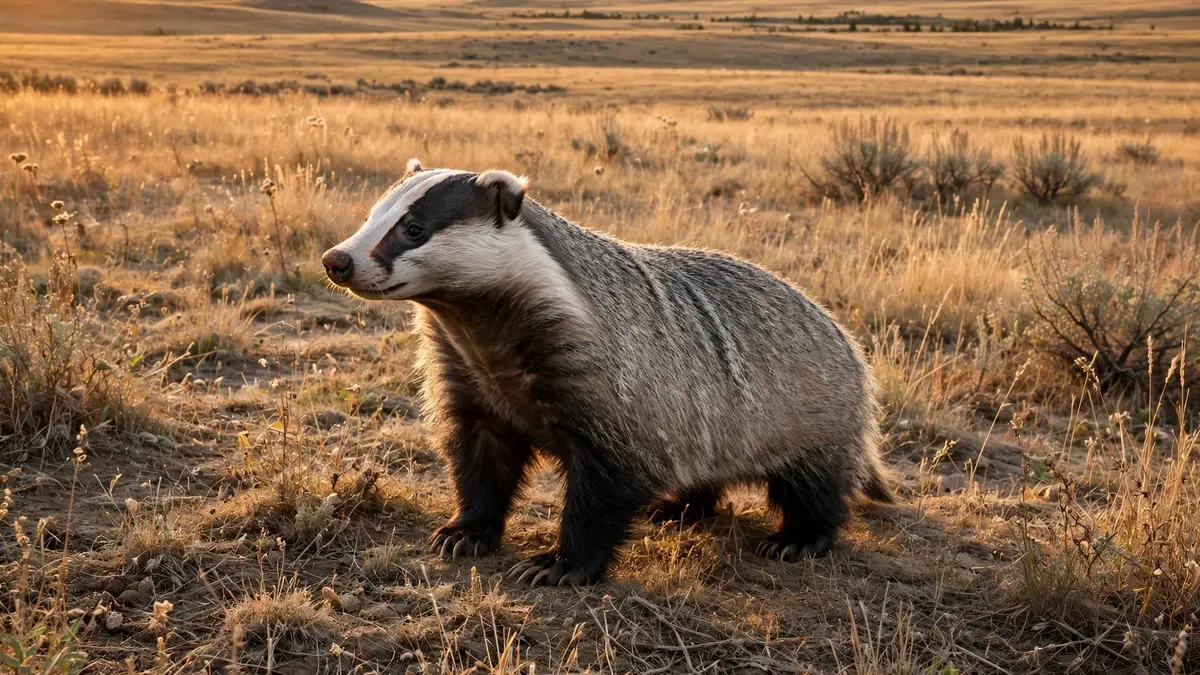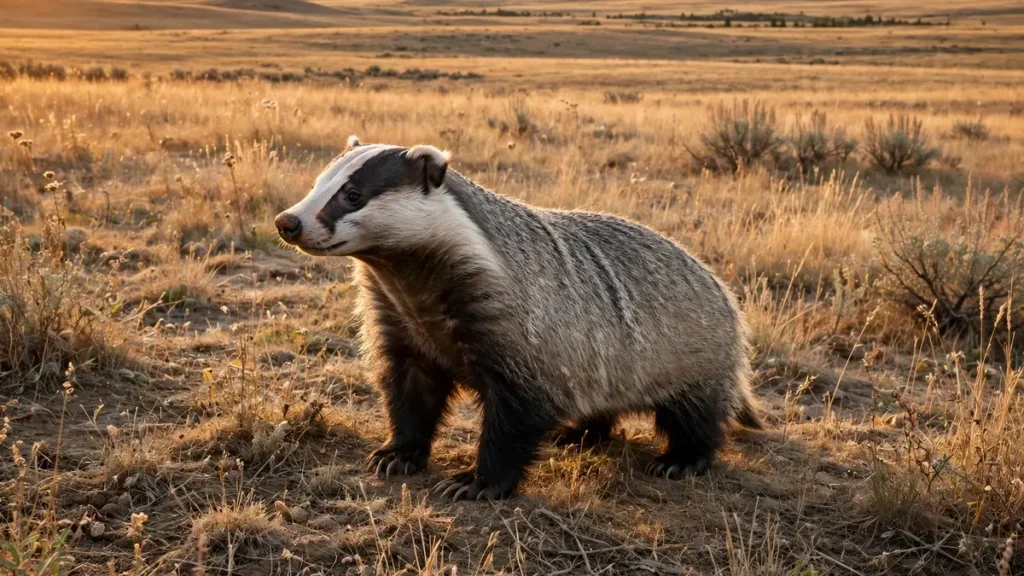
The American badger species is a single species, Taxidea taxus, a digging hunter of the North American prairies, and one of the fastest diggers of any mammal. If you are asking how many American badger species there are, the answer is one: there is only one American badger species in the world, though it is split into four subspecies, and every American badger alive today belongs to it.
The American badger belongs to the family Mustelidae, the weasel family, and it lives across central and western North America, from Canada through the United States to Mexico. Its silver-grey fur, its black and white striped face, and its huge front claws make it one of the most recognisable animals of the open prairie.
Key takeaways
- There is only one American badger species, Taxidea taxus, and it is split into four subspecies across North America.
- American badgers have huge front claws up to 5 centimetres long, built for digging out burrowing prey.
- American badgers hunt in partnership with coyotes, flushing prey out of burrows so the coyote can catch it above ground.
- American badgers are mostly solitary and nocturnal, spending their days in burrows they dig themselves.
- American badgers are listed as Least Concern, though some regional populations are falling as grassland is lost.
What makes an American badger an American badger
An American badger is a stocky low-slung mammal with silver-grey fur, a black and white striped face, short powerful legs and huge front claws, and it measures roughly 60 to 75 centimetres long and usually weighs between 6 and 12 kilogrammes, with males larger than females. The badgers of the northern plains are the largest of the four subspecies, while the badgers of Mexico are the smallest.
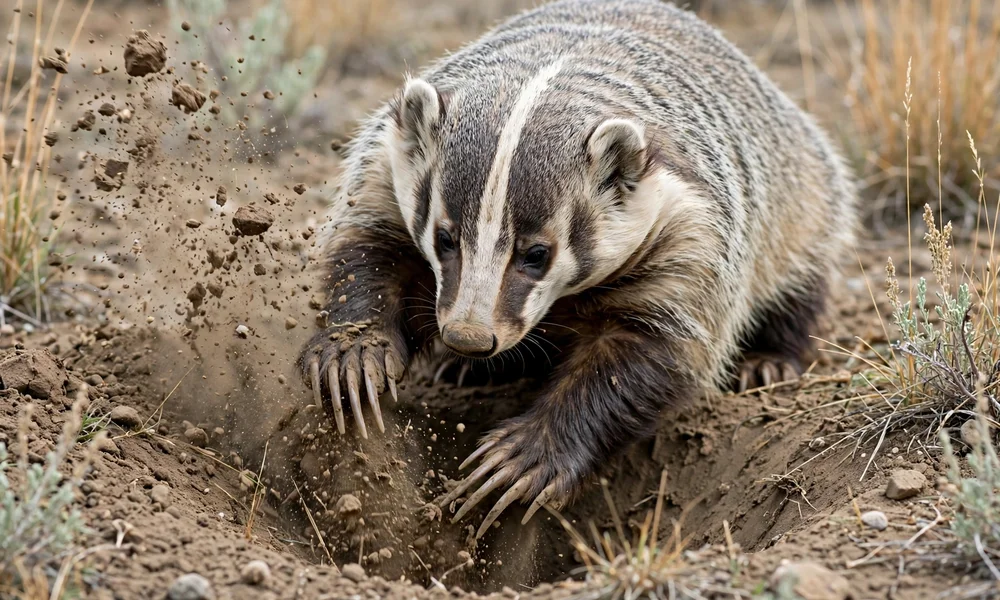
The claws define the American badger: front claws up to 5 centimetres long, curved and sharp, that can tear through hard dry soil faster than a man with a spade. The badger digs with its front feet and kicks the soil backwards with its hind feet, vanishing underground in seconds when it senses danger. Like other badgers, the American badger has loose skin and a powerful bite, so it can twist around and fight back even when grabbed by a predator.
The American badger species and their relatives
There is one American badger species, Taxidea taxus, and it is split into four subspecies. The northern badger lives across the plains of Canada and the northern United States, and it is the most widespread of the four. The western badger lives in the deserts and valleys of the western United States, the Mexican badger lives in the dry country of Mexico and the southwestern United States, and the eastern badger lives in the Great Lakes region, where it is the rarest of the four.
The Eurasian badger is the American badger’s most famous relative, a striped badger of the woodlands of Europe and Asia that lives in family groups, while the honey badger is a fearless badger of Africa and Asia that eats snakes and honey. The wolverine is the largest land member of the weasel family, a powerful hunter of the northern forests, and the striped skunk is a black and white skunk of North America. The sea otter is a marine cousin that cracks shellfish with stones, and the North American river otter is a playful otter of the rivers and lakes.
| Type | Animal | Where it lives | Best-known food | Length or Weight |
|---|---|---|---|---|
| Species | American badger (Taxidea taxus) | Grasslands of North America | Ground squirrels and pocket gophers | 60 to 75 cm, 6 to 12 kg |
| Close relative | Eurasian badger | Woodlands of Europe and Asia | Earthworms, fruit and small animals | 56 to 90 cm, 7 to 17 kg |
| Close relative | Honey badger | Africa and Asia | Snakes, honey and small animals | 55 to 77 cm, 5 to 16 kg |
| Close relative | Wolverine | Northern forests of North America and Eurasia | Carrion, rodents and deer | 65 to 113 cm, 9 to 25 kg |
| Close relative | Striped skunk | North America | Insects, mice and fruit | 52 to 77 cm, 1.8 to 6.3 kg |
| Close relative | Sea otter | North Pacific coasts | Sea urchins, clams and crabs | 1 to 1.5 m, 14 to 45 kg |
| Close relative | North American river otter | Rivers and lakes of North America | Fish, frogs and crayfish | 0.9 to 1.3 m, 5 to 14 kg |
How American badgers live
American badgers are creatures of the open prairie. An American badger lives alone, except for a mother with cubs, roaming the grassland by night and sleeping in a burrow by day, and it can roam over a home range of up to 10 square kilometres. Like other otters, it is a member of the weasel family, but it is a digger, not a swimmer, and it spends more time underground than any of its relatives.
Ground squirrels, pocket gophers and prairie dogs make up most of the diet, along with mice, voles, snakes, lizards and insects, and an American badger eats by digging its prey out of its burrow, blocking the escape tunnels and digging down to the nest. It hunts by smell, sniffing out a burrow and digging straight down to it, and it can dig faster than its prey can dig away.
Breeding happens in summer, and after a delayed implantation the female gives birth in spring to a litter of one to five cubs, usually two or three, in a burrow lined with grass. The cubs are born blind and helpless, and they stay in the burrow for their first weeks, opening their eyes at about four weeks and leaving the burrow at about six weeks. The young stay with their mother through the summer, learning to dig and hunt, and they leave to find their own territories in autumn. American badgers live for around 9 to 10 years in the wild, and up to 14 years or more.
Where American badgers live
The American badger lives across central and western North America, from British Columbia and Manitoba in Canada through the Great Plains and the western United States to Mexico, and it is most common in the grasslands of the Dakotas, Montana, Wyoming and Colorado, where ground squirrels are plentiful. It is seen regularly in the prairies of Saskatchewan and the deserts of Arizona, where it digs its burrows in the dry soil.
Open grassland is the key requirement. An American badger needs open country with soft soil to dig in and plenty of burrowing rodents to eat, so it follows the prairie dog towns and ground squirrel colonies as they shift with the seasons, and when the grassland is ploughed the badgers have nowhere to live. It depends on the rodents staying plentiful, and it digs new burrows almost every day, leaving a trail of fresh dirt mounds across the prairie.
The species is listed as Least Concern, and its numbers are stable across most of its range. The main pressures are the loss of grassland to farming, collisions with cars, and the loss of prairie dogs and ground squirrels to poisoning and shooting. The eastern subspecies is endangered in Ontario, and the western subspecies is endangered in British Columbia, where only a few hundred animals remain.
Best seasons for American badger watching
There is no closed season, because American badgers are active all year, but the best time to look for them depends on where you go. In the northern plains the best months are often May to September, when the badgers hunt in the long summer evenings. In the deserts of the southwest the best months are often March to May, when the badgers are out in the cooler spring mornings.
Staying safe around American badgers
An American badger is a wild animal with sharp teeth and powerful claws, and it can bite hard enough to break a finger, though badgers almost never attack people. Keep your distance, never approach a badger burrow, and never try to touch or feed a badger, because a cornered badger will fight fiercely and can injure a dog badly. If you see a badger, stay in your vehicle or behind a fence, and watch with binoculars, because badgers that are disturbed may abandon their burrows.
American badger watching checklist
A little preparation turns a prairie visit into a real chance of seeing an American badger, so pack for sun, wind and long quiet hours.
- Binoculars with good low-light performance, for picking a grey shape out of the grass at dusk.
- A camera with a zoom lens, because badgers should always be watched from a distance.
- Sun cream and a hat, because the best watching is in the bright prairie sun.
- A booked tour with a guide who knows the badger burrows and the prairie dog towns.
- A plan to be out at dawn or dusk, when the badgers are most active and hunting.
- Patience and silence, because badgers are shy animals and a noisy group will send them underground.
- A field guide to North American mammals, for telling an American badger from a wolverine at a glance.
Frequently asked questions
How many American badger species are there?
There is one American badger species, Taxidea taxus. It is split into four subspecies, the northern, western, Mexican and eastern badgers, but they are all the same species, and the American badger is the only living member of its genus.
Why do badgers hunt with coyotes?
Badgers hunt with coyotes because the two animals hunt the same prey in different ways. The badger digs into a burrow from below while the coyote waits above, and a ground squirrel that escapes the badger runs straight into the coyote, and a squirrel that escapes the coyote dives back into the badger, so both hunters eat better together than alone.
How fast can an American badger dig?
An American badger can dig through hard dry soil faster than a man with a spade, and it can vanish underground in seconds. Its front claws are up to 5 centimetres long, and it digs with its front feet while kicking the soil backwards with its hind feet, leaving a fresh mound of dirt at the burrow mouth.
Can you keep an American badger as a pet?
No. An American badger is a wild animal that needs open grassland, digs burrows every day, and is fully protected by law in most of the places where it lives. Badgers in rescue centres are there to recover from injury, and they are not pets.
How is this guide different from the African buffalo species guide?
This guide covers the single American badger species, a digging hunter that lives alone in burrows on the North American prairie, while our African buffalo species guide covers the single African buffalo species, a horned grazer that lives in herds of hundreds on the African savanna. The badger weighs up to 12 kilogrammes and digs through hard soil, and the buffalo weighs up to 900 kilogrammes and charges at 57 kilometres per hour.
Are American badgers endangered?
American badgers are listed as Least Concern, so they are not classed as endangered. Their numbers are stable across most of North America, though the eastern subspecies is endangered in Ontario and the western subspecies is endangered in British Columbia, where only a few hundred animals remain.
Conclusion
The American badger species shows how much power one small animal can hold: a single species of digging hunter, with claws like spades, a striped face, and a life spent underground on the North American prairie.
If you go looking for one, go in the summer to the prairies of Montana or the Dakotas, go quietly, and go with patience. Watch an American badger dig into a prairie dog town and you will understand why it has earned its place as the fastest digger of the prairie, and why keeping its grassland matters most.