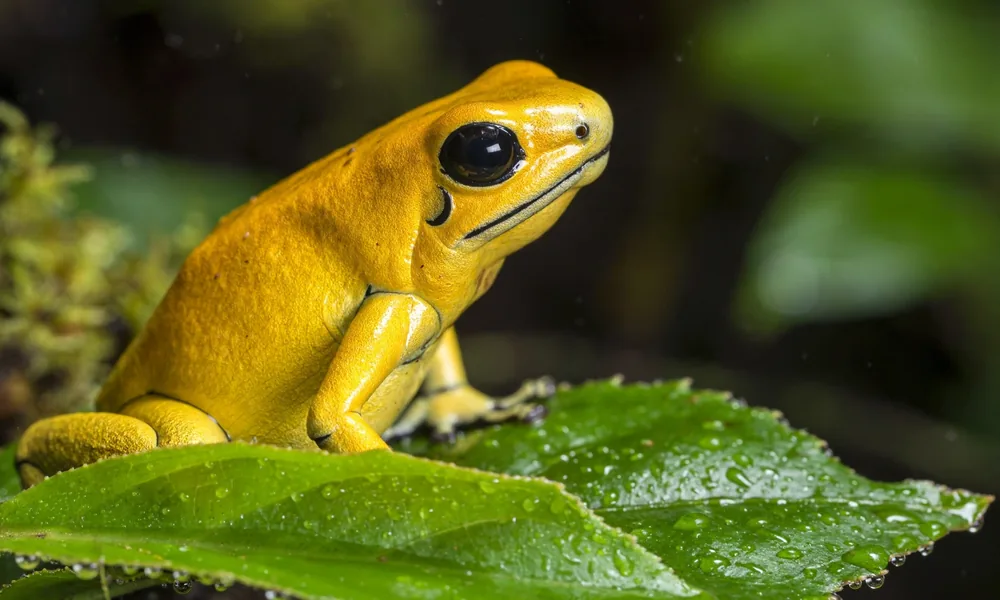
The golden poison frog species is a frog barely longer than your thumb that carries one of the most powerful natural toxins known to science in its skin. If you are asking what a golden poison frog is, the short answer is Phyllobates terribilis, a bright yellow, orange or mint-green frog from a small stretch of lowland rainforest on the Pacific coast of Colombia, an adult of about five to six centimetres and nearly 30 grams at most, and a wild frog that is generally estimated to carry about one milligram of batrachotoxin, enough poison to kill between ten and twenty people. It is the largest member of the poison dart frog family, and it is also the most toxic vertebrate known.
That combination of tiny size and terrible chemistry has made the golden poison frog famous far beyond its small home, and it has also made it one of the most misunderstood frogs on Earth. It does not spit poison, it does not chase people, and it does not make its own toxin at all. It gathers the raw chemicals from the small creatures it eats, stores them in glands under its skin, and wears its warning colour in plain sight all day long. This guide follows the whole story: how the frog looks, where it lives, what it eats, how it raises its young, why it is Endangered, and how to watch for it without putting yourself or the frog at risk. National Geographic files its live profile under the name golden poison frog rather than golden poison dart frog, which is worth knowing if you go looking for it.
Key takeaways
- The golden poison frog species is Phyllobates terribilis, the largest poison dart frog, reaching about five to six centimetres long and nearly 30 grams, and it lives only in lowland rainforest on the Pacific coast of Colombia.
- Wild frogs carry batrachotoxin in their skin glands, a toxin they gather from their diet, and a single wild adult is generally estimated to hold about one milligram, enough to kill ten to twenty people.
- The frog is diurnal and terrestrial, spending its days hopping about the leaf litter of the forest floor, and it is Endangered on the IUCN Red List because its range is so small and its forest is being cleared.
- Males do the parenting, guarding the eggs, keeping them moist, and carrying each tadpole on his back to water in a bromeliad, a tree hole or a puddle.
- Captive-bred golden poison frogs are harmless because they never eat the wild prey that supplies the toxin, which is why the frogs in zoos can be handled safely.
The golden poison frog species and their relatives
The golden poison frog belongs to the family Dendrobatidae, the poison dart frogs, a family of small, brightly coloured frogs from Central and South America that carry alkaloid toxins in their skin. The genus is Phyllobates, a small group of frogs that stands apart from every other dendrobatid because its members are the only frogs known to carry batrachotoxin, one of the most powerful natural toxins found anywhere in the animal kingdom. The genus now holds seven recognised species, spread from eastern Nicaragua to the Pacific coast of Colombia, and the golden poison frog is the largest and most toxic of them all.
Phyllobates terribilis was formally described in 1978 by the herpetologists Charles W. Myers and Borys Malkin and the biochemist John W. Daly, from frogs collected along the Quebrada Guangui in the Rio Saija drainage of Cauca Department in Colombia. The species name terribilis is a reference to the deadly toxins in the skin, and it was well chosen. The frog had been known to the Embera people of the region long before scientists described it, because Embera hunters used the skin secretions of this frog and two of its relatives to poison the darts of their blowguns, a use that gave the whole family its common name.
| Type | Animal | Where it lives | Best-known food | Length or Weight |
|---|---|---|---|---|
| Family | Poison dart frogs (Dendrobatidae) | Central and South America | Ants, mites and small insects | About 1.5 cm to 6 cm long |
| Genus | True poison dart frogs (Phyllobates) | Nicaragua to Colombia | Ants, beetles and mites | About 2.5 cm to 6 cm long |
| Species | Golden poison frog (Phyllobates terribilis) | Pacific coast of Colombia | Ants, beetles, mites and flies | Up to 6 cm long, nearly 30 g |
| Species | Black-legged poison frog (Phyllobates bicolor) | Choco region of western Colombia | Ants and small insects | Males 32 to 40 mm, females 36 to 43 mm |
| Species | Kokoe poison frog (Phyllobates aurotaenia) | Pacific coast of Colombia | Ants and small insects | Smaller than the golden poison frog |
| Species | Lovely poison frog (Phyllobates lugubris) | Nicaragua to Panama | Ants and small insects | About 2.5 cm long |
The closest relative of the golden poison frog in size and danger is the black-legged poison frog, Phyllobates bicolor, a frog of the Choco region of western Colombia that grows to about four centimetres and shares the uniform yellow-to-orange colouring of its larger cousin. It differs from the golden poison frog by being smaller and by having its belly and limbs coloured differently from its back, and it is one of the three Colombian Phyllobates species that Embera and Noanama hunters used to poison their darts. Like the golden poison frog, it is a frog of the forest floor, active by day, and it carries batrachotoxin in its skin.
Within the genus, the frogs sort themselves into two groups that a field naturalist can tell apart at a glance. The bicolor group, which holds the golden poison frog, the black-legged poison frog and the kokoe poison frog, is made up of the larger, yellower frogs, while the lugubris group, which holds the lovely poison frog, the golfodulcean poison frog and their kin, is made up of smaller frogs that are mostly black with bright stripes down their sides. The striped frogs are less toxic on average than the yellow ones, and some populations of the lovely poison frog are not known to be toxic at all. Like the frog in general, the golden poison frog begins life as a tadpole and ends it as a four-legged adult, but no ordinary frog carries a milligram of batrachotoxin in its skin, and no ordinary frog is guarded by its father all the way to the water.
What a golden poison frog looks like
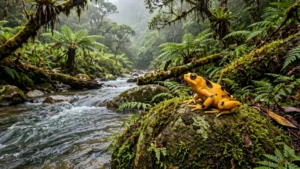
A golden poison frog looks like a small jewel that has learned to walk. The body is compact and sturdy for a poison dart frog, with four long, slender legs that end in four toes that are not webbed, and the skin is smooth and slightly glossy, as if it had been polished. Adults reach about five to six centimetres from snout to vent, and they can weigh nearly 30 grams, which makes them heavyweights among poison dart frogs, a family in which most species are between one and a half and four centimetres long. Females are usually a little larger than males, and males may have enlarged toe pads and a darker throat that they use when they call.
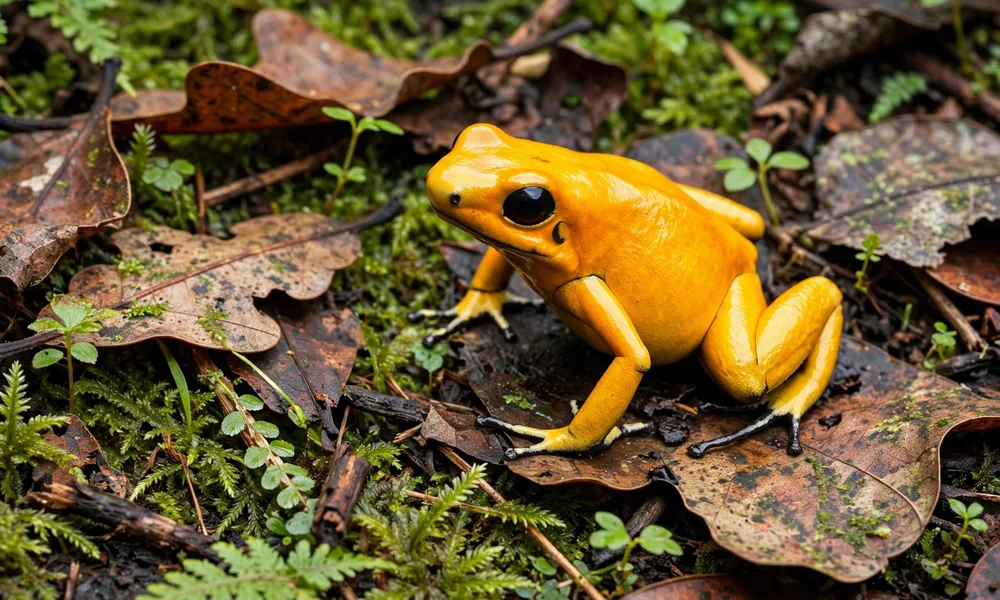
The colour is the first thing anyone notices, and it is the whole point of the frog. Most golden poison frogs are a uniform, brilliant yellow, the colour of fresh butter or a ripe lemon, while others are golden orange or a pale mint green, depending on where they live. There are no spots, no stripes and no pattern to break up the colour, and that plainness is deliberate. The uniform bright colour is aposematic, which is the scientific word for a warning colour, and it tells every predator in the forest that this small frog is not worth eating. A predator that has tried once does not try twice, and most predators never try at all.
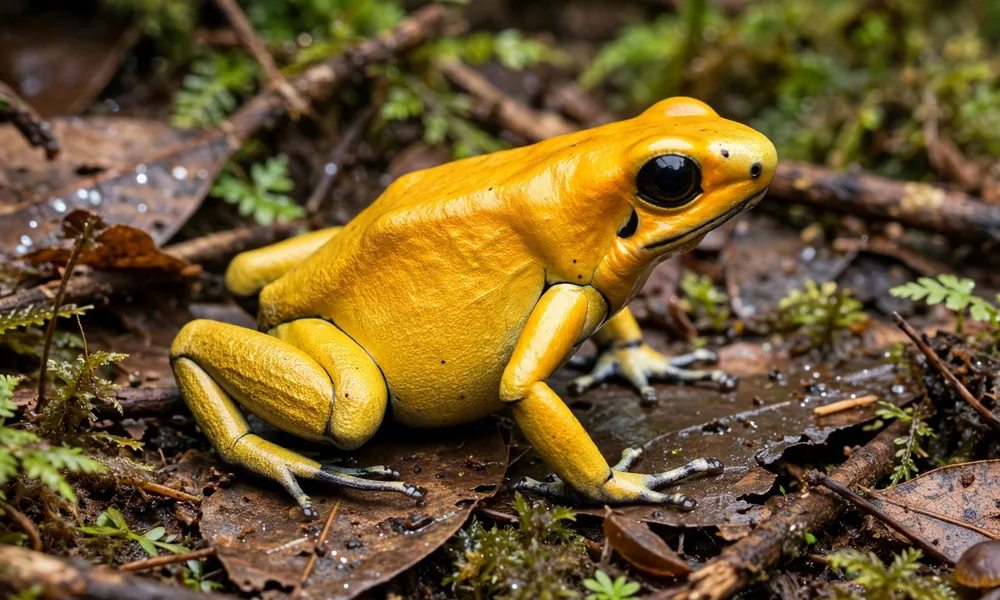
Compared with other poison dart frogs, the golden poison frog is easy to tell apart once you know what to look for. No other poison dart frog is as large, no other is as uniformly yellow, and no other carries as much batrachotoxin. The black-legged poison frog is the one most often confused with it, and it is smaller, with black legs or a belly that differs in colour from its back. The strawberry poison dart frog, which many people picture when they think of poison frogs, is red with blue legs and far smaller, and it carries a different set of toxins altogether.
Where golden poison frogs live
Golden poison frogs live in one small and very specific part of the world, and they live nowhere else. They are endemic to the humid lowland rainforests of the Pacific coast of Colombia, in the departments of Cauca and Valle del Cauca, in the Choco rainforest, one of the wettest places on Earth. The heart of the range is the upper Rio Saija drainage, where the frog was first collected, and later fieldwork extended the known range northward into southern Valle del Cauca. The whole range covers less than 5,000 square kilometres, and the most careful recent assessment puts the extent of occurrence at about 1,500 square kilometres, which is smaller than many cities.
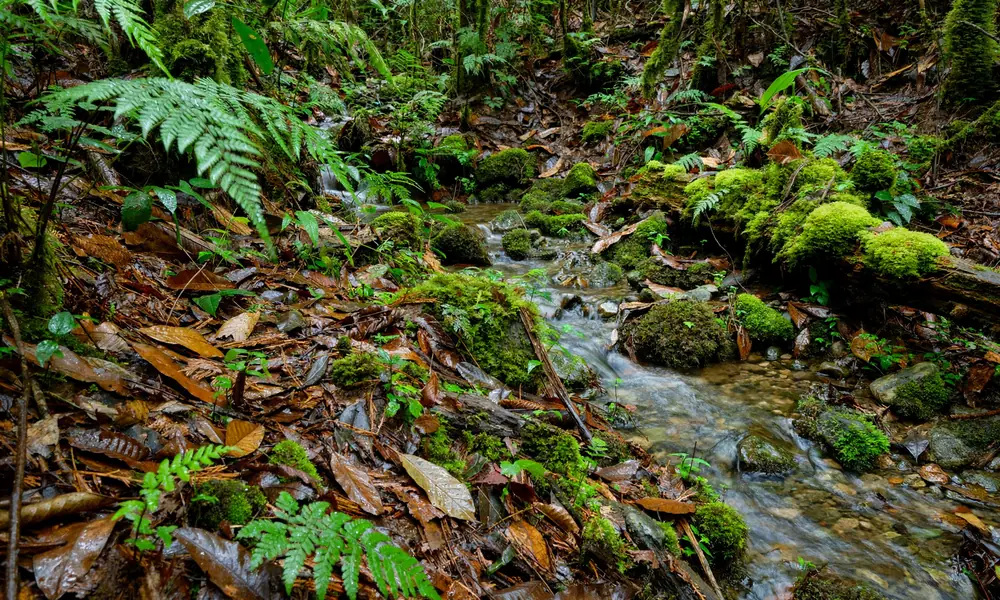
The habitat they choose is the floor of the forest, and they are rarely found far from it. Golden poison frogs live from near sea level up to roughly 200 metres above sea level, in perpetually wet forest with steep, rocky terrain and streams running through it. The forest floor is covered in leaf litter, fallen branches and moss, and the air is warm and humid all year round, with very high annual rainfall. The frogs spend most of their time on the ground among the leaves, rarely climbing trees, and they are most often found near streams and in damp hollows where the leaf litter stays wet even in the drier weeks.
What golden poison frogs eat
Golden poison frogs are insect eaters, and their diet is written on the forest floor itself. The everyday food is small invertebrates that live among the leaves: ants, mites, beetles, flies, spiders, caterpillars and maggots, with termites and crickets added when they are available. The frogs feed during the day, hopping about the leaf litter and picking off prey with a quick flick of the tongue, and they are among the most voracious eaters in their family, taking far more prey than a frog of their size might be expected to need. A frog that eats well grows fast, breeds well, and carries more toxin than a frog that eats poorly.
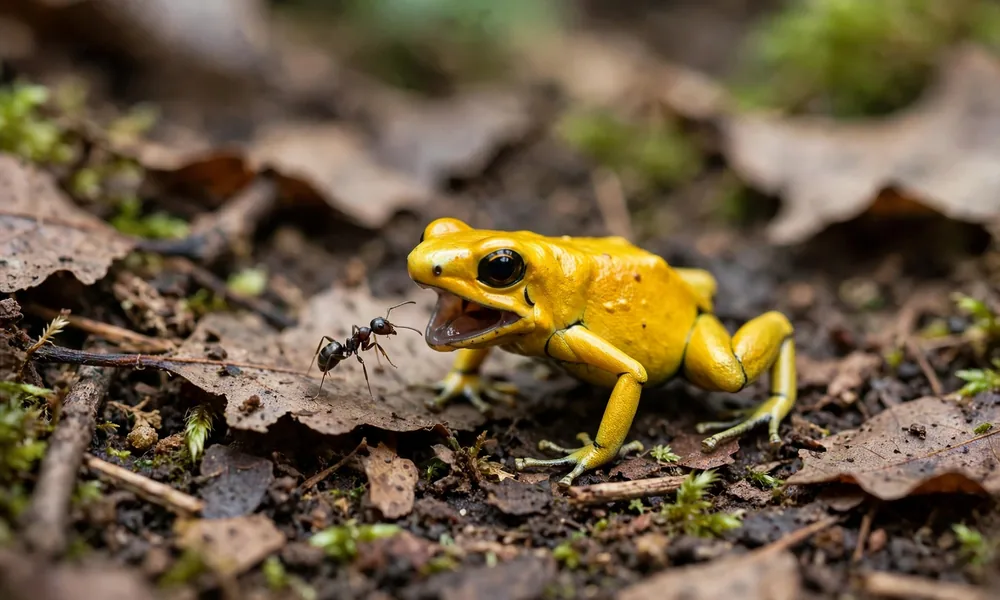
What sets the golden poison frog apart is that its food is also its weapon. The frog does not manufacture batrachotoxin in its own body. Instead, it takes the raw chemicals from the small arthropods it eats, most likely small melyrid beetles and certain ants and mites, and concentrates them in the granular glands under its skin. The chemistry is still being worked out, but the evidence is clear: frogs raised in captivity on fruit flies and other harmless prey never develop the toxin, and wild-caught frogs lose it over time when they are fed a captive diet. The poison is borrowed, not built, and the frog’s diet is the reason it is dangerous.
Feeding follows the rhythm of the day, and it is busiest in the warm, bright hours. Golden poison frogs are diurnal, which means they are active by day and rest at night, and they feed most actively in the morning and the late afternoon, when the forest floor is warm and the small insects are moving. They hunt by sight, watching for movement among the leaves, and they take prey that is small enough to swallow whole, which for a frog of five centimetres means prey of a few millimetres. Like the axolotl, the golden poison frog is an amphibian whose diet changes as it grows, but the axolotl is a water animal that hunts in the dark and grows to thirty centimetres, while the golden poison frog is a land animal that hunts in daylight and never grows past six.
How golden poison frogs behave
Golden poison frogs are day frogs, and their day is a quiet round of feeding, calling, defending a small patch of forest floor, and watching for the next meal. They spend most of their time on the ground, hopping from leaf to leaf, pausing to scan the litter for movement, and flicking out the tongue when something small and edible moves. They are not strong jumpers by frog standards, and they do not need to be, because their food comes to them in the leaves and their defence is chemical rather than athletic. When a larger animal approaches, a golden poison frog does not flee in panic, it sits still and lets its colour do the talking.
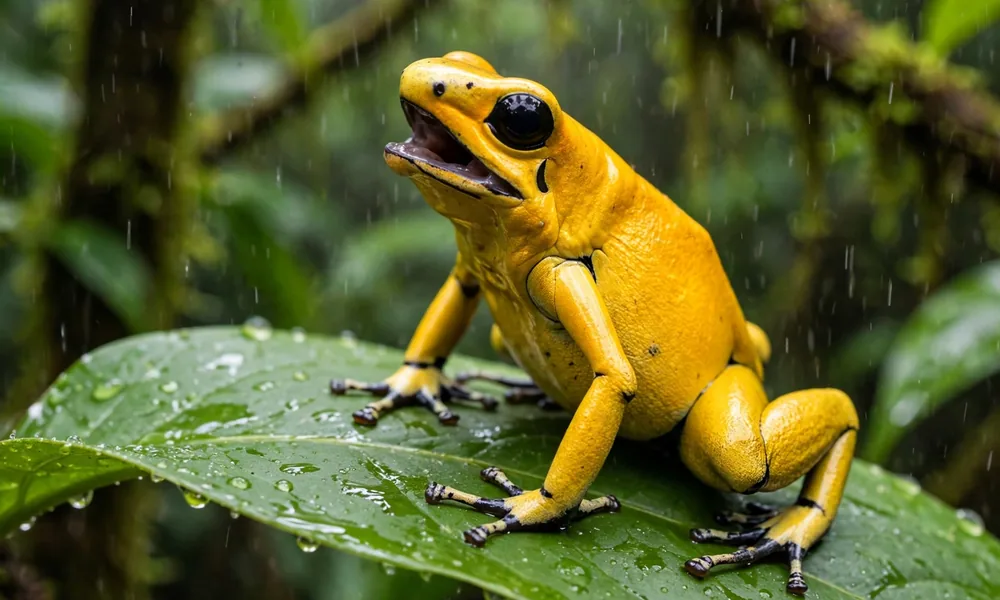
The most famous behaviour in the golden poison frog is not a behaviour at all, but a chemical fact: the toxin in its skin. Batrachotoxin works by holding open the voltage-gated sodium channels of nerve and muscle cells, so that the nerves cannot switch off and the muscles cannot relax, and the result is paralysis, heart failure and death. The toxin is extraordinarily potent, with a lethal dose in mice of about two micrograms per kilogram of body weight, which makes it roughly 250 times more potent by mass than strychnine and about five times more potent than tetrodotoxin. The frog itself is immune to its own poison, thanks to small changes in the shape of its own sodium channels that stop the toxin from binding.
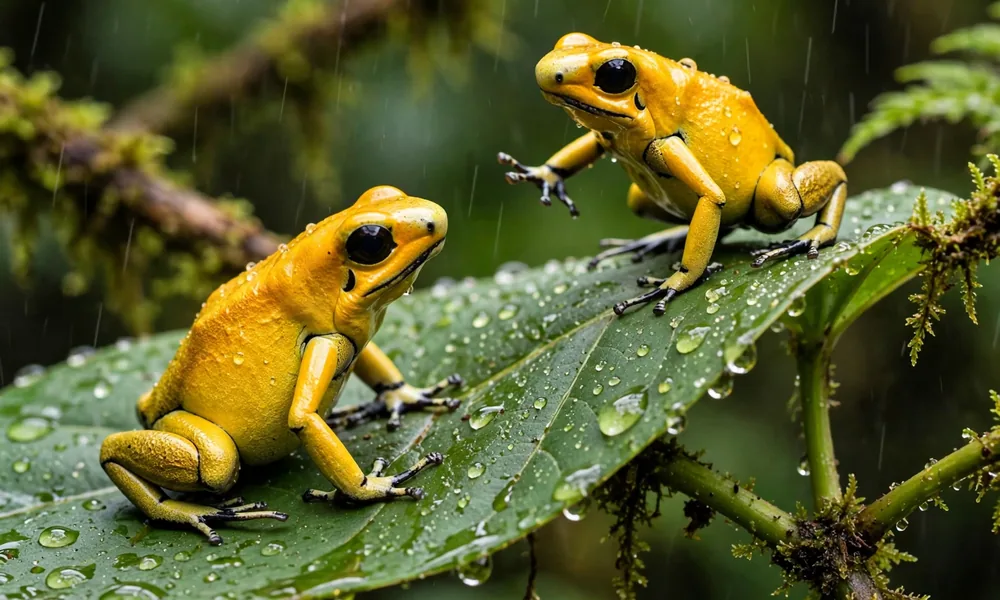
Golden poison frogs are territorial, and both sexes will fight for what they hold. Males defend small territories against other males, and females fight other females, in aggressive wrestling matches in which the frogs grapple with their front legs and try to push each other off the leaf or the patch of ground. The fights are not usually fatal, because the frogs are evenly matched and the loser can hop away, but they are serious enough that a frog will remember a rival and avoid it. Males also call to defend their ground and to attract a female, with a soft trilling or buzzing call that is quieter than the calls of many frogs, because a frog that lives on the forest floor does not need to be heard across a pond.
Breeding and life cycle
Golden poison frogs breed through the rainy season, and the timing is set by the rain itself. The frogs reach sexual maturity at about eighteen months old, when the males are about 3.7 centimetres long and the females are about 4.0 centimetres, and breeding is most active when the forest is at its wettest. The male sits on a leaf and calls, with two trilling or buzzing calls, one lasting about six to seven seconds and the other about two to three seconds, and only the males call. When a female answers, the male leads her to a moist spot in the leaf litter or under a rock, where she lays her eggs.
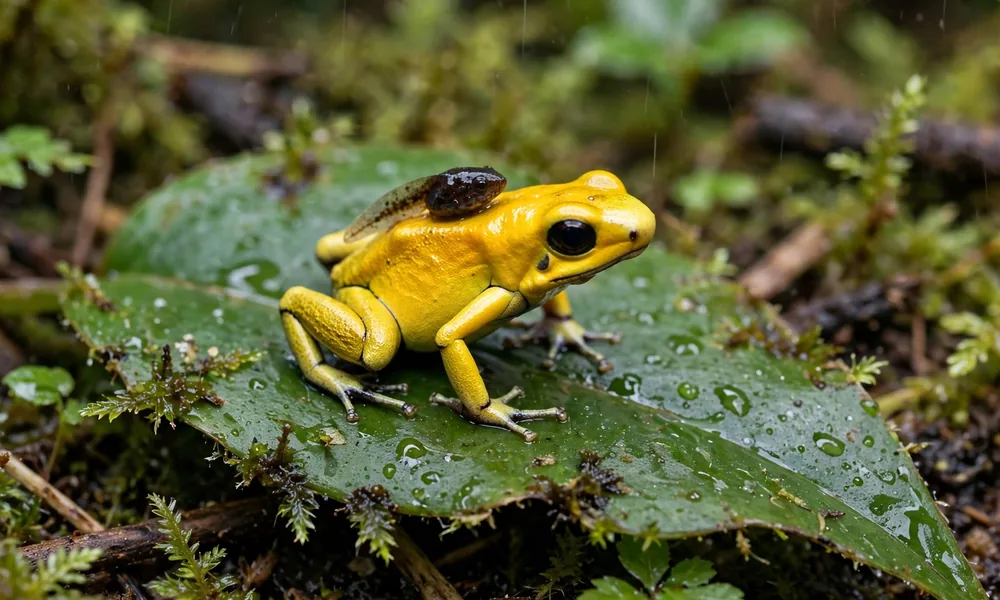
The female lays between eight and twenty-eight gelatinous eggs, each about 0.8 to 1.1 centimetres long, and the male fertilises them as she lays them. The eggs are laid on land, in a damp, hidden place, and the male stays with them, guarding them and keeping them moist, though in the wet forest he does not need to moisten them very often. The eggs hatch in about two weeks, and the grey-brown tadpoles that emerge are freed from the egg mass by the male, who uses his hind legs to help them out. Then the real parenting begins, because the male carries each tadpole, one at a time, on his back to water.
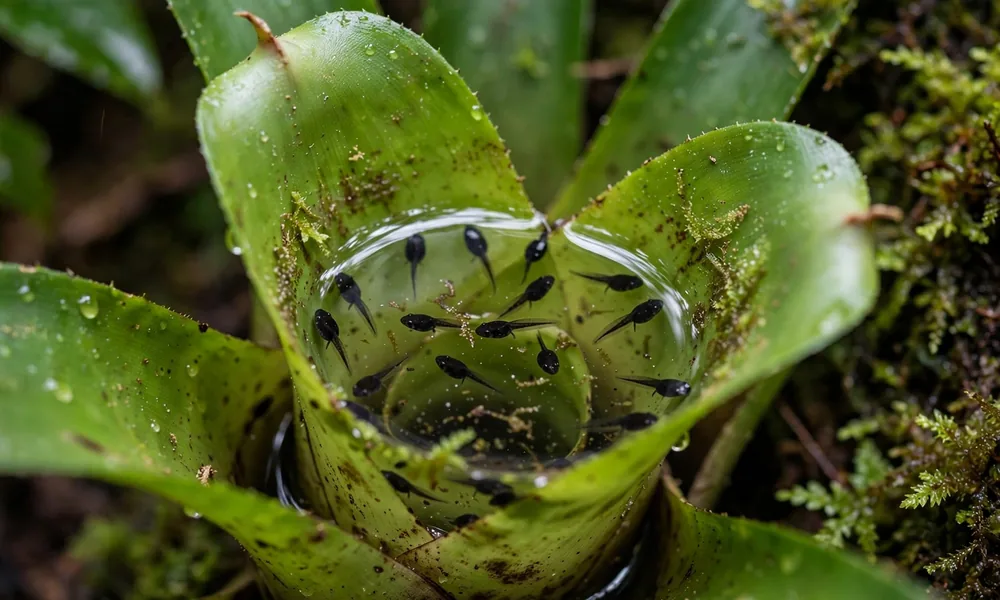
The water the male chooses is small and still: groundwater, a pool in the centre of a bromeliad plant, a low tree hole, or a puddle on the forest floor. The tadpoles are left in these isolated pockets of water, where there are few predators and little competition, and they develop there for about ten to fourteen weeks before they metamorphose into froglets of one and a half to two centimetres. The tadpoles are independent from the day they are left in the water, able to feed and hide within hours, but most of them will never reach adulthood, eaten by insects and other small predators in their first weeks. How long a golden poison frog lives is believed to be six to ten years in the wild, and longer in captivity, where there are no predators and the food is regular.
Conservation status
The golden poison frog is listed as Endangered on the IUCN Red List, assessed in 2017, and the reasoning is straightforward: it has a tiny range, that range is being broken up, and the forest it needs is being lost. The frog is known from only a few threat-defined locations, its extent of occurrence is about 1,500 square kilometres, and the population is decreasing. It is also listed on Appendix II of CITES, which controls international trade in the species, and it is one of the most range-restricted vertebrates on Earth, a frog whose whole world could fit inside a single county.
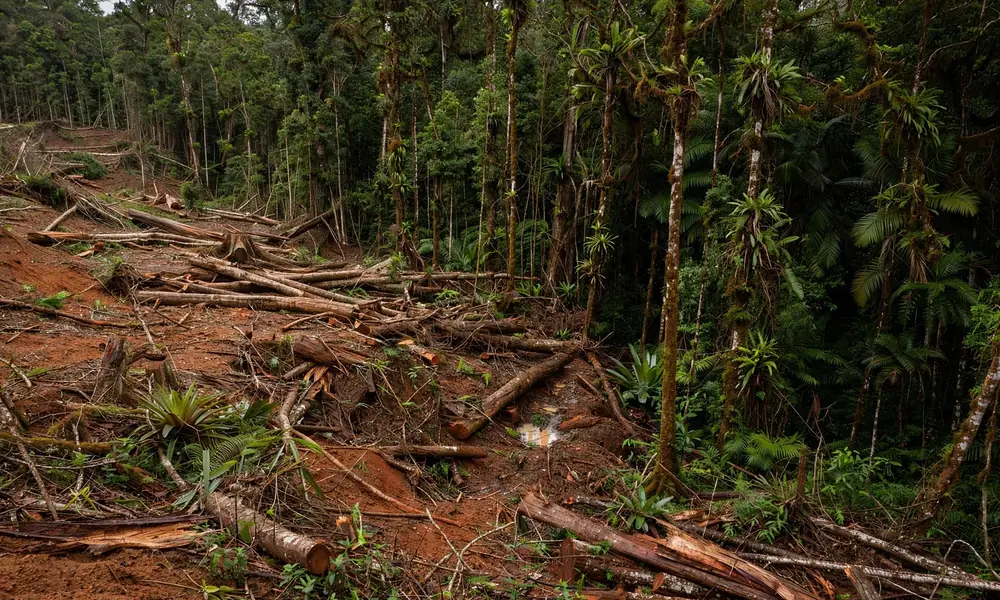
The main pressure is habitat loss. The lowland rainforest of the Pacific coast of Colombia is being cleared for logging, for farming, for cattle, and for the cultivation of coca, and the small range of the golden poison frog sits in the middle of that pressure. When a patch of forest is cleared, the frogs in it die, and when the forest between patches is cleared, the frogs cannot move between the patches that remain. Pollution from mining and from the chemicals used in coca cultivation adds to the damage, because the frogs live on the forest floor and in small pools of water that collect whatever runs off the land.
The most useful conservation work is practical, and it is the same work that helps the whole Choco rainforest. Protecting the remaining forest from further clearing keeps the frog’s habitat intact, and connecting the fragments with corridors of forest lets the frogs move between populations. The ProAves Rana Terribilis Amphibian Reserve was established in the Choco specifically to protect the golden poison frog and the lowland rainforest around it, and it is the kind of small, focused reserve that matters most for a frog with a range this small. Captive breeding in zoos also helps, because it keeps a safety population alive and teaches people about the frog without taking animals from the wild.
Best seasons for golden poison frog watching
The best time to look for a golden poison frog is the rainy season, when the frogs are breeding and the forest floor is at its wettest and most alive. Breeding happens through the rainy season, and the males are calling, the females are laying, and the fathers are carrying tadpoles to the water, so a visit in the wet months gives you the best chance of seeing the frogs at their busiest. The frogs are present in the forest all year round, so there is no wrong season in the strict sense, but a visit in the dry weeks will show you fewer frogs and less behaviour.
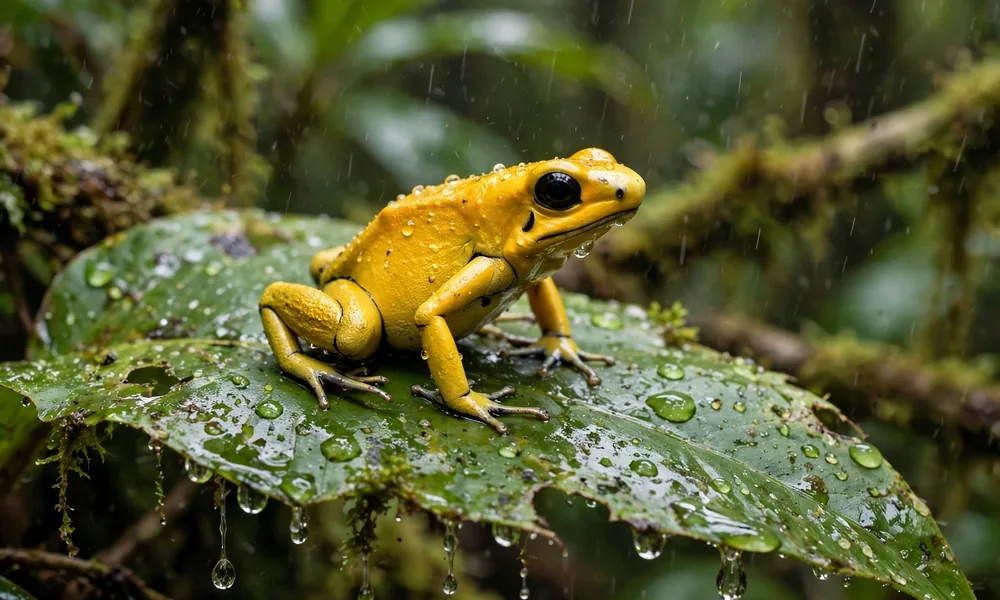
The best hours are the day, because the golden poison frog is a diurnal frog and it is out in the open while the sun is up. From the morning until the late afternoon, the frogs are hopping about the leaf litter, feeding, calling and defending their territories, and they are at their most visible then, bright yellow against the brown and green of the forest floor. A slow walk through the forest with a local guide, watching the ground ahead of you and listening for the soft trilling call, is all you need, and the frogs will often sit still long enough to see them clearly, if you move gently and keep your distance.
Staying safe around golden poison frogs
A golden poison frog is dangerous in exactly one way, and it is a way that is easy to avoid. The batrachotoxin in its skin can kill a person if it gets into the bloodstream, through a cut, through the mouth, or through the eyes, and a single wild frog carries enough to kill ten to twenty people. The frog does not inject the poison, it does not spit it, and it does not chase people, so the danger comes only from touching the frog and then touching your own mouth, eyes or an open cut, or from eating or drinking something the frog has touched. The safety rule is simple, and it is absolute: never touch a wild golden poison frog, and never let a child or a pet touch one.
There are a few practical points for the forest itself. Wear long sleeves and long trousers, wear good boots, and keep your hands out of the leaf litter where the frogs live, because the frogs are not the only animals in the leaves. Work with a guide, stay on the path, and keep an eye on the weather, which can change fast in the Choco rainforest. Wash your hands after any contact with the forest floor, and never put your hands to your face while you are watching frogs. A golden poison frog will not hurt you if you leave it alone, but the forest deserves respect, and the sensible approach is to enjoy the frog from a distance and leave it exactly where you found it.
Golden poison frog watching checklist
A little preparation turns a walk in the Choco rainforest into a real chance of seeing a golden poison frog at its best, bright yellow on the leaf litter in the rain.
- A local guide who knows the forest and the frog, and who can find the damp hollows where the frogs live.
- A visit in the rainy season, when the frogs are breeding and the forest floor is at its wettest.
- A morning walk, when the frogs are feeding and calling and are out in the open on the leaf litter.
- Good waterproof boots and long sleeves, so that a wet forest floor stays comfortable from start to finish.
- A camera that works in low forest light, so you can record the frog without getting close to it.
- Clean hands and a strict no-touching rule, so that neither you nor the frog is put at risk.
- Respect for the frog and the forest, keeping your distance, keeping the frog where it is, and leaving the rainforest as you found it.
Frequently asked questions
How big do golden poison frogs get?
Most golden poison frogs measure about five to six centimetres from snout to vent, and a good frog weighs nearly 30 grams, which makes them the largest poison dart frogs in the world. Females are usually a little larger than males, and the males are usually about 3.7 centimetres long when they reach maturity at about eighteen months, while the females are about 4.0 centimetres. The froglets that leave the water are only one and a half to two centimetres long, and they grow steadily through their first year.
What do golden poison frogs eat?
A golden poison frog eats ants, mites, beetles, flies, spiders, caterpillars and maggots, which it picks off the leaf litter during the day with a quick flick of the tongue. The diet matters for more than food, because the frog gathers the raw chemicals for its batrachotoxin from the small arthropods it eats, most likely small melyrid beetles and certain ants and mites. Tadpoles eat algae, microscopic plants, detritus and carrion in the small pools where the male leaves them, and they will eat smaller tadpoles if they get the chance.
Why are golden poison frogs so poisonous?
Golden poison frogs are so poisonous because they store batrachotoxin, one of the most powerful natural toxins known, in the granular glands under their skin. The toxin works by holding open the sodium channels of nerve and muscle cells, so that the nerves cannot switch off and the muscles cannot relax, and the result is paralysis, heart failure and death. The frog does not make the toxin itself, it gathers it from its diet, which is why captive-bred frogs are harmless, and the frog is immune to its own poison thanks to small changes in its own sodium channels.
Are golden poison frogs dangerous to people?
Yes, wild golden poison frogs are dangerous to people if they are touched and the toxin gets into the bloodstream, and a single wild frog is generally estimated to carry enough batrachotoxin to kill ten to twenty people. The frog does not inject the poison, it does not spit it, and it does not chase people, so the danger comes only from handling the frog or from getting the toxin into a cut, the mouth or the eyes. Never touch a wild golden poison frog, wash your hands after any contact with the forest floor, and enjoy the frog from a distance.
Can you keep a golden poison frog as a pet?
You can, but only a captive-bred frog, and only if you are prepared to look after it properly. Captive-bred golden poison frogs are harmless because they have never eaten the wild prey that supplies the toxin, and they are widely kept in terrariums by experienced keepers. A captive frog needs a warm, humid terrarium with leaf litter, hiding places and small pools of water, and it needs a diet of fruit flies and other small insects, and it should be handled as little as possible. Never buy a wild-caught frog, and never release a pet frog into the wild, because it does not belong there.
How is this guide different from the glass frog guide?
This guide covers the golden poison frog, a bright yellow, ground-dwelling frog of about six centimetres from a small patch of Colombian rainforest that carries batrachotoxin in its skin and is Endangered, while our glass frog guide covers a small, translucent tree frog that lives in the canopy, shows its organs through its clear belly, and carries no poison at all. One is a frog you watch on the leaf litter in daylight, bright and dangerous; the other is a frog you watch on a leaf at night, almost invisible and entirely harmless.
Conclusion
The golden poison frog species is a reminder that the most dangerous animal in a forest can also be the smallest and the most beautiful. A frog of five centimetres, bright yellow from snout to vent, carrying enough batrachotoxin to kill twenty people in its skin, and raising its young with a father’s care on the floor of one of the wettest forests on Earth, is a creature that deserves both respect and protection.
If you go looking for one, go to the Choco rainforest in the rainy season, go in the morning with a local guide, and walk slowly through the damp leaf litter with your eyes on the ground and your hands in your pockets. Find the wet hollows, listen for the soft trilling call, and wait for a flash of yellow among the leaves, and you will have met the golden poison frog that turns a small patch of Colombian forest into one of the most remarkable places in the animal kingdom.