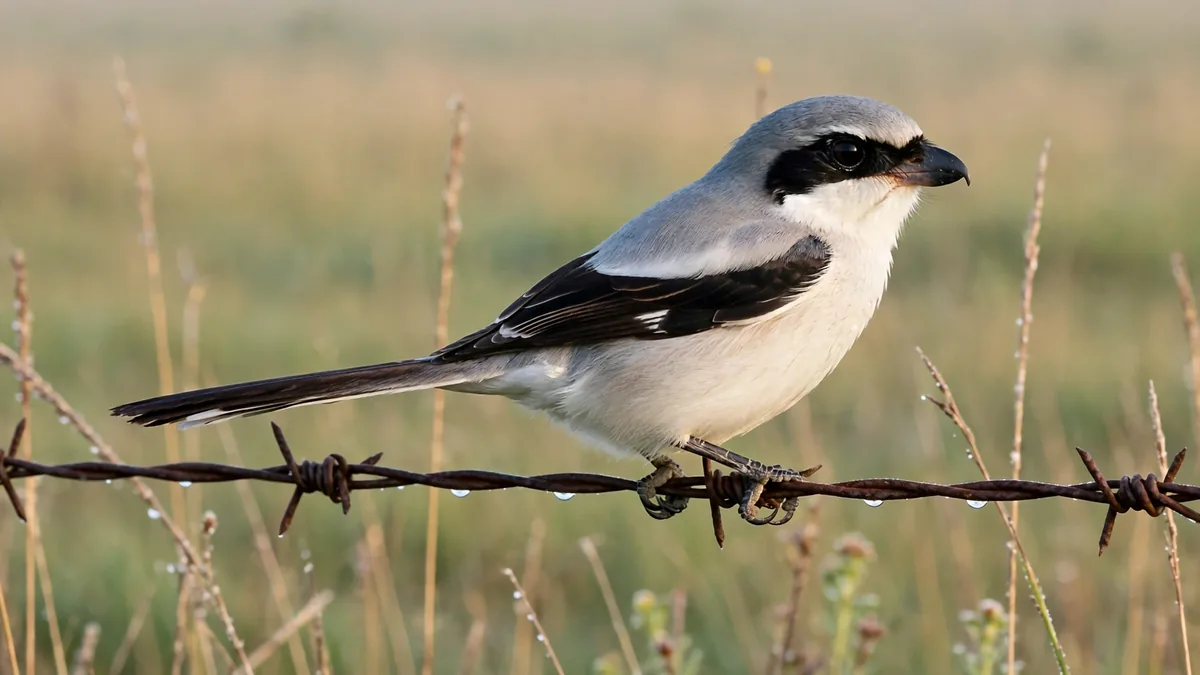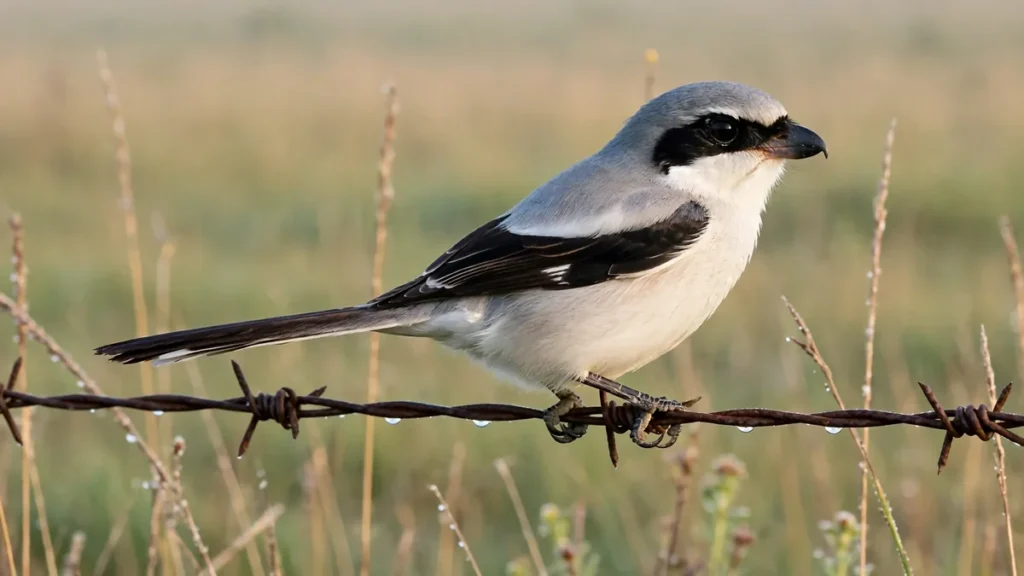
The loggerhead shrike species is a single species, Lanius ludovicianus, a grey, black and white songbird with a black bandit mask and a hooked bill that hunts like a bird of prey and pins its catch on thorns or barbed wire. If you are asking how many loggerhead shrike species there are, the answer is one, and it is the only shrike that lives right across North America, from southern Canada to Mexico.
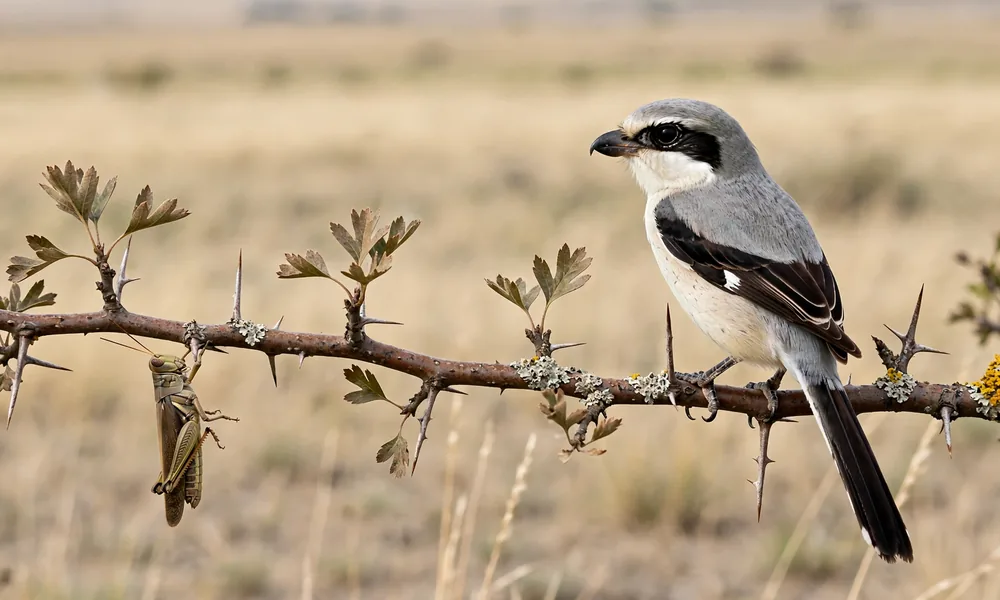
The loggerhead shrike is nicknamed the butcherbird, and the name is earned. It has no talons, so it cannot grip and tear its food the way a hawk does, and it solves the problem by wedging its prey onto a sharp point and pulling the flesh free. A fence line hung with grasshoppers is the shrike’s pantry.
Key takeaways
- The loggerhead shrike species is Lanius ludovicianus, a grey songbird with a black mask, a hooked bill and black wings with white patches.
- Adults are 20 to 23 centimetres long, with a wingspan of 28 to 32 centimetres and a weight of 34 to 51 grams.
- Shrikes hunt from a high perch and impale large prey on thorns or barbed wire.
- They live in open country across North America, wherever there are perches, short grass and thorny shrubs.
- The species is listed as Near Threatened, and its eastern subspecies is Endangered in Canada, with very few wild birds left.
What makes a loggerhead shrike a loggerhead shrike
A loggerhead shrike is a robin-sized songbird, 20 to 23 centimetres long, with pale grey upperparts, a white throat and belly, and a broad black mask that runs through the eye and across the forehead. Its bill is short, stout and black, with a hooked tip and a small notch that helps it grip and tear prey. The wings are black with a bold white patch, and the long tail is black with white outer feathers. Males and females look alike.
The name loggerhead refers to the bird’s large head, which looks oversized on its compact body, and the head does the work: the shrike kills with a sharp bite to the neck, twisting its head to sever the spine of a small vertebrate. Its voice is harsh and jarring, a mix of squeaky whistles, shrill trills and guttural warbles, and the male sings a rattling song from a high perch in spring.
The loggerhead shrike species and their relatives
The loggerhead shrike belongs to Lanius, a genus of around 30 shrike species in the family Laniidae, and it is the only member of the genus that breeds across North America. Seven subspecies are usually recognised, differing slightly in size and shade, and the far northern birds are the most migratory, travelling south for the winter while southern birds stay put.
Its closest relatives are the other grey shrikes of the northern hemisphere, above all the northern shrike of Canada and Alaska and the great grey shrike of Europe and Asia, which look so similar that they can be hard to tell apart. More distant cousins include the red-backed shrike, which breeds in Europe and winters in Africa, and the woodchat shrike of the Mediterranean. All of them share the hooked bill, the mask and the habit of pinning prey on a thorn.
| Type | Animal | Where it lives | Best-known food | Length or Weight |
|---|---|---|---|---|
| Genus | Shrikes (genus Lanius) | Open country worldwide | Insects and small vertebrates | About 16 to 25 cm long |
| Species | Loggerhead shrike (Lanius ludovicianus) | North America | Grasshoppers, lizards and mice | About 20 to 23 cm long |
| Species | Northern shrike (Lanius borealis) | Canada, Alaska and the far north | Small birds and voles | About 23 to 25 cm long |
| Species | Great grey shrike (Lanius excubitor) | Europe and northern Asia | Voles and small birds | About 22 to 26 cm long |
| Species | Red-backed shrike (Lanius collurio) | Europe, wintering in Africa | Insects and small lizards | About 16 to 18 cm long |
| Species | Woodchat shrike (Lanius senator) | Mediterranean Europe and Africa | Insects and lizards | About 17 to 19 cm long |
How loggerhead shrikes live
Loggerhead shrikes are sit-and-wait hunters. A bird takes up a lookout on a wire, a fence post or the outer branch of a tree, usually about four metres up, and scans the grass below for movement. When it spots prey it drops silently, snatches the victim in its bill, and carries it to a thorn, a sharp twig or a barb of wire, where it pushes the body onto the point. The spike holds the prey steady while the shrike tears off pieces, and surplus food is left hanging for later.
Most of the diet is insects, above all grasshoppers, crickets, beetles and caterpillars, but the shrike is a true opportunist and also takes spiders, lizards, frogs, mice, bats and small birds, sometimes prey nearly as heavy as itself. In winter, when insects are scarce, small vertebrates become more important, and the birds may hunt along roadsides where the short grass makes prey easy to see. They hunt by day, usually alone.
Shrikes are monogamous and begin breeding in their first spring. The male courts the female with an erratic, swooping flight display, then the pair builds a bulky cup of twigs and grass in a dense shrub or thorny hawthorn, whose spines hide the nest. The female lays four to eight eggs, usually five or six, and incubates them for about 16 or 17 days while the male brings her food. Both parents feed the nestlings, which leave the nest after about 19 days and depend on the adults for another three or four weeks.
Where loggerhead shrikes live
Loggerhead shrikes live across southern Canada, most of the United States and Mexico, a range that covers grassland, pasture, savanna, desert scrub and farmland. Northern birds are migratory and move south for the winter, while birds in the southern United States and Mexico are resident and stay in the same place all year. They are birds of open country, and they have followed farming wherever fields are broken by hedgerows and scattered trees.
A shrike needs three things in its territory: open ground with short grass where it can see its prey, a high perch from which to hunt, and a thorny shrub or tree in which to nest and store food. Pastures with grazing animals suit them well, because the short turf makes hunting easy, and a fence line of barbed wire doubles as both perch and pantry. They share this open farmland with the American robin, which is about the same size, though the robin hunts worms on the ground, and with the barn owl, which hunts the same fields by night.
The loggerhead shrike is listed as Near Threatened on the IUCN Red List, assessed in 2020, with about 7 million mature individuals and numbers still falling. Breeding Bird Survey counts in Canada fell by about 2.7 percent a year between 1970 and 2015. The migratory eastern subspecies, Lanius ludovicianus migrans, is listed as Endangered under Canada’s Species at Risk Act, and the federal recovery strategy of 2015 noted that fewer than 100 wild individuals remained; the prairie subspecies, Lanius ludovicianus excubitorides, is listed as Threatened. Habitat loss, the clearing of hedgerows, pesticides and road collisions are the main causes, and captive breeding programmes in Ontario are releasing young birds to rebuild the eastern population.
Best seasons for loggerhead shrike watching
The best time to look for loggerhead shrikes is spring and early summer, from March to June, when males sing from high perches and pairs feed nestlings around the nest shrub. Early morning is best, when the birds sit upright on wires and fence posts in the open, and winter is also good in the south, where resident birds hunt pastures and roadsides all day.
Staying safe around loggerhead shrikes
A loggerhead shrike is harmless to people and would rather fly away than meet one, though its hooked bill can nip if handled, so never try to pick one up. Watch from a distance with binoculars, never approach a nest shrub, and never touch the impaled prey on a thorn, because a disturbed store may be abandoned.
If you find a shrike’s larder on a fence, enjoy it from the path and do not return every day, because repeated visits can draw attention to the site. Stay on marked paths in farmland, ask before crossing private land, and never handle a shrike, which is protected by law across the United States, Canada and Mexico.
Loggerhead shrike watching checklist
A little preparation turns a drive through open farmland into a real chance of seeing a loggerhead shrike.
- A spring visit to open pasture or farmland with fence lines and scattered shrubs.
- An early morning start, when shrikes sit upright on wires and posts to hunt.
- Binoculars, because a grey shrike on a wire is easy to miss.
- An eye for barbed wire and hawthorn, where impaled prey gives the bird away.
- Patience along quiet country roads, where birds hunt the short grass.
- A camera with a zoom lens, for close views from a distance.
- Respect for nest shrubs and private land, because a disturbed nest may be abandoned.
Frequently asked questions
How many loggerhead shrike species are there?
There is one loggerhead shrike species, Lanius ludovicianus. Seven subspecies are usually recognised, differing slightly in size and shade, but they are all the same species.
Why is it called a butcherbird?
The nickname comes from the shrike’s habit of impaling its prey on thorns, sharp twigs or barbed wire, like meat hung in a butcher’s shop. With no talons, it uses the spike as an anchor to tear food apart, and stores surplus prey there to eat later.
What does a loggerhead shrike eat?
A loggerhead shrike eats mostly insects, above all grasshoppers, crickets, beetles and caterpillars, but it also takes spiders, lizards, frogs, mice, bats and small birds. Larger prey is killed with a bite to the neck, then impaled on a thorn so the bird can tear it apart.
Are loggerhead shrikes dangerous?
No, loggerhead shrikes are harmless to people and would rather fly away than confront anyone. Their hooked bill can nip if the bird is handled, so admire them from a distance and never pick one up.
How is this guide different from the lilac-breasted roller guide?
This guide covers the loggerhead shrike, a grey masked songbird of North American open country that hunts from a perch and impales its prey on thorns, while our lilac-breasted roller species guide covers the lilac-breasted roller, a brightly coloured bird of African savanna that dives onto insects and small animals. One is a grey butcherbird of fences and pastures; the other is a jewel of African grassland.
Are loggerhead shrikes endangered?
The species as a whole is not endangered, but it is listed as Near Threatened on the IUCN Red List, with about 7 million mature individuals and numbers still falling. The eastern migratory subspecies is in far worse trouble: it is listed as Endangered in Canada, where fewer than 100 wild birds remained when its recovery strategy was written in 2015.
Conclusion
The loggerhead shrike species is a bird that breaks the rules of its own family: one species, Lanius ludovicianus, a songbird with the hunting habits of a small hawk and a pantry hung on thorns.
If you go looking for one, go in spring, go early, and scan the wires and fence posts of open farmland. Find a grey bird with a black mask sitting upright on a wire, and you will see why it is called the butcherbird.