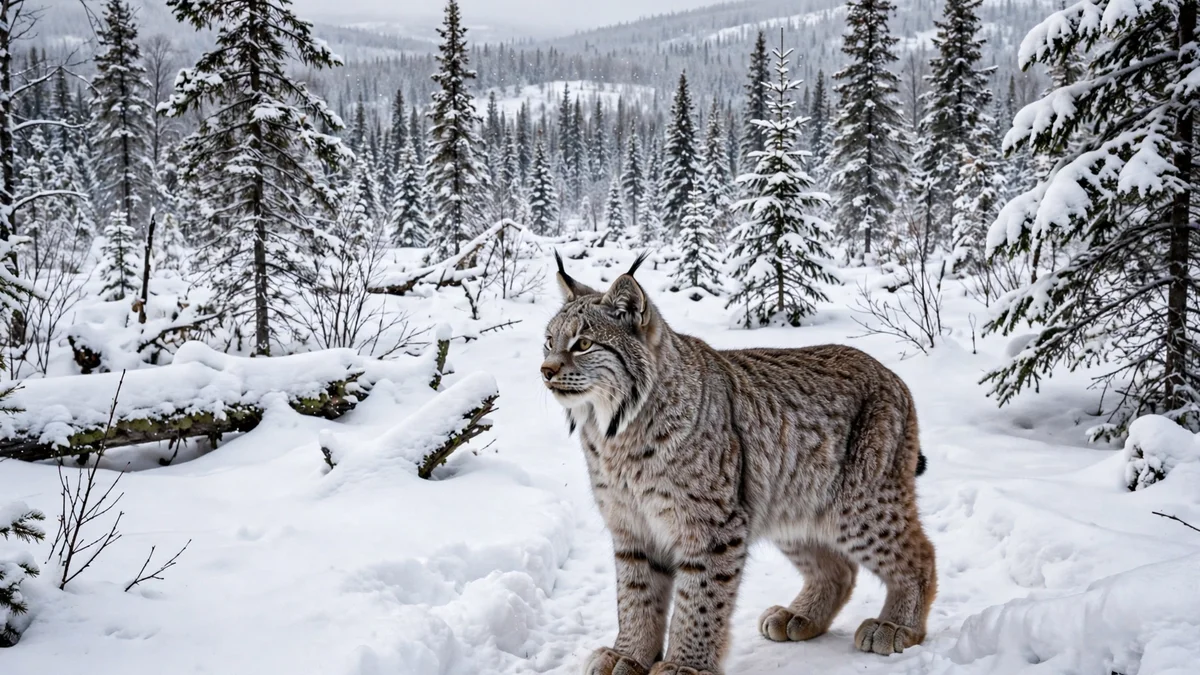
The Canada lynx species is a single species, Lynx canadensis, a snowshoe-footed cat of the boreal forest, and one of the most specialised hunters of the far north. If you are asking how many Canada lynx species there are, the answer is one: there is only one Canada lynx species in the world, and every Canada lynx alive today belongs to it.
The Canada lynx belongs to the family Felidae, the cat family, and it lives in the boreal forests of Canada and Alaska, from the Yukon to Newfoundland, and south into the northern United States. Its huge paws, its ear tufts, its short black-tipped tail and its grey coat make it one of the most recognisable cats of the snow.
Key takeaways
- There is only one Canada lynx species, Lynx canadensis, and it lives almost entirely in the boreal forest of Canada and Alaska.
- Canada lynx have huge paws that spread like snowshoes, letting them walk on deep snow where other predators sink.
- Snowshoe hares make up most of the diet, and lynx numbers rise and fall with the hare in a ten-year cycle.
- Canada lynx are solitary hunters that stalk their prey in silence, leaping on it from a few metres away.
- Canada lynx are listed as Least Concern, though they are listed as threatened in the contiguous United States.
What makes a Canada lynx a Canada lynx
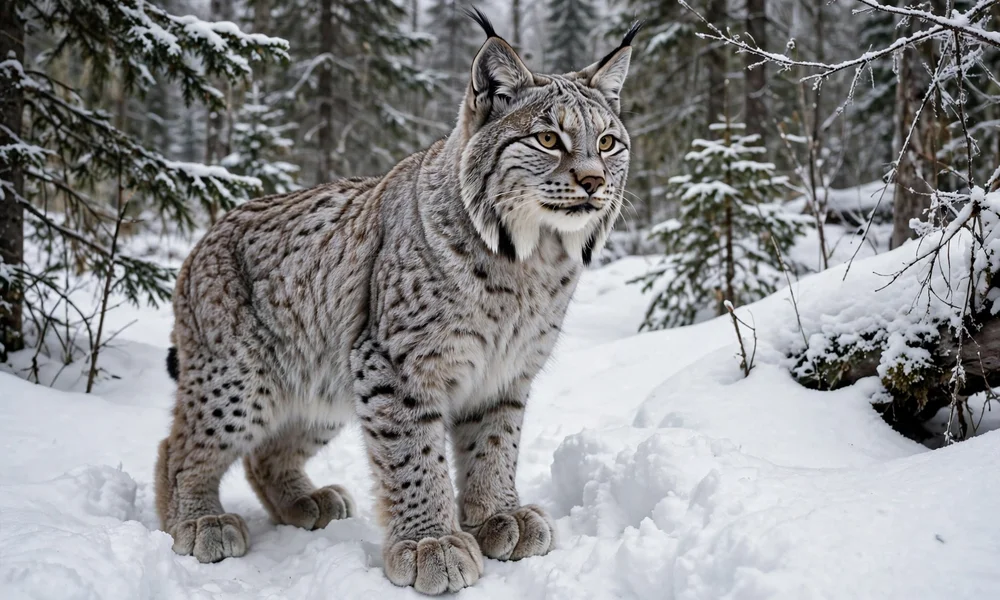
A Canada lynx is a medium-sized wild cat with grey-brown fur, black ear tufts, a short tail with a black tip, and huge furry paws, and it measures roughly 76 to 106 centimetres long and usually weighs between 8 and 14 kilogrammes, with males larger than females. Its legs are long for a cat of its size, and its back slopes down from shoulders to hips, giving it a hunched look.
The paws define the Canada lynx: huge paws up to 10 centimetres wide, covered in thick fur, that spread like snowshoes and let the cat walk on deep soft snow without sinking. The paws give the lynx its edge in winter, when hares run lightly over the snow and heavier predators flounder. Like other bobcats, the Canada lynx has a short tail, but the lynx tail is black all the way around its tip, while the bobcat tail is white underneath.
The Canada lynx species and their relatives
There is one Canada lynx species, Lynx canadensis, and it is the only lynx of North America. Canada lynx in different parts of the boreal forest form separate populations, from Alaska to Newfoundland, but they are all the same species, and young lynx wander hundreds of kilometres looking for empty territories when hare numbers crash.
The bobcat is the Canada lynx’s closest relative, a smaller spotted cat of North America that lives further south, while the Eurasian lynx is the largest lynx, a forest cat of Europe and Asia. The Iberian lynx is the rarest lynx, a spotted cat of Spain and Portugal, and the cougar is a large cat of the Americas that shares the lynx’s forests. The ocelot is a small spotted cat of Central and South America, and the snow leopard is a grey cat of the high mountains of Asia.
| Type | Animal | Where it lives | Best-known food | Length or Weight |
|---|---|---|---|---|
| Species | Canada lynx (Lynx canadensis) | Boreal forest of Canada and Alaska | Snowshoe hare | 76 to 106 cm, 8 to 14 kg |
| Close relative | Bobcat | North America, from Canada to Mexico | Rabbits, rodents and birds | 60 to 100 cm, 6 to 18 kg |
| Close relative | Eurasian lynx | Forests of Europe and Asia | Deer, hares and rodents | 80 to 130 cm, 18 to 30 kg |
| Close relative | Iberian lynx | Spain and Portugal | European rabbit | 85 to 110 cm, 9 to 13 kg |
| Close relative | Cougar | Americas, from Canada to Patagonia | Deer and small mammals | 1.5 to 2.7 m, 34 to 72 kg |
| Close relative | Ocelot | Central and South America | Rodents, birds and lizards | 68 to 100 cm, 8 to 16 kg |
| Close relative | Snow leopard | High mountains of Central Asia | Wild sheep, goats and marmots | 86 to 125 cm, 22 to 55 kg |
How Canada lynx live
Canada lynx are creatures of the boreal forest. A Canada lynx lives alone, except for a mother with kittens, roaming the snowy forest by night and resting in a den by day, and it can roam over a home range of up to 200 square kilometres. Like other lynxes, it is a patient hunter, and it stalks its prey in silence, freezing when the prey looks up and moving when it looks away.
Snowshoe hares make up most of the diet, along with red squirrels, grouse, voles and the occasional deer fawn, and a Canada lynx eats by stalking a hare through the snow, creeping to within a few metres and then leaping on it. It hunts mostly at night, when hares are out feeding, and it can eat a hare a day when hares are plentiful, caching the leftovers under snow for later.
Breeding happens in spring, and after a gestation of about two months the female gives birth to a litter of one to six kittens, usually two or three, in a den under a fallen tree or in a rocky hollow. The kittens are born blind and helpless, and they stay in the den for their first weeks, opening their eyes at about ten days and leaving the den at about two months. The young stay with their mother through their first winter, learning to hunt hares, and they leave to find their own territories in spring. Canada lynx live for around 15 years in the wild, and up to 20 years or more.
Where Canada lynx live
The Canada lynx lives in the boreal forests of Canada and Alaska, from the Yukon and British Columbia to Quebec and Newfoundland, and south into Montana, Minnesota, Maine and Washington, and it is most common in the snowy forests of the Yukon and northern Ontario, where snowshoe hares are plentiful. It is seen regularly in Denali National Park in Alaska, where the lynx hunt hares along the forest edge.
Boreal forest is the key requirement. A Canada lynx needs thick forest with dense undergrowth where hares hide, and deep snow that favours its huge paws, so it follows the hares as their numbers rise and fall, and when the hares crash the lynx wander far looking for food. It depends on the hare cycle, and lynx numbers rise and fall with the hare in a ten-year cycle, with lynx numbers peaking a year or two after the hares.
The species is listed as Least Concern, and its numbers are stable across most of Canada. The main pressures are the loss of boreal forest to logging, trapping, and the loss of snow as the climate warms, which lets bobcats and coyotes move north into lynx country. In the contiguous United States the Canada lynx is listed as threatened, with only a few hundred animals left in the lower 48 states.
Best seasons for Canada lynx watching
There is no closed season, because Canada lynx are active all year, but the best time to look for them depends on where you go. In Alaska the best months are often December to March, when the lynx hunt hares in the snow and their tracks are easy to follow. In Canada the best months are often January to March, when the lynx are out in the long winter nights.
Staying safe around Canada lynx
A Canada lynx is a wild animal with sharp teeth and claws, and it can bite hard enough to injure a person, though lynx almost never attack people. Keep your distance, never approach a lynx den, and never try to touch or feed a lynx, because a cornered lynx will fight fiercely and can injure a dog badly. If you see a lynx, stay calm, make yourself look big, make noise, and back away slowly, and never run, because a lynx can outrun a person in deep snow.
Canada lynx watching checklist
A little preparation turns a winter forest visit into a real chance of seeing a Canada lynx, so pack for cold, snow and long quiet hours.
- Binoculars with good low-light performance, for picking a grey shape out of the snowy forest.
- A camera with a zoom lens, because lynx should always be watched from a distance.
- Warm clothes and a windproof jacket, because the best watching is on cold winter mornings.
- Snowshoes or skis, for following lynx tracks through deep snow.
- A booked tour with a guide who knows the lynx territories and the hare runs.
- A plan to be out at dawn or dusk, when the lynx are most active and hunting.
- Patience and silence, because lynx are shy animals and a noisy group will send them away.
Frequently asked questions
How many Canada lynx species are there?
There is one Canada lynx species, Lynx canadensis. It is the only lynx of North America, and its closest relatives are the bobcat, the Eurasian lynx and the Iberian lynx, but they are all separate species.
Why do Canada lynx have such big paws?
Canada lynx have huge paws because they hunt in deep snow. The paws spread like snowshoes and let the lynx walk on soft snow without sinking, while hares run lightly over the snow and heavier predators like coyotes flounder, so the lynx can catch hares that other hunters cannot reach.
Do Canada lynx numbers follow the hare cycle?
Yes. Canada lynx numbers rise and fall with the snowshoe hare in a ten-year cycle. When hares are plentiful the lynx raise more kittens, and when hares crash the lynx raise few kittens and wander far looking for food, with lynx numbers peaking a year or two after the hares.
Can you keep a Canada lynx as a pet?
No. A Canada lynx is a wild animal that needs boreal forest, hunts hares by night, and is fully protected by law in most of the places where it lives. Lynx in rescue centres are there to recover from injury, and they are not pets.
How is this guide different from the American badger species guide?
This guide covers the single Canada lynx species, a snowshoe-footed cat that hunts hares in the boreal forest of Canada, while our American badger species guide covers the single American badger species, a digging hunter that lives alone in burrows on the North American prairie. The lynx weighs up to 14 kilogrammes and walks on snow, and the badger weighs up to 12 kilogrammes and digs through hard soil.
Are Canada lynx endangered?
Canada lynx are listed as Least Concern, so they are not classed as endangered. Their numbers are stable across most of Canada, though they are listed as threatened in the contiguous United States, where only a few hundred animals remain.
Conclusion
The Canada lynx species shows how much grace one animal can hold: a single species of snowshoe-footed cat, with ear tufts and huge paws, and a life spent hunting hares in the boreal forest of the far north.
If you go looking for one, go in the winter to Alaska or the Yukon, go quietly, and go with patience. Watch a Canada lynx walk across deep snow and you will understand why it has earned its place as the ghost of the boreal forest, and why keeping its snowy forest matters most.