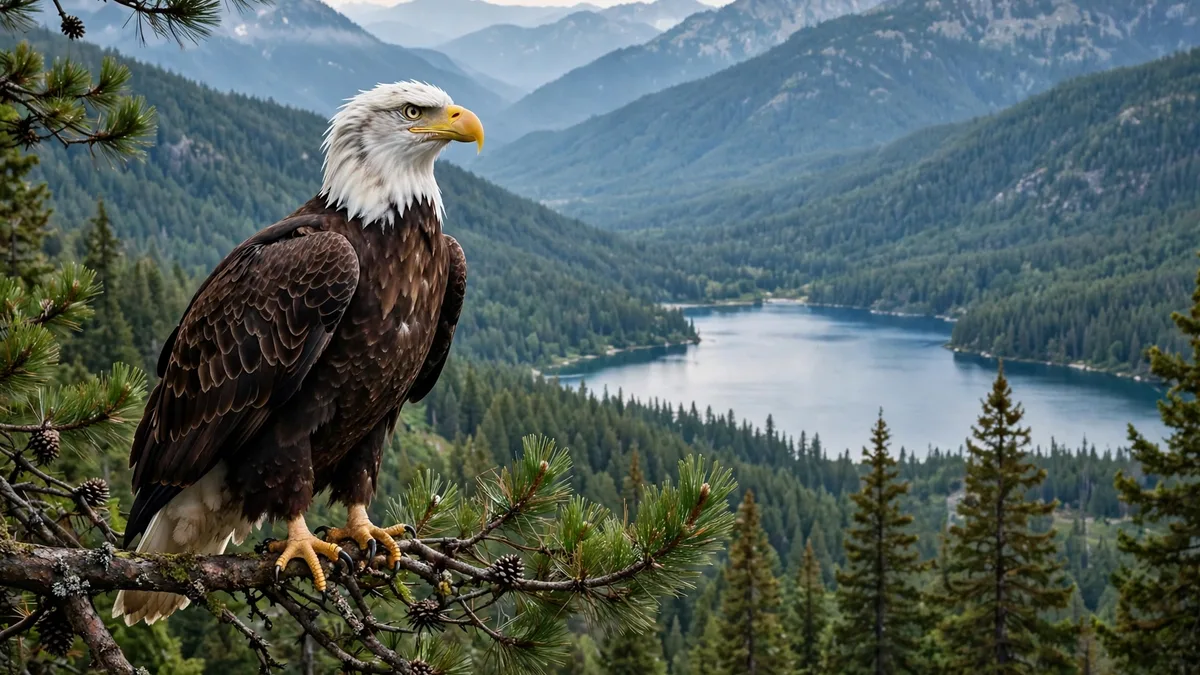
The bald eagle species is a single species, Haliaeetus leucocephalus, a great sea eagle of North America with a snow-white head, a dark brown body and a wingspan of around two metres. If you are asking how many bald eagle species there are, the answer is one: there is only one bald eagle species in the world, and every bald eagle alive today belongs to it.
The bald eagle belongs to the genus Haliaeetus, the sea eagles, and it is the national bird of the United States, a symbol that appears on the country’s seal, its coins and its flags. Its name comes from an old word for white, piebald, because the adult bird’s head is white, not bald at all.
Key takeaways
- There is only one bald eagle species, Haliaeetus leucocephalus, with two recognised subspecies in the north and south of its range.
- Bald eagles have a wingspan of about 1.8 to 2.3 metres, with females larger than males.
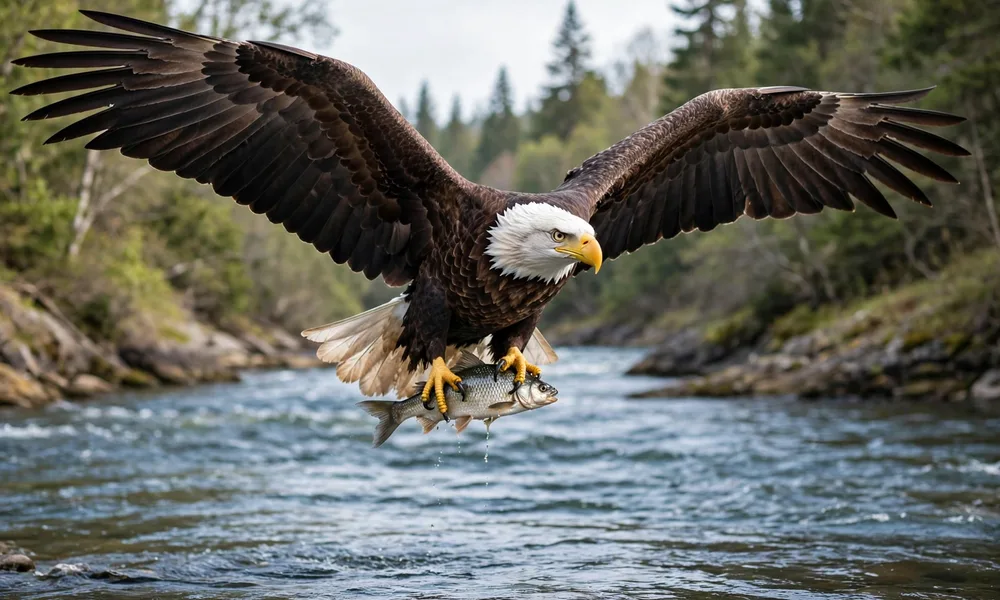
- Bald eagles eat mainly fish, which they snatch from the water with their talons without landing.
- Bald eagles were listed as Endangered in the United States but recovered and were delisted in 2007; they are now listed as Least Concern.
- Bald eagles build some of the largest nests of any bird, which they reuse and add to year after year.
What makes a bald eagle a bald eagle
A bald eagle is a large bird of prey with a white head and tail, a dark brown body and wings, a heavy yellow beak and yellow legs with powerful talons. Its body measures roughly 70 to 100 centimetres long, with a wingspan of about 1.8 to 2.3 metres, and it usually weighs between 3 and 6.3 kilogrammes, with females noticeably larger than males.
The white head defines the bald eagle: adults gain their full white head and tail at about five years old, while young birds are mottled brown all over and take years to reach adult plumage. Its eyesight is famously sharp, letting it spot a fish from high above the water, and its talons are strong enough to lift prey weighing several kilogrammes. Like other eagles, the bald eagle soars on broad wings, riding rising air with slow, deep wingbeats.
The bald eagle species and its relatives
Haliaeetus leucocephalus is the only bald eagle species, and it is split into two recognised subspecies. Haliaeetus leucocephalus leucocephalus lives in the southern United States and Mexico, while Haliaeetus leucocephalus washingtoniensis lives in Alaska, Canada and the northern United States, and is slightly larger. The two subspecies overlap in the middle of the range.
The white-tailed eagle of Europe and northern Asia is the bald eagle’s closest relative, another large sea eagle of coasts and lakes, but it has a pale head rather than a pure white one. The golden eagle is a mountain hunter that takes rabbits and young deer, and the Steller’s sea eagle of the Russian Far East is even heavier than the bald eagle.
| Type | Animal | Where it lives | Best-known food | Length or Weight |
|---|---|---|---|---|
| Species | Bald eagle (Haliaeetus leucocephalus) | North America | Fish | Wingspan 1.8 to 2.3 m |
| Subspecies | Northern bald eagle | Alaska, Canada and the northern USA | Fish and water birds | Wingspan up to about 2.3 m |
| Close relative | White-tailed eagle | Europe and northern Asia | Fish and water birds | Wingspan 1.8 to 2.4 m |
| Close relative | Golden eagle | Mountains of North America, Europe and Asia | Rabbits, hares and marmots | Wingspan 1.8 to 2.3 m |
| Close relative | Steller’s sea eagle | Russian Far East and Japan | Salmon and other fish | Wingspan 2 to 2.5 m |
| Close relative | African fish eagle | Lakes and rivers of sub-Saharan Africa | Fish | Wingspan 2 to 2.4 m |
| Close relative | Harpy eagle | Rainforests of Central and South America | Monkeys and sloths | Wingspan 1.8 to 2.2 m |
How bald eagles live
Bald eagles are creatures of the water’s edge. A bald eagle lives as part of a breeding pair, holding a territory around a lake, river or coast, and the pair stays together for life, returning to the same nest year after year. Like other forest animals, it roosts and nests in tall trees, choosing a strong branch with a clear view over the water.
Fish make up most of the diet, and the eagle hunts by soaring over the water, dropping down to snatch a fish from the surface with its talons, usually without landing or getting wet. It also eats water birds, small mammals and carrion, and it is quick to steal a catch from an osprey or another eagle in mid-air.
Breeding happens in late winter or spring, and the pair builds or repairs a huge nest of sticks, lined with grass and moss, in a tall tree or on a cliff. The nest is used for years, growing larger with each season. The female usually lays one to three eggs, and after an incubation of about 35 days the chicks hatch, staying in the nest for ten to twelve weeks before their first flight. Bald eagles live for around 20 to 30 years in the wild, and longer in captivity.
Where bald eagles live
The bald eagle lives only in North America, from Alaska and Canada across the United States to northern Mexico. It is most common in Alaska, British Columbia and the Pacific Northwest, and around the Great Lakes and the coasts of Florida, and it is one of the characteristic North American animals of the continent’s lakes and coasts. It needs open water, tall trees for nesting and plenty of fish.
Lakes, rivers and coasts are the key requirement. A bald eagle needs water that stays open through the winter, and it moves south or to the coast when northern lakes freeze. It depends on clean water and healthy fish stocks.
The species is listed as Least Concern, and its recovery is one of the great conservation stories of North America. By the 1960s the pesticide DDT had thinned the shells of its eggs, and only a few hundred breeding pairs remained in the lower 48 states of the United States. After DDT was banned and the species was protected, numbers rose steadily, and the bald eagle was removed from the United States Endangered species list in 2007. Hundreds of thousands now live across the continent, although lead poisoning from shot and fishing tackle remains a threat.
Best seasons for bald eagle watching
There is no closed season, because bald eagles are present in their home range all year, but winter is usually the best time to look for them. The trees are bare, the eagles gather around open water and salmon runs, and the birds are easier to spot against the pale sky. In Alaska and British Columbia the autumn salmon runs draw large numbers, while in the lower United States the winter months from November to February bring northern birds south.
The summer has its own rewards: the breeding pairs are feeding chicks and the days are long. Whichever season you choose, the best hours are the early morning and the late afternoon, when the eagles hunt and soar in the rising air.
Good places to try include the Chilkat River in Alaska, where thousands gather at the autumn salmon run, the Skagit River in Washington and the Mississippi River in winter.
Staying safe around bald eagles
A bald eagle is a wild animal with a heavy beak and sharp talons, and it can hurt a person, though bald eagles almost never attack people. Keep your distance, never approach a nest or a bird on the ground, and never try to touch or feed one. If you find an injured eagle, do not handle it yourself, but call a local wildlife rescue service, because even a weakened eagle can strike with its talons.
Admire from a distance. Avoid flash photography near a nest too, because a bright flash can startle a breeding pair and disturb its chicks.
Bald eagle watching checklist
A little preparation turns a lakeside walk into a real chance of seeing a bald eagle, so pack for cold wind, bright water glare and early mornings.
- Binoculars with good low-light performance, for picking an eagle out of the bare branches.
- A camera with a long lens, because eagles should always be watched from a distance.
- Warm layers and sun protection, because lakeside wind is cold and the glare is strong.
- Water and snacks for long walks, because the best sightings come after hours of searching.
- A booked local guide who knows the nests, the roosts and the salmon runs.
- A plan to be out at dawn, when eagles are most active and the light is at its best.
- Patience and silence, because eagles are wary birds and a noisy group will send them away.
Frequently asked questions
How many bald eagle species are there?
There is one bald eagle species, Haliaeetus leucocephalus. It is split into two recognised subspecies, one northern and one southern, but they are the same species. No second bald eagle species is recognised.
Why is it called a bald eagle if it is not bald?
The name comes from an old English word, piebald, meaning white-headed, and it describes the adult bird’s snow-white head. Young bald eagles are brown all over, and they do not gain the white head and tail until they are about five years old.
What do bald eagles eat?
Bald eagles eat mainly fish, which they snatch from the water with their talons, and they also eat water birds, small mammals and carrion. They often steal fish from ospreys and other eagles in mid-air, and they gather in large numbers at salmon runs and around open water in winter.
How big is a bald eagle’s nest?
Bald eagle nests are among the largest of any bird, often more than two metres across and over a metre deep. A pair reuses the same nest for years, adding new sticks each season.
How is this guide different from the great white shark species guide?
This guide covers the single bald eagle species, a bird of prey of the lakes and coasts of North America, while our great white shark species guide covers the single great white shark species, a fish that hunts in the cool coastal seas. The bald eagle flies and hunts from the air, and the great white swims and hunts from below the surface.
Are bald eagles endangered?
Bald eagles are listed as Least Concern, so they are not classed as endangered. They were once listed as Endangered in the United States, but they recovered after DDT was banned and were delisted in 2007.
Conclusion
The bald eagle species shows how much recovery one animal can hold: Haliaeetus leucocephalus, with a wingspan of around two metres, eyesight several times sharper than ours, and a life spent fishing the lakes, rivers and coasts of North America. It is the national bird of the United States, and it came back from the edge of extinction within living memory.
If you go looking for one, go in winter, go to open water, and go quietly. Watch a bald eagle drop from the sky and lift a fish from the river in its talons, and you will understand why it has earned its place as a symbol of North America, and why keeping its waters clean matters most.