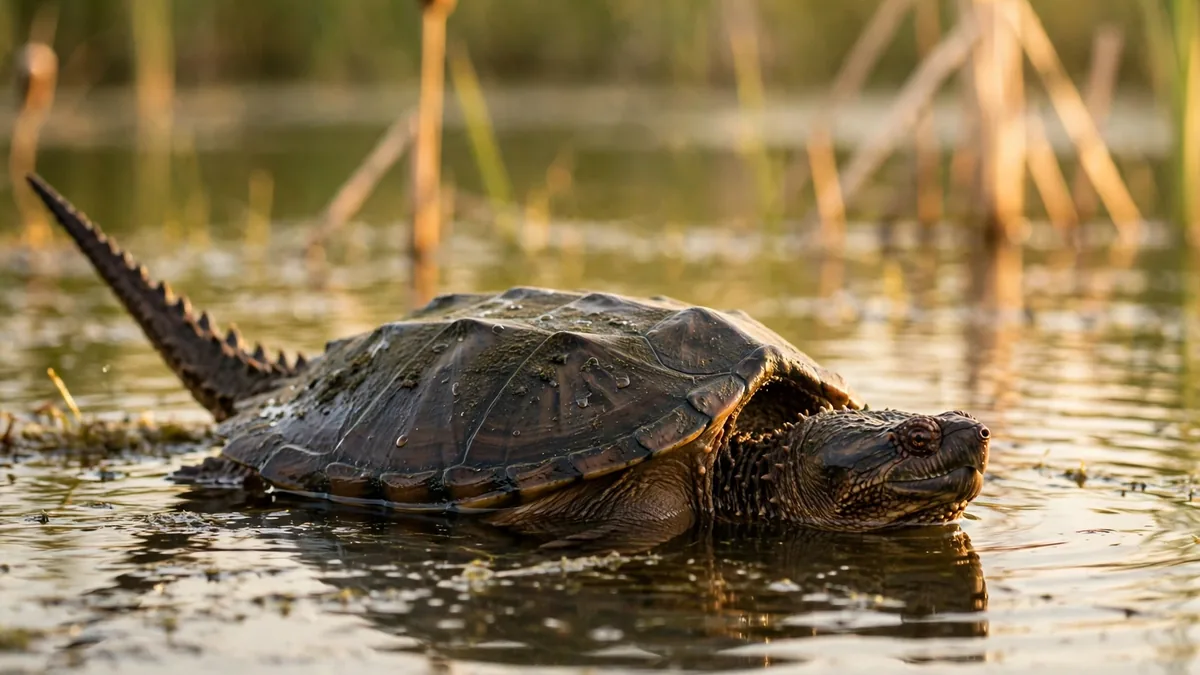
The snapping turtle species is the heavyweight of North America’s ponds and slow rivers, a big, rough-shelled freshwater turtle that spends most of its life underwater and only comes ashore to bask or to lay eggs. If you are asking what a snapping turtle is, the short answer is Chelydra serpentina, the common snapping turtle, a turtle with a carapace 20 to 50 centimetres long, a long tail with a saw-toothed ridge along the top, and a bite strong enough to demand real respect. It cannot pull its head and legs fully inside its shell the way most turtles can, so it stands its ground instead, and that is where its reputation comes from.
Most people meet a snapping turtle by accident. It might be the dark shape gliding under the surface of a farm pond at dusk, or the big, muddy animal crossing a country road in June, or the head that breaks the water in a marsh and watches you with small, unblinking eyes. It looks ancient, and it does not hurry for anyone. A large adult can weigh 4.5 to 16 kilograms, and a very big old male can reach about 35 kilograms, which makes it one of the heaviest freshwater turtles on the continent.
Key takeaways
- The snapping turtle species is Chelydra serpentina, the common snapping turtle of North America, with a carapace 20 to 50 centimetres long.
- It has a long tail with a saw-toothed ridge, a small plastron, and a shell too small to hide in, so it cannot fully retract its head and legs.
- Adults usually weigh 4.5 to 16 kilograms, while a very large old male can reach about 35 kilograms.
- It is an omnivore that eats fish, frogs, insects, plants and carrion, and it will take almost anything it can catch or find.
- Females lay 20 to 40 eggs in a sandy nest, the sex of the young depends on the temperature of the nest, and the species hibernates underwater beneath the ice in winter.
The snapping turtle species and its relatives
Snapping turtles belong to the family Chelydridae, a small family of freshwater turtles found only in the Americas, and to the genus Chelydra, which holds the common snapping turtle and its close kin. The scientific name, Chelydra serpentina, was given by Carl Linnaeus in 1758: Chelydra comes from a Greek word for a water snake or tortoise, and serpentina means snakelike, a nod to that long, muscular tail. The common snapping turtle lives across a huge sweep of North America, from southern Canada through the eastern and central United States and down into Mexico.
There is one close relative that matters a great deal, and it is worth getting the two straight. The alligator snapping turtle is a separate species, Macrochelys temminckii, a much bigger animal of the rivers of the south-eastern United States, with a carapace that can reach about 80 centimetres and large males that can weigh more than 80 kilograms. It has a worm-like lure on its tongue for fishing, a far more massive head, and extra ridges on its shell. The common snapping turtle is smaller, smoother-shelled, and far more widespread, and it does not have the lure. People mix the two up constantly, and the difference matters, because the alligator snapping turtle is rarer and far more protected.
| Type | Animal | Where it lives | Best-known food | Length or Weight |
|---|---|---|---|---|
| Family | Snapping turtles (Chelydridae) | Fresh water in the Americas | Fish, frogs and carrion | About 20 cm to 80 cm long |
| Genus | Snapping turtles (Chelydra) | North and Central America | Fish, frogs, insects and plants | About 20 cm to 50 cm long |
| Species | Common snapping turtle (Chelydra serpentina) | Canada, the United States and Mexico | Fish, frogs, insects, plants and carrion | About 20 cm to 50 cm long, 4.5 kg to 16 kg |
| Species | Alligator snapping turtle (Macrochelys temminckii) | Rivers of the south-eastern United States | Fish, molluscs and carrion | Up to about 80 cm long, over 80 kg |
| Species | Painted turtle (Chrysemys picta) | Ponds and lakes across North America | Plants, insects and small fish | About 10 cm to 25 cm long |
| Species | Common musk turtle (Sternotherus odoratus) | Slow rivers and ponds of eastern North America | Snails, insects and carrion | About 8 cm to 14 cm long |
The painted turtle is the snapping turtle’s cheerful little neighbour, and it shows how different two pond turtles can be. A painted turtle measures only about 10 to 25 centimetres long, basks in crowds on sunny logs, and can pull everything neatly inside a smooth, brightly marked shell. The common musk turtle is smaller still, about 8 to 14 centimetres long, and it spends its time walking along the bottom of slow rivers, eating snails and releasing a musky smell when picked up. Next to them, the snapping turtle looks built for a rougher job: a bigger body, a heavier jaw, and a shell that offers less cover but leaves the animal free to move, bite and swim hard.
Snapping turtles have changed very little over millions of years, and the fossil record shows animals much like the ones in today’s ponds going back a long way. The design works: a big, bottom-walking turtle that eats almost anything and lives in water too muddy or too low in oxygen for fussier species. They are not sea turtles, and they are not tortoises. A snapping turtle is a freshwater animal through and through.
What a snapping turtle looks like
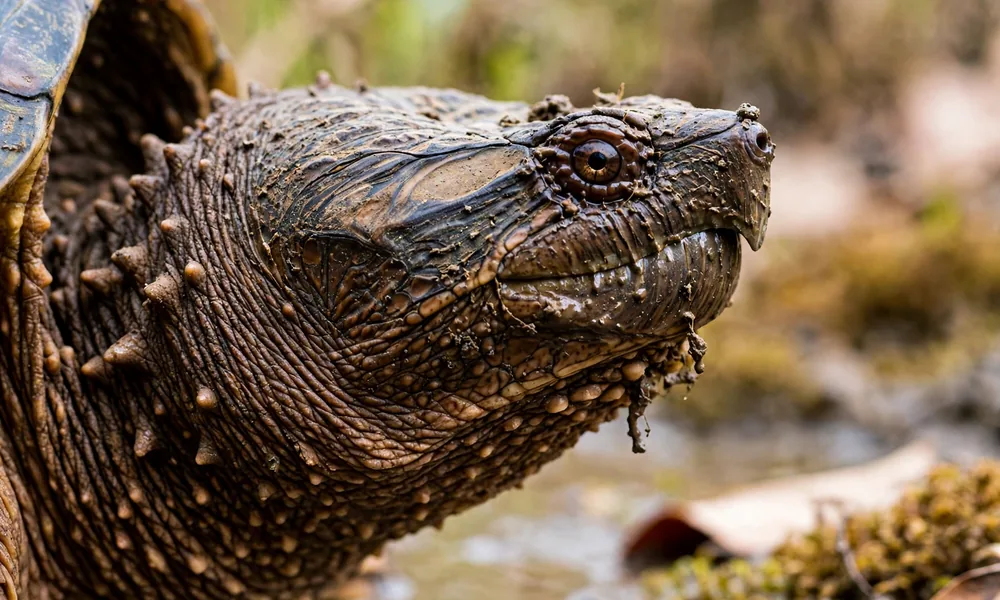
A snapping turtle looks like a turtle that has been left out in the weather for a very long time. The carapace, the upper shell, is dark brown or olive, rough and often covered in green algae, and in young animals it carries three clear ridges running down its length. In older animals those ridges wear smooth, and the shell can look almost black, pitted and scarred from years of life on the bottom. The shell measures 20 to 50 centimetres long in most adults, and it is flatter and smaller in proportion to the body than the shell of most pond turtles, which is the whole point: the snapping turtle does not hide inside its shell, because it cannot.
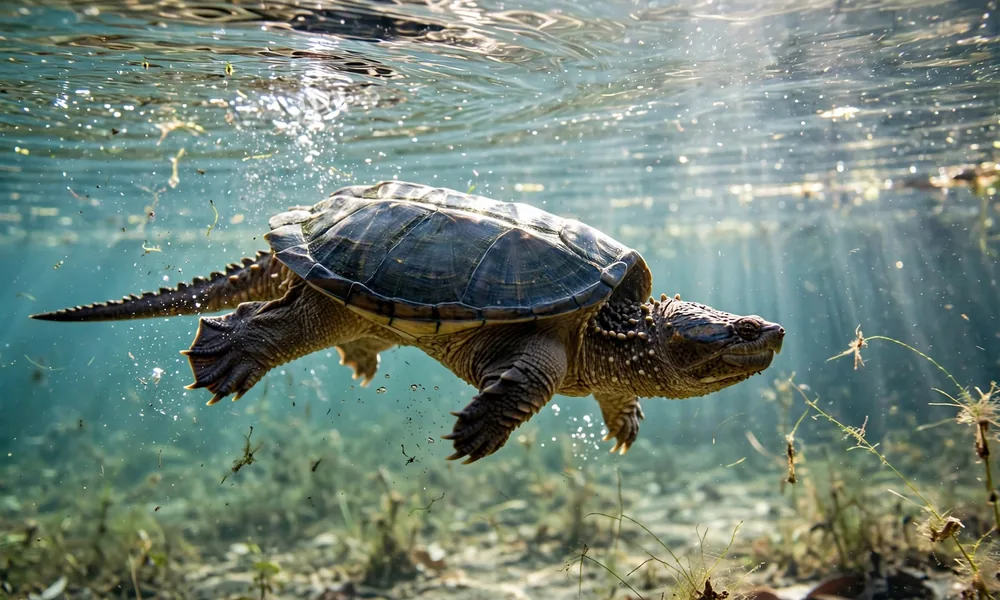
The plastron, the flat shell underneath, is the real giveaway. It is small, narrow and cross-shaped, leaving the legs, neck and tail largely exposed. That is why the animal cannot retract fully: there is simply not enough shell to cover it. The neck is long and thick, with rough, warty skin, and the head is large, with a hooked upper jaw that looks like a beak and small eyes set high on the skull. The tail is the other feature nobody forgets once they have seen it. It is long, often as long as the shell itself, thick at the base, and it carries a row of pointed, saw-like scales along the top that give it a ridged, almost dinosaur look.
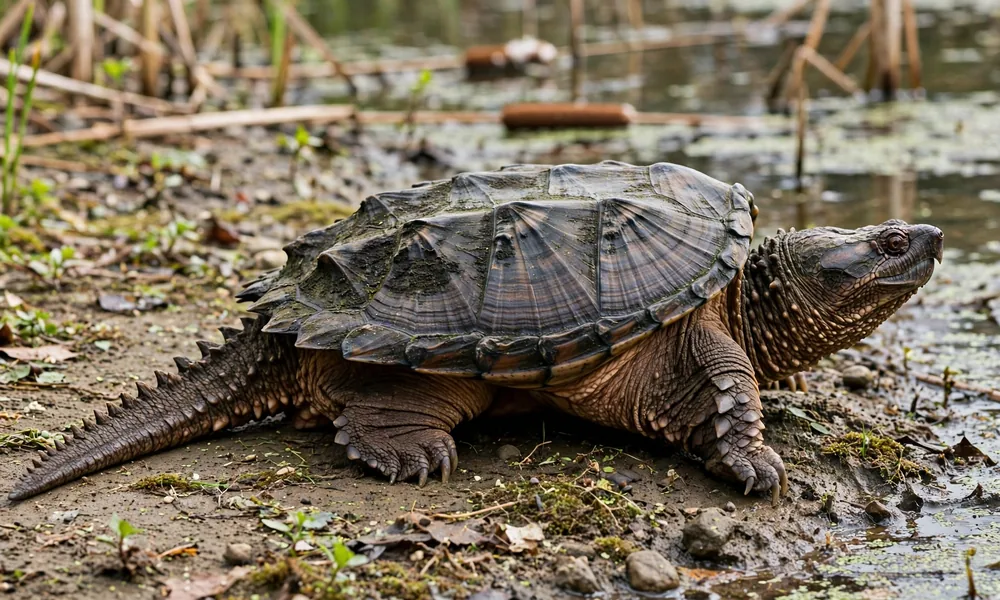
The legs are thick and powerful, with strong claws for digging and gripping the muddy bottom, and the feet are webbed, which helps the animal swim in short bursts. The skin is dark brown or grey, rough and wrinkled, and often stained with mud or algae, which helps the turtle disappear against the bottom of a pond. Males and females look much alike, though a male is usually a little larger and heavier, with a longer, thicker tail. Females are a touch smaller, but the difference is not reliable enough to sex an animal by eye alone.
Young snapping turtles look like small, rough copies of their parents, with clearer ridges on the shell, a proportionally longer tail, and a pattern that fades as they grow. A hatchling is only about 2.5 to 3.5 centimetres long, small enough to sit on a coin, and it is far more vulnerable than an adult. Everything eats a baby snapping turtle: herons, raccoons, large fish, even other turtles. The ones that survive grow fast in their first few years, and once the shell passes about 20 centimetres, very few predators will take one on. That is the bargain of the snapping turtle’s life: a dangerous start, and then decades of being too big and too bad-tempered to bother.
Where snapping turtles live
Snapping turtles live across a huge part of North America, from Nova Scotia and southern Canada, through the eastern and central United States, and south into Mexico. They are one of the most widespread freshwater turtles on the continent, and they turn up in almost any permanent body of water: ponds, lakes, marshes, slow rivers, canals, swamps and farm dams. They are not fussy about clear water. In fact, they prefer it muddy and weedy, with a soft bottom they can bury themselves in and plenty of cover to hunt from.
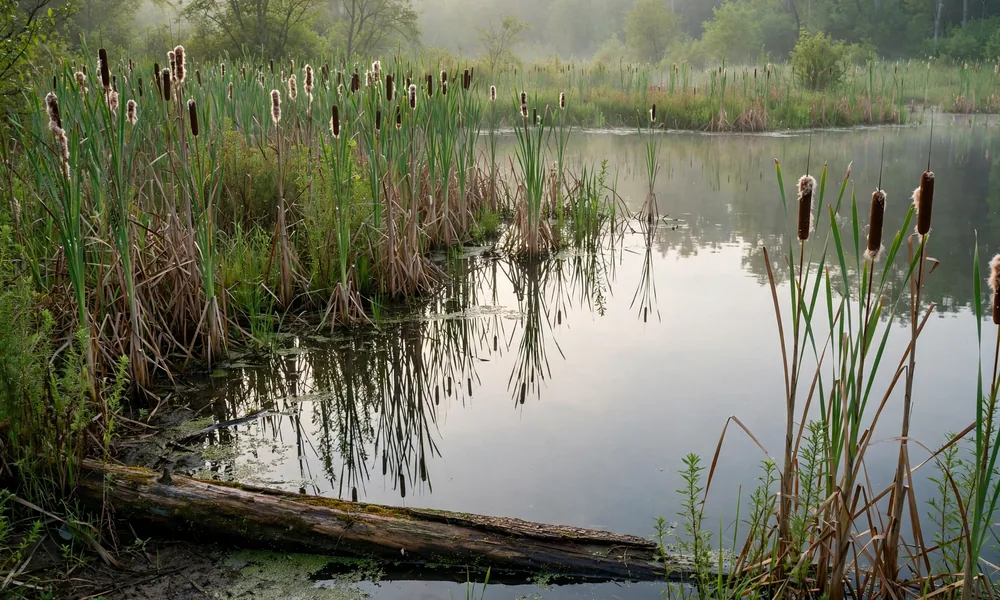
The habitat they choose is slow water with a muddy bottom and plenty of plants. A snapping turtle spends most of its life on the bottom, half-buried in silt, with only its eyes and nostrils above the surface, waiting for something edible to come close. It likes water with a good depth of mud, because it can dig itself in and hide, and it likes fallen logs and tangled roots, because they give it cover and a place to rest. A pond with a sandy bottom and no weeds is poor ground for a snapper. A marsh full of cattails, lily pads and black mud is home.
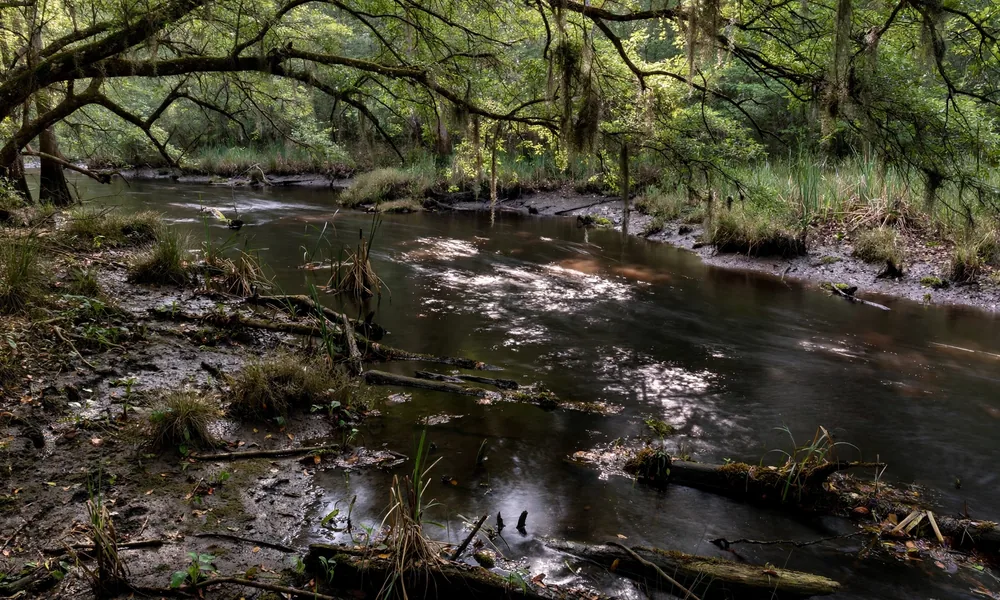
Snapping turtles are also surprisingly tolerant of people. They live in city park ponds, in golf course water hazards, in drainage ditches and in reservoirs, and they do well in water too murky or too low in oxygen for many other animals. They can even live in brackish water for a while, though they prefer fresh water. What they cannot live without is water itself. A snapping turtle out of water for a day is a stressed animal, and on land it is slow, exposed and vulnerable, which is exactly why it is so defensive when you meet one on a road.
The range is set by cold as much as by water. In the north, where winters are long and hard, snapping turtles spend months under the ice, barely moving, in a state close to hibernation. In the south they stay active for most of the year, feeding through the winter whenever the water warms enough. They do not migrate, and most adults stay in the same pond or the same stretch of river for years, learning every log, every weed bed and every muddy hollow in it.
What snapping turtles eat
Snapping turtles are omnivores with very few manners, and they eat almost anything they can catch, find or overpower. The everyday diet is fish, and a snapper will take minnows, sunfish, perch and any other fish slow or careless enough to come within reach. It also eats frogs, tadpoles, crayfish, snails, insects and worms, and it will happily eat plants too: pondweed, algae, duckweed and fallen fruit. Carrion is a big part of the diet as well, and a dead fish on the bottom is a meal a snapping turtle will not pass up.
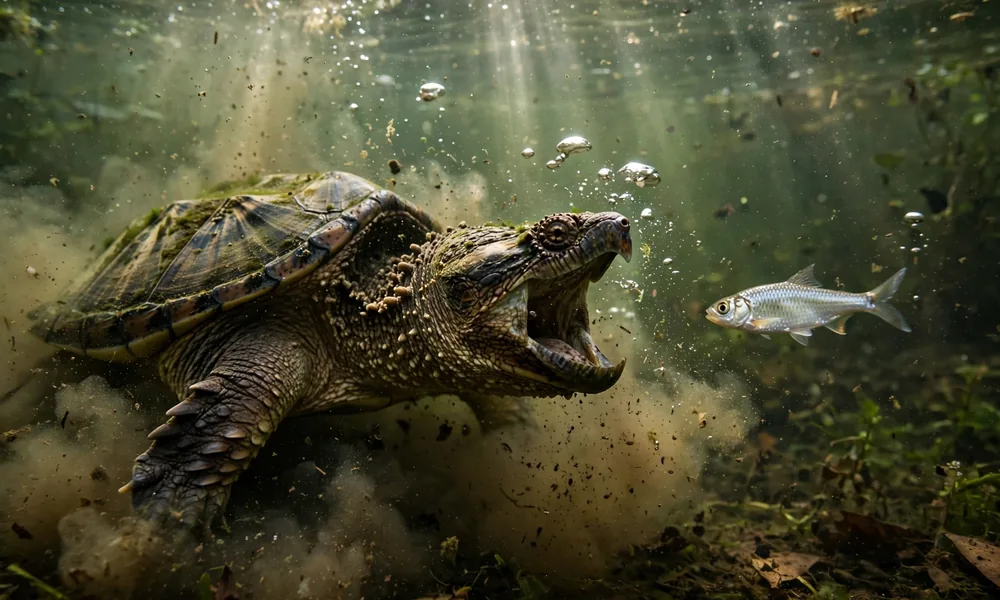
The hunting style is a mix of waiting and lunging, and it is built around the animal’s greatest asset, which is patience. A snapping turtle will sit on the bottom, half-buried in mud, for hours, moving only its eyes, until a fish drifts too close. Then the neck shoots out in a blur, the jaws snap shut, and the fish is held in a grip it cannot escape. The bite is not just strong, it is quick, and the turtle can strike at prey in front of it faster than most people expect. In the water the turtle is a different animal from the slow, clumsy creature you see on land: it is fast, accurate and surprisingly agile.
On land, the snapping turtle’s diet changes a little. It will eat earthworms, slugs, insects and the occasional mouse or nestling bird, and it will graze on plants and berries near the water’s edge. Young snapping turtles eat more animal food than adults do, because they need the protein to grow, and they hunt actively in the shallows. Adults eat more plants as they age, and a big old snapper may spend much of the summer eating pondweed and algae between fish meals. Like the turtle family as a whole, the snapper is an opportunist first and a hunter second, and it takes what the pond offers.
Feeding is tied to the seasons and to the temperature of the water. Snapping turtles feed most in the warm months, from late spring through early autumn, when the water is warm, the fish are active and the plants are growing. In cold water they slow down, eat less, and eventually stop feeding altogether for the winter. A turtle that has fed well through the summer carries fat into the winter, and that fat is what gets it through months under the ice without a meal.
How snapping turtles behave
Snapping turtles are mostly solitary, mostly underwater, and mostly quiet, and those three habits shape almost everything they do. By day they rest on the bottom or bask on a log, and at dusk they become active, moving through the weeds and along the muddy bottom in search of food. They are not social animals. Two adults in the same pond will mostly ignore each other, except in the breeding season, and a snapping turtle that meets another snapper is as likely to snap at it as to share a basking log.
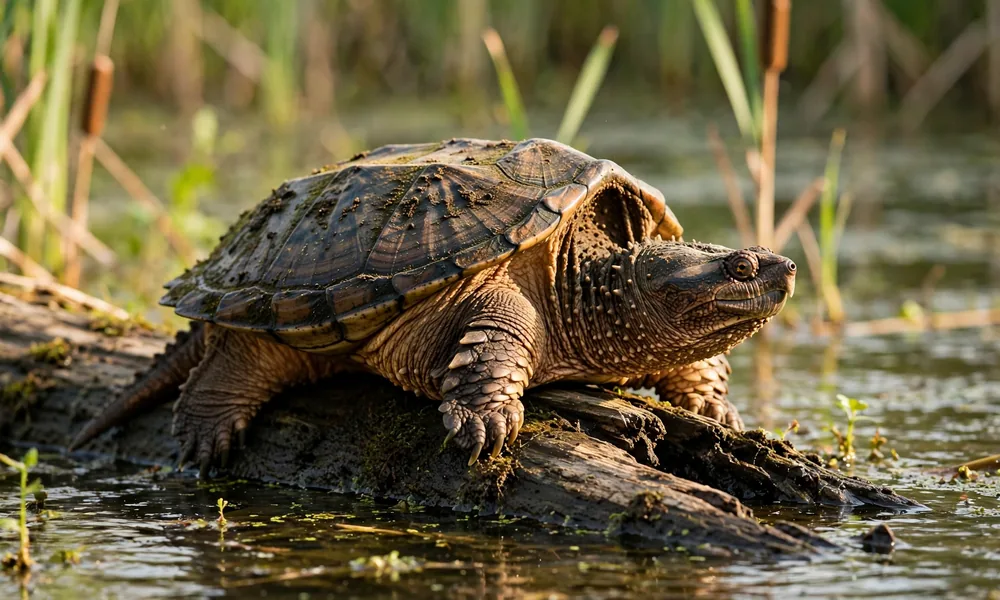
Basking is one of the few behaviours that brings a snapping turtle out into the open. It will haul itself onto a log, a rock or a muddy bank and sit in the sun for an hour or more, warming its body and drying its shell, which helps keep algae and leeches down. It is wary while it basks, and it will slide back into the water at the first sign of trouble, usually with a loud splash. In cold weather it basks less, and in summer it may bask in the early morning and spend the hottest part of the day in deep, cool water.
When a snapping turtle is threatened on land, it does not behave like other turtles. It cannot pull inside its shell, so it does not try. Instead it turns to face the threat, opens its mouth, hisses, and strikes with its neck extended, and if it gets hold of something it bites hard and holds on. The bite is genuinely powerful, strong enough to crush bone, and it is the reason for every warning sign at every pond. In the water, though, the same animal is shy. A snapping turtle met while swimming will almost always swim away, and most bites happen on land, to people who pick the animal up or step too close.
Snapping turtles are also strong travellers when they need to be. They will walk long distances overland to find a new pond, to find a mate, or to find a nesting site, and a female in June may walk a kilometre or more from the water to lay her eggs. They navigate by memory and by the lay of the land, and they return to the same ponds year after year. They are not fast on land, but they are determined, and they will keep walking through grass, mud and gravel until they reach water again.
Breeding and life cycle
Snapping turtles breed in the spring, usually from April to June, when the water has warmed and the animals are feeding well again after the winter. Males find females in the water, and mating happens underwater. Courtship is a rough, unhurried affair: the male follows the female, nudges her, and grips the edge of her shell with his claws. Mating lasts only a few minutes, after which the two go their separate ways, and the female carries the eggs for several weeks before she comes ashore to lay them.
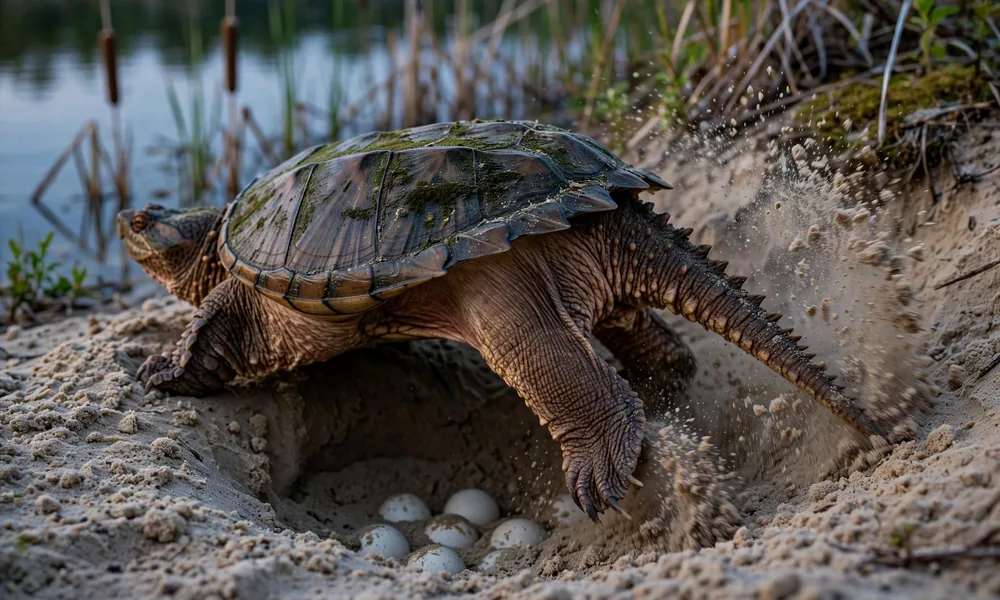
The female lays her eggs on land, usually in June, in a sandy or loose soil near the water, though she may walk a long way from the pond to find the right spot. She digs the nest with her hind legs, scooping out a flask-shaped hole about 10 to 15 centimetres deep, and she lays 20 to 40 round, white, leathery eggs in it, covering them carefully with soil when she is done. A single female may lay only one clutch a year, and in the north she may skip a year altogether if the summer is short or food is scarce. She does not stay to guard the nest. Once the eggs are covered, she walks back to the water and never returns.
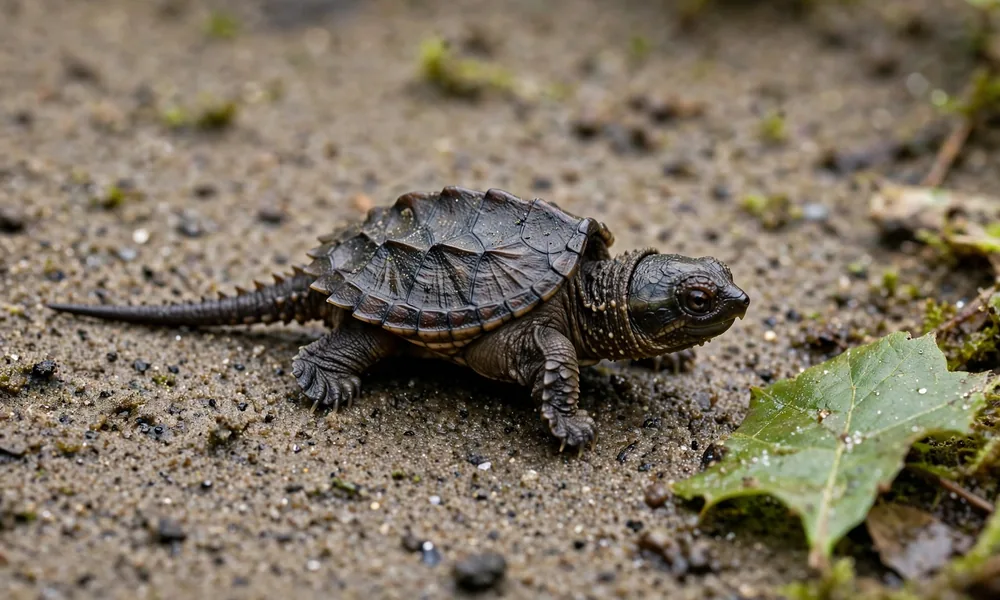
Incubation takes about two to three months, depending on the temperature of the soil, and the sex of the young depends on that temperature. This is temperature-dependent sex determination, and it works the same way in snapping turtles as it does in many other turtles: cooler nests produce more males, warmer nests produce more females, and nests in the middle produce a mix. A hot summer can therefore tilt a whole year’s hatchlings towards females, and a cool summer towards males, which is one reason a changing climate worries turtle researchers. The eggs are soft-shelled and leathery, not hard like a bird’s egg, and they need damp soil to survive: a nest that dries out will fail.
The hatchlings emerge in late summer or early autumn, usually in August or September, and they dig themselves out of the nest and make straight for the water. It is a dangerous journey. Raccoons, crows, herons, snakes and large fish take a heavy toll, and in many places most of a year’s hatchlings never reach the pond. The ones that do make it grow fast on insects, tadpoles and small fish, and they reach breeding size at about 8 to 10 years old in the south, and later, sometimes 15 years or more, in the cold north. A snapping turtle that survives its first year can live a very long time: 30 to 40 years in the wild is common, and some animals pass 50.
Hibernation is the last great event of the year, and it is one of the snapping turtle’s most remarkable tricks. As the water cools in late autumn, the turtle sinks to the bottom of the pond, buries itself in the mud, and slows right down. Its heart beats slowly, its body temperature falls to match the water, and it barely moves for months, even while the pond freezes over above it. It does not breathe air during this time. Instead it takes in a small amount of oxygen through the skin, and through the thin, blood-rich lining of its cloaca, which is enough to keep it alive in the cold, still water. When the ice melts in spring, the turtle stirs and rises to take its first breath in months.
Conservation status
The common snapping turtle is listed as Least Concern by the International Union for Conservation of Nature, and the reasoning is straightforward: it has a very large range, it is still common across much of that range, and it tolerates disturbed water that many other turtles cannot live in. That broad picture hides a more worrying local one, and it is worth understanding both sides, because the snapping turtle’s slow life makes it fragile in ways that are easy to miss. A turtle that takes 10 to 15 years to start breeding, and lays eggs that mostly get eaten, cannot replace lost adults quickly.
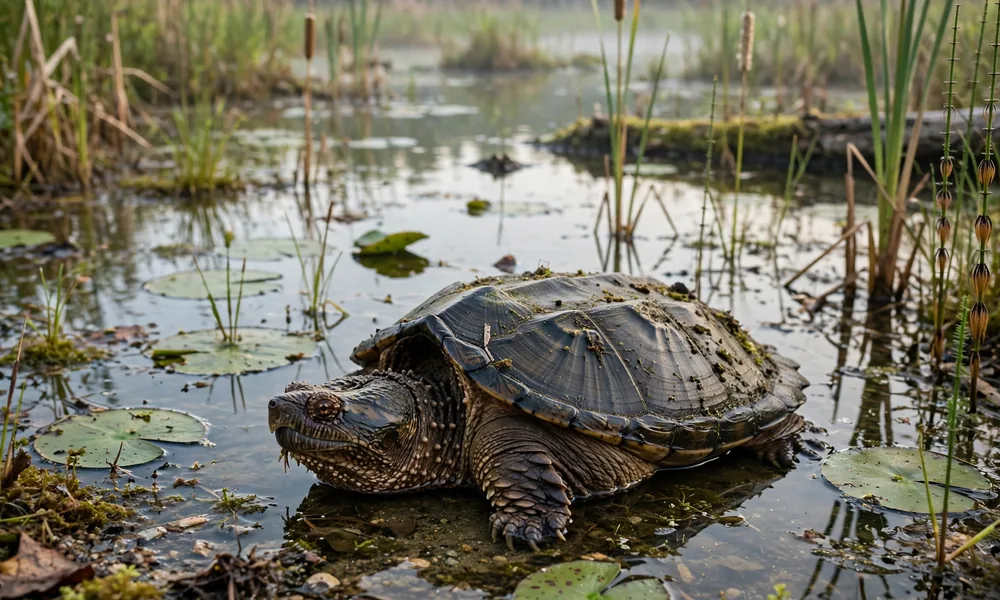
The main pressure is the road. Every June, females cross roads to reach nesting sites, and thousands are killed by cars each year, and because it is almost always the breeding females that cross, the loss hits the population twice as hard. Habitat loss is the second pressure, as wetlands are drained for building and farming, and as ponds are filled in or fenced off. Collection is a third pressure: snapping turtles are taken for food in some places, and for the pet trade in others, and a big adult taken from a pond leaves a gap that takes a decade to fill.
The most useful conservation work is practical, and much of it is done by ordinary people. Road signs and culverts that let turtles cross safely, and fences that guide females to a safe nesting spot, all make a real difference. If you find a snapping turtle on a road, never pick it up by the tail, which can injure its spine: lift it gently by the back of the shell, keep your hands well away from the head, and carry it across in the direction it was heading. Never move it to a different pond. A snapping turtle knows its own water, and a moved turtle will often walk for miles trying to get back.
Best seasons for snapping turtle watching
The best time to look for a snapping turtle is late spring and early summer, from May to July, when the water is warm, the animals are feeding hard, and the females are coming ashore to lay their eggs. June is the best month of all, because a female on her way to a nest is one of the few times a snapping turtle is out of the water in daylight and easy to see, walking slowly across a road or a grassy bank. The breeding season also brings the males out, and they are more active and more visible then than at any other time of year.
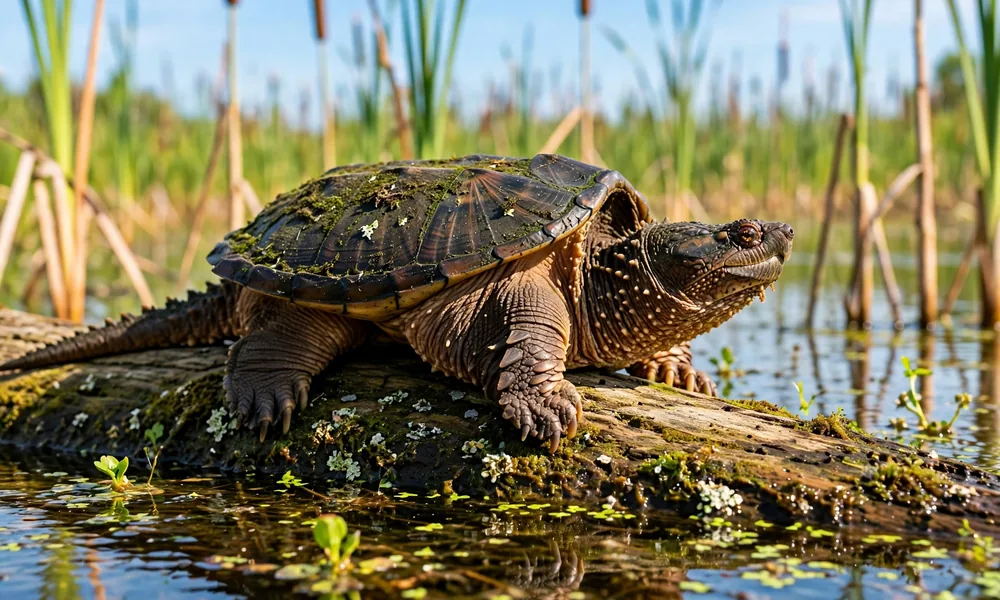
The best hours are the early morning and the late afternoon, when the sun is low and the turtles come out to bask. A warm, sunny morning after a cool night is ideal: the turtles will be on logs and banks, soaking up the heat, and they will stay put longer than they will at midday. In the heat of midsummer, the evening is good too, as the animals start to move and feed in the shallows. By autumn they grow quiet, and in winter they are under the ice, out of sight entirely until the spring thaw.
Staying safe around snapping turtles
A snapping turtle is not dangerous to people who leave it alone, but it is an animal to treat with real respect, and the safety rules are mostly about not frightening it and never trying to pick it up. The animal has no venom, it does not chase people, and its first response to a human in the water is to swim away. On land, though, a cornered snapping turtle will turn, hiss, and strike, and its bite can crush bone and take a finger, so the rule is simple: never grab one, never corner one against a bank, and never try to make it display by poking it or pulling its tail.
Wear closed shoes near ponds and marshes, and watch where you put your hands among logs and rocks, not because of the snapping turtle but because of the snakes and insects that share its country. If you find one on a road, lift it by the back of the shell only, keep well clear of the head, and move it in the direction it was already going. If you are bitten, wash the wound with soap and water, keep it clean, and seek medical advice promptly, as with any deep animal bite.
Snapping turtle watching checklist
A little preparation turns a walk around a pond in June into a real chance of seeing one of these big, rough-shelled turtles.
- A visit in late spring or early summer, from May to July, when the turtles are feeding and the females are coming ashore to nest.
- An early morning or late afternoon start, when the animals are basking on logs and banks in the low sun.
- A weedy pond, marsh or slow river with a muddy bottom, fallen logs and plenty of cover for the turtles to hide in.
- A slow walk that scans logs, banks and the water surface, watching for a dark shell or a head breaking the surface.
- Binoculars, which let you watch a basking turtle from a distance without driving it back into the water.
- Closed shoes and long trousers, for the mud, the reeds and the other animals that share the turtle’s ground.
- Respect for the animal and its ground, keeping your distance, never handling it, and leaving nests and basking logs as you found them.
Frequently asked questions
How big do snapping turtles get?
Most adult snapping turtles have a carapace 20 to 50 centimetres long and weigh 4.5 to 16 kilograms, and a very large old male can reach about 35 kilograms. Females are a little smaller than males, and young animals are much smaller, at about 2.5 to 3.5 centimetres when they hatch.
Can a snapping turtle bite off a finger?
A snapping turtle’s bite is strong enough to crush bone and to cause a serious injury, including the loss of a finger, though such injuries are rare and almost always happen when someone picks the animal up or puts a hand near its head. The turtle does not chase people, and in the water it will swim away. The sensible approach is to admire it from a distance and never try to handle it.
Why can a snapping turtle not hide in its shell?
The snapping turtle’s plastron, the flat shell underneath, is small, narrow and cross-shaped, so it leaves the head, legs and tail exposed. There is simply not enough shell to cover the animal, which is why it defends itself by biting rather than by hiding. Most pond turtles have a large plastron that lets them pull everything inside, but the snapping turtle gave that up in exchange for a bigger body and a stronger bite.
What do snapping turtles eat?
A snapping turtle eats fish, frogs, tadpoles, crayfish, snails, insects and worms, as well as plants such as pondweed and duckweed, and it will also eat carrion. It hunts by waiting half-buried on the bottom and lunging at prey that comes too close, and it feeds most in the warm months, from late spring through early autumn.
How long do snapping turtles live?
A snapping turtle that survives its dangerous first year can live 30 to 40 years in the wild, and some animals pass 50. They grow slowly, reach breeding size at about 8 to 10 years old in the south and later in the north, and they spend each winter hibernating under the ice, barely moving, until the spring thaw.
How is this guide different from the painted turtle guide?
This guide covers the snapping turtle, a big, rough-shelled freshwater turtle of North America that hunts fish and frogs from the muddy bottom, cannot hide in its shell and bites hard when cornered, while our painted turtle guide covers a small, smooth-shelled pond turtle that basks in crowds on sunny logs, eats plants and insects, and pulls neatly inside a brightly marked shell. One is a heavyweight ambush hunter of the mud; the other is a small, sociable sun-bather of the shallows.
Conclusion
The snapping turtle species is a reminder that a turtle does not need a pretty shell to be remarkable. A big, rough carapace, a long saw-toothed tail, a neck that strikes like a snake and a bite that commands respect have made Chelydra serpentina one of the most successful freshwater turtles in North America, at home in a farm pond, a city park lake, a marsh full of cattails and a slow river alike.
If you go looking for one, go in June, go in the early morning, and walk slowly around a weedy pond with your eyes on the logs and the water’s edge. Find the dark shell basking in the low sun, watch it from a good distance, and leave it exactly as you found it, and you will have met the turtle that has been doing things its own way, unhurried and unbothered, for millions of years.