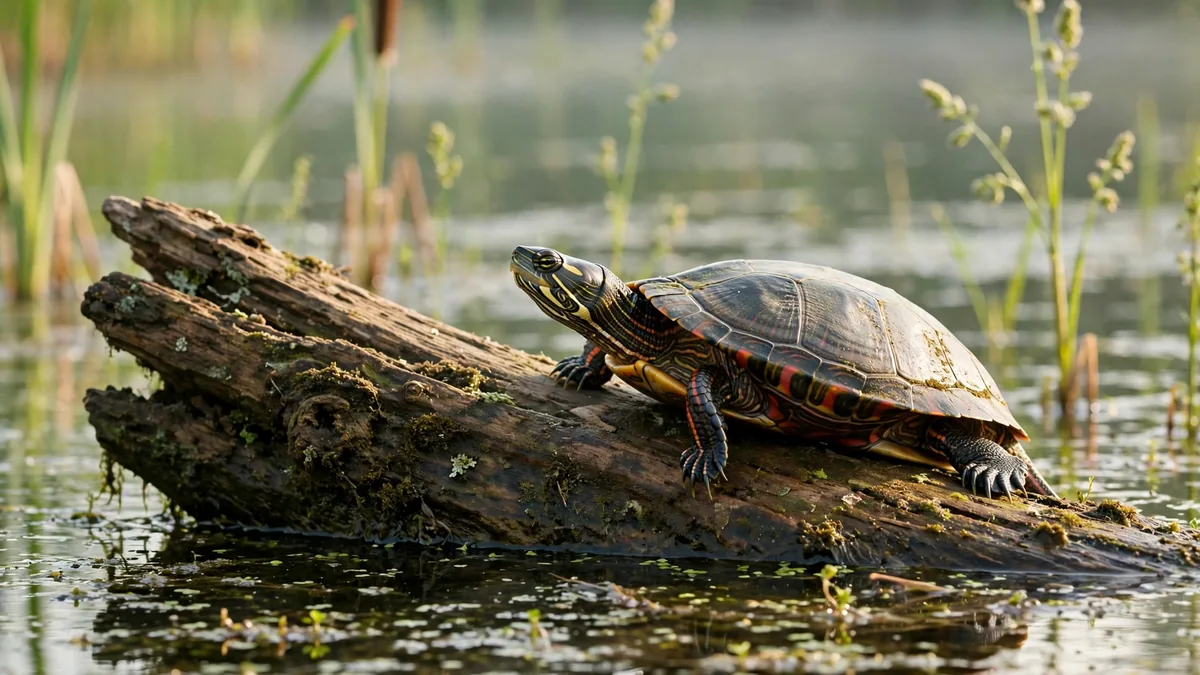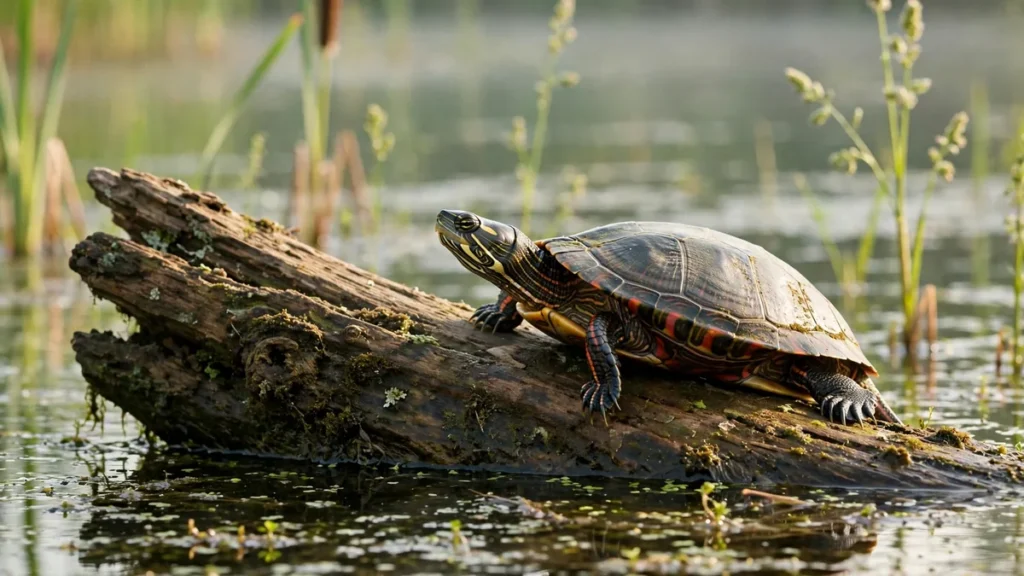
The painted turtle species is North America’s most widespread turtle, a small, brightly marked reptile that spends its days basking on logs and its winters asleep beneath the ice. If you are asking what a painted turtle is, the short answer is Chrysemys picta, a pond turtle with a smooth, dark shell edged in red and yellow, a carapace usually 10 to 25 centimetres long, and a habit of piling up with its neighbours on any sunny log that sticks out of the water. It is not a rare or secretive animal that only experts ever see. A painted turtle is the turtle on the log in the park pond, the turtle crossing the road in June, and the turtle a child points at from the bank on a summer afternoon.
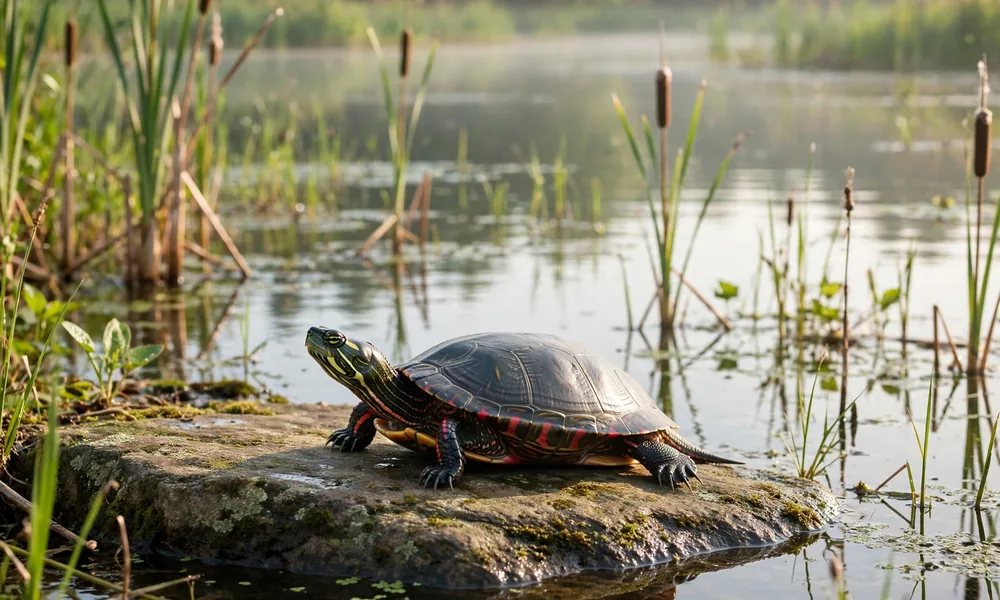
Most people meet a painted turtle in exactly that way, and the meeting is usually a quiet one. The animal is stretched out on a half-sunken branch in the morning sun, its shell dark olive with red and yellow markings along the rim, its head striped in yellow, and then it slips into the pond at the first footstep and is gone, leaving only a ripple and a widening ring of water. That mix of bold colour and quick caution is the painted turtle all over: one of the commonest reptiles on the continent, and one of the most charming, because it lives where people live, in ponds and lakes and slow rivers, and it basks in plain sight for anyone patient enough to watch.
Key takeaways
- The painted turtle species is Chrysemys picta, the most widespread turtle in North America, with a carapace usually 10 to 25 centimetres long.
- It has four subspecies, eastern, midland, western and southern, which differ in the pattern on the underside of the shell.
- It is a strong basker, spending hours on logs and rocks in the sun, and it eats plants, insects, snails and small fish.
- Females lay 4 to 20 eggs in a nest dug on land, and the sex of the hatchlings depends on the temperature of the nest.
- It can survive the winter under the ice of a frozen pond, slowing its body almost to a standstill for months at a time.
The painted turtle species and its relatives
Painted turtles belong to the family Emydidae, the pond turtles, and to the genus Chrysemys, a group that contains the painted turtle alone. The scientific name, Chrysemys picta, means quite simply the painted turtle, from the Greek chrysos for gold and the Latin picta for painted, and it was given by Johann Gottlob Schneider in 1783, when the animal was first described from specimens taken in eastern North America. The name has stuck ever since, even though the turtle’s range reaches far beyond the east, across almost the whole of the continent.
For a long time, the painted turtle was treated as a single species with a very large range, and that is still the standard view, but it is divided into four subspecies, each with its own home ground and its own pattern on the underside of the shell. The eastern painted turtle lives along the Atlantic coast, the midland painted turtle lives around the Great Lakes and the middle of the continent, the western painted turtle lives from the prairies to the Pacific coast, and the southern painted turtle lives along the Gulf Coast and the lower Mississippi.
| Type | Animal | Where it lives | Best-known food | Length or Weight |
|---|---|---|---|---|
| Family | Pond turtles (Emydidae) | North America, Europe and Asia | Plants and small animals | About 10 cm to 40 cm long |
| Genus | Painted turtles (Chrysemys) | North America | Plants, insects and small fish | About 10 cm to 25 cm long |
| Species | Painted turtle (Chrysemys picta) | North America | Plants, insects and small fish | About 10 cm to 25 cm long |
| Species | Red-eared slider (Trachemys scripta elegans) | Southern United States | Plants, insects and small fish | About 15 cm to 30 cm long |
| Species | Common snapping turtle (Chelydra serpentina) | North and Central America | Fish, frogs and carrion | About 20 cm to 50 cm long |
| Species | Eastern box turtle (Terrapene carolina carolina) | Eastern United States | Plants, fungi and insects | About 10 cm to 20 cm long |
The closest relatives of the painted turtle are the other pond turtles of North America, and the resemblance is easy to see. The red-eared slider of the southern United States is a similar size and shape, though it wears a bright red stripe behind each eye, while the cooter turtles of the rivers are larger and heavier, with long, striped necks. The painted turtle is the smallest and most brightly marked of the common pond turtles, and it is the one that has spread furthest, from the cold lakes of Canada to the warm ponds of Mexico.
Like the turtle family as a whole, the painted turtle carries its home on its back, and the shell is both its shelter and its signature. The shell is smooth and flat, built for slipping through the water rather than for walking on land, and it is decorated in a way that no other common pond turtle quite matches, with red and yellow markings that look as though someone has painted them on with a fine brush. One turtle on a log can be hard to tell from another, but a painted turtle, once you have seen the red rim of its shell, is hard to mistake for anything else.
One thing that sets the painted turtle apart from most of its relatives is how far north it lives. The painted turtle is the only turtle found across the whole of Canada south of the Arctic, and it survives winters that would kill most other reptiles, buried in the mud beneath the ice of a frozen lake for months at a time.
What a painted turtle looks like
A painted turtle is a small, flat turtle, light in the hand and smooth to the touch, with a shell that looks polished rather than rough. Most adults have a carapace, the upper shell, of about 10 to 25 centimetres long, and the shell is low and smooth, without the high dome of a land tortoise and without the rough ridges of a snapping turtle. The weight is usually 300 grams to about 1 kilogram, though a big old female, fat on a summer of pondweed and snails, can be heavier.
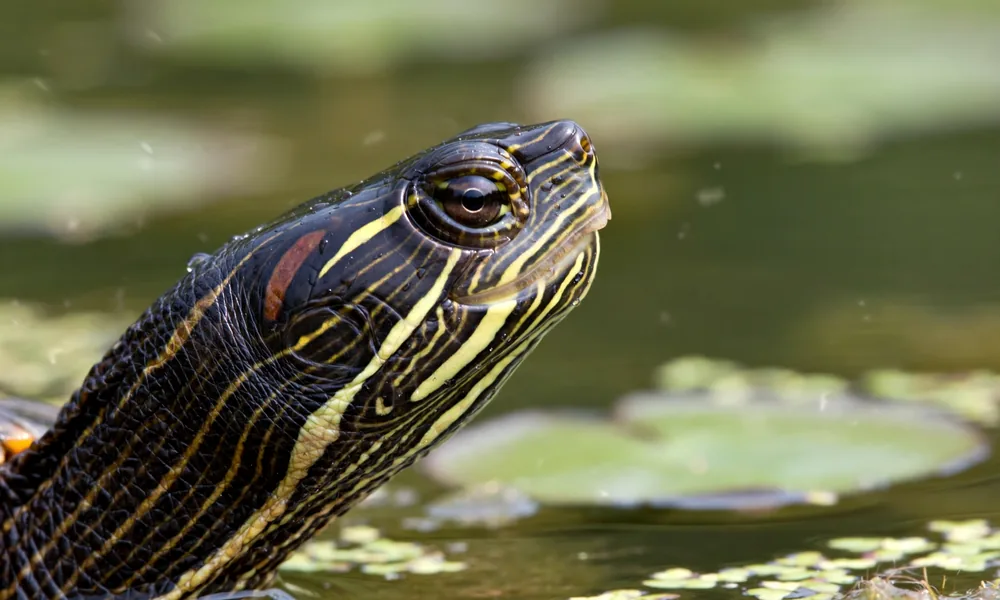
The colouring is the first thing anyone notices, and it is unmistakable once you have seen it. The upper shell is dark olive or black, sometimes with a faint red or yellow line down the middle, and the rim of the shell is marked with red and yellow, as though someone has run a paintbrush around the edge. The underside of the shell, the plastron, is yellow or orange with a dark blotch in the middle, and the pattern of that blotch is what tells the four subspecies apart. The head, neck, legs and tail are dark with fine yellow stripes, and the stripes on the head are the brightest of all, running in neat lines from the nose back past the eyes.
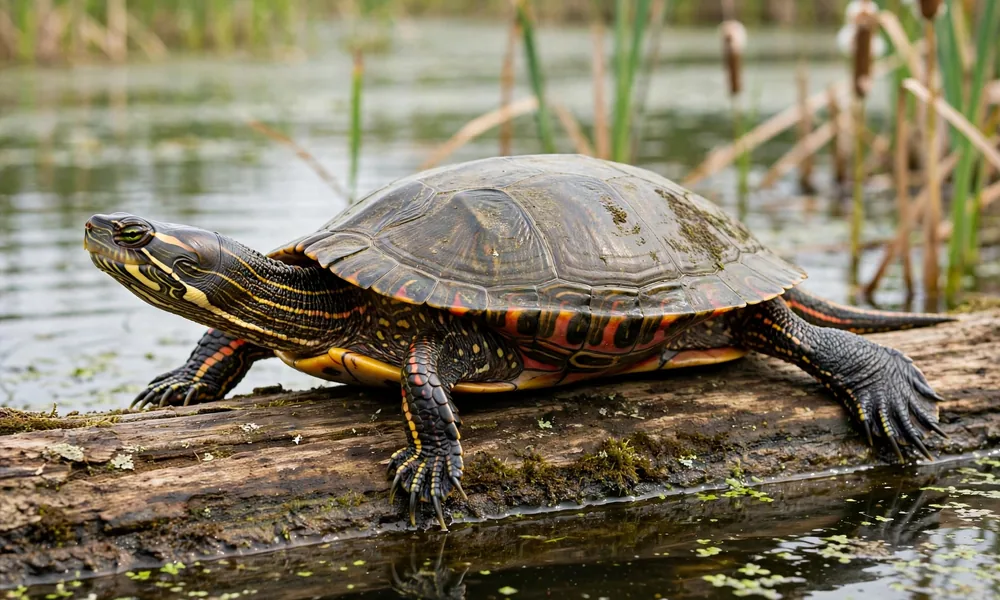
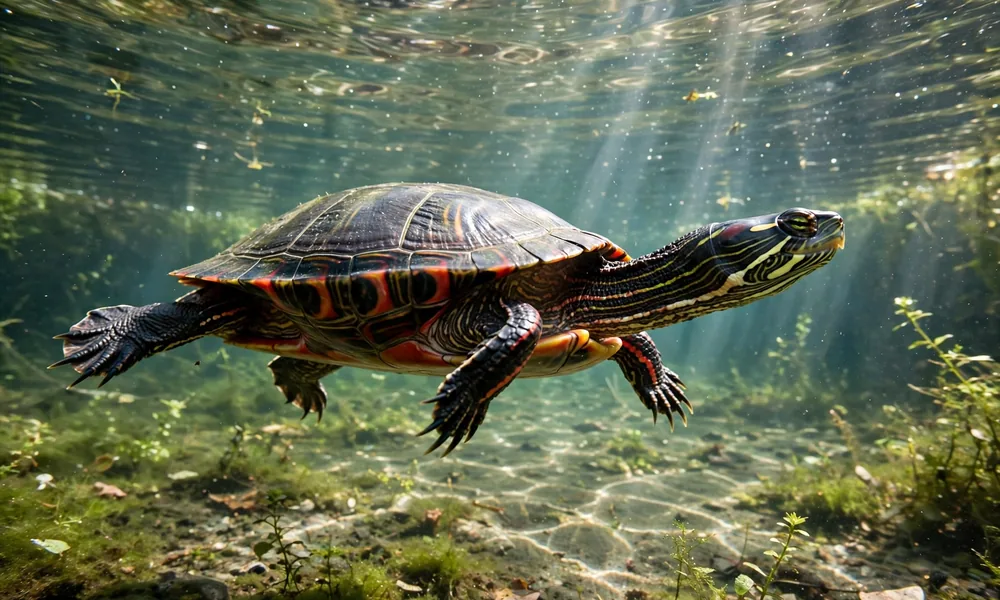
The head is small and pointed, with dark eyes, a short snout and a mouth that looks as though it is smiling, and the neck is long enough to reach up to the surface for a breath while the rest of the body stays underwater. The legs are short and sturdy, with webbed feet that paddle well in the water and claws that grip the mud and the logs, and the tail is short in a female and longer and thicker in a male.
Females are usually a little larger than males, with a shorter tail and a flatter underside to the shell, while males are smaller, with a longer tail and a slightly hollow underside that helps them balance during mating. Young painted turtles are much more brightly marked than adults, with bold red and yellow markings that stand out sharply against the dark shell, and the colours soften a little as the animal ages, though they never fade away entirely.
Where painted turtles live
Painted turtles live across North America, in a range that runs from the Atlantic coast of Canada and the United States, through the Great Lakes and the prairies, and west to the Pacific coast, and south to the Gulf of Mexico and northern Mexico. They are found from British Columbia to Nova Scotia, and from the cold lakes of the north to the warm ponds of the south, and they are the most widespread turtle on the continent by a clear margin. They are absent only from the driest deserts of the south-west, where there is no permanent water, and from the far north, beyond the tree line, where the summers are too short for their eggs to develop.
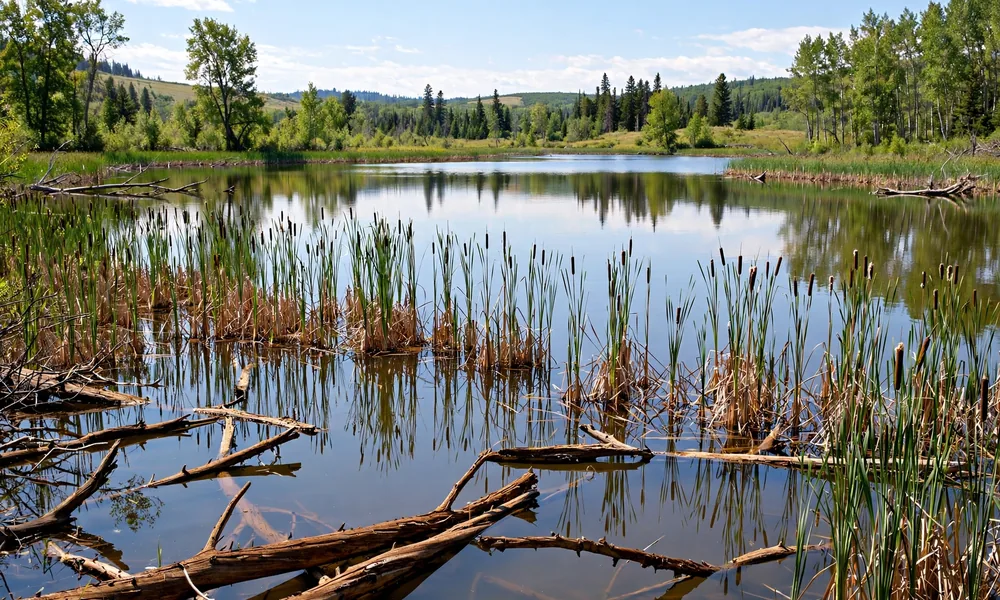
The habitat they choose is always quiet water. In the wild a painted turtle lives in ponds and lakes, in marshes and slow rivers, in beaver ponds and farm ponds and park lakes, usually in water that is shallow, warm and full of plants. They are swimmers first and foremost, and they spend much of the day in or beside the water, basking on a log or a rock, slipping into the pond to feed, and climbing out again to warm up in the sun. A painted turtle rarely wanders far from water unless it has to, and it is far more at home in a reed bed than it is on open dry ground.

A painted turtle needs somewhere to bask as well as somewhere to swim. By day it basks in the open, stretched out on a log, a rock or a muskrat lodge, but at night, and in the heat of the afternoon, it retreats to the bottom of the pond, resting in the mud or tucked among the water plants. A basking log is a prized spot, and several painted turtles will often pile up on the same log, one on top of another, in a slow, sleepy heap.
The climate matters a great deal to where they can live, and the painted turtle has solved the problem of cold winters in a remarkable way. In the north, where the ponds freeze over for months, the painted turtle buries itself in the mud at the bottom of the pond and slows its body almost to a standstill, breathing through its skin and the lining of its cloaca, and waiting out the winter without eating or moving.
What painted turtles eat
Painted turtles are generalist feeders with a healthy appetite, and they eat almost anything they can find in the pond. The everyday diet is built around the plants of the shallow water: duckweed, pondweed, algae and the soft leaves of water lilies, all grazed from the surface or plucked from the stems below. A painted turtle will spend hours drifting through a weed bed, nibbling at the plants, and a pond full of duckweed can keep a whole colony of painted turtles fed through the summer.
Insects and other small animals are the second pillar of the diet, and the painted turtle is a quick and eager hunter in the water. It eats dragonfly larvae, water beetles, snails, small crustaceans and tadpoles, snapping them up with a quick dart of its head, and it will also take small fish when it can catch them, though it is too slow to chase a healthy fish in open water. Carrion is eaten too, and a painted turtle will pick at a dead fish or a drowned frog with the same enthusiasm it shows for a fresh snail. Like the alligator snapping turtle, a painted turtle is a pond hunter that takes what the water offers, but the snapping turtle is a huge, bottom-dwelling ambush hunter with a bite to respect, while the painted turtle is a small, active swimmer that grazes and picks its way through the shallows.
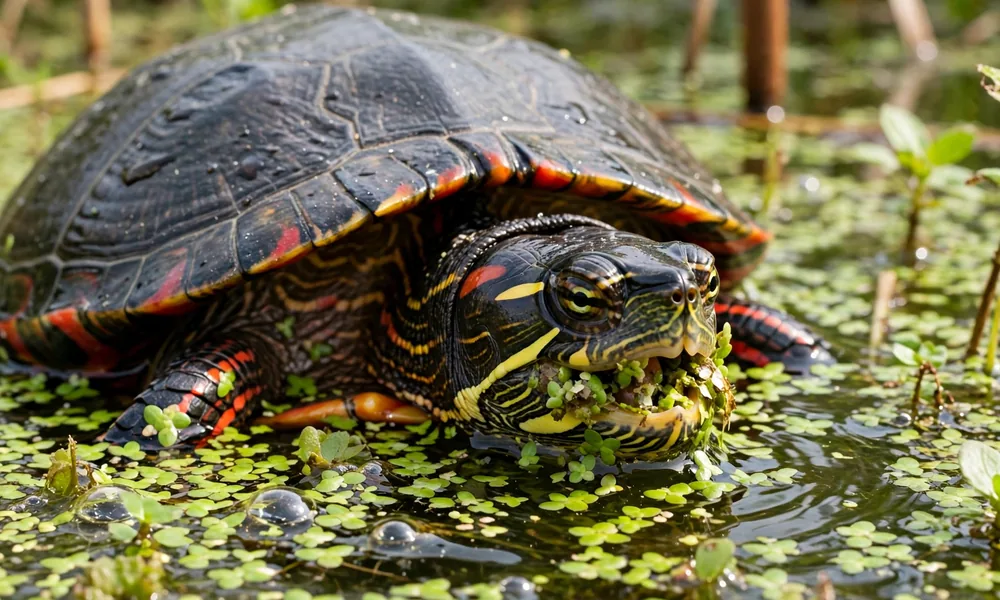
What sets the painted turtle apart from many other pond turtles is how much of its diet is plants. Young painted turtles are mostly meat-eaters, hunting insects and small animals to fuel their fast growth, but as they grow older they eat more and more plants, and an adult painted turtle may eat mostly pondweed and algae for much of the summer.
Feeding changes with the seasons. In the spring, when the turtles come out of hibernation hungry and thin, they feed hard on whatever is available, building up fat for the breeding season. In the summer, when the pond is warm and the plants are thick, feeding is easy and the turtles grow fast.
How painted turtles behave
Painted turtles are day-active, strong baskers and sociable sunbathers, and those three habits shape almost everything they do. By day they are out and about, basking on a log in the morning sun, then slipping into the water to feed, then climbing out again to warm up and digest. They are not creatures of the night. At dusk they slide off their logs and settle on the bottom of the pond, and they spend the night resting in the mud or among the water plants, safe from the herons and raccoons that hunt after dark.
The basking is the behaviour most people remember, and it is worth watching properly. A painted turtle basks to warm its body, to dry its shell and to kill the algae and leeches that grow on it, and it will stretch its legs out behind it and its neck out in front, spread flat on a log like a small, dark pancake, soaking up the sun for hours. Several turtles will often share a log, piling up on top of each other in a slow, sleepy heap, and the whole pile will slide into the water at the first footstep, one turtle after another, with a soft plop each time.
When a painted turtle is threatened, it does not behave like an animal that wants to fight. Its first response is usually to slip into the water and vanish, and if that is not possible it will pull its head and legs into its shell and wait, safe behind a wall of bone. It has no venom, it does not chase people, and its bite is small and weak compared with a snapping turtle’s, though a large adult can still nip a finger that is offered too close. Like the Aldabra giant tortoise, a painted turtle is a shelled reptile that relies on its armour rather than on speed or teeth, but the tortoise is a giant land animal that weighs hundreds of kilograms, while the painted turtle is a small pond animal that weighs less than a bag of sugar.
Painted turtles are tolerant of each other for most of the year, and they do not defend a territory the way a lizard does. A good basking log may hold a dozen turtles, and a good feeding ground may be shared by many more, and the animals jostle gently for the best spot in the sun without ever coming to blows.
Breeding and life cycle
Painted turtles breed in the spring and early summer, usually from April to June across most of their range, when the water is warm and the pond is full of food. Males seek out females in the shallow water, and courtship is a gentle, fluttering affair: the male swims in front of the female, turns to face her, and waves his long front claws in front of her eyes in a slow, rhythmic dance, and the female may watch for a while before she accepts him or swims away. Mating takes place in the water, and it lasts only a few minutes, after which the male moves on and the female goes off to find a place to lay her eggs.
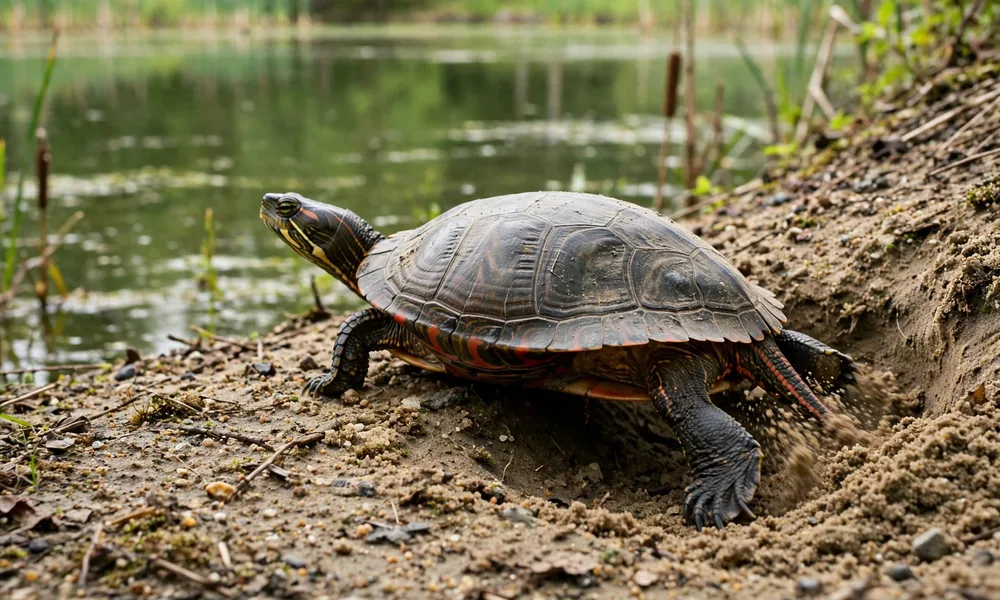
The female lays her eggs on land, in a nest she digs herself. She comes ashore in the evening, usually in June or July, and walks some way from the water to find a sunny, well-drained spot, often a sandy bank, a garden bed or the edge of a road. She digs a flask-shaped hole with her hind feet, lays 4 to 20 soft, white eggs in it, covers them carefully with soil, and pats the ground flat with her plastron before she walks back to the water. She never sees her eggs again, and she gives them no care at all once they are buried.
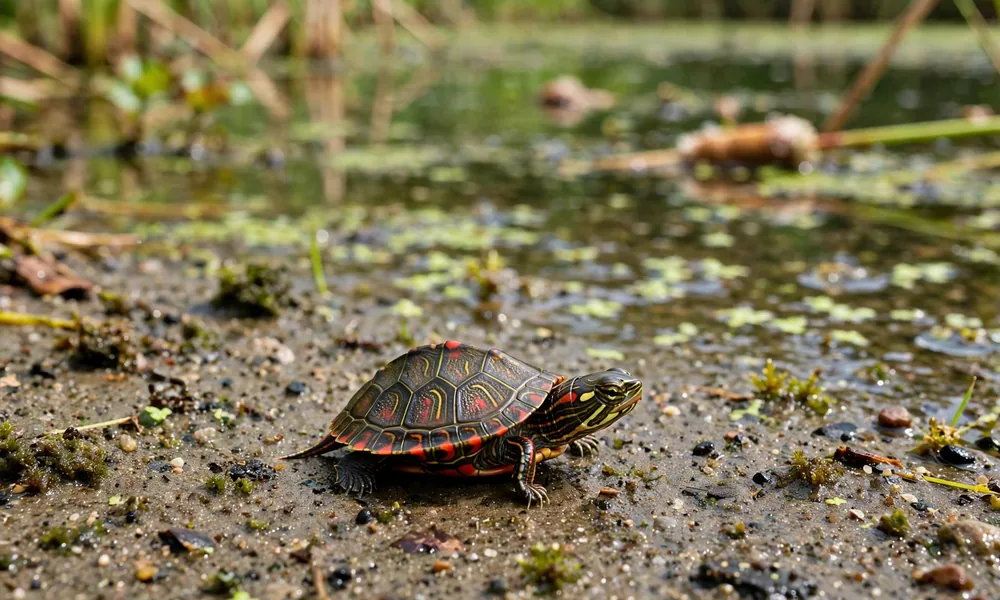
Incubation takes about two to three months depending on temperature, and the temperature of the nest decides the sex of the hatchlings, a system called temperature-dependent sex determination. Warm nests, above about 29 degrees Celsius, produce mostly females, while cooler nests produce mostly males, and a nest in the middle produces a mix. The hatchlings emerge at about 2 to 3 centimetres long, perfect miniature copies of their parents with bright red and yellow markings, and they are independent from birth, able to swim and hunt small insects within days.
Growth is slow, and a painted turtle reaches breeding size at about five to seven years old, when it is close to full length. The lifespan in the wild is thought to be around twenty to thirty years, though animals that survive the dangerous first year, when they are small enough to be eaten by herons, raccoons and large fish, can live considerably longer.
Conservation status
The painted turtle is listed as Least Concern by the International Union for Conservation of Nature, and the reasoning is straightforward: it has a very large range, it is still common in much of that range, and it adapts well to living near people, in farm ponds and park lakes as well as in wild wetlands. That broad picture hides a more worrying local one, and it is worth understanding both sides, because the painted turtle is one of the most commonly collected turtles in North America.
The main pressure is collection. Painted turtles are taken in large numbers for the pet trade, where young animals are sold to keepers around the world, and they are also taken for food in some parts of their range. The trade is regulated in many states and provinces, with limits on how many turtles can be taken and a ban on selling very small turtles in the United States, but the rules are hard to enforce in the field, and illegal collection still takes animals from local populations.

The second pressure is the road. A female painted turtle that crosses a road to lay her eggs is in real danger, and thousands of turtles are killed on roads every summer, many of them breeding females whose loss is felt by the whole population. A turtle that has lived for twenty years can be killed in a second by a car, and the loss of breeding females is the hardest blow a turtle population can take, because turtles are slow to replace themselves. The most useful conservation work is practical: building fences and tunnels that guide turtles safely under roads, and protecting the nesting banks where females lay their eggs.
Habitat loss is the third pressure, as wetlands are drained for farming and housing, and as the ponds and marshes that painted turtles need are filled in. The most useful conservation work is simple: protecting wetlands, leaving logs and basking spots in place, and giving turtles a safe way to cross the roads that cut through their home.
Best seasons for painted turtle watching
The best time to look for a painted turtle is the warm season, from about May to September across most of its range, when the ponds are warm, the turtles are basking for hours at a time, and the animals are out feeding and breeding for much of the day. The breeding season brings the females ashore to lay their eggs, which makes them easier to find, though they should never be disturbed while they are nesting. In the winter the animals are asleep under the ice, and a pond walk will produce nothing at all.
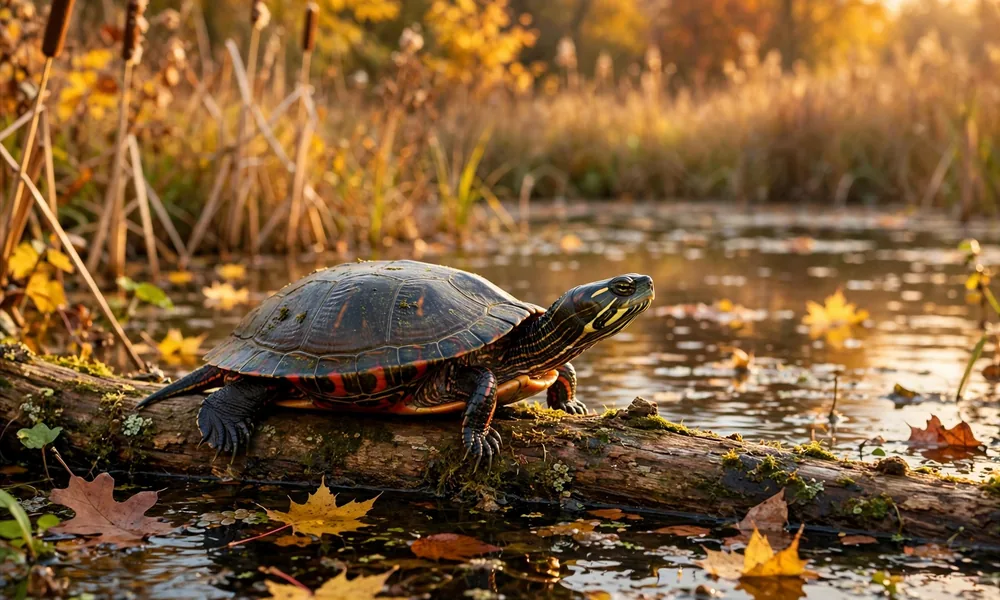
The best hours are the first few hours after sunrise, from about eight o’clock until midday, when the painted turtle is warm, alert and hungry, and when it is most likely to be basking on a log or a rock in plain view. By late afternoon it may come out again to bask, and a quiet walk along a pond bank at dusk can be rewarding. A pair of binoculars helps, because a painted turtle will often slide into the water long before you are close enough to see it clearly.
Staying safe around painted turtles
A painted turtle is not dangerous to people, and the safety rules are mostly about not frightening it and not trying to pick it up. The animal has no venom, it does not chase people, and its first response to a human is usually to slip into the water and vanish. A large adult can nip if it is grabbed, though, so the rule is simple: never grab one, never pick one up by its tail, and give it a clear path to the water.
There are a few practical points for the ground itself. Wear closed shoes on a pond bank, and watch where you put your hands among rocks and logs, not because of the painted turtle but because of the snakes and snapping turtles that share its country, and because a painted turtle’s pond is, by definition, good ground for other animals too. If you find a painted turtle crossing a road, help it across in the direction it was already going, and never carry it back to the water it came from. If you are nipped, wash the wound with soap and water, keep it clean, and seek medical advice if it becomes red, swollen or infected, as with any animal bite.
Painted turtle watching checklist
A little preparation turns a morning walk around a North American pond into a real chance of seeing one of these small, brightly marked turtles.
- A visit in the warm season, from May to September, when the turtles are basking and feeding for much of the day.
- A morning start, from about eight o’clock until midday, when the animals are warm, alert and most likely to be out in the open.
- A pond, lake or slow river with logs and rocks, where turtles can bask, feed and slip into the water.
- A slow walk that scans logs, rocks and branches at the water’s edge, listening for the soft plop of a turtle sliding in.
- Binoculars, which let you watch a turtle from a distance without driving it into the water.
- Closed shoes and long trousers, for the snakes and thorny ground that share the painted turtle’s pond bank.
- Respect for the animal and its ground, keeping your distance, never handling it, and leaving logs and basking spots as you found them.
Frequently asked questions
How big do painted turtles get?
Most adult painted turtles have a carapace, the upper shell, of about 10 to 25 centimetres long, and they weigh about 300 grams to about 1 kilogram, though a big old female can be heavier. Females are usually a little larger than males, and young animals are much smaller, at about 2 to 3 centimetres when they hatch.
Are painted turtles dangerous?
No, painted turtles are not venomous, and they are not dangerous to people. They can nip if they are grabbed, though, and a large adult has a sharp beak that can break the skin, because they are wild animals with a bite meant for snails and plants. The sensible approach is to admire them from a distance and never try to pick one up.
What do painted turtles eat?
A painted turtle eats pondweed, duckweed, algae and other water plants, and it also eats insects, snails, tadpoles and small fish. Young painted turtles eat mostly meat, to fuel their fast growth, while adults eat more and more plants, and an adult may eat mostly pondweed and algae for much of the summer.
Where do painted turtles lay their eggs?
A female painted turtle lays 4 to 20 soft, white eggs in a nest she digs on land, usually in a sunny, well-drained spot some way from the water, in June or July. She covers the eggs with soil and walks back to the pond, and the eggs hatch after about two to three months, with the temperature of the nest deciding whether the hatchlings are male or female.
Can painted turtles survive under the ice?
Yes. The painted turtle is one of the few reptiles that can survive for months under the ice of a frozen pond, buried in the mud at the bottom and slowing its body almost to a standstill. It breathes through its skin and the lining of its cloaca, it does not eat or move, and it waits out the winter until the ice melts in the spring.
How is this guide different from the Nile monitor guide?
This guide covers the painted turtle, a small pond turtle of North America that basks on logs, eats pondweed and snails and sleeps under the ice all winter, while our Nile monitor guide covers a large river lizard of Africa that swims, climbs and hunts crabs and fish along the banks of the Nile and the Zambezi. One is a gentle basker of the cold northern ponds; the other is a bold hunter of the warm African rivers.
Conclusion
The painted turtle species is a reminder that an animal does not need to be a giant to be unforgettable. A small dark shell edged in red and yellow, a head striped in gold, a life lived on a log in the sun and under the ice in the winter have made Chrysemys picta one of the best-known reptiles in North America, at home in a park pond, in a farm pond and in the wild wetlands of a thousand lakes alike.
If you go looking for one, go on a warm morning in the summer, go soon after sunrise, and walk slowly around the pond with your eyes on the logs and fallen branches and your ears open for a soft plop. Find the basking log, wait quietly at a distance, and you will have met the most widespread turtle on the continent, doing what it has done for millions of years.