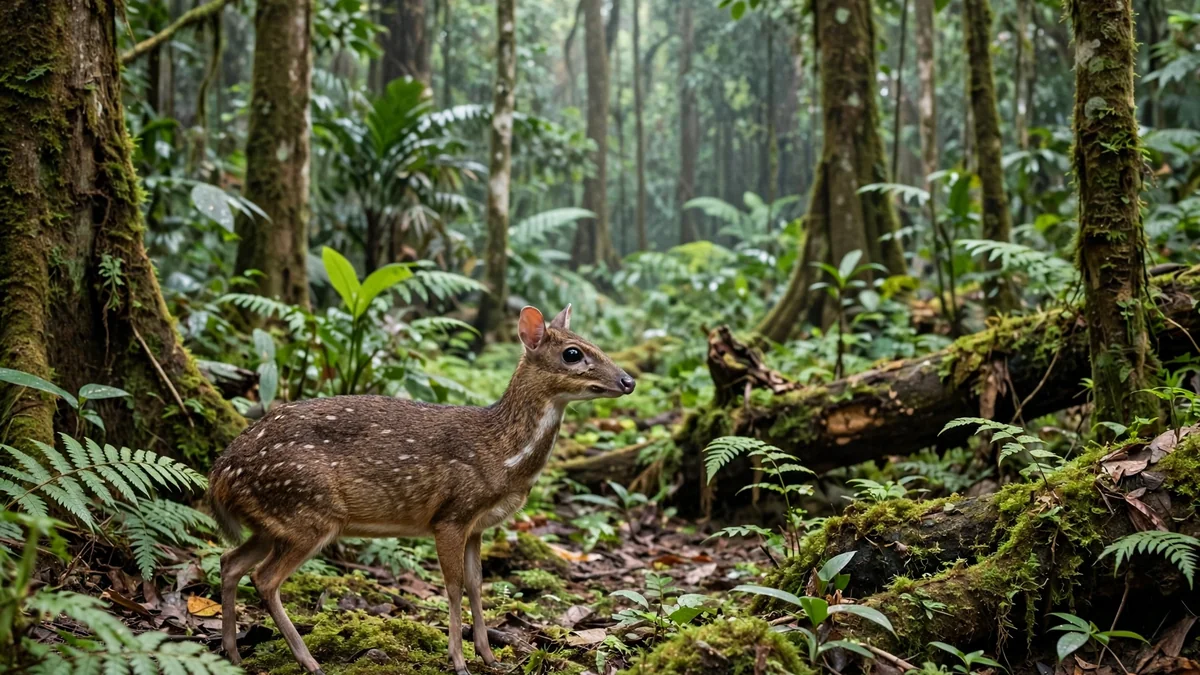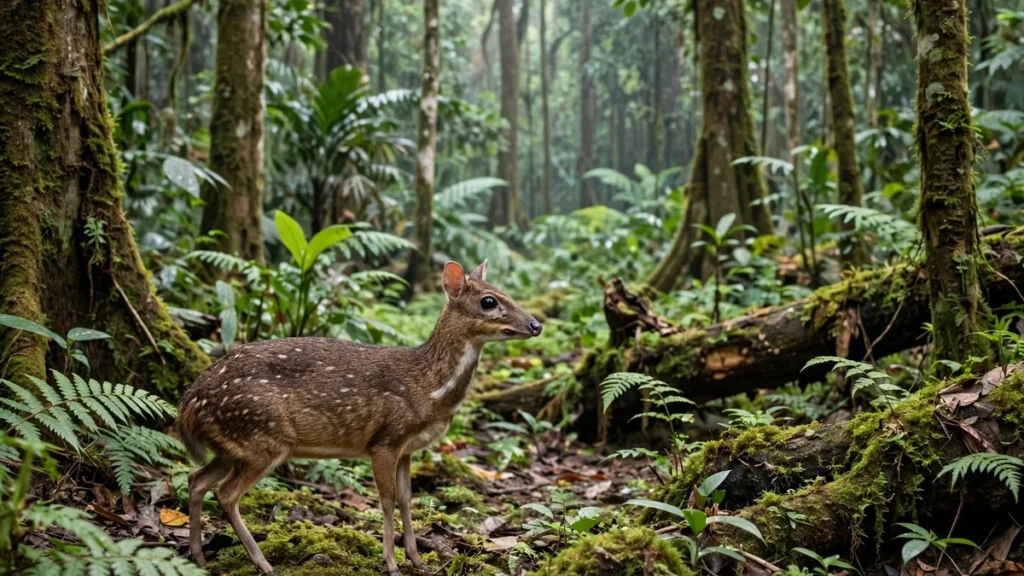
Mouse deer species are the smallest hoofed animals on Earth, tiny antlerless deer-like ruminants that live in the rainforests of Asia and Africa. If you are wondering how many mouse deer species there are, the answer is about 10 living species, although the exact number depends on the authority, because the Asian mouse deer of the genus Tragulus are still being divided by genetic research, and this guide introduces the best-known of them, from the greater mouse deer of South-east Asia to the water chevrotain of Africa.
Key takeaways
- There are about 10 living mouse deer species, in the genera Tragulus, Moschiola and Hyemoschus.
- Mouse deer are antlerless, and males carry long, sharp upper canine teeth like small tusks instead of antlers.
- The lesser mouse deer is one of the smallest hoofed animals in the world, about 45 centimetres long and under 2 kilogrammes.
- Most mouse deer live in the rainforests of South-east Asia, while the water chevrotain is the only African species.
- Mouse deer are shy, mostly nocturnal animals that feed on fallen fruit, leaves and buds on the forest floor.
What makes a mouse deer a mouse deer
A mouse deer looks like a deer shrunk to the size of a rabbit, with very slender legs, an arched back, a pointed face, large dark eyes and a soft brown or reddish-brown coat, often with pale markings on the throat and chest. The smallest species stand only about 20 centimetres tall at the shoulder, and even the largest reach only about 40 centimetres.
Mouse deer belong to the family Tragulidae and are also known as chevrotains. They are among the most primitive living ruminants: they chew the cud, but their stomach has three chambers rather than the usual four found in cattle, sheep and true deer. This simple stomach, their small size and their lack of antlers mark them out as an ancient branch of the ruminant family tree. In place of antlers they have long upper canine teeth, which in males grow downwards like small, sharp tusks.
The mouse deer species and their relatives
The Asian genus Tragulus holds the greater, lesser and Java mouse deer. The greater mouse deer, Tragulus napu, is the largest Asian species, about 70 to 75 centimetres long and up to 5 kilogrammes, and it lives across much of South-east Asia. The lesser mouse deer, Tragulus kanchil, is the smallest, about 45 centimetres long and under 2 kilogrammes, and it is widespread from Myanmar and Thailand through Malaysia, Sumatra and Borneo. The Java mouse deer, Tragulus javanicus, lives on Java and Bali, and the Balabac mouse deer, Tragulus nigricans, lives only on Balabac Island in the Philippines, where it is listed as Endangered.
The second Asian genus is Moschiola, the spotted chevrotains of the Indian subcontinent: the Indian spotted chevrotain, Moschiola indica, in the forests of India, the Sri Lanka spotted chevrotain, Moschiola meminna, found only on Sri Lanka, and the yellow-striped chevrotain, Moschiola kathygre, recognised as a separate species in 2005 in the wet forests of south-west Sri Lanka.
The third genus has a single species, the water chevrotain, Hyemoschus aquaticus, the only mouse deer that lives in Africa and the largest chevrotain, at about 85 centimetres long and 10 to 15 kilogrammes. It lives in the rainforests of West and Central Africa, always near rivers and streams, and it is a strong swimmer that dives underwater to escape danger. True deer are the closest relatives of mouse deer, but they belong to a different family, Cervidae, and they grow antlers. The muntjac, pudu and dik-dik are small deer and antelope often compared with mouse deer, and they are listed below as close relatives. Lengths are head and body lengths.

| Type | Animal | Where it lives | Best-known food | Length |
|---|---|---|---|---|
| Species | Water chevrotain | West and Central African rainforest | Fallen fruit and leaves | 0.85 metres |
| Species | Greater mouse deer | South-east Asian rainforest | Fallen fruit, leaves and buds | 0.75 metres |
| Species | Lesser mouse deer | South-east Asia | Fallen fruit, leaves and shoots | 0.45 metres |
| Species | Java mouse deer | Java and Bali | Fallen fruit and leaves | 0.55 metres |
| Species | Indian spotted chevrotain | India | Fallen fruit, leaves and buds | 0.50 metres |
| Close relative | Muntjac | Asia | Leaves, fruit and shoots | 0.90 metres |
| Close relative | Pudu | South America | Leaves, fruit and flowers | 0.85 metres |
| Close relative | Dik-dik | Eastern and southern Africa | Leaves, shoots and fruit | 0.65 metres |
How mouse deer live
Mouse deer are mostly active at dawn, at dusk and through the night, resting during the heat of the day in dense thickets, hollow logs or tangles of roots. They are generally solitary, and each animal holds a small territory that it defends against others of the same sex. When two males meet they may fight with their canine tusks, but these fights are usually brief and the loser slips away into the undergrowth.
Most mouse deer eat fallen fruit, leaves, buds and shoots, picking food from the forest floor rather than grazing in the open. The water chevrotain also eats the occasional crab or insect. Mouse deer usually give birth to a single young after a pregnancy of about five to six months. The young is born well developed, with its eyes open and a spotted coat, and it can stand within half an hour of birth. A female can mate again within a day or two of giving birth, so she can raise two young in a single year.
Where mouse deer live
Most mouse deer live in the lowland rainforests of South-east Asia, from Myanmar and Thailand through the Malay Peninsula, Sumatra, Borneo, Java and the Philippines. They prefer dense, undisturbed forest with a thick layer of leaf litter and fallen fruit, and they are often found near streams. The rainforest animals that share this habitat include hornbills, gibbons and clouded leopards, and mouse deer are prey for all of the larger hunters.
Within the forest, mouse deer stay close to cover and rarely venture into open ground. They use the same well-worn paths through the undergrowth, moving between feeding places, resting sites and water, and they freeze when they sense danger, relying on their camouflage before they run. The forest animals of South-east Asia include several mouse deer species living side by side in the same forest. The water chevrotain lives in the rainforests of West and Central Africa, staying close to rivers, swamps and flooded forest. The nocturnal animals of these African forests include the water chevrotain, which feeds through the night along riverbanks and rests by day in dense riverside thickets.
Best seasons for mouse deer watching
The best time of day to watch mouse deer is at first light or at dusk, when they leave their resting places to feed. At these hours the forest floor is lit by low, slanting light, and a mouse deer moving through the leaf litter is easier to spot than in the flat light of midday, when the animals are hidden in thickets. A quiet walk along a forest path at dawn gives the best chance of a sighting.
The dry season is the best season in most of South-east Asia, because the animals concentrate around the remaining fruiting trees and water sources, and the thinner undergrowth makes them easier to see. Fallen fruit also draws mouse deer to the same places night after night, so asking a local guide which trees are fruiting is the quickest way to find a feeding site.
Staying safe around mouse deer
Mouse deer are harmless to people, and their first response to a person is always to freeze and then to run away. They are small, shy animals that want nothing to do with humans, and there is no record of a mouse deer attacking a person unprovoked. The only risk comes from a cornered animal, because a male mouse deer has sharp canine tusks and can bite if it is grabbed or trapped, so never try to pick one up, and never block its escape route.
The greater risk in mouse deer country is to the animals themselves. Mouse deer are hunted for meat across much of their range, and they are caught in snares set for other animals, so many populations are falling even where the forest still stands. Dogs are also a real danger and should be kept on a lead in and around rainforest. Watching from a distance and never feeding a mouse deer are the best ways to help.
Mouse deer watching checklist
Mouse deer are small, quiet and well camouflaged, so a little preparation makes the difference between a sighting and a long, empty walk.
- Go at dawn or dusk, when mouse deer leave their resting places to feed.
- Wear dull green or brown clothing, so you blend into the forest.
- Walk slowly, stop often, and scan the leaf litter ahead for movement.
- Listen for the soft rustle of leaves, which often gives a feeding mouse deer away.
- Bring binoculars, because a mouse deer is small and often feeds 20 or 30 metres from the path.
- Keep your distance, stay quiet, and never use a flash or a bright torch at night.
- Ask a local guide which fruiting trees are drawing mouse deer.
Frequently asked questions
How many mouse deer species are there?
There are about 10 living mouse deer species. The Asian genus Tragulus holds six to eight species, depending on the authority, the genus Moschiola holds three species, and the water chevrotain is the single African species.
Are mouse deer real deer?
No, mouse deer are not true deer. True deer belong to the family Cervidae and grow antlers, while mouse deer belong to the family Tragulidae, the chevrotains, and they never grow antlers.
What do mouse deer eat?
Mouse deer eat mainly fallen fruit, leaves, buds and shoots, picking food from the forest floor. The water chevrotain also eats the occasional crab or insect.
Are mouse deer dangerous?
Mouse deer are not dangerous to people. They are small, shy animals whose first response is to freeze and then to run away. A cornered male can bite with its sharp canine tusks, so never try to pick one up or block its escape route.
Where can I see a mouse deer in the wild?
The best places are the lowland rainforests of South-east Asia, including Malaysia, Sumatra, Borneo and Java, and the riverine rainforests of West and Central Africa for the water chevrotain. Go at dawn or dusk in the dry season, walk quietly with a local guide, and look beneath fruiting trees and along stream banks.
How is this guide different from the deer species guide?
This guide covers the chevrotains, the tiny antlerless mouse deer of the family Tragulidae, while the deer species guide covers the true deer of the family Cervidae, the antlered deer of Europe, Asia and the Americas. The two groups look alike at a glance, but they differ in family, in antlers, in stomach structure and in size.
Conclusion
Mouse deer are small, quiet animals, but they carry a long history in their three-chambered stomachs and their tusked, antlerless heads. About 10 species survive, from the greater mouse deer of the South-east Asian rainforest to the water chevrotain of the African rivers, and each one depends on dense forest.
The best way to meet a mouse deer is to walk quietly at dawn, with a guide who knows the fruiting trees and the paths the animals use, and to watch without disturbing them. If their forests are protected, these tiny deer will keep slipping through the leaf litter for generations to come.