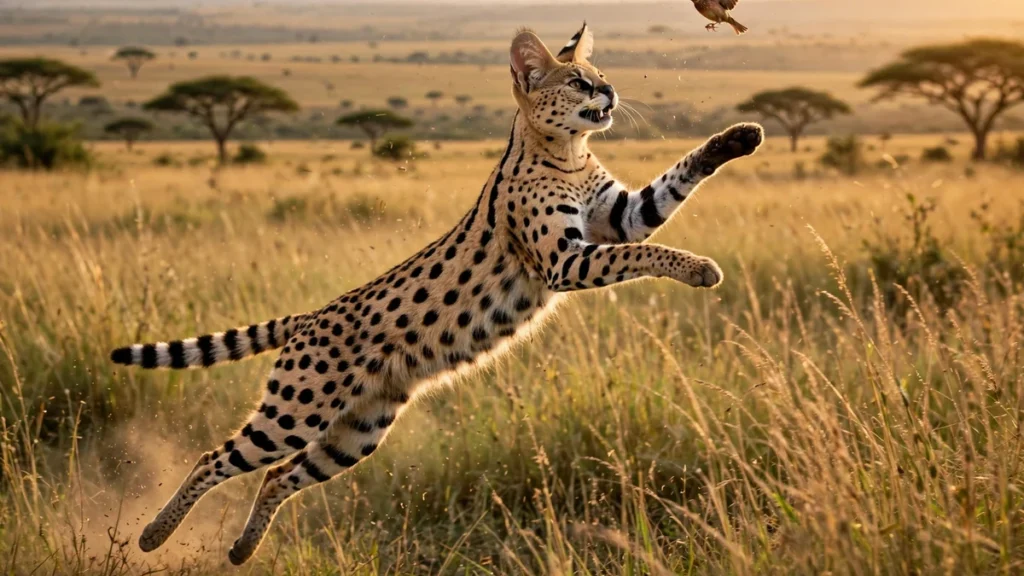
The serval species is one of the most striking small cats of Africa, a long-legged hunter of tall grass that can leap high into the air to catch a rodent it has never seen. If you are asking how many serval species there are, the answer is one: a single species, Leptailurus serval, with several recognised subspecies that all belong to the same cat. This guide explains how to recognise a serval, how it lives and hunts, where to find it, and how it differs from similar cats.
Key takeaways
- There is only one serval species, Leptailurus serval, although several subspecies are recognised across Africa.
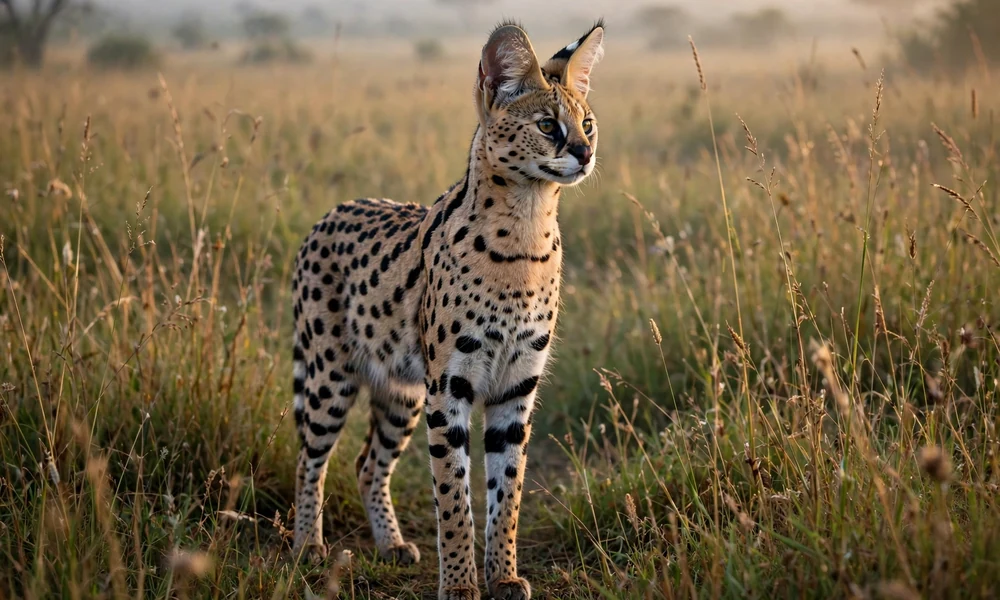
- Servals have the longest legs relative to body size of any cat, with very large ears and a spotted golden coat.
- A serval can leap up to 3 metres into the air to pounce on rodents hidden in tall grass.
- Servals live in grassland, savanna and wetlands across sub-Saharan Africa, needing tall cover and water nearby.
- Servals are shy, mostly nocturnal hunters that avoid people, and are listed as Least Concern by the IUCN.
What makes a serval a serval
A serval is a medium-sized wild cat, noticeably taller than a domestic cat but much smaller than a leopard or cheetah. Adults stand about 54 to 62 centimetres at the shoulder, with a body length of roughly 59 to 92 centimetres, and usually weigh between 9 and 18 kilogrammes, males larger than females. What first catches the eye is the legs: a serval has the longest legs relative to its body of any cat, which lift it above the grass.
The ears are the second giveaway. A serval’s ears are very large, tall and oval, and they can turn independently to track sounds. A serval can hear a rodent moving underground, and it often hunts by sound alone, standing still with its ears swivelling before it leaps. The coat is golden-tan with bold black spots and stripes, paler on the belly, and the tail is short, ringed in black with a black tip.
Servals belong to the genus Leptailurus, which contains only this one species, in the cat family Felidae. Although servals look like a small cheetah at a glance, the spots are a shared solution to hunting in dappled grassland, not a sign of close kinship. As one of Africa’s most specialised predator animals, the serval is built for one job above all others: catching small prey in tall grass. Several subspecies are recognised, including the southern serval and the East African serval, but the differences between them are small, mainly coat shade and spot size.
The serval species and its relatives
The serval sits among the small cats of Africa, a group that includes the caracal, the African wildcat and the African golden cat. Of these, the caracal is the closest lookalike, but it is easy to tell apart: it has a plain sandy coat with no spots, and its ears end in long black tufts. The African wildcat is smaller and stockier, with a tabby pattern, shorter legs and a longer tail.
Further afield, the jungle cat of Asia is similar in size and also hunts in reeds and grassland, but it has a plain coat and shorter ears. The ocelot of Central and South America is another spotted small cat of similar size, but it lives in forest and has shorter legs and a longer tail. The cheetah and the leopard are larger cats that share the serval’s spotted coat, yet both are much bigger, the cheetah built for speed and the leopard for power and climbing. The African golden cat, the serval’s closest forest relative, is about the same size, but most individuals are plain reddish-brown and it hunts in dense rainforest. The table below sets out the single serval species alongside these seven close relatives.
| Type | Animal | Where it lives | Best-known food | Length |
|---|---|---|---|---|
| Species | Serval | Grassland and wetlands of sub-Saharan Africa | Rodents | 59–92 cm |
| Close relative | Caracal | Dry savanna and scrub of Africa and western Asia | Small mammals and birds | 62–91 cm |
| Close relative | African wildcat | Savanna and scrub of Africa and the Middle East | Rodents and small birds | 45–75 cm |
| Close relative | Jungle cat | Wetlands and grassland from Egypt to South-East Asia | Rodents and birds | 58–76 cm |
| Close relative | Ocelot | Forests of Central and South America | Small mammals and birds | 55–100 cm |
| Close relative | Cheetah | Savannas of Africa and a small population in Iran | Antelope and hares | 110–150 cm |
| Close relative | Leopard | Forests, savanna and mountains of Africa and Asia | Antelope, monkeys and other mammals | 90–190 cm |
| Close relative | African golden cat | Rainforests of West and Central Africa | Rodents, birds and small antelope | 61–101 cm |
How servals live
Servals are mostly solitary and mainly active at night and at dawn and dusk, resting through the heat of the day in tall grass. Like many nocturnal animals, they rely on hearing as much as sight, and their large ears can pick up the faint rustle of a rodent in the grass or underground. Each serval holds a territory that it marks with scent.
Hunting is where the serval’s build makes sense. A serval stands still, listening, then leaps high into the air and comes down with its forepaws on the prey. It can leap up to 3 metres high and more than 3 metres sideways, and it catches its prey on about half of its attempts, a high success rate for a small cat. Rodents make up most of the diet, with birds, frogs, insects and lizards taken when the chance arises.
Female servals give birth to one to four kittens, usually two or three, after a gestation of about 66 to 77 days. The kittens are born in a hidden den in dense grass, and are weaned at about four to five months old. Young servals stay with their mother until they are about a year old. In the wild a serval lives for about 10 years, while in captivity it can live for 20 years or more.
Where servals live
Servals live across sub-Saharan Africa, from Senegal in the west to Ethiopia in the east and south to South Africa. They are absent from the deep rainforest of the Congo Basin and from the driest deserts, because they need two things above all: tall grass or reeds for cover, and water nearby. Their favoured homes are moist savanna, grassland, marshes and reed beds.
Servals also use the edges of forests and woodland, but they do not live in dense forest itself. Unlike many forest animals, the serval needs open ground where it can leap and pounce, and thick forest gives it neither the room nor the rodent-rich grassland it depends on. In farmland, servals hunt in fallow fields and along hedgerows, which can bring them close to people and poultry.
The species is listed as Least Concern by the IUCN, but numbers are falling in many places as wetlands are drained, grassland is ploughed, and servals are killed for their skins or shot as suspected poultry thieves. They are protected by law in many African countries and listed on Appendix II of CITES, which controls international trade.
Best seasons for serval watching
The best time to look for servals is the dry season, roughly from May to October in southern and East Africa, when shorter grass and scarcer water concentrate animals around remaining pools. In the wet season the grass grows tall and servals are harder to spot. Good places include the Serengeti, Maasai Mara, Okavango Delta and Kruger National Park.
Time of day matters as much as season. Servals are most active at dawn and dusk, when rodents are moving, and a quiet drive at first light gives the best chance. Look along the edges of reed beds, drainage lines and damp hollows, where the grass stays green longest and rodents are thickest. A serval often stands still for a long time, ears moving, before it leaps, so a patient scan of a promising patch of grass is worth more than a fast drive past it.
Staying safe around servals
Wild servals are shy and avoid people, and they pose very little danger to humans. A serval that meets a person will normally slip away unnoticed, and there are no records of wild servals attacking people unprovoked. The main risk is to small pets and poultry, which a serval may take if they are left out at night near grassland, so keep cats indoors after dark and poultry in a secure coop.
If you do meet a serval, keep your distance and enjoy the sighting. Do not approach it, do not try to feed it, and do not corner it in thick cover. Keep dogs on a lead, so they cannot chase a serval. If a serval stands its ground, stay calm, look tall and back away slowly. Never handle a serval kitten you find alone: the mother is usually nearby.
Serval watching checklist
- Visit in the dry season, May to October, when shorter grass makes servals easier to spot.
- Go out at dawn or dusk, when servals are most active and rodents are moving.
- Scan reed beds, drainage lines and damp hollows, where rodents gather and servals hunt.
- Bring binoculars, so you can confirm the long legs, large ears and spotted coat.
- Move quietly, and pause often to watch a promising patch of grass.
- Keep dogs on a lead and small pets indoors at night in serval country.
- Record the time, place and behaviour of any sighting for the local park or reserve.
Frequently asked questions
How many serval species are there?
There is only one serval species, Leptailurus serval. Several subspecies are recognised, but they are all the same species, and the differences between them are small.
How is this guide different from the big cat species guide?
This guide covers a single small cat species, the serval, in depth, while the big cat species guide covers the large cats such as lions, tigers, leopards and cheetahs. That guide compares the serval with its much larger spotted cousins.
Are servals dangerous to people?
No, wild servals are not dangerous to people. They are shy, solitary hunters that avoid humans and slip away when approached. They may take a small pet or poultry, but attacks on people are not recorded.
Can you keep a serval as a pet?
In most places, no, or only with a special licence. Servals are wild animals with specialist needs that do not settle well in a home. Keeping one is restricted or banned in many countries, and the savannah cat, a serval-domestic hybrid, is the legal alternative in some places.
What is the difference between a serval and a cheetah?
A cheetah is much larger and faster, built for chasing antelope across open plains. A serval is smaller, with longer legs relative to its body, much larger ears and a shorter tail, and it hunts rodents by leaping rather than by chasing.
Where is the best place to see a serval in the wild?
The Serengeti and Maasai Mara, the Okavango Delta and Kruger National Park are among the most reliable places, because they hold good serval numbers in open grassland with guided drives. Go at dawn or dusk in the dry season, and ask local guides about recent sightings.
Conclusion
The serval species is a single, unmistakable cat: one species, Leptailurus serval, with long legs, large ears and a spotted coat, built to hunt by ear and by leap in the tall grass of Africa. It is not a small cheetah, but a specialist of grassland and wetland, and its future depends on keeping those wet grasslands intact.














