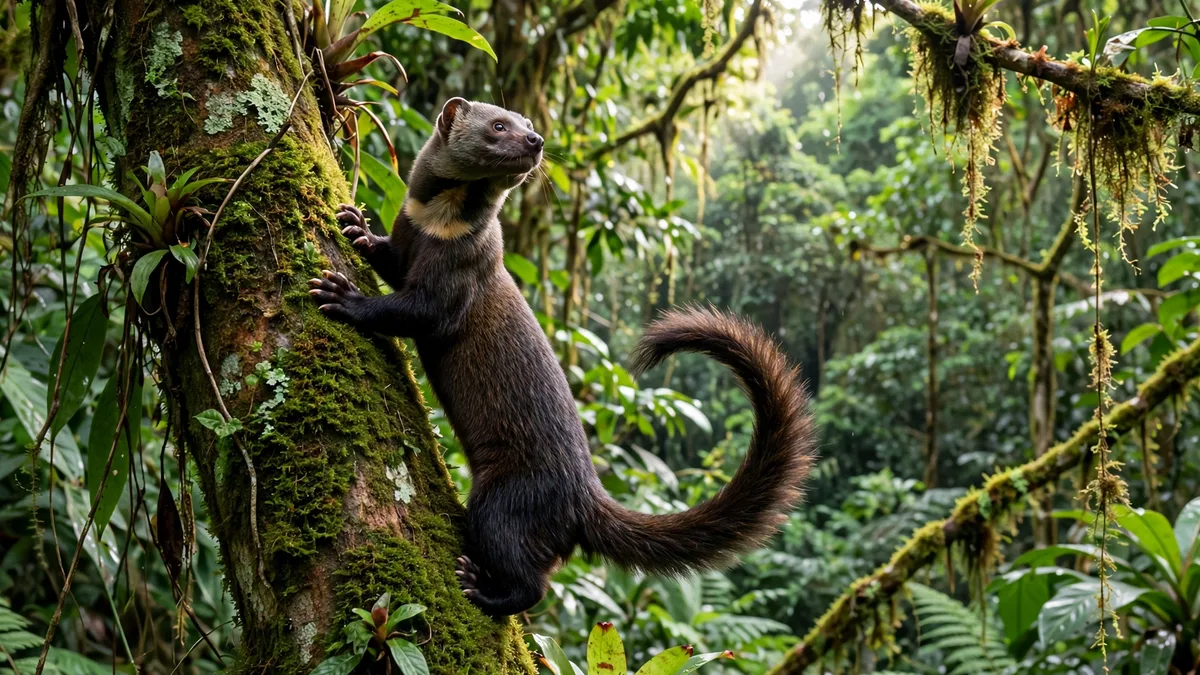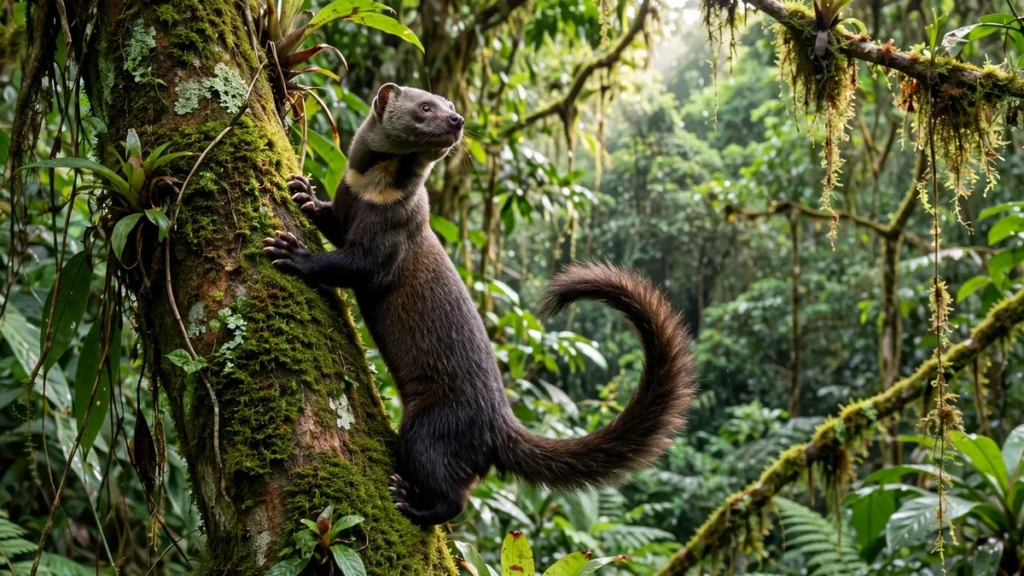
The tayra species is one of the most agile hunters of the American tropics, a long-legged forest mustelid that climbs like a squirrel and hunts like a weasel. If you are asking how many tayra species there are, the answer is one: a single species, Eira barbara, the only member of its genus, with seven recognised subspecies that all belong to the same animal. This guide explains how to recognise a tayra, how it lives and feeds, where to find it, and how it differs from its closest relatives.
Key takeaways
- There is only one tayra species, Eira barbara, although seven regional subspecies are recognised across its range.
- Tayras are large, long-legged mustelids with dark brown to black fur, a paler head, and a pale throat patch.
- A tayra is an expert climber that hunts on the ground and in the trees, and can swim across rivers when it needs to.
- Tayras are omnivores, eating fruit, small mammals, birds, reptiles, insects, and honey.
- Tayras live in tropical and subtropical forests from Mexico to northern Argentina, and are listed as Least Concern by the IUCN.
What makes a tayra a tayra
A tayra is a large mustelid, about the size of a medium-sized dog, with a long body, long legs, a long neck, and a long bushy tail. Adults measure 56 to 71 centimetres in head-body length, with a tail of 37 to 46 centimetres, and weigh between 2.7 and 7 kilogrammes, males about a third larger than females. The build is slender and athletic, and it moves with a bounding gait.
The coat is the first thing to look for. The body is covered in coarse, dark brown to black fur, while the head and neck are often paler, greyish or brownish, giving the animal a hooded look. Many tayras also carry a pale patch on the throat and chest. The ears are small and rounded, and the feet are broad, with strong curved claws.
Tayras belong to the genus Eira, which contains only this one species, in the mustelid family Mustelidae, the same family that holds otters, badgers, martens, fishers, and wolverines. The species was first described by Carl Linnaeus in 1758. Local names include tolomuco, motete, irara, and high-woods dog. Seven subspecies are recognised, but the differences between them are small, mainly coat shade.
What sets the tayra apart is how completely it uses the forest in three dimensions. It climbs with ease, using its long tail for balance, and it can cross rivers when it must, although it generally avoids water.
The tayra species and its relatives
The fisher of North American boreal forest is similar in shape, but it has a grizzled brown coat, no pale throat patch, and the two never meet. The greater grison, which shares the tayra’s South American forests, is smaller and shorter-legged, with a grey back and black belly. The wolverine is heavier and lives in the far north.
Otters are the relatives most often confused with tayras, because both are long-bodied mustelids that swim. A river otter, however, is built for water, with webbed feet, a thick tapering tail, and a low, streamlined body, while the tayra is built for climbing, with longer legs and a bushy tail. Martens are smaller tree-dwellers, badgers are heavier diggers, and the honey badger is stockier still, with a broad grey-white saddle.

| Type | Animal | Where it lives | Best-known food | Length |
|---|---|---|---|---|
| Species | Tayra | Forests of Central and South America | Fruit and small mammals | 56–71 cm |
| Close relative | Wolverine | Arctic and northern forests | Carrion and small mammals | 65–105 cm |
| Close relative | Fisher | Boreal forests of North America | Porcupines and small mammals | 75–120 cm |
| Close relative | River otter | Rivers and wetlands of North America | Fish and crustaceans | 66–107 cm |
| Close relative | Badger | Woodland and farmland in Europe | Earthworms and small mammals | 60–90 cm |
| Close relative | Pine marten | Forests of Europe and Asia | Small mammals and berries | 45–58 cm |
| Close relative | Greater grison | Forests and grassland of South America | Small mammals and birds | 45–60 cm |
| Close relative | Honey badger | Africa and southern Asia | Snakes, honey, and small mammals | 60–77 cm |
How tayras live
Tayras are mainly active by day, with peaks of activity in the early morning and the late afternoon, although they sometimes move at night. They are usually solitary, travelling alone or in pairs, although a mother with young may travel with them. They find prey mainly by scent, because their eyesight is relatively poor, and once they locate something they chase it down actively rather than waiting in ambush. They move in a bounding gallop on the ground and leap confidently between branches.
Tayras are opportunistic omnivores, and food is whatever the forest offers. Small mammals, above all rodents, form the largest part of the diet, but they also eat birds and their eggs, lizards, insects, and large amounts of fruit. They climb into fruiting trees to feed, and they will raid beehives for honeycomb when they find it. This broad diet is one reason tayras cope well in disturbed forest and farmland, where more specialised hunters struggle.
A tayra’s home is a hollow tree or a burrow dug by another animal. Home ranges are large, with individuals recorded covering up to 24 square kilometres and travelling six kilometres or more in a single night. Gestation lasts about 63 to 70 days, and a litter is usually two or three young, born blind and covered in fur. In captivity tayras have lived for 18 years or more.
Where tayras live
The tayra ranges through the tropical and subtropical forests of Central and South America, from Mexico in the north, south through every Central American country to Panama, and across most of South America to Bolivia and northern Argentina. It is absent from Chile, Uruguay, and most of Argentina. It also lives on the island of Trinidad. The IUCN lists the tayra as Least Concern, and it is common through much of its range, in places the most frequently seen forest carnivore.
Within that range, tayras use tropical evergreen and deciduous forest, secondary growth, gallery forest along rivers, cloud forest, and dry scrub forest, from the lowlands up to about 2,000 to 2,400 metres. They are also seen in tree plantations and farmland. Because they tolerate disturbed habitat and live near people, tayras are sometimes seen at the edges of villages and farms, where they may raid poultry, corn, and sugar cane, although the damage is usually small. Patient watchers have the best chance at dawn and dusk in protected lowland rainforest.
Best seasons for tayra watching
Tayras do not hibernate and do not migrate, so they can be seen at any time of year, but the dry season is generally the most rewarding time to look. In Central America the dry months run roughly from December to April, and in the Amazon around June to November. Trails are firmer, the undergrowth is thinner, and animals concentrate around remaining fruit and water, which brings them into the open more often. When fig trees are in fruit, tayras visit the same trees day after day, and a quiet wait beneath one is the classic way to see one.
In the wet season the forest is greener and trails are quieter, but rain washes scent and sound away, and tayras often shelter until a shower passes. Mornings after rain can be excellent. Whatever the season, the early morning and the late afternoon remain the best hours, and a guided walk with a local naturalist is worth more than any choice of month.
Staying safe around tayras
Tayras are wild animals with sharp teeth and strong claws, and they should always be watched from a distance. They are not normally aggressive towards people, and their first response to a human is usually to run or climb out of reach, but a cornered animal or a mother with young can bite, and a bite needs medical attention. Never try to touch, feed, or approach a tayra. If one appears on a trail, stand still, give it room, and let it move away in its own time.
Feeding tayras is harmful as well as risky. Animals that learn to take food from people lose their caution, become a nuisance around lodges and farms, and are more likely to be killed as pests. Tayras that visit farms may take poultry, so farmers should keep chickens in secure coops at night. In forest areas, store food properly and keep rubbish sealed so wildlife is not drawn into camps.
Tayra watching checklist
Pack light, move quietly, and plan around the animal’s habits.
- Visit at dawn or in the late afternoon, when tayras are most active.
- Walk quietly with a local guide who knows the fruiting trees and den sites.
- Carry binoculars for the canopy and a camera with a fast shutter for a brief sighting.
- Wear dull, quiet clothing and sturdy boots for muddy, uneven forest trails.
- Watch fruiting fig and palm trees, and listen for falling fruit and rustling branches.
- Keep a respectful distance and never feed, call, or chase a tayra.
- Record the time, place, and behaviour of any sighting for local wildlife records.
Frequently asked questions
How many tayra species are there?
There is only one tayra species, Eira barbara, the sole member of the genus Eira. Seven regional subspecies are recognised, but they are all the same species, differing mainly in coat shade.
Are tayras dangerous to people?
Tayras are not normally dangerous. They are shy, daytime hunters that avoid people and will usually run or climb away. Like any wild carnivore, they can bite if cornered or protecting young, so watch them from a distance and never feed or approach them.
What do tayras eat?
Tayras are omnivores with a very broad diet: small mammals, especially rodents, along with birds, eggs, lizards, insects, and large amounts of fruit. They also climb trees to reach fruit and honey, and raid beehives for honeycomb.
Where can I see a tayra in the wild?
Tayras live in tropical and subtropical forests from Mexico to northern Argentina, and on Trinidad. The best chances are in protected lowland rainforest at dawn or dusk, near fruiting trees. Among the region’s rainforest animals, the tayra is one of the most frequently seen forest carnivores.
How is this guide different from the otter species guide?
This guide covers the tayra, a climbing forest mustelid, while our otter species guide covers the otters, the swimming mustelids of rivers and coasts. The two groups are close relatives in the same family, but they are built for different lives: the tayra for the trees and the forest floor, the otter for the water.
Are tayras endangered?
No. The tayra is listed as Least Concern by the IUCN and is common through most of its range. It benefits from a broad diet and an ability to live in secondary forest and farmland, although it still needs forest cover. As one of the most adaptable predator animals of the American tropics, it lives alongside people where habitat remains.
Conclusion
The tayra species is a single, remarkable animal: one species, Eira barbara, filling a niche that no other mustelid in the Americas fills quite the same way. Dark-coated and long-legged, it hunts, climbs, and forages from Mexico to northern Argentina. Its broad diet and tolerance of disturbed forest have kept it common where more specialised hunters have faded. Protect the forest it climbs in, and the tayra will look after itself. For more on the forests it calls home, see our guide to forest animals.