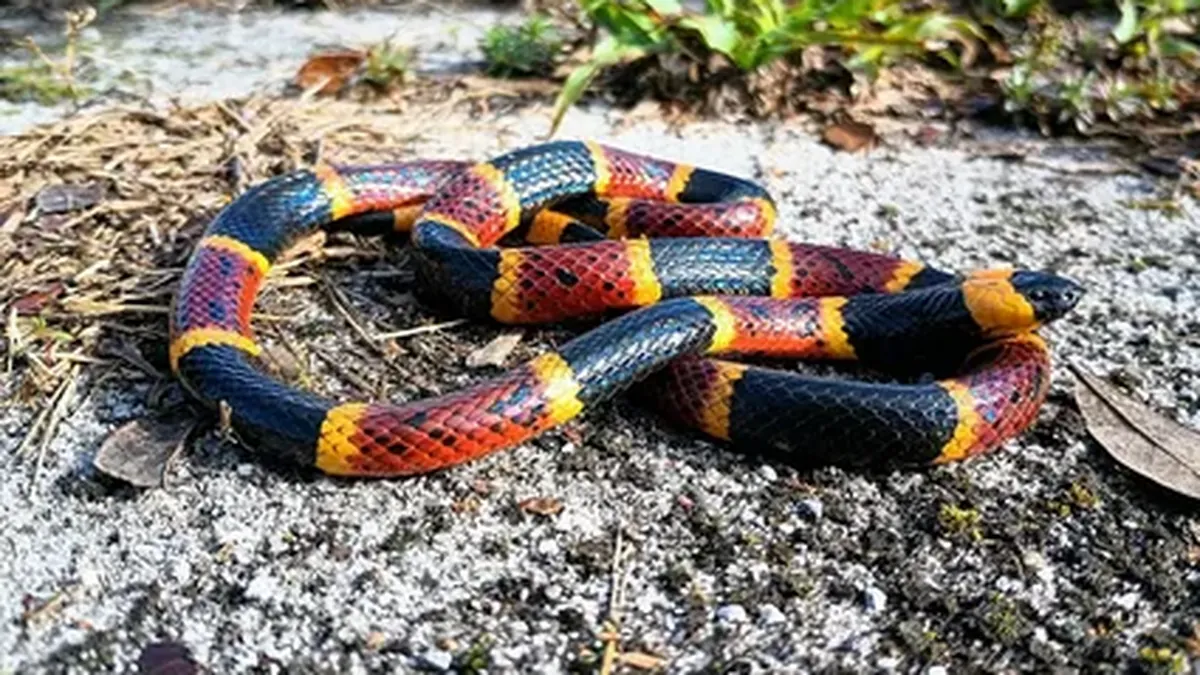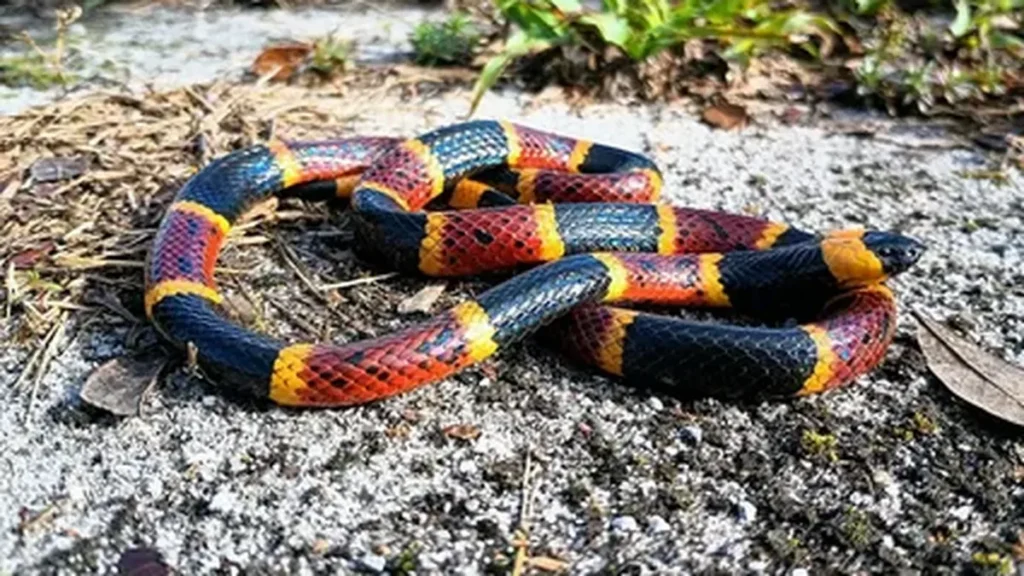
A flash of red, yellow, and black moves beneath fallen leaves. For a moment, it looks like a colorful piece of cord lying across the forest floor. Then it begins to slither away. If you encounter a coral snake, those bright colors are worth noticing but they are not an invitation to get closer.
Coral snakes are the type of snakes that are among North America’s most distinctive venomous snakes. Their smooth bodies and vivid bands can make them look almost decorative, yet their venom can cause serious medical emergencies. They are generally secretive and prefer to avoid people, but accidental encounters can happen when someone moves rocks, handles debris, or reaches into hidden spaces.
Coral snakes are venomous snakes found in parts of the southern United States. The safest way to identify one is from a distance, using its overall appearance and location—not a rhyme or a hands-on inspection.
What Is a Coral Snake?
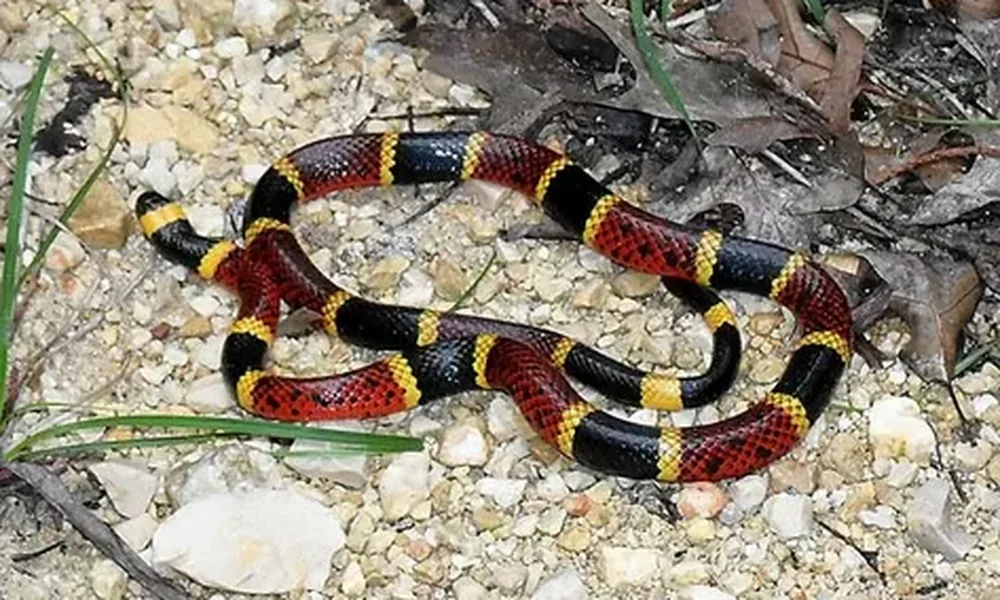
Coral snakes belong to the cobra family, Elapidae, which also includes cobras, kraits, and sea snakes. Several coral snake species occur in the Americas, including the eastern coral snake (Micrurus fulvius) in the southeastern United States.
Unlike many familiar pit vipers, coral snakes do not have the heat-sensing facial pits found between the eyes and nostrils of copperheads and rattlesnakes. They also have relatively small, fixed front fangs.
Their venom primarily affects the nervous system. Although bites are uncommon, the potential consequences are serious enough that every suspected coral snake bite requires immediate emergency medical evaluation.
Coral snakes are not aggressive hunters of humans. They are predators of smaller animals, and they usually spend much of their time hidden beneath leaf litter, soil, or other cover.
How to Identify a Coral Snake
The most recognizable feature of many North American coral snakes is their pattern of brightly colored rings.
Depending on the species, these rings may include red, yellow or white, and black. The bands encircle the body, creating a striking pattern that often stands out against the ground.
Other features can include:
- Smooth, glossy scales: The body often has a polished appearance.
- Slender build: Many coral snakes have relatively narrow bodies.
- Small, rounded head: The head is not dramatically wider than the neck.
- Short, blunt-looking tail: The tail may be relatively short compared with the body.
- Brightly colored bands: Red, black, and yellow or pale bands are common in several North American species.
Color patterns vary among species, and some harmless snakes imitate the appearance of coral snakes. Because the consequences of misidentification can be serious, do not approach a snake to inspect its head, scales, or band order.
If you see a brightly banded snake, keep your distance and let it move away.
People sometimes use the term garden snake for harmless snakes they encounter around yards, gardens, and outdoor spaces. However, “garden snake” is not a precise species name, and several different snake species may be found in gardens. Because harmless snakes can sometimes resemble venomous species, avoid handling an unfamiliar snake simply because it appears small or harmless.
Where Do Coral Snakes Live?
In the United States, coral snakes occur mainly in parts of the South and Southeast, although the exact range depends on the species.
The eastern coral snake is found in parts of the southeastern United States, including Florida and areas of neighboring states. Other coral snake species occur in different parts of North America and beyond.
Their habitats can include:
- Pine forests and wooded areas
- Scrublands and sandy habitats
- Leaf litter and loose soil
- Areas beneath fallen logs and rocks
- Locations with suitable small reptile and other prey populations
Coral snakes are secretive and spend much of their time out of sight. You may encounter one while gardening, hiking, moving a log, or clearing debris from the ground.
They are not restricted to remote wilderness. Some suitable habitats occur near residential areas, so it is sensible to use caution when working outdoors in regions where coral snakes live.
Are Coral Snakes Venomous?
Yes. Coral snakes are venomous, and their venom can cause serious neurological effects.
Unlike venom that mainly damages tissue around a bite, coral snake venom can interfere with the communication between nerves and muscles. Severe envenomation may lead to weakness, difficulty swallowing, drooping eyelids, and potentially life-threatening breathing problems.
A bite may not cause dramatic swelling or immediate severe pain. That means the absence of obvious symptoms does not rule out dangerous envenomation.
Coral snakes generally avoid people and bites are uncommon. However, their secretive habits and the possibility of delayed symptoms make it especially important not to dismiss a suspected bite.
If you think a coral snake has bitten someone, call emergency services immediately. Do not wait for symptoms to appear.
Coral Snake vs. King Snake: What’s the Difference?
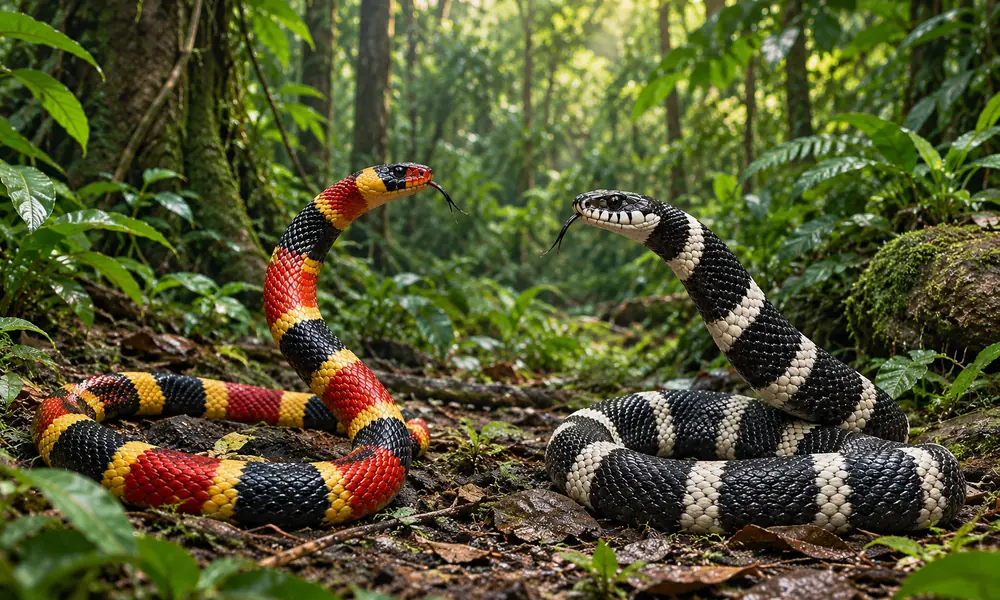
Some harmless kingsnakes have red, black, and pale bands that resemble those of coral snakes. This resemblance has contributed to the popularity of a traditional identification rhyme.
However, the rhyme about red bands touching yellow or black is not a dependable safety rule. It can fail with different species, regional patterns, and unusual individuals.
A comparison of general features can help explain the difference, but it should not replace professional identification.
| Feature | Coral snake | Some harmless kingsnakes |
| Color pattern | Often bright red, yellow or white, and black rings | May have similar colors or bands |
| Head shape | Usually small and not sharply distinct from the neck | Varies by species |
| Venom | Medically significant venom | Nonvenomous |
| Typical behavior | Secretive; often stays hidden | Varies by species |
| Safe identification | Requires reliable species-level identification | Requires reliable species-level identification |
Never pick up a banded snake to check its colors. A photograph taken from a safe distance may help a wildlife professional, but only take one if doing so does not bring you closer to the animal.
What Do Coral Snakes Eat?
Coral snakes are predators that feed mainly on small animals they can overpower and swallow.
Their diet can include:
- Small lizards
- Small snakes
- Other small reptiles
- Occasionally other suitable small vertebrates, depending on the species
Many coral snakes hunt in concealed spaces, using their slender bodies to move through leaf litter, loose soil, and gaps beneath natural debris.
Their diet helps maintain the balance of local wildlife communities. Although they are venomous, coral snakes are not looking for opportunities to bite people. Humans are not their prey.
Are Coral Snakes Aggressive?
Coral snakes are generally secretive rather than aggressive toward people. They often spend their time hidden and may try to escape when disturbed.
Trouble can occur when someone handles a snake, attempts to kill it, or reaches into a space where it is sheltering. A snake that cannot escape may bite in defense.
Their quiet behavior can be misleading: a snake that remains still is not necessarily safe to touch.
Snake behavior can also be understood as a form of animal communication. A snake may freeze, retreat, coil, or attempt to escape when it feels threatened. These behaviors indicate that the animal is responding to its surroundings rather than seeking interaction with humans. Giving the snake space allows it to move away without escalating the encounter.
If you encounter one:
- Stop and give it space.
- Do not corner it or block its escape route.
- Keep children and pets away.
- Do not attempt to capture, kill, or relocate it.
- Contact a qualified wildlife professional if it is near a doorway or a frequently used area.
A calm retreat is safer than trying to determine whether the snake is about to move.
Coral Snake Bite Symptoms
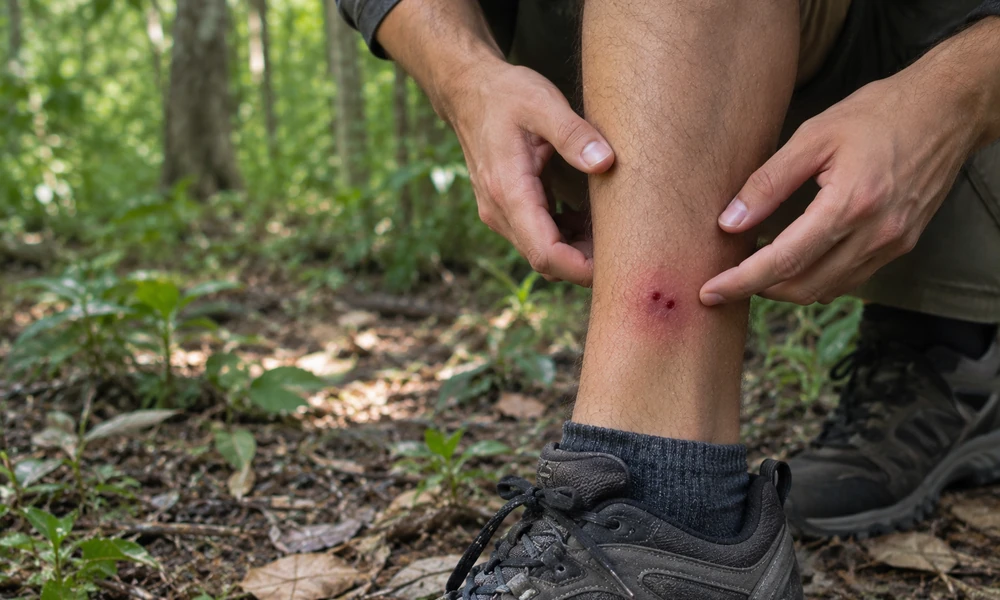
Coral snake bites can be difficult to assess because the initial wound may appear minor. Symptoms may develop over time and can include:
- Tingling or discomfort around the bite
- Drooping eyelids
- Difficulty speaking or swallowing
- Muscle weakness
- Blurred or double vision
- Difficulty breathing
These symptoms require emergency medical attention. Do not wait for them to develop if a coral snake bite is suspected.
What to Do After a Suspected Coral Snake Bite
- Call emergency services immediately.
- Keep the affected person calm and as still as possible.
- Follow the emergency dispatcher’s instructions.
- Remove rings or tight items near the affected area if this can be done easily before swelling develops.
- Do not cut the wound, suck out venom, apply ice, or use a tourniquet.
- Do not try to catch or kill the snake for identification.
Avoid relying on home remedies or waiting to see whether symptoms become severe. Medical professionals can assess the exposure and provide appropriate monitoring and treatment.
How to Avoid Coral Snake Encounters
You do not need to avoid every wooded trail or garden in coral snake country. A few sensible habits can lower the chance of accidentally disturbing one.
Watch where you place your hands. Avoid reaching blindly beneath logs, rocks, boards, or thick leaf litter.
Use appropriate footwear. Closed-toe shoes and long pants are sensible when walking through dense vegetation or clearing outdoor debris.
Use a flashlight at night. Make sure you can see the ground and the path ahead when walking outside after dark.
Keep outdoor areas tidy. Manage accumulated debris near doors and frequently used walkways, without reaching into concealed spaces.
Leave unfamiliar snakes alone. Do not assume a snake is harmless because it appears small, quiet, or brightly colored.
These precautions are useful for many snake species, not just coral snakes.
Frequently Asked Questions
Are coral snakes deadly?
Their venom can be life-threatening, especially if it affects breathing. Bites are uncommon, but every suspected bite needs immediate emergency medical care.
Where are coral snakes found in the United States?
Several species occur in parts of the southern United States. The eastern coral snake is found in the Southeast, including Florida and neighboring areas.
Can you identify a coral snake by its colors?
Color bands are useful clues, but patterns vary and harmless snakes can look similar. Never rely on a rhyme alone to decide whether a snake is safe.
Are coral snakes aggressive toward humans?
They are generally secretive and avoid people. Bites are more likely when a snake is handled, cornered, or accidentally disturbed.
What should you do if you see a coral snake?
Keep your distance, keep children and pets away, and allow the snake to move off. If it is in a dangerous location, contact a qualified wildlife professional.
What should you do after a coral snake bite?
Call emergency services immediately, keep the personstill, and follow medical instructions. Do not wait for symptoms or attempt home treatment.
A Beautiful Snake Best Left Alone
Coral snakes are remarkable animals. Their vivid bands are instantly recognizable, their hunting habits are specialized, and their secretive lives often go unnoticed beneath the forest floor.
But beauty is not a reason to get closer.
If you encounter a brightly banded snake, leave it undisturbed and focus on getting yourself and others safely away. You do not need to touch an animal to appreciate it, and with coral snakes, keeping your distance is the smartest way to protect both yourself and the wildlife around you.
Disclaimer: This article is provided for informational and educational purposes only. We are not advertising, endorsing, or promoting any product, service, treatment, or commercial brand mentioned or discussed in connection with this topic.