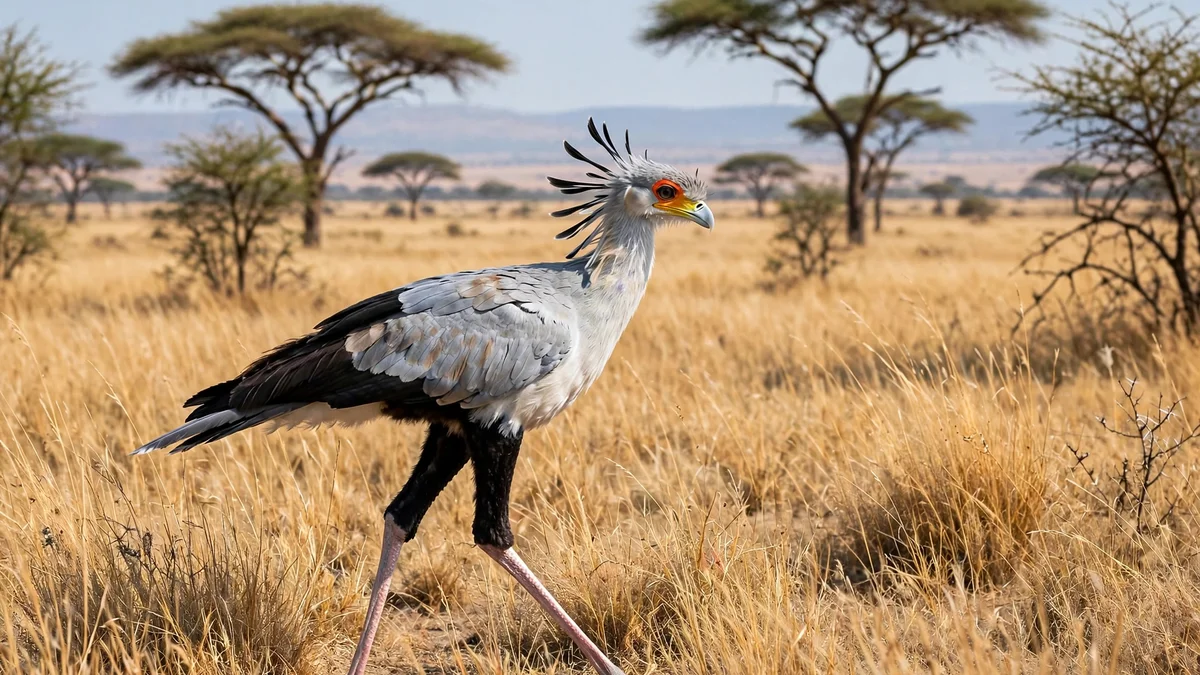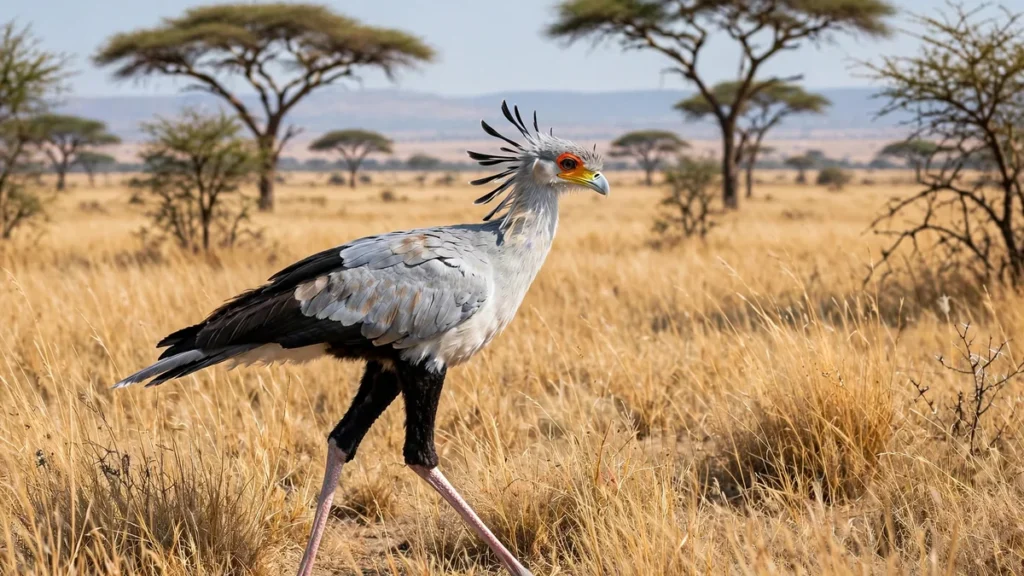
The secretary bird species is a single species, Sagittarius serpentarius, a snake-hunting bird of prey of the African savanna, and the only member of its family. If you are asking how many secretary bird species there are, the answer is one: there is only one secretary bird species in the world, and every secretary bird alive today belongs to it.
The secretary bird belongs to the family Sagittariidae, a family with just this one species, and it lives in the open grasslands and savannas of sub-Saharan Africa, from Senegal to South Africa. Its long legs, its grey plumage, its black crest feathers and its snake-stomping feet make it one of the most recognisable birds of prey in the world.
Key takeaways
- There is only one secretary bird species, Sagittarius serpentarius, and it is the only member of its family.
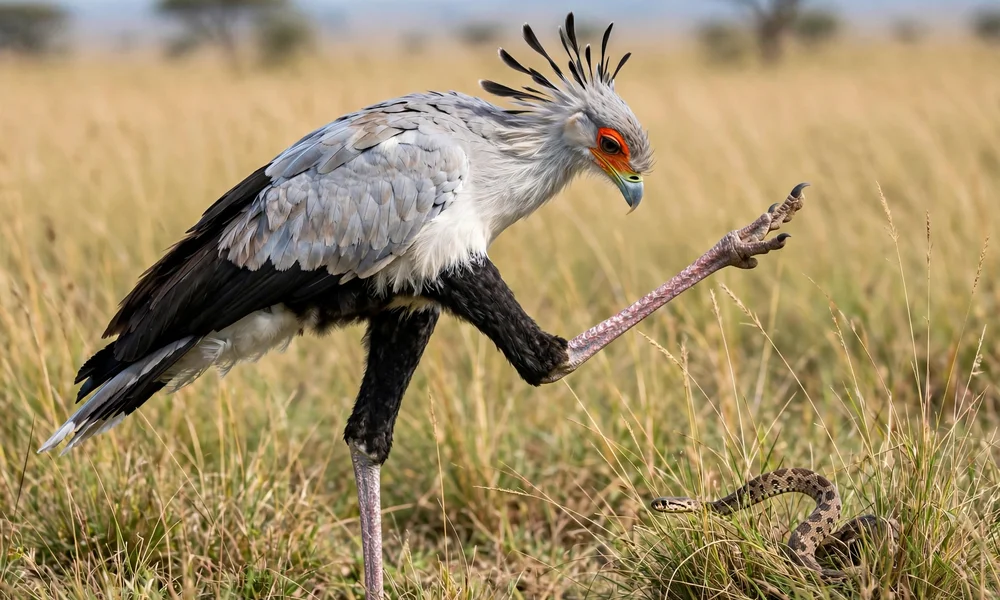
- Secretary birds hunt snakes on foot, killing them with kicks that strike with a force of about 195 newtons, five times the bird’s own body weight.
- Secretary birds are named for their crest feathers, which look like quill pens tucked behind a secretary’s ear.
- Secretary birds spend most of their lives on the ground, walking as much as 30 kilometres a day while they hunt.
- Secretary birds are listed as Endangered, after being uplisted from Vulnerable in 2020.
What makes a secretary bird a secretary bird
A secretary bird is a tall bird of prey with grey plumage, black flight feathers, a black crest, long pinkish legs and a hooked beak, and it stands roughly 1.2 to 1.5 metres tall, with a wingspan of 1.9 to 2.1 metres, and usually weighs between 2.3 and 4.3 kilogrammes. Its legs are the longest of any bird of prey, built for walking and stomping rather than perching.
The crest defines the secretary bird: a spray of long black feathers on the back of the head that looks like a row of quill pens tucked behind the ear of an old-fashioned secretary, which is how the bird got its name. Its feet are its weapons, and it kills snakes by stamping on them with kicks that strike in a fraction of a second, with a force of about 195 newtons, five times its own body weight. Like other eagles, the secretary bird has a hooked beak and sharp talons, but it hunts on foot, not from the air, and it can fly well when it needs to, soaring on thermals like a vulture.
The secretary bird species and their relatives
There is one secretary bird species, Sagittarius serpentarius, and it is the only living member of its family and its genus. Secretary birds across Africa form a single widespread population, from the Sahel to the Cape, but they are all the same species, and the birds move freely across the savanna following the rains and the snakes.
The bateleur is the secretary bird’s closest relative among the African eagles, a short-tailed eagle with a rocking flight, while the martial eagle is the largest eagle of Africa, a powerful hunter of hares and small antelope. The crowned eagle is a forest eagle that hunts monkeys, the tawny eagle is a brown eagle of the savanna, and the African fish eagle is a white-headed eagle that hunts over lakes and rivers. The lanner falcon is a fast falcon of the open country, and the kestrel is a small falcon that hovers over grassland.
| Type | Animal | Where it lives | Best-known food | Length or Weight |
|---|---|---|---|---|
| Species | Secretary bird (Sagittarius serpentarius) | Open grassland of sub-Saharan Africa | Snakes, lizards and small mammals | 1.2 to 1.5 m tall, 2.3 to 4.3 kg |
| Close relative | Bateleur eagle | Savanna of sub-Saharan Africa | Small mammals, birds and carrion | 55 to 70 cm, 1.8 to 3 kg |
| Close relative | Martial eagle | Open country of sub-Saharan Africa | Hares, small antelope and birds | 78 to 96 cm, 3 to 6.2 kg |
| Close relative | Crowned eagle | Forests of sub-Saharan Africa | Monkeys, small antelope and hyrax | 80 to 99 cm, 2.5 to 4.7 kg |
| Close relative | Tawny eagle | Savanna and steppe of Africa and Asia | Small mammals, birds and carrion | 60 to 75 cm, 1.6 to 3 kg |
| Close relative | African fish eagle | Lakes and rivers of sub-Saharan Africa | Fish and water birds | 63 to 75 cm, 2 to 3.6 kg |
| Close relative | Lanner falcon | Open country of Africa and Asia | Small birds and mammals | 35 to 50 cm, 0.5 to 1.1 kg |
How secretary birds live
Secretary birds are creatures of the open grassland. A secretary bird lives alone or in a pair, walking through the savanna by day and roosting in an acacia tree by night, and it can walk as much as 30 kilometres in a single day while it hunts. Like other African animals, it follows the rains, moving with the grass as the seasons change.
Snakes make up much of the diet, along with lizards, small mammals, insects and the occasional bird, and a secretary bird hunts by striding through the grass and flushing its prey out, then stamping on it with rapid kicks. It kills snakes by striking them on the head and neck, and it eats its prey whole, swallowing a snake head first, and it can eat several snakes in a single day.
Breeding happens in the dry season, when prey is easy to find, and the pair builds a large flat nest of sticks in the top of an acacia tree, sometimes reusing the same nest for years and adding to it until it is more than 2 metres across. The female lays one to three pale eggs, and both parents incubate them for about 45 days. The chicks are born grey and downy, fed by both parents for about 75 to 80 days before they can fly, and they stay with their parents for months, learning to hunt on foot. Secretary birds live for around 10 to 15 years in the wild, and up to 19 years in captivity.
Where secretary birds live
The secretary bird lives in the open grasslands and savannas of sub-Saharan Africa, from Senegal and the Sahel through East Africa to South Africa, and it is most common in the grasslands of Kenya, Tanzania and South Africa, where the grass is short and the snakes are plentiful. It is seen regularly in the Masai Mara in Kenya and the Kruger National Park in South Africa, striding through the grass in the early morning.
Open grassland is the key requirement. A secretary bird needs short grass to walk and hunt in, and an acacia tree to nest in, so it follows the grazing animals that keep the grass short, and when the grass grows tall or the land is ploughed the birds have nowhere to live. It depends on snakes and lizards being plentiful, and it walks the grassland all day, looking for movement in the grass.
The species is listed as Endangered, and its numbers are falling across its range. The main pressures are the loss of grassland to farming and development, the loss of acacia trees to charcoal burning, and collisions with power lines. The species was uplisted from Vulnerable to Endangered in 2020, after surveys showed its numbers had fallen sharply, and it is now fully protected in most of the countries where it lives.
Best seasons for secretary bird watching
There is no closed season, because secretary birds are active all year, but the best time to look for them depends on where you go. In Kenya the best months are often June to October, the dry season, when the grass is short and the birds are easy to spot. In South Africa the best months are often May to September, when the birds are breeding and easy to find near their nests.
Staying safe around secretary birds
A secretary bird is a wild bird with a hooked beak and powerful kicking legs, and it can hurt a person, though secretary birds almost never attack people. Keep your distance, never approach a secretary bird nest, and never try to catch a secretary bird, because a frightened bird may abandon its eggs and the chicks may die. If you see secretary birds hunting, stay in the vehicle and watch with binoculars, because birds that are disturbed may leave their hunting ground for good.
Secretary bird watching checklist
A little preparation turns a savanna visit into a real chance of seeing a secretary bird, so pack for sun, dust and long quiet hours.
- Binoculars with good low-light performance, for picking a tall grey bird out of the grass.
- A camera with a long lens, because secretary birds should always be watched from a distance.
- Sun cream and a hat, because the best watching is in the bright midday sun.
- A booked safari with a guide who knows the secretary bird territories and the safe routes.
- A plan to be out in the morning, when the birds are most active and hunting.
- Patience and silence, because secretary birds are shy birds and a noisy group will send them away.
- A field guide to birds of prey, for telling a secretary bird from a crane at a glance.
Frequently asked questions
How many secretary bird species are there?
There is one secretary bird species, Sagittarius serpentarius. It is the only living member of its family and its genus, and its closest relatives are the eagles and hawks of Africa. No second secretary bird species is recognised.
Why is it called a secretary bird?
The secretary bird is named for the crest feathers on the back of its head, which look like a row of quill pens tucked behind the ear of an old-fashioned secretary. The name was given by early European naturalists, and it has stuck ever since, though the bird’s Afrikaans name means snake bird.
How do secretary birds kill snakes?
Secretary birds kill snakes by stomping on them with their long legs. The kicks strike in a flash, with a force of about 195 newtons, five times the bird’s own body weight, and the bird aims for the snake’s head and neck, then swallows the snake whole.
Can you keep a secretary bird as a pet?
No. A secretary bird is a wild bird that needs the open savanna, eats snakes every day, and is fully protected by law in most of the countries where it lives. Secretary birds in zoos need huge enclosures with grassland and trees, and they are not pets.
How is this guide different from the California condor species guide?
This guide covers the single secretary bird species, a snake-hunting bird of prey that walks the African savanna on long legs, while our California condor species guide covers the single California condor species, a giant vulture that soars over the mountains of North America. The secretary bird weighs up to 4.3 kilogrammes and hunts on foot, and the condor weighs up to 14 kilogrammes and soars on thermals.
Are secretary birds endangered?
Secretary birds are listed as Endangered, so they are not classed as extinct, but their numbers are falling fast. The species was uplisted from Vulnerable in 2020, and the loss of grassland, the loss of acacia trees and collisions with power lines are the main threats.
Conclusion
The secretary bird species shows how much grace one bird can hold: a single species of snake-stomping bird of prey, with a crest like quill pens, and a life spent striding through the grasslands of Africa.
If you go looking for one, go in the dry season to the Masai Mara or the Kruger, go quietly, and go with patience. Watch a secretary bird stomp a snake in the grass and you will understand why it has earned its place as the snake bird of the savanna, and why keeping its grassland matters most.