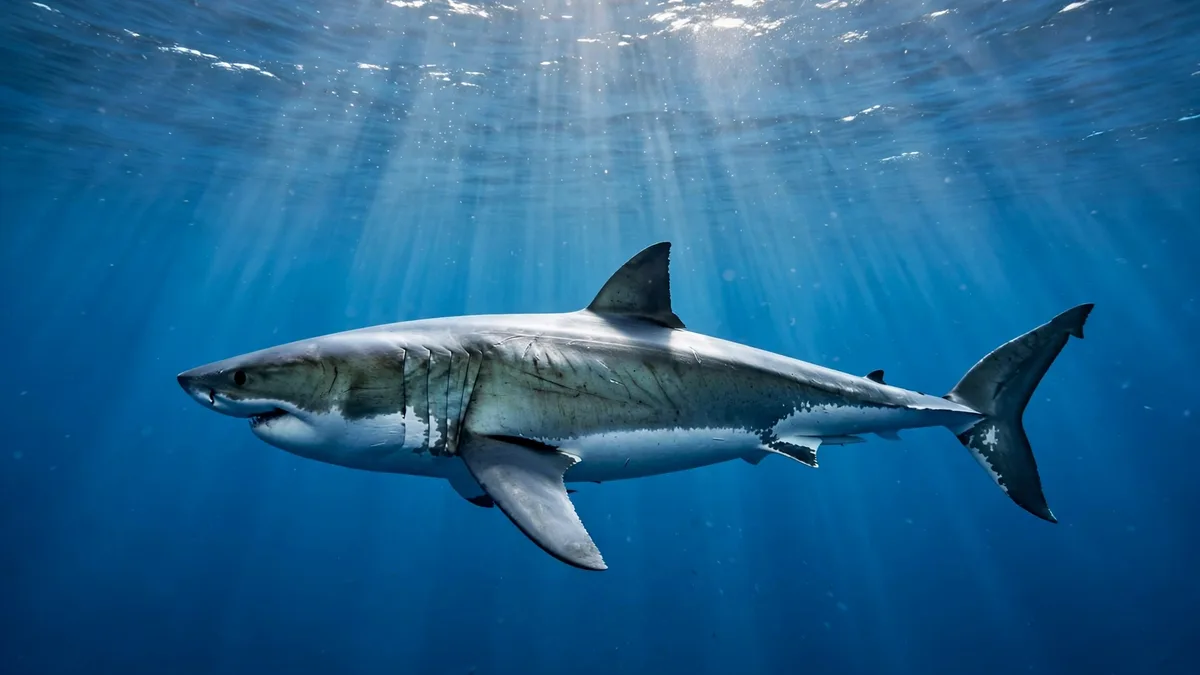
The great white shark species is a single species, Carcharodon carcharias, the largest predatory fish on Earth, a grey-backed hunter of cool coastal waters that most people know from films far better than from fact. If you are asking how many great white shark species there are, the answer is one: there is only one great white shark species in the world, and every great white alive today belongs to it.
The great white belongs to the mackerel shark family, Lamnidae, and it is the only living species in its genus, Carcharodon. It is built like a torpedo, with a pointed snout, a crescent-shaped tail, and a grey back that fades into a white belly.
Key takeaways
- There is only one great white shark species, Carcharodon carcharias, and it is the largest predatory fish on Earth.
- Great whites have around 300 serrated teeth arranged in rows, with new teeth moving forward to replace lost ones throughout life.
- Great whites can sense the tiny electric fields of living animals through organs called the ampullae of Lorenzini.
- Unprovoked attacks on people are rare, at around 70 a year worldwide, and most are not fatal.
- Great whites are listed as Vulnerable, with their numbers falling because of fishing, bycatch and the trade in fins and jaws.
What makes a great white shark a great white shark
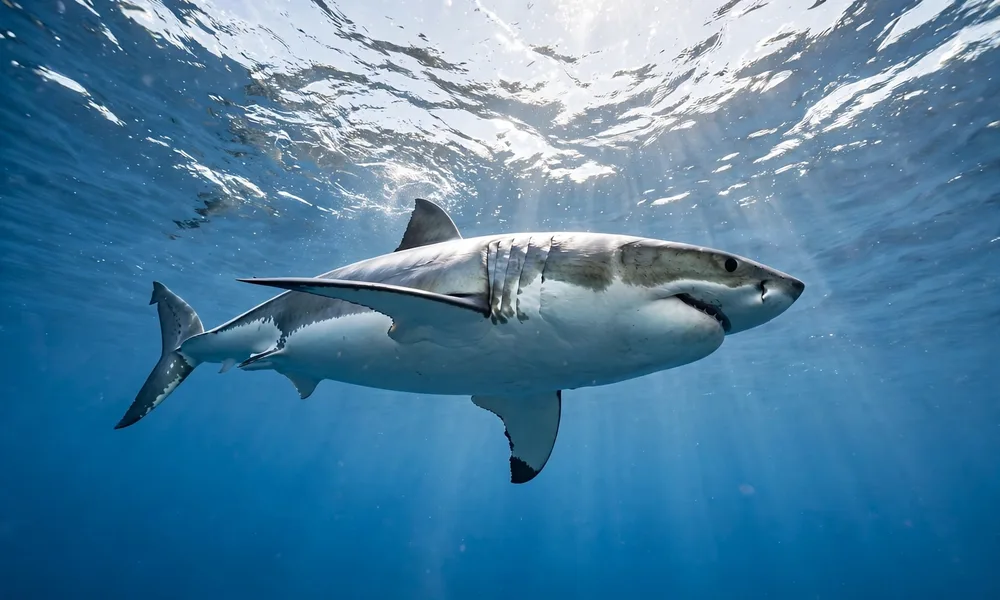
A great white shark is a large, heavy-bodied shark with a grey or grey-brown back, a white belly, a pointed snout and a powerful tail that drives it through the water at bursts of speed. Females grow larger than males, reaching lengths of around 4.5 to 6 metres, while males are usually around 3.5 to 4.5 metres long, and a large adult can weigh well over 1,000 kilogrammes.
The teeth define the great white: around 300 of them, broad, triangular and serrated like a steak knife, set in several rows so that a broken tooth is quickly replaced by one moving forward from behind. The eyes are dark and relatively small, and the snout carries hundreds of tiny jelly-filled pores, the ampullae of Lorenzini, which detect the faint electric fields given off by the muscles and heartbeats of other animals. Like other sharks, the great white must keep swimming to breathe, day and night.
The great white shark species and its relatives
Carcharodon carcharias is the only great white shark species, and it is not split into formally recognised subspecies. Scientists have found that great whites in different oceans, such as the Atlantic, the Pacific and the Indian Ocean, form distinct populations that rarely mix, but these are regional populations of the same species, not separate species. The great white is the only living member of its genus.
The shortfin mako is the great white’s closest living relative in build, being another fast mackerel shark, but it is smaller, slimmer and even quicker over short distances, while the great white is heavier and stronger. The tiger shark is a large coastal hunter, the bull shark can swim far up rivers into fresh water, and the whale shark is the largest fish of all, yet it eats only plankton.
| Type | Animal | Where it lives | Best-known food | Length or Weight |
|---|---|---|---|---|
| Species | Great white shark (Carcharodon carcharias) | Cool coastal waters worldwide | Seals, sea lions and fish | Up to about 6 m, up to about 2,000 kg |
| Close relative | Shortfin mako shark | Open oceans worldwide | Tuna and swordfish | Up to about 4 m |
| Close relative | Tiger shark | Tropical and subtropical seas | Turtles, fish and carrion | Up to about 5 m |
| Close relative | Bull shark | Warm coastal waters and rivers | Fish, rays and small sharks | Up to about 3.5 m |
| Close relative | Great hammerhead shark | Tropical seas worldwide | Stingrays and other sharks | Up to about 6 m |
| Close relative | Basking shark | Cool temperate seas | Plankton | Up to about 10 m |
| Close relative | Whale shark | Tropical and warm temperate seas | Plankton and small fish | Up to about 12 m |
How great white sharks live
Great white sharks are creatures of the open coast. A great white lives alone for most of its life, roaming huge distances across the ocean, and it gathers with other great whites only around rich feeding grounds, such as seal colonies. Like other predator animals, it is a patient hunter, cruising slowly before striking.
Seals and sea lions make up a large part of the diet of adult great whites, along with dolphins, large fish such as tuna, and carrion, including dead whales. Young great whites eat mainly fish and smaller sharks, and their diet shifts towards marine mammals as they grow. The shark hunts by stealth, approaching from below and behind, and its grey back and white belly act as camouflage, dark against the deep water from above and pale against the bright surface from below.
Breeding happens slowly, and the female gives birth to live young, usually between two and ten pups, after a gestation of about a year. The pups are born at around 1.2 to 1.5 metres long and must fend for themselves at once. Great whites grow slowly and mature late, with females not breeding until they are well over a decade old, and they may live for 70 years or more.
Where great white sharks live
The great white lives in cool and temperate coastal waters around the world, from the coasts of California and Mexico to South Africa, southern Australia, New Zealand and the Mediterranean Sea. It is most common where cold, nutrient-rich water meets the coast, and where seals and sea lions gather, and it is one of the best-known whales and sharks of the temperate seas, although it is a fish, not a whale.
Coastal hunting grounds are the key requirement. A great white needs seal colonies, fish-rich waters and room to roam, and it follows its prey as the seasons change, travelling thousands of kilometres across open ocean between feeding areas. Some have been tracked crossing whole ocean basins, from South Africa to Australia. It depends on healthy seas and abundant prey, like many other large hunters of the ocean.
The species is listed as Vulnerable, and its numbers are falling in many regions. The main pressures are fishing and bycatch, the trade in fins, jaws and teeth, and the loss of prey such as seals. Great whites are protected in many countries, but they still die in fishing gear, and their slow breeding means small losses take a long time to replace.
Best seasons for great white shark watching
There is no single closed season, because great whites are present in their home waters all year, but the best time to look for them depends on the place. In South Africa the winter months, from about May to September, bring the most sharks to the seal colonies around the Cape, In California the sharks gather around the Farallon Islands and the coast in late summer and autumn, when elephant seals haul out.
The season matters less than the conditions: calm seas, clear water and a licensed boat trip give the best chance of a sighting, and no trip can promise one, because great whites are wild animals that roam over huge areas.
Good places to try include the waters around Gansbaai in South Africa, the Neptune Islands in South Australia, Isla Guadalupe in Mexico and the Farallon Islands off California, all of which are known for regular great white visits.
Staying safe around great white sharks
A great white shark is a wild animal with a mouth full of sharp teeth, and it can hurt a person, though unprovoked attacks are rare, at around 70 a year worldwide, and most are not fatal. Keep your distance, never swim alone in waters where great whites are known to hunt, and avoid swimming at dawn or dusk, when sharks are most active.
Do not swim near seal colonies, river mouths after heavy rain, or places where fish are being cleaned or bait is in the water, because these draw sharks in. Admire great whites from a boat or a cage, with a licensed operator, and never try to touch or feed one. Any bite should be treated as a medical emergency at once.
Great white shark watching checklist
A little preparation turns a boat trip into a real chance of seeing a great white shark, so pack for cold wind, sea spray and long hours on the water.
- Binoculars with good low-light performance, for picking a shark fin out of the waves.
- A camera with a long lens, because sharks should always be watched from a boat, never from the water.
- Warm layers and a waterproof jacket, because the sea wind is cold even on a sunny day.
- Sea-sickness tablets, taken before boarding, because the best trips spend hours at sea.
- A booked licensed operator with a strong safety record, who knows the local sharks and the rules.
- A plan to be out early, when sharks are most active and the light is at its best.
- Patience and silence, because great whites are quiet hunters and a noisy boat will send them away.
Frequently asked questions
How many great white shark species are there?
There is one great white shark species, Carcharodon carcharias. Populations in different oceans rarely mix, but they are regional populations of the same species, not separate species. No second great white shark species is recognised.
How many teeth does a great white shark have?
A great white has around 300 teeth at any one time, arranged in several rows, with the front rows doing the biting and the back rows moving forward to replace teeth that break or fall out.
What is the ampullae of Lorenzini?
The ampullae of Lorenzini are tiny jelly-filled pores on the snout of a shark that detect the faint electric fields given off by the muscles and heartbeats of living animals. They help a great white find prey hidden in the sand or swimming in murky water, even when it cannot see it.
Are great white sharks dangerous to people?
Great whites can hurt a person, but unprovoked attacks are rare, at around 70 a year worldwide, and most are not fatal. Most bites appear to be a single investigatory bite, after which the shark lets go.
How is this guide different from the killer whale species guide?
This guide covers the single great white shark species, the largest predatory fish on Earth, while our killer whale species guide covers the single killer whale species, a toothed whale that hunts in family groups. The great white is a solitary fish that hunts alone, and the killer whale is a social mammal that hunts in pods.
Are great white sharks endangered?
Great whites are listed as Vulnerable, so they are not classed as endangered, but their numbers are falling in many regions. They breed slowly and mature late, so even small losses to fishing and bycatch take a long time to replace.
Conclusion
The great white shark species shows how much specialisation one animal can hold: Carcharodon carcharias, with around 300 serrated teeth, electroreception that senses the heartbeat of hidden prey, and a life spent roaming the cool coastal waters of the world. It is the largest predatory fish on Earth, and it has ruled the temperate seas for millions of years.
If you go looking for one, go in the cooler months, go with a licensed operator, and go with patience. Watch a great white cruise past the boat in clear blue water and you will understand why it has earned its place as the most famous shark in the world, and why keeping its seas healthy matters most.