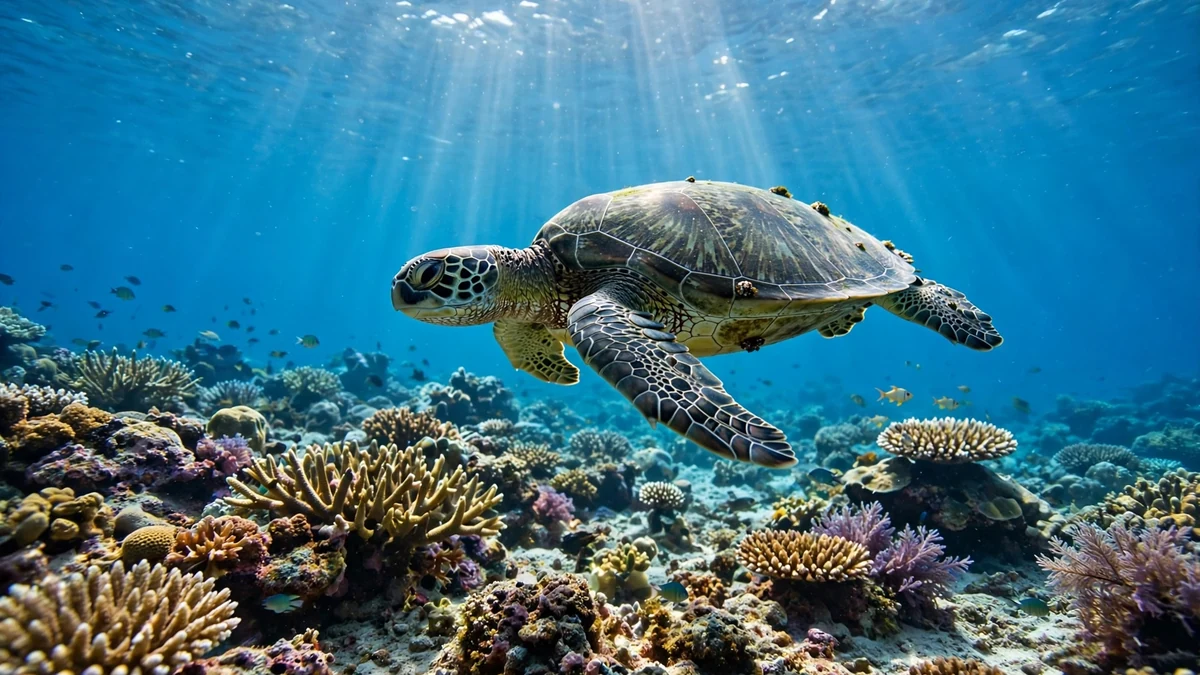
Turtle species number around 350, and they include sea turtles that cross whole oceans, tortoises that live for more than a century on land, and terrapins that swim in ponds and rivers. If you are wondering which turtle species exist and how to tell a turtle from a tortoise or a terrapin, the short answer is this: turtles are reptiles with a shell, tortoises are land-dwelling turtles, terrapins are freshwater turtles, and sea turtles are the marine turtles that spend their lives in the ocean and only come ashore to lay eggs.
Key takeaways
- There are around 350 turtle species, split between sea turtles, freshwater turtles and land tortoises.
- Tortoises live on land, terrapins live in fresh water, and sea turtles live in the ocean.
- A turtle’s shell is part of its body: the top is the carapace, the bottom is the plastron, and it cannot leave its shell.
- Female sea turtles return to the beach where they were born to lay their eggs.
- Galapagos giant tortoises can live for more than a century, and leatherback sea turtles are the largest turtles alive.
What makes a turtle a turtle
A turtle is a reptile with a shell made of bone covered in horny plates called scutes. The shell is not a house the turtle can leave: the top half, the carapace, is joined to the turtle’s spine and ribs, and the bottom half, the plastron, protects its belly. A turtle can pull its head, legs and tail inside the shell for protection, though sea turtles cannot pull their heads in at all.
Turtles are cold-blooded, so they bask in the sun to warm up and move into the shade or water to cool down. Most turtles are slow on land but graceful swimmers, and sea turtles can hold their breath for hours while resting underwater. Turtles have no teeth: they bite and tear their food with a sharp, horny beak.
The words turtle, tortoise and terrapin cause endless confusion, and the meanings change from place to place. In Britain, turtle usually means a sea or freshwater turtle, tortoise means a land turtle, and terrapin means a freshwater turtle. In America, turtle is often the general word for the whole group. The rule used in this guide is simple: tortoises live on land, terrapins live in fresh water, and sea turtles live in the ocean.
Sea turtles: the ocean travellers
There are seven sea turtle species, and they are among the greatest travellers in the animal kingdom. The leatherback is the largest turtle alive, growing to nearly two metres long and weighing up to 900 kilograms, and it crosses whole oceans, from the tropics to the cold waters of the far north. Unlike other sea turtles, the leatherback’s shell is leathery rather than hard, and it feeds almost entirely on jellyfish.
The green turtle is the best-known sea turtle, named not for its shell but for the green colour of its fat. It grazes on seagrass in shallow tropical waters and is the only sea turtle that eats mainly plants as an adult. The loggerhead is named for its huge head and powerful jaws, which crush crabs, shellfish and other hard-shelled prey.

The hawksbill is the sea turtle of the coral reefs, with a narrow, pointed beak that reaches into cracks in the reef to pull out sponges. Its shell was once prized for tortoiseshell, and it is now one of the most endangered sea turtles. The olive ridley is the smallest sea turtle, and it is famous for the mass nestings, called arribadas, when thousands of females come ashore on the same beach on the same nights. The flatback lives only around Australia, and Kemp’s ridley, the rarest sea turtle, nests almost entirely on one beach in Mexico.
Tortoises: the land dwellers
Tortoises are the land-dwelling turtles, with domed shells, short sturdy legs and feet like an elephant’s. They live in deserts, grasslands and dry scrub, and they eat grasses, leaves, fruit and flowers. The Galapagos giant tortoise is the largest tortoise alive, weighing up to 400 kilograms, and some individuals are believed to be more than a century old.
The Aldabra giant tortoise of the Seychelles is almost as large, and it lives on a single atoll in the Indian Ocean, where more than a hundred thousand of them graze the grasslands. The spur-thighed tortoise of the Mediterranean is the tortoise most often seen in southern Europe, basking on dry hillsides in the morning, while the desert tortoise of the American south-west spends much of the year underground, escaping the heat in a burrow.
Tortoises are famous for their long lives. A Galapagos giant tortoise can live for more than a century, and the oldest known tortoise of all, a Seychelles giant tortoise, lived to around 190 years old. Their slow life suits their slow food: they eat plants that are hard to digest, and they can go for weeks without eating or drinking when food is scarce.
Terrapins and freshwater turtles
Terrapins are the freshwater turtles, living in ponds, lakes, rivers and marshes. They have flatter shells than tortoises, webbed feet for swimming, and they bask on logs and banks in the sun. The red-eared slider of North America is the best-known terrapin, named for the red stripe behind each eye, and it is now found in ponds all over the world after escaping from the pet trade.
The European pond turtle is the freshwater turtle of much of Europe, living in quiet ponds and slow rivers, where it eats insects, small fish, frogs and water plants. The painted turtle of North America is one of the most colourful, with red and yellow markings on its shell, and it is one of the most cold-hardy turtles, surviving winters frozen under the ice of northern lakes.
Some freshwater turtles are very different from the rest. The alligator snapping turtle of the American south-east is a huge, rough-shelled turtle with a worm-like lure on its tongue that it wiggles to attract fish. The softshell turtles of Asia and North America have flat, leathery shells and long necks, and they bury themselves in the mud of riverbeds. The mata mata of South America looks like a pile of dead leaves, and it sucks fish into its mouth by opening its jaws suddenly.
Where turtles live
Sea turtles live in the oceans of the world, and the ocean animals of the tropical seas include all seven sea turtle species. Green turtles graze on seagrass meadows, hawksbills feed on coral reefs, and leatherbacks follow jellyfish across whole oceans. Female sea turtles come ashore only to lay their eggs, always returning to the region, and often the very beach, where they were born.
Freshwater turtles live in ponds, lakes and slow rivers, and the river animals of warm regions include terrapins basking on logs and banks. Tortoises live in dry places: the deserts, grasslands and scrub of Africa, the Mediterranean, Asia and the Americas, and the islands of Galapagos and Aldabra hold the giant tortoises. The coastal animals of tropical beaches include nesting sea turtles in the summer months.
The best time to see turtles is in the morning, when terrapins and tortoises come out to bask in the sun. Sea turtles are best seen while snorkelling over seagrass meadows and coral reefs, or at night on a nesting beach with a guide, when the females come ashore to lay eggs. The lake animals of quiet waters include pond turtles basking on fallen logs in the summer.
| Species | Where it lives | Size | Best-known trait |
|---|---|---|---|
| Leatherback sea turtle | Open oceans worldwide | 2 metres | Largest turtle; eats jellyfish |
| Green turtle | Tropical and subtropical seas | 1.5 metres | Grazes on seagrass |
| Hawksbill turtle | Tropical coral reefs | 1 metre | Pointed beak; eats sponges |
| Galapagos giant tortoise | Galapagos Islands | 1.5 metres | Lives more than 100 years |
| Aldabra giant tortoise | Aldabra Atoll, Seychelles | 1.2 metres | One of the largest tortoises |
| Red-eared slider | Ponds and rivers, North America | 30 centimetres | Red stripe behind each eye |
| European pond turtle | Ponds and slow rivers, Europe | 35 centimetres | Europe’s freshwater turtle |
| Alligator snapping turtle | Rivers, south-eastern United States | 80 centimetres | Worm-like lure on its tongue |
Staying safe around turtles
Most turtles are harmless, but a few deserve respect. The alligator snapping turtle has a powerful bite and should never be handled, and a nesting sea turtle should never be disturbed: a frightened female may return to the sea without laying her eggs. Never pick up a wild turtle: it may carry germs, and handling stresses the animal.
On a nesting beach, keep your distance, use no white light, and never stand between a turtle and the sea. If you find a turtle on a road, help it across in the direction it was already going, and never move it to a new place: turtles know their home range and a moved turtle may wander for the rest of its life.
Turtle watching checklist
- Go out in the morning, when terrapins and tortoises bask in the sun.
- Look for terrapins on logs and banks in quiet ponds and slow rivers.
- Snorkel over seagrass meadows and coral reefs for sea turtles.
- Visit a nesting beach at night only with a guide, and use no white light.
- Never pick up a wild turtle, and never move one to a new place.
- Leave no trace: take your rubbish home and keep to marked paths.
Frequently asked questions
How many turtle species are there?
There are around 350 turtle species, including seven sea turtles, many freshwater turtles and around 60 tortoises. New species are still being found, especially among the freshwater turtles of South-East Asia.
What is the difference between a turtle and a tortoise?
A tortoise is a land-dwelling turtle: it lives on land, has a domed shell and short, sturdy legs. Turtles is the general word for the whole group, including sea turtles and freshwater turtles, while terrapins are the freshwater turtles that live in ponds, lakes and rivers.
How is this guide different from the ocean animals guide?
This is a species-level guide to turtles: it covers sea turtles, tortoises and terrapins in detail. The ocean animals guide is a general roundup of many different ocean animals, from whales to fish, and does not go into any one group in this depth.
How is this guide different from the coastal animals guide?
This guide covers turtles as a group, from giant tortoises to sea turtles and pond terrapins. The coastal animals guide is a general roundup of many different animals of the coasts, and only a few of them are turtles: most turtles live inland or in the open ocean.
How long do tortoises live?
Galapagos giant tortoises can live for more than a century, and the oldest known tortoise lived to around 190 years old. Even small tortoises often live for 50 years or more, which is why a pet tortoise is a commitment for life.
Do sea turtles really return to the beach where they were born?
Yes, female sea turtles return to the region, and often the very beach, where they were born to lay their own eggs. Scientists believe they find their way using the Earth’s magnetic field, the sun and the smell of the water.
Conclusion
Turtle species are the slow, long-lived survivors of the reptile world: leatherbacks crossing whole oceans, green turtles grazing seagrass meadows, hawksbills on the coral reefs, giant tortoises on Galapagos and Aldabra, and terrapins basking on logs in quiet ponds.
The next step is to pick one place and one morning — a pond bank, a desert trail or a tropical reef — and watch for the first shell in the sun.