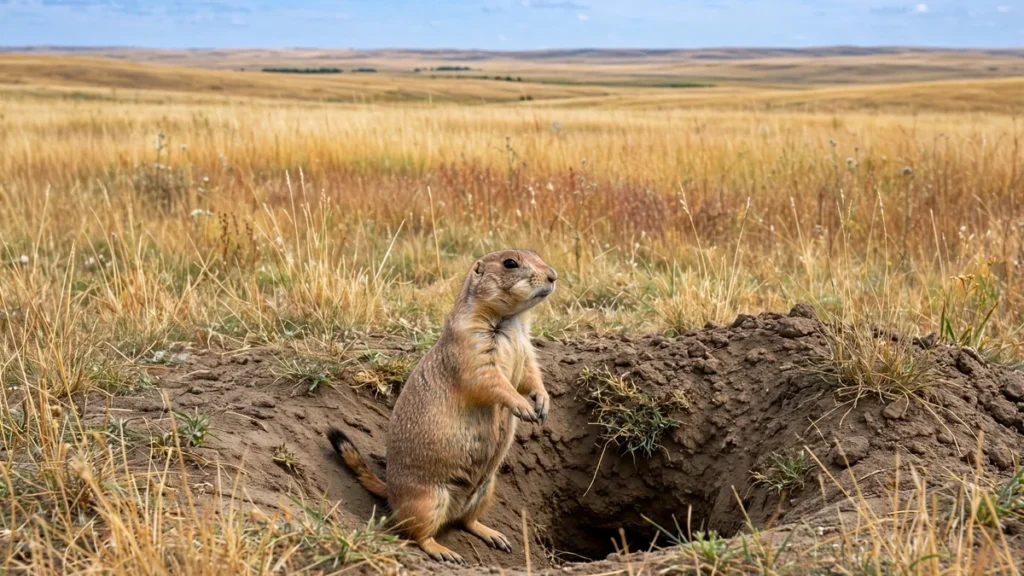
Prairie dog species are the chatty ground squirrels of the North American prairie, and there are five prairie dog species in the genus Cynomys: the black-tailed, white-tailed, Gunnison’s, Utah and Mexican prairie dogs. If you are wondering how many prairie dog species there are and what sets them apart, the short answer is this: all five are stout, burrowing ground squirrels, not dogs at all, living in large colonies called towns and warning each other with sharp barks.
Key takeaways
- There are five prairie dog species in the genus Cynomys: black-tailed, white-tailed, Gunnison’s, Utah and Mexican.
- Prairie dogs are ground squirrels, not dogs, and they are named for their dog-like barking alarm calls.
- They live in colonies called towns, in family groups called coteries, and they dig burrows with raised, crater-shaped entrances.
- The black-tailed prairie dog is the most common species, while the Utah and Mexican prairie dogs are rare and endangered.
- Prairie dogs eat grasses and other plants, and they are key food for eagles, hawks, coyotes, badgers and the black-footed ferret.
What makes a prairie dog a prairie dog
A prairie dog is a stout, short-legged ground squirrel built for life underground and on the open grassland. Its body is compact and muscular, about 30 to 40 centimetres long from nose to tail, with a short tail, small rounded ears, dark eyes and strong front claws made for digging. Its fur is sandy brown above and paler below, and its tail tip is black or white.
Prairie dogs are social animals, and their voices are tuned for colony life. They give sharp, chattering alarm calls that warn the whole town when an eagle circles overhead or a coyote trots through the grass, and different calls mean different kinds of danger. They eat mainly grasses, leaves, roots and seeds, grazing close to their burrows where they can run for cover, and they spend much of the day above ground feeding and standing guard.
The prairie dogs of the world
The black-tailed prairie dog is the best-known and most widespread species, living across the Great Plains from Canada through the United States to northern Mexico. It is about 35 centimetres long, with a black-tipped tail, and it lives in huge towns that can hold thousands of animals. Black-tailed prairie dogs are active for most of the year, and visitors are most likely to see this species, standing at its burrow mounds and barking.
The white-tailed prairie dog lives in the higher, colder grasslands of Wyoming, Colorado, Utah and Montana, where winters are long and summers are short. It is about 35 centimetres long, with a white-tipped tail, and it spends much of the year underground, hibernating through winter and emerging in spring to feed and raise its young. Its colonies are smaller and more scattered.
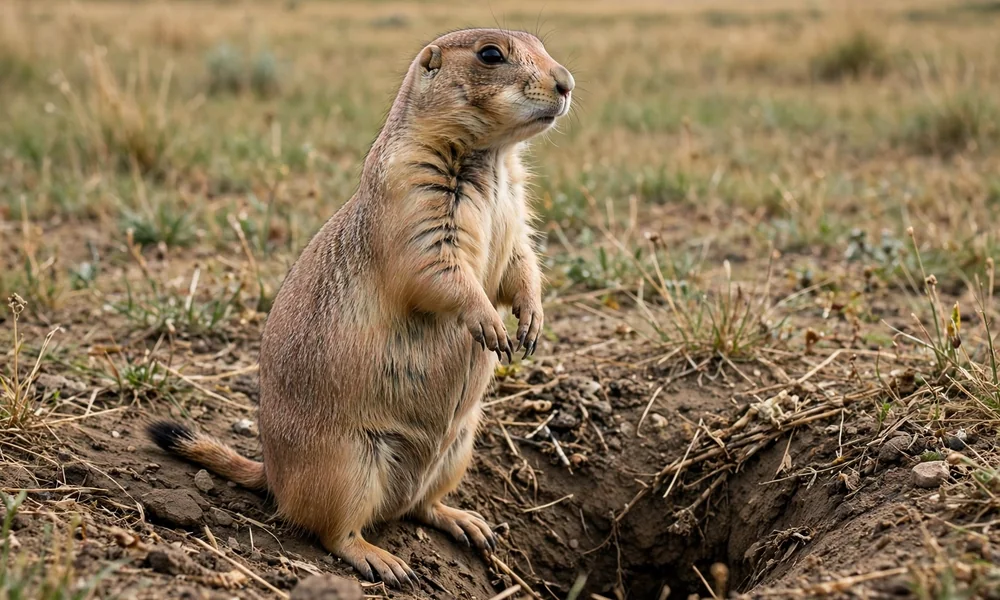
Gunnison’s prairie dog lives in the high grasslands and open woodlands of the Four Corners region, where Arizona, New Mexico, Colorado and Utah meet. It is about 35 centimetres long, with a tail that is greyish white with a dark band, and it lives in colonies on dry, open ground among grasses, sagebrush and scattered pines. It hibernates through winter, and its varied alarm calls can describe an approaching predator.
The Utah prairie dog is the smallest species, about 30 centimetres long, and it lives only in the grasslands and open valleys of south-western Utah. It is rare and endangered, with a cinnamon-brown coat and a dark patch above each eye, and it lives in small colonies on open, well-drained ground. It hibernates for much of the year, emerging in spring to feed on grasses and flowers.
The Mexican prairie dog lives only in the high grasslands of north-eastern Mexico, in Coahuila, Nuevo León and San Luis Potosí, at heights of around 1,600 to 2,200 metres. It is about 35 centimetres long, with a yellowish-brown coat and a dark-tipped tail, and it lives in large colonies on the open plains. Like the Utah prairie dog, it is endangered.
How prairie dogs live: colonies, burrows and barks
A prairie dog lives in a town, a colony of burrows that can hold dozens, hundreds or even thousands of animals. Each town is divided into family groups called coteries, usually one adult male, several adult females and their young, and each coterie defends its own patch of burrows. The animals in a coterie greet each other by touching noses and teeth, a habit known as kissing, and they share the work of watching for danger.
The burrow is the heart of prairie dog life. A burrow can be several metres deep, with chambers for sleeping, raising young and storing food, and a raised, crater-shaped entrance built from packed earth. The raised rim keeps rainwater out and gives the prairie dog a lookout post. When a prairie dog spots danger, it barks, and the call spreads through the town in a wave, sending animals diving into their burrows or standing upright to watch.
Prairie dogs eat mainly grasses, leaves, roots, flowers and seeds, grazing near their burrows and clipping the grass short around the town so they can see danger coming. They breed once a year, in spring, and females raise litters of three to five pups in the burrow, bringing them above ground after about six weeks. The young learn the alarm calls and the paths between burrows, and by autumn they feed and dig for themselves.
Where prairie dogs live
Prairie dogs live only in North America, on the grasslands and open plains from southern Canada through the Great Plains of the United States to northern Mexico. They favour short-grass prairie, open meadows and dry, well-drained ground where they can dig deep burrows and see danger from far away. The desert animals of the dry south-west include prairie dogs on the edge of the desert grasslands, and the mountain animals of the high plains include the white-tailed and Gunnison’s prairie dogs, which live at heights of well over 1,000 metres.
Each species has its own corner of the prairie. The black-tailed prairie dog ranges widest, across the Great Plains from Canada to Mexico, while the white-tailed prairie dog lives in the colder, higher grasslands of the northern Rockies and the Colorado Plateau. The other three live only in smaller areas: the Four Corners, south-western Utah and north-eastern Mexico.
| Species | Where it lives | Best-known food | Length |
|---|---|---|---|
| Black-tailed prairie dog | Great Plains, Canada to Mexico | Grasses, leaves, roots, seeds | 0.35 metres |
| White-tailed prairie dog | Wyoming, Colorado, Utah and Montana | Grasses, leaves, roots, seeds | 0.35 metres |
| Gunnison’s prairie dog | Four Corners region, United States | Grasses, leaves, flowers, seeds | 0.35 metres |
| Utah prairie dog | South-western Utah only | Grasses, flowers, leaves | 0.30 metres |
| Mexican prairie dog | North-eastern Mexico only | Grasses, leaves, roots, seeds | 0.35 metres |
Best seasons for prairie dog watching
Spring and early summer are the finest seasons for prairie dog watching, when the animals emerge from their winter burrows, the grass is green, and the young pups appear above ground for the first time. In May and June, the towns are at their liveliest, with pups playing near the burrow entrances and adults standing guard.
Summer is also good, though the midday heat sends prairie dogs underground to rest, so the best watching is in the cooler hours of the morning and evening. In autumn, the animals feed hard to build up fat for winter, and the white-tailed, Gunnison’s and Utah prairie dogs disappear into hibernation, while the black-tailed prairie dog stays active for longer. In winter, most towns are quiet.
Staying safe around prairie dogs
Prairie dogs are wild animals, and they deserve respect. Never try to catch a prairie dog, never put your hand into a burrow, and never handle one with bare hands. A prairie dog is small, but it has sharp teeth and claws, and it can bite if it feels trapped. Keep dogs on a lead near prairie dog towns, and leave the animals a clear path to their burrows. Leave a young prairie dog alone, because its mother is almost certainly nearby.
Prairie dogs can carry fleas, and in some areas those fleas can carry plague, a disease that affects prairie dogs and, rarely, people. Do not touch dead prairie dogs, do not sit or lie on the ground in a prairie dog town, and use insect repellent where plague has been reported. Keep a sensible distance from the burrows, using binoculars to watch up close.
Prairie dog watching checklist
- Look for raised, crater-shaped burrow mounds on open grassland, with clipped grass around them.
- Watch in the early morning or late afternoon, when prairie dogs are feeding and standing guard.
- Listen for sharp barks, the alarm call that gives the prairie dog its name.
- Use binoculars to watch from a distance, and never block the path to a burrow.
- Keep dogs on a lead, do not touch prairie dogs or burrows, and wash your hands afterwards.
- Leave no trace: take your rubbish home and keep to marked paths and viewing areas.
Frequently asked questions
How many prairie dog species are there?
There are five prairie dog species in the genus Cynomys: the black-tailed, white-tailed, Gunnison’s, Utah and Mexican prairie dogs. All five are ground squirrels, not dogs.
How is this guide different from the squirrel species guide?
This guide covers only the five prairie dog species of the genus Cynomys, from the black-tailed to the Mexican prairie dog, and how they live in colonies, dig burrows and bark warnings on the North American prairie. The squirrel species guide covers the whole squirrel family, from tree squirrels to marmots around the world.
Are prairie dogs really dogs?
No, prairie dogs are not dogs at all. They are ground squirrels, close relatives of marmots and other ground squirrels, and they got their name because their sharp alarm calls sound like a small dog barking. Coyotes are one of their main predators.
Why do prairie dogs bark?
Prairie dogs bark to warn the colony of danger. Different barks mean different kinds of predator, so the town knows whether an eagle is circling overhead, a coyote is walking through the grass or a badger is digging nearby. The call spreads from animal to animal in a wave.
Which prairie dog species are endangered?
The Utah prairie dog and the Mexican prairie dog are both endangered, and they live only in small areas: the Utah prairie dog in south-western Utah, and the Mexican prairie dog in north-eastern Mexico. Both are protected by law.
Where is the best place to see a prairie dog?
The best place to see a prairie dog is a prairie dog town on open grassland in spring or early summer, in the early morning or late afternoon. The black-tailed prairie dog is the easiest to find, in national parks and grasslands across the Great Plains.
Conclusion
Prairie dog species, all five of them, are the busy, barking builders of the North American prairie: black-tailed prairie dogs standing guard on the Great Plains, white-tailed prairie dogs hibernating through long winters, and Utah and Mexican prairie dogs holding on in the last corners of their grassland homes.
The next step is to visit a prairie dog town on a spring morning, watch the burrow mounds for a small brown shape standing upright and barking, and remember that the animal you are watching is a ground squirrel, not a dog.














