
Gerbil species are the desert rodents of the subfamily Gerbillinae, and there are more than 100 gerbil species living across the dry lands of Africa and Asia. If you are wondering which gerbil species exist and how such small animals survive in some of the hottest, driest places on Earth, the short answer is this: gerbils are built for the desert, with sandy fur, long hind legs for jumping, keen hearing and deep burrows where the air stays cool, and they get most of their water from the seeds they eat.
Key takeaways
- There are more than 100 gerbil species in the subfamily Gerbillinae, living in the deserts and dry grasslands of Africa and Asia.
- The Mongolian gerbil is the best-known gerbil species, and the one kept as a pet around the world.
- Jirds are gerbils: Shaw’s jird, the Libyan jird and the bushy-tailed jird all belong to the same subfamily as the Mongolian gerbil.
- Gerbils dig deep burrows with chambers for sleeping, storing food and raising young, and spend the heat of the day underground.
- The great gerbil is the largest gerbil species, at about 20 centimetres long, while the smallest are barely 10 centimetres long.
What makes a gerbil a gerbil
A gerbil is a small rodent built for life in the desert. Its body is compact and covered in soft, sandy fur that blends with the dunes and dry grass, and its belly is paler than its back. Its head is small and rounded, with large dark eyes and long whiskers that feel the way ahead in a dark burrow. Its tail is long, often as long as its body, and it helps the gerbil balance when it stands upright.
The gerbil’s hind legs are the key to its desert life. They are long and strong, so a gerbil can hop and jump across the sand in quick bounds, spending as little time as possible in the open. A gerbil can also stand upright on its hind legs, holding its small front paws against its chest, to scan the desert for hawks, foxes and snakes. Its hearing is sharp, and its kidneys lose very little water in its urine. The gerbil has taken dry-country life further than the hamster species that share its grasslands, which hoard food in cheek pouches and sleep through the cold season.
The gerbils of the world
The Mongolian gerbil is the best-known of all gerbil species, and the one most people meet first. It lives in the deserts and dry grasslands of Mongolia and northern China, digging burrows up to three metres deep, and it is about 12 centimetres long, with sandy brown fur and a long dark-tipped tail. They live in family groups, feeding at dawn and dusk. The pet gerbil in homes around the world is the Mongolian gerbil, Meriones unguiculatus.
The fat-tailed gerbil lives in the deserts of North Africa, from Morocco and Algeria to Egypt, and it is named for its thick tail, which stores fat. It is about 10 centimetres long, with soft sandy fur and a short, club-shaped tail, and it lives alone in a burrow, coming out at night to eat seeds, grasses and insects, living off that stored fat when food is scarce.
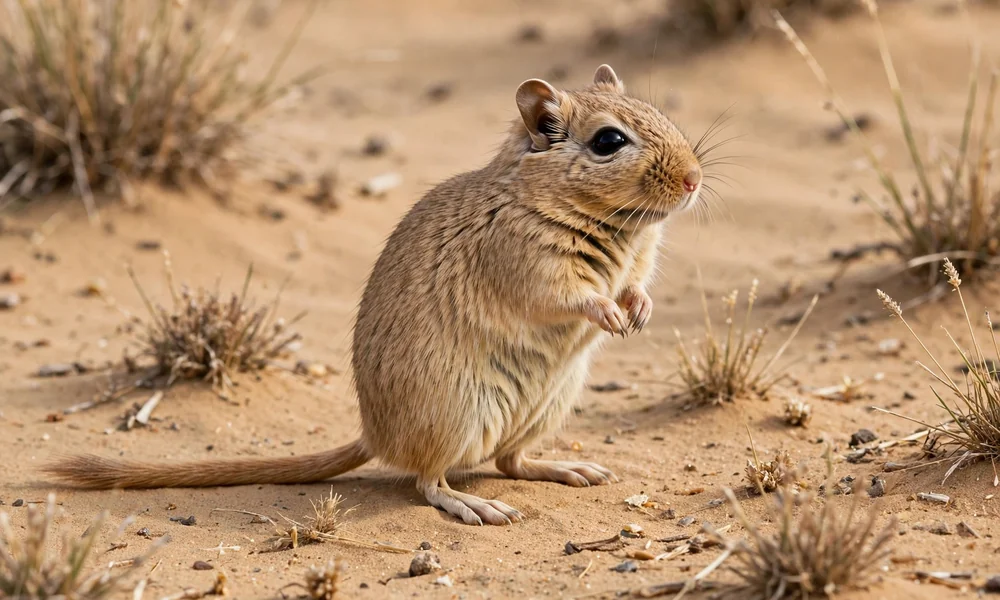
Shaw’s jird is one of the largest gerbils of North Africa, living in the deserts of Morocco, Algeria, Tunisia and Libya, and it is about 15 centimetres long, with grey-brown fur and a long, tufted tail. It digs burrows with several entrances and feeds by day on seeds, leaves and roots. The Libyan jird lives across the same North African deserts and east into Arabia, and it is about 15 centimetres long, with sandy fur and a long tail. It survives in the driest places in the Sahara, feeding on seeds and dry grasses and rarely drinking at all.
The Indian gerbil lives in the dry plains and farmland of India, Pakistan and Sri Lanka, and it is about 18 centimetres long, with grey-brown fur, digging burrows in fields and village edges. It feeds on seeds, grains and roots, and farmers know it well. The great gerbil lives in the deserts of Central Asia, from Kazakhstan to Mongolia and northern China, and it is the largest gerbil species, about 20 centimetres long, with sandy fur and a long tail. Great gerbils live in family colonies in large burrow systems, feeding by day on seeds and shrubs.
The pallid gerbil lives in the sandy deserts of Egypt and Libya, and it is about 10 centimetres long, with very pale, almost white fur that blends with the pale sand. It is active at night, feeding on seeds and insects and digging shallow burrows in the dunes. The bushy-tailed jird lives in the rocky deserts of Egypt, Israel and Arabia, and it is about 15 centimetres long, with grey-brown fur and a long, bushy tail. It climbs among rocks and boulders as well as digging, feeding on seeds and leaves. Together, these eight species show how far the gerbil family has spread, from the Sahara to the Gobi.
How gerbils live
A gerbil lives most of its life underground, in a burrow dug with strong front paws. The burrow is a maze of tunnels with separate chambers for sleeping, storing food and raising young, and it can be several metres long, with more than one entrance. Deep underground the air stays cool by day and warm at night. A gerbil spends the hottest hours asleep in its burrow, and comes out in the cool of dawn and dusk to feed, or at night if it is a nocturnal species.
Gerbils eat seeds, grasses, leaves and roots, with the odd insect, and store food in their burrows for the lean season. A gerbil rarely needs to drink water, because it gets most of the moisture it needs from its food, and it produces very little urine. Gerbils are social, and many species live in family groups, sharing a burrow and warning each other by thumping a hind foot. Hawks, owls, foxes, snakes and wild cats all hunt gerbils, and a gerbil’s best defence is its speed, its hearing and the safety of its burrow.
Where gerbils live
Gerbils live across the deserts and dry grasslands of Africa and Asia, from the Sahara to the Gobi, wherever the land is dry, sandy and open. They favour sand dunes, dry plains, rocky deserts and farmland edges, digging burrows in soft soil under shrubs and dry grasses. The desert animals of these dry lands include gerbils, jerboas and sand cats, all of which have learned to live with very little water. The nocturnal animals of the desert include the fat-tailed gerbil and the pallid gerbil, which come out only after dark, when the sand has cooled.
| Species | Where it lives | Best-known food | Body length |
|---|---|---|---|
| Mongolian gerbil | Mongolia and northern China | Seeds, grasses | 0.12 metres |
| Fat-tailed gerbil | Morocco, Algeria and Egypt | Seeds, grasses, insects | 0.10 metres |
| Shaw’s jird | Morocco, Algeria, Tunisia and Libya | Seeds, leaves, roots | 0.15 metres |
| Libyan jird | North Africa and Arabia | Seeds, dry grasses | 0.15 metres |
| Indian gerbil | India, Pakistan and Sri Lanka | Seeds, grains, roots | 0.18 metres |
| Great gerbil | Central Asia to northern China | Seeds, leaves, shrubs | 0.20 metres |
| Pallid gerbil | Egypt and Libya | Seeds, insects | 0.10 metres |
| Bushy-tailed jird | Egypt, Israel and Arabia | Seeds, leaves | 0.15 metres |
Best seasons for gerbil watching
Spring is the finest season for gerbil watching in the deserts of North Africa and Central Asia, when gerbils are out in the cool morning and late afternoon, gathering seeds and repairing burrows. The gerbils are busy and easy to spot as they hop between the shrubs, standing upright to look around.
Autumn is the best season in the Gobi and the Mongolian grasslands, when the young gerbils have left the burrow and family groups are gathering seeds for winter. Watch at dawn and dusk, when the gerbils are most active, and look for small sandy shapes hopping across the sand. In the heat of summer, gerbils stay underground through the middle of the day, so dawn and dusk are always the best times to look.
Staying safe around gerbils
Gerbils are wild animals, and they deserve respect. Never try to catch a wild gerbil, never dig into a burrow, and never handle one with bare hands. A gerbil is small, but it has sharp teeth and it can give a painful bite if it is frightened or cornered. Keep dogs on a lead near gerbil colonies. If you find a young gerbil alone, leave it where it is, because its mother is almost certainly nearby.
Gerbil watching checklist
- Look for mounds of earth and small holes in the sand, which mark a burrow entrance.
- Watch desert edges and dry grassland at dawn and dusk, when gerbils feed.
- Look for small sandy shapes hopping across open ground, then standing upright.
- Listen for the soft thump of a hind foot, a gerbil’s warning to its family.
- Never dig into a burrow or try to catch a wild gerbil, and keep dogs on a lead.
- Leave no trace: take your rubbish home and keep to marked paths.
Frequently asked questions
How many gerbil species are there?
There are more than 100 gerbil species in the subfamily Gerbillinae. The table above shows eight of the best-known gerbils: the Mongolian, fat-tailed, Shaw’s jird, Libyan jird, Indian, great, pallid and bushy-tailed jird. The exact count changes as scientists split one species into two.
How is this guide different from the mouse species guide?
This guide covers only the gerbil species of the subfamily Gerbillinae, from the Mongolian gerbil to the bushy-tailed jird, and how they survive the desert. The mouse species guide covers the mice of the family Muridae, which live all over the world and are not desert specialists at all.
What is the best gerbil species to keep as a pet?
The Mongolian gerbil is the best gerbil species to keep as a pet, and it is the only gerbil species that is widely kept in homes. It is friendly, curious and active by day, and best kept in pairs or small groups, because it is a social animal. It needs deep bedding to dig in, a wheel to run on, and a diet of seeds and grains.
Are jirds gerbils?
Yes, jirds are gerbils. Shaw’s jird, the Libyan jird and the bushy-tailed jird all belong to the same subfamily, Gerbillinae, as the Mongolian gerbil and the fat-tailed gerbil. The word jird is simply an old name for some of the larger gerbils, and it does not mark a separate group.
Do gerbils need to drink water?
Wild gerbils rarely drink water, because they get most of the moisture they need from the seeds, grasses and roots they eat, and their kidneys save water well. A pet gerbil, on the other hand, should always have a bottle of fresh water, because pet food is drier than wild food.
Where is the best place to see a wild gerbil?
The best place to see a wild gerbil is a desert edge or a dry grassland at dawn or dusk. Look for the mounds of earth at the burrow entrances, then sit quietly and wait for a gerbil to come out to feed, stand upright, and hop away at the first sign of danger.
Conclusion
Gerbil species, more than 100 of them, are the small, tough survivors of the desert world: Mongolian gerbils in the Gobi, fat-tailed gerbils in the Sahara, and great gerbils in Central Asia.
The next step is to walk a desert edge at dawn, watch for a quick sandy shape hopping between the shrubs, and remember that this small desert mammal is one of the best-adapted animals on Earth.














