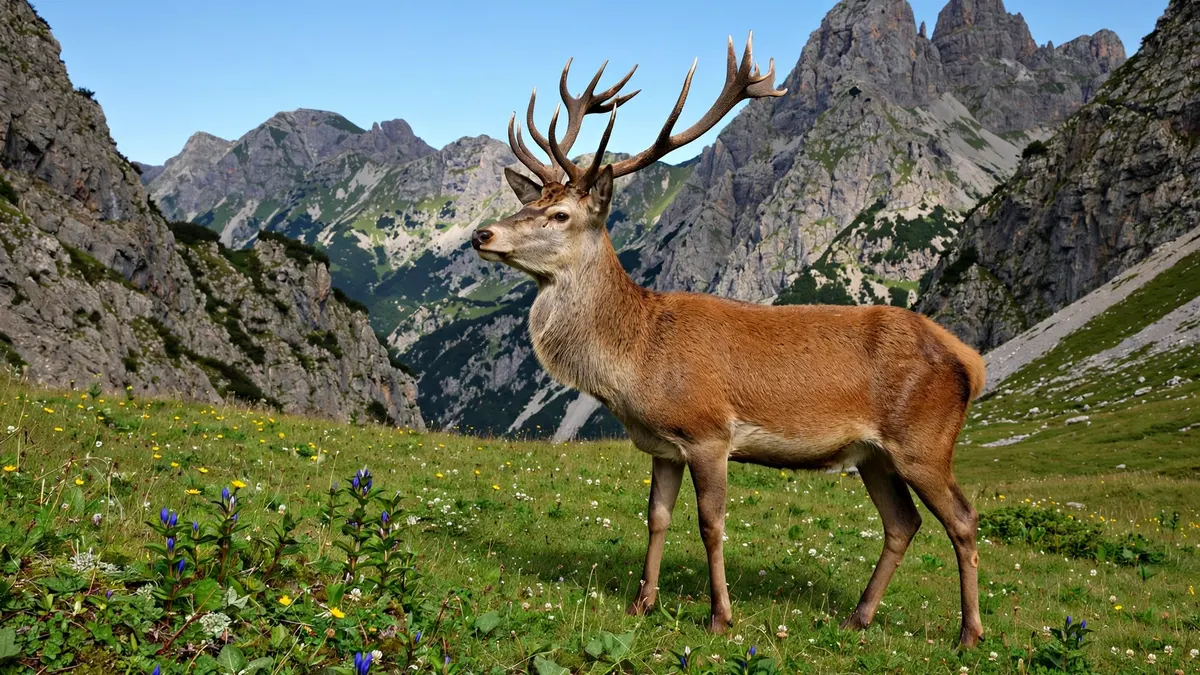
Liechtenstein animals include chamois and Alpine ibex on the high slopes of the Rätikon, red deer and roe deer in the forests of the Rhine valley, marmots whistling in the alpine meadows, and golden eagles circling over the peaks. If you are wondering which animals live in Liechtenstein and where to see them, the short answer is this: the mountains hold chamois, ibex, marmots and eagles, the valley forests hold deer, foxes and badgers, and the Rhine and its wetlands hold herons, kingfishers and water birds.
Liechtenstein is one of the smallest countries in Europe, a principality of just 160 square kilometres wedged between Switzerland and Austria. Yet it holds two very different worlds: the flat, farmed floor of the Rhine valley in the west, and the steep, rocky Rätikon mountains in the east, rising to the Grauspitz at 2,599 metres.
Key takeaways
- Chamois and Alpine ibex live on the high slopes of the Rätikon, and marmots in the alpine meadows above the treeline.
- Red deer and roe deer live in the forests of the Rhine valley and the lower slopes, with foxes, badgers and pine martens in the same woods.
- Golden eagles, ravens and alpine choughs patrol the peaks, while herons, kingfishers and dippers work the Rhine and its mountain streams.
- Liechtenstein has no endemic land mammal: no mammal lives only in Liechtenstein, but its alpine wildlife is among the most accessible in the Alps.
- Dawn and dusk are best for mammals, spring and early summer for the birds of the valley, and late summer for marmots and eagles in the high mountains.
What makes Liechtenstein’s wildlife special
Liechtenstein sits where the Rhine valley meets the Alps, and its wildlife is shaped by that meeting. In the west, the river plain is farmland, meadow and riverside woodland, home to deer, hares and water birds. In the east, the land rises fast through forest to rock and high pasture, home to chamois, ibex and marmots.
Liechtenstein has no endemic land mammal: no mammal lives only in Liechtenstein. What it has instead is a well-kept corner of the central Alps, where the same mountain animals as Switzerland and Austria live in valleys walked and farmed for centuries. More than two-fifths of the country is forest, and above the forest lie open alpine meadows that belong to the chamois and the marmot.
The golden eagle, the great bird of the Alps, nests on the cliffs of the Rätikon, and the Alpine ibex, once hunted to near extinction across the Alps, now stands again on the high ridges. Both are signs of how carefully these mountains have been kept.
The great mammals of the mountains
The chamois is Liechtenstein’s most characteristic animal, a sure-footed goat-antelope that lives on the steep slopes and rocky ledges of the Rätikon. In summer the herds graze the high meadows above the treeline, and in winter they drop to the forest edge. A slow scan of the ridges at dawn will often find them.

The Alpine ibex stands on the highest ridges, its great curved horns marking the males from a long way off. Ibex were reintroduced to the Alps after vanishing from most of their range. They are shy and keep to the cliffs, so a sighting takes a telescope, a high path and patience.
Red deer are the largest animals of the valley forests, living in the woods of the Rhine plain and the lower slopes. The stags are most impressive in autumn, during the rut, when their roaring carries through the forests at dusk. Roe deer are far easier to see, grazing in the meadows and forest edges at dawn and dusk. Among the predators, the red fox is common in farmland and forest edges, and the pine marten hunts in the old woods.
The marmot is the voice of the high meadows, whistling a sharp alarm as walkers approach its burrows. Marmots sleep underground all winter and emerge in spring to feed on the alpine grasses, and a summer walk above the treeline will rarely pass without hearing one. The mountain animals of Liechtenstein also include the badger, most active after dark, and the red squirrel of the conifer woods.
Wolves have returned to the wider Alps and are occasional visitors to Liechtenstein, crossing from Switzerland or Austria, but they are not residents. Brown bears have been absent for centuries, and the lynx is at most a rare visitor here.
Birds of the peaks and the valley
The golden eagle is the great bird of the Rätikon, hunting marmots and chamois kids over the high slopes and nesting on the remote cliffs of the east. The raven croaks over the forests and peaks, and the alpine chough, a black crow with a yellow beak, follows walkers along the high ridges.
The black grouse lives in the upper forests and dwarf-shrub slopes, and the rock ptarmigan, white in winter and mottled brown in summer, lives above the treeline. The wallcreeper, a small grey bird with crimson wings, climbs the rock faces, and the peregrine falcon nests on the cliffs of the Rätikon.
Down in the valley, the birds change completely. The kingfisher flashes along the Rhine and its side channels, and the dipper walks the fast mountain streams from the Rätikon. Grey herons stand in the shallows, and the Ruggeller Riet, the large reed-bed reserve in the north, holds reed warblers, water rails and marsh harriers in summer.
Small mammals, reptiles and the Rhine
Not all of Liechtenstein’s wildlife is large. The meadows and hedgerows of the Rhine valley hold hares, and the nocturnal animals of Liechtenstein include the badger, the pine marten and the fox, all most active after dark. Bats hunt over the rivers and meadows at dusk.
Adders bask on sunny slopes in the mountains, and the grass snake hunts frogs along the Rhine and its ponds. The ponds and marshes hold common frogs, common toads and alpine newts, and summer evenings fill with frog calls from the reed beds.
The Rhine holds brown trout and grayling in its clean, cold water, and the mountain streams hold trout in their fast, clear runs. The forest animals of the valley also include dormice and bank voles, and the conifer woods hold crossbills and nutcrackers, which feed on the seeds of spruce and pine.
Where to see Liechtenstein’s wildlife
Chamois and marmots are best in the high mountains of the east, where the paths above Malbun and Steg climb through the meadows to the ridges of the Rätikon. Go early, scan the slopes with binoculars, and listen for the marmot’s whistle. Ibex are best on the highest ridges, and a telescope and a guide greatly improve your chances.
Red deer are best in the forests of the Rhine valley and the lower slopes. The autumn rut, when the stags roar, is the best time of all. The animals of Switzerland live just across the Rhine, and the same forests and peaks continue into the neighbouring countries.
Golden eagles are best over the high ridges of the Rätikon on a clear, still morning, when they ride the thermals above the peaks. Kingfishers and dippers are best along the Rhine and its mountain streams, and the birds of the Ruggeller Riet are reached by the tracks through the reed beds in the north, most active in the morning and evening.
| Species | Where to look | Best season | How likely is a sighting |
|---|---|---|---|
| Chamois | High slopes of the Rätikon | Summer, at dawn | Good with binoculars |
| Alpine ibex | Highest ridges of the east | Summer, at dawn | Low, needs a telescope |
| Alpine marmot | Meadows above the treeline | Summer | Good, listen for whistles |
| Red deer | Forests of the Rhine valley | Autumn, during the rut | Fair at dawn and dusk |
| Golden eagle | High ridges of the Rätikon | Spring to autumn | Fair on a clear morning |
| Kingfisher | Rhine and its side channels | All year | Good along the banks |
| Black grouse | Upper forests and shrub slopes | Spring, at dawn | Low, needs patience |
Best seasons for wildlife watching
Spring is the finest season. The marmots emerge from their burrows, the black grouse display at dawn on the upper slopes, and the birds of the Ruggeller Riet return to the reed beds. It is also the most sensitive season, so keep to paths and give every animal more space than you think it needs.
Summer is the easiest season for the high mountains, with long days, the chamois, ibex and marmots at their most active, and the golden eagles riding the thermals. Autumn brings the deer rut in the valley forests, when the stags roar at dusk.
Winter is the quiet season, and the hardest for watching, but chamois tracks are easiest to find in the snow, and the Rhine valley holds wintering water birds and ravens over the forests.
Staying safe around Liechtenstein’s wildlife
Liechtenstein’s wild animals are usually calm, but they deserve respect, and the mountains most of all. Never approach a chamois or an ibex on a steep slope, never walk between a deer and its young, and never leave food or rubbish where wild animals can reach it. Keep your distance, check the weather before climbing to the high ridges, and walk with a local guide in the mountains of the east.
Liechtenstein wildlife watching checklist
- Book a guided chamois walk above Malbun or Steg, and go early.
- Walk the high meadows in summer and listen for marmots whistling.
- Scan the ridges of the Rätikon on a clear morning for golden eagles.
- Visit the Ruggeller Riet in late spring for reed warblers and marsh harriers.
- Walk the banks of the Rhine at dawn for kingfishers and dippers.
- Leave no trace: take your rubbish home and keep to marked paths.
Frequently asked questions
What is the most famous animal in Liechtenstein?
The chamois is the most famous, and the herds of the Rätikon are one of the best reasons to climb into the mountains of the east. The golden eagle is the best-loved bird of the peaks.
Are there wolves and bears in Liechtenstein?
No, there are no resident wolves or bears in Liechtenstein. Wolves have returned to the wider Alps and may pass through, but they do not live here, and brown bears have been absent for centuries.
What animal lives only in Liechtenstein?
No land mammal lives only in Liechtenstein. The country holds no endemic land mammal, but it does hold chamois, ibex, marmots and golden eagles, and its alpine wildlife is among the most accessible in the Alps.
When is the best time to see chamois in Liechtenstein?
Chamois are best in the high meadows of the Rätikon in summer, at dawn, when the herds graze above the treeline. They drop to the forest edge in winter, where they are easier to spot.
Can I see golden eagles in Liechtenstein?
Yes. Golden eagles nest on the cliffs of the Rätikon and hunt over the high slopes from spring to autumn. They are best watched on a clear, still morning, riding the thermals above the peaks.
Where can I see marmots in Liechtenstein?
Marmots are best in the meadows above Malbun and Steg, where their burrows dot the high pastures. Listen for their whistle, and watch for them feeding in summer.
Conclusion
Liechtenstein’s wildlife rewards patience: chamois on the slopes of the Rätikon, marmots whistling in the high meadows, golden eagles over the peaks, and red deer in the Rhine valley forests are all within reach if you plan around the seasons.
The next step is to pick one species and one season — a summer morning above Malbun for chamois and marmots, a spring walk in the Ruggeller Riet for reed birds, or an autumn evening in the valley forests for the deer rut — and plan around it.