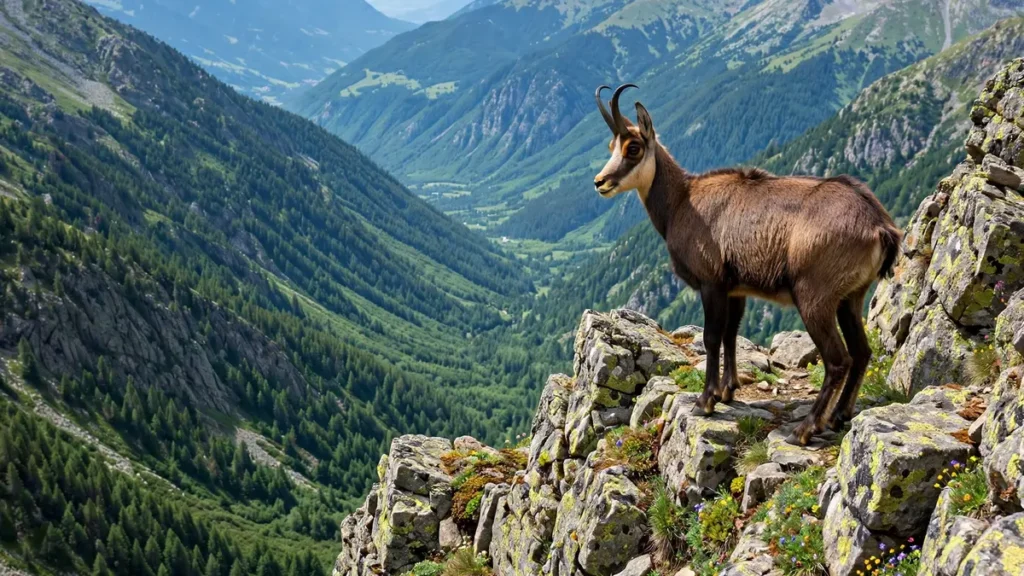
Andorra animals include chamois on the high ridges, bearded vultures and golden eagles over the valleys, marmots whistling from the alpine meadows, red deer and wild boar in the forests below, and trout in the cold mountain streams. If you are wondering which animals live in Andorra, the short answer is this: Andorra has no endemic land mammal of its own, but as a small, high country in the Pyrenees it holds the classic mountain wildlife of the range.
Andorra is one of the smallest countries in Europe, and one of the highest, with its valleys sitting above a thousand metres and its peaks rising past two thousand nine hundred. Almost the whole country is mountain, and its wildlife is mountain wildlife: animals of rock, pine forest and cold, clear water.
Key takeaways
- Andorra has no endemic land mammal: no mammal lives only in Andorra, a fact worth stating plainly.
- The Pyrenean chamois, known locally as the isard, is the most characteristic animal of the Andorran mountains.
- Bearded vultures, reintroduced to the Pyrenees, are one of the great conservation successes of the range.
- Brown bears and wolves are rare visitors to Andorra, wandering in from France and Spain rather than living there.
- Summer is the best season for Andorra’s wildlife, when the marmots are out, the vultures are soaring and the high meadows are in flower.
What makes Andorra’s wildlife special
Andorra is a country of height. Its lowest point is still high by the standards of most of Europe, and its mountains rise steeply from narrow valleys to rocky ridges and peaks. That height shapes everything: the forests are pine and fir, the meadows above them are alpine, and the animals are the ones that can live on rock and in cold air.
The chamois is the animal that defines these mountains. The Pyrenean chamois, the isard, lives on the steepest ground, where its hooves grip rock that looks impossible to stand on, and it moves between the high meadows in summer and the lower slopes in winter.
Andorra’s wildlife is Pyrenean wildlife, shared with France and Spain across borders that animals do not recognise. Bears cross from France, wolves from Spain, vultures range over the whole chain, and the desman swims in streams that flow from one country to another.
Chamois, ibex and the mountain grazers
The Pyrenean chamois is a small, sure-footed goat-antelope, reddish-brown in summer and dark brown in winter, with short, hooked horns that curve back over its head. In summer the herds graze the high alpine meadows, and in winter they come down to the forested slopes where the snow is thinner. They are most easily seen at dawn.
Alpine ibex have been brought back to the Pyrenees after an absence of many years, reintroduced to slopes where the native Pyrenean ibex died out long ago. The big males, with their huge curved horns, are now a regular sight on the rocky ridges of the range. Like the mountain animals of other high ranges, ibex live where few other grazers can follow.
Red deer live in the forests of the lower valleys, and the autumn rut fills the woods with roaring stags. Roe deer are smaller and shyer, living at the forest edge and in the meadows, and wild boar root through the oak and pine woods at night.
Marmots are the whistlers of the high meadows. These stout, sociable rodents live in family groups in deep burrows, feeding on grass and herbs through the summer and sleeping through the long winter underground. Their sharp whistle, given at the first sign of an eagle, is one of the characteristic sounds of the Andorran summer.
Bearded vultures, eagles and the birds of the peaks
The bearded vulture, also called the lammergeier, is the most spectacular bird of the Pyrenees. It is a huge vulture with a wingspan of nearly three metres, rust-coloured plumage, a wedge-shaped tail and a black beard, and it feeds on bones, dropping them from a height onto rocks to break them open. The species was wiped out in the Pyrenees and then brought back by reintroduction.
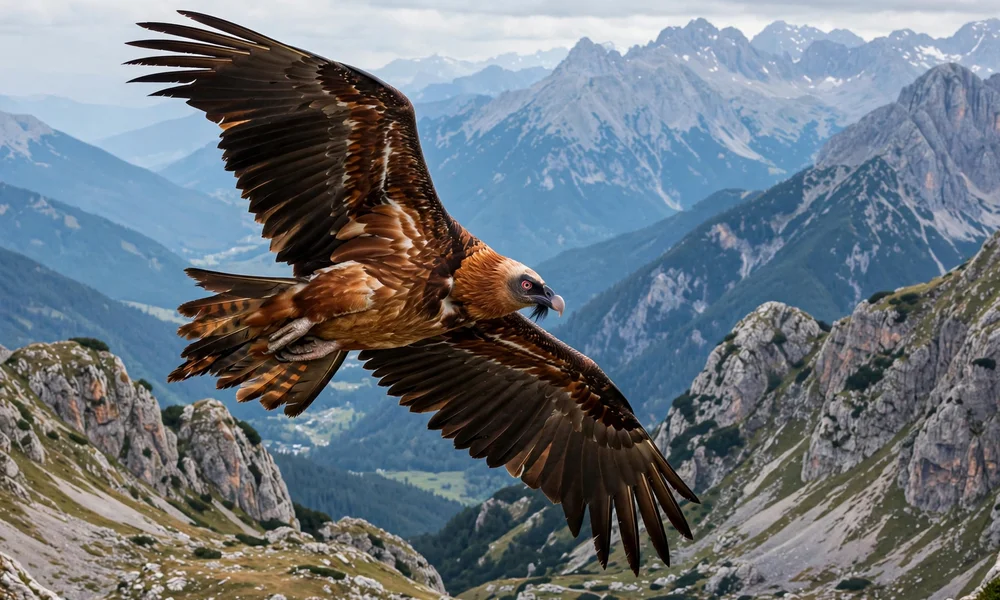
Golden eagles hunt over the same ridges, taking marmots, hares and young chamois, and griffon vultures, the big pale vultures of the Pyrenees, soar in groups over the valleys, looking for carrion. The three together are the great birds of the Andorran sky, and a summer day on a high pass can show all three.
Smaller birds fill the forests and meadows. The owls of Andorra include the tawny owl of the woodlands and the Tengmalm’s owl of the high pine forests, and the capercaillie, a huge forest grouse, lives in the old pine woods. Alpine choughs, black birds with yellow beaks, tumble and play around the highest peaks.
In the mountain streams, the dipper walks underwater in search of insects, and the grey wagtail bobs on the rocks. The streams are cold, clear and fast, and they hold brown trout, the fish of the Andorran valleys.
Bears, wolves and the rarest animals
Brown bears are rare visitors to Andorra, not residents. A small population lives in the Pyrenees, spread across France and Spain, and individual bears wander into Andorra from time to time, crossing the high passes in search of food. The bears are shy, keeping to the quietest forests and moving mostly at night.
Wolves are rarer still. They have returned to the Pyrenees from the east, and a few animals pass through the range, but there is no settled wolf pack in Andorra. Among the predators of the mountains, the most regular are smaller: the red fox, the pine marten and the stoat that turns white in winter.
The rarest animal of all is the Pyrenean desman, a small, shrew-like mammal with a long trunk-like nose that lives in cold mountain streams. The desman is a genuine Pyrenean endemic, found only in the Pyrenees and a few mountains of northern Spain, but it is not an Andorra-only animal, and it is very hard to see: it hunts at night in fast water, and it is threatened by dams and pollution.
The forests also hold red squirrels, dormice and pine martens, and the meadows are rich in butterflies, including the Apollo, a large white butterfly of the high mountains. Adders bask on sunny rocks in the valleys, and the Pyrenean frog lives in the cold streams of the high valleys.
Where to see Andorra’s wildlife
The best place to look for chamois is the high ground: the ridges and meadows above the tree line, reached by the paths from the mountain passes. Go at dawn, when the herds are feeding on the open slopes, and take binoculars. The Sorteny Valley nature park, in the north of the country, is one of the best places to start.
For vultures, the high passes are best. On a warm summer day, bearded vultures, griffon vultures and golden eagles all soar on the rising air, and a few hours watching from a pass can show all three. The Coma Pedrosa Natural Park, around Andorra’s highest peak, holds chamois, marmots and eagles.
For marmots, look for the colonies on the grassy slopes below the ridges, where the burrows are marked by mounds of dug earth. The animals are out in the morning and late afternoon, and their whistle will tell you where they are before you see them. The forest animals of the valleys are best at dawn, in the pine woods below the ski areas.
| Species | Where to look | Best season | How likely is a sighting |
|---|---|---|---|
| Pyrenean chamois | High ridges and alpine meadows | Summer, at dawn | Good |
| Bearded vulture | High passes and ridges | Summer, midday thermals | Fair |
| Alpine marmot | Grassy slopes below the ridges | June to September | Good |
| Golden eagle | Mountain ridges and valleys | All year | Fair |
| Red deer | Pine forests of the valleys | Autumn, during the rut | Good |
| Pyrenean desman | Cold mountain streams | Night, all year | Very low |
| Brown bear | Quiet forests, border areas | Spring to autumn | Very low |
Best seasons for wildlife watching
Summer is the finest season in Andorra. The snow has gone from the high meadows, the marmots are out, the vultures are soaring on the warm air and the alpine flowers are in bloom.
Spring is the season of return, when the birds come back to the high valleys and the chamois move up to the meadows. Autumn brings the deer rut in the forests, and the larches turn gold on the slopes.
Winter is the quiet season, and the hardest for watching, but it has its own rewards: chamois and ibex on the snowy ridges, golden eagles over the white valleys, and the tracks of foxes, stoats and deer in the snow.
Staying safe around Andorra’s wildlife
Andorra’s wild animals are usually calm, but the mountains themselves demand respect. Weather changes fast at height, so check the forecast, carry warm and waterproof clothing, and tell someone where you are going. Keep your distance from chamois and ibex, never approach a bear or a wolf, and never feed any wild animal.
Andorra wildlife watching checklist
- Watch for chamois at dawn on the high ridges, with binoculars and patience.
- Spend a warm summer day on a high pass, watching for bearded vultures, griffon vultures and golden eagles.
- Visit a marmot colony in the morning, and listen for the sharp whistle that warns of an eagle.
- Walk the Sorteny Valley nature park for alpine flowers, butterflies and mountain birds.
- Look for trout in the clear pools of the mountain streams, and for dippers.
- Leave no trace: keep to marked paths and never feed wild animals.
Frequently asked questions
What animal lives only in Andorra?
No land mammal lives only in Andorra. Its wildlife is the wildlife of the Pyrenees, shared with France and Spain. The Pyrenean desman is a Pyrenees endemic, found only in the Pyrenees, but it is not an Andorra-only animal.
What is the most famous animal in Andorra?
The Pyrenean chamois, known locally as the isard, is the most famous animal in Andorra. It lives on the high ridges and alpine meadows, and it is the animal most visitors hope to see.
Are there bears in Andorra?
Brown bears are rare visitors to Andorra, not residents. A small population lives in the Pyrenees across France and Spain, and individual bears wander into Andorra from time to time. Seeing one is very unlikely.
Can I see bearded vultures in Andorra?
Yes, bearded vultures can be seen in Andorra, especially on warm summer days from the high passes, where they soar on the rising air. They were reintroduced to the Pyrenees after being wiped out.
What is a Pyrenean desman?
The Pyrenean desman is a small, shrew-like mammal with a long trunk-like nose that lives in cold mountain streams. It is a genuine Pyrenean endemic, found only in the Pyrenees, it hunts at night, and it is very hard to see.
When is the best time to see wildlife in Andorra?
Summer is the best time, from June to September, when the marmots are out, the vultures are soaring and the high meadows are in flower. Dawn is best for chamois and deer, and midday is best for vultures.
Conclusion
Andorra’s wildlife rewards those who climb for it: chamois on the high ridges, bearded vultures over the passes, marmots whistling from the meadows and trout in the cold streams. It is a small country, but it holds the Pyrenees at their most concentrated, and its animals are the mountains’ animals.
The next step is to pick one valley and one season — a summer morning in the Sorteny Valley for chamois and marmots, a warm day on a high pass for the vultures, or an autumn walk in the pine forests for the deer rut — and plan your visit around the high ground.














