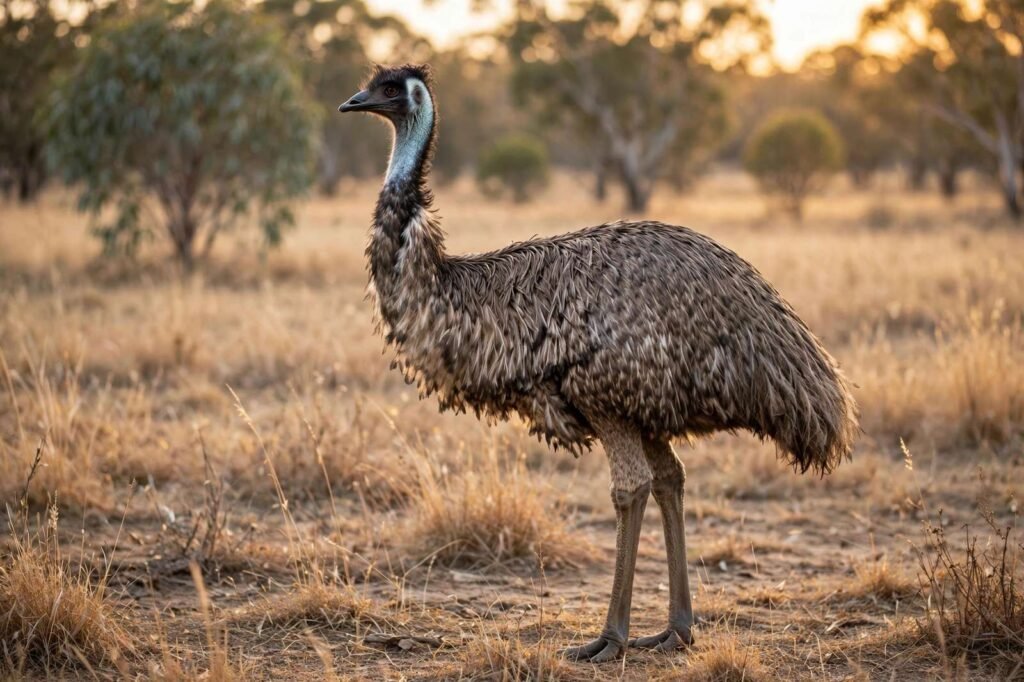
The emu is Australia’s largest native bird, a flightless runner that stands taller than most people and covers open country on powerful legs. If you are wondering what an emu is, how fast it runs, what it eats and where it lives, the short answer is this: it is the world’s second-largest living bird, it survives on plants, seeds, fruit and insects across most of mainland Australia, and it can sprint at around 50 km/h in short bursts.
Key takeaways
– The emu is the second-largest living bird, after the ostrich, standing around 1.5–1.9 metres tall and weighing roughly 30–55 kg.
– It is flightless but a strong runner, reaching around 50 km/h in short bursts.
– Emus live across most of mainland Australia, in grassland, open woodland, scrub and semi-arid country.
– They eat plants, seeds, fruit, flowers and insects, and can manage for long periods on the moisture in their food.
– The male incubates the eggs for about eight weeks, barely eating or drinking, then raises the striped chicks for months.
What is an emu?
The emu (Dromaius novaehollandiae) is a large, flightless bird native to Australia and a member of the ratites, the flightless birds that also include the ostrich, the cassowary, the rhea and the kiwi. Like its relatives, it has small wings, a flat breastbone without the keel that anchors flight muscles, and long legs built for running.
An adult emu stands around 1.5–1.9 metres tall, with females often slightly larger than males, and weighs roughly 30–55 kg. Its body is covered in shaggy, hair-like brown-grey feathers that help it blend into dry grass and scrub. The neck and head are mostly bare, with blue-grey skin, and the legs are long, bare and scaly, ending in three-toed feet with strong claws. Emus do not occur in the wild in Norway, but they are a familiar sight in zoos and wildlife parks, and a fine example of animal adaptations.
Where emus live
The emu’s range covers most of mainland Australia, from the tropical north to the temperate south. It is found in grassland, savanna, open woodland, scrub and semi-arid country, avoiding the driest deserts and the densest rainforest. Emus do not live in Tasmania in the wild, and they are not native to New Zealand.
Emus are wanderers rather than settlers. They hold no fixed territory for most of the year, moving across the landscape in response to food and water. After rain they travel to reach fresh growth, and in dry spells they gather around waterholes and farmland. This nomadic habit is one reason the species has survived across such a huge and varied continent. See our guide to animal migration for more on how animals move with the seasons. Their preferred habitat is open country with scattered trees and shrubs, where they can see a long way and run without obstruction. Like the grassland animals of other continents, emus are built for wide horizons, and they feed on crops and grain on the edge of farmland too.
What emus eat
Emus are omnivores, but plants make up most of their diet. They eat leaves, shoots, grasses, seeds, fruit, berries and flowers, and they take insects and other small invertebrates when they find them. Their diet shifts with the season: flowers and shoots in spring, seeds after rain, and whatever green material remains in dry times.
An emu swallows small stones, known as gastroliths, which sit in the gizzard and help grind up tough plant material. Emus drink when water is available, but they can manage for long periods on the moisture in their food. Emus also act as seed dispersers: seeds eaten with fruit pass through the gut and are dropped far from the parent plant, sometimes many kilometres away, helping plants colonise new ground.
Speed and movement
The emu cannot fly, but it is one of the fastest running birds on earth. It can reach around 50 km/h in short bursts and sustain a steady pace over longer distances. Its long legs give it a stride of well over two metres at full speed.
When it is not running, an emu walks at a relaxed pace, often for hours at a time as it forages. It is a strong swimmer too, crossing rivers and waterholes with its neck held above the water. Emus are mostly active during the day, feeding in the morning and late afternoon and resting in the shade during the heat of midday. They sleep at night, sitting on the ground with their legs folded beneath them.

Behaviour and social life
Emus are generally calm, curious birds. Outside the breeding season they are often found in loose groups, feeding together without much aggression.
An emu communicates with a range of sounds. The most famous is a deep, booming call, produced by a pouch in the neck, which carries a long way across open country. Females make the loudest booming calls, especially during the breeding season, while males make softer grunting and drumming sounds. Emus also hiss when threatened.
Despite their size, emus are wary of people and usually keep their distance, walking or running away when approached. If cornered, however, an emu can be dangerous: a kick from those long, powerful legs, armed with sharp claws, can cause serious injury. Wild emus should always be given space: stay well back, use binoculars or a long lens, and never feed them by hand. Emus fed by people can become bold and pushy, which is bad for the bird and risky for visitors.
Breeding and chicks
Emu breeding is unusual because the male does most of the work. Pairing takes place in the cooler months, and the female lays dark green eggs in a shallow nest scraped into the ground and lined with leaves and grass. Once the eggs are laid, the female may move on and pair with another male, while the first male settles onto the nest.
The male incubates the eggs for about eight weeks. During this time he hardly eats or drinks, and he loses a substantial amount of weight. He turns the eggs regularly and defends the nest fiercely, one of the most committed examples of paternal care in the bird world.
When the chicks hatch, they are striped in cream and brown, a camouflage pattern that helps them hide in grass and scrub. They are precocial, able to walk, feed and follow their father within hours of hatching. The father stays with them for many months, guarding them and leading them to food and water. The chicks grow quickly, reaching close to adult size within a year, and the stripes fade as they mature.
Predators and threats
Adult emus have few natural predators. Their size, speed and powerful kick deter most attackers, and life in open country means they usually see danger coming. The main threats to adults are large predators such as dingoes. Eggs and chicks are far more vulnerable, taken by foxes, feral cats, goannas, eagles and other predators. This is why the father’s long guarding period matters so much.
The emu is not considered threatened as a species. Its population is large, its range is wide, and it has adapted to farming and settlement better than many Australian animals. Local populations can still suffer from habitat clearing, fences that block movement routes, road traffic and drought. The species as a whole, though, remains common across the Australian mainland.
Emu vs ostrich vs cassowary vs rhea
The emu is often confused with other large flightless birds. The table below sets out the main differences.
| Feature | Emu | Ostrich | Cassowary | Rhea |
|---|---|---|---|---|
| Where it lives | Mainland Australia | Africa | Rainforest in north-east Australia and New Guinea | Grasslands of South America |
| Height | Around 1.5–1.9 m | Around 2.1–2.8 m | Around 1.5–1.7 m | Around 1.4–1.7 m |
| Weight | Around 30–55 kg | Around 90–150 kg | Around 40–60 kg | Around 20–40 kg |
| Top speed | Around 50 km/h | Around 70 km/h | Around 50 km/h | Around 60 km/h |
| Most distinctive feature | Shaggy brown feathers, bare blue-grey neck | Largest living bird, bare pink-grey neck | Tall casque, bright blue neck | Grey-brown plumage |
| Habitat | Grassland, open woodland, scrub | Savanna and desert | Dense rainforest | Open pampas and grassland |
Table: How the emu compares with the ostrich, cassowary and rhea.
The ostrich is the only bird larger than the emu. The cassowary is a forest bird with a tall casque, and the rhea is the South American equivalent of the emu, smaller but with similar habits. All four are ratites, each evolved to suit a different continent. For more, see our collection of animal facts.
Spotting emus: a practical checklist
If you hope to see an emu in the wild in Australia, or to watch one well in a wildlife park, this checklist will help.
– Go early or late: Emus feed in the morning and late afternoon, and rest in the shade at midday.
– Look in open country: Grassland, open woodland and scrub are best; dense forest and the driest desert are unlikely spots.
– Scan the horizon: Emus are tall and dark against pale grass, and their long necks show above the vegetation first.
– Move slowly and quietly: Emus are wary. Approach gradually, keep low, and avoid sudden movements or loud noise.
– Keep your distance: Stay well back and use binoculars or a telephoto lens for a close view.
– Never feed wild emus: Feeding makes them bold around people, which puts both the birds and visitors at risk.
– Give families extra space: A male with striped chicks will be especially protective.
– Bring water and sun protection: Emu country is hot, dry and exposed: carry water, wear a hat and sunscreen, and tell someone where you are going.
Frequently asked questions
Can emus fly?
No. Emus are flightless birds. Their wings are small and their breastbone is flat, without the keel that anchors flight muscles. They have traded flight for running, reaching around 50 km/h in short bursts.
How tall is an emu?
An adult emu stands around 1.5–1.9 metres tall, with females often slightly larger than males. That makes the emu the second-largest living bird, after the ostrich, and taller than most people.
What do emus eat?
Emus eat plants, seeds, fruit, berries, flowers and leaves, along with insects, caterpillars and other small invertebrates. They swallow small stones to help grind tough plant material, and can manage for long periods on the moisture in their food.
Are emus dangerous?
Emus are generally calm and wary, and they prefer to run away from people. They can be dangerous if cornered or provoked, because a kick from their long legs and sharp claws can cause serious injury. Give wild emus plenty of space and never feed them by hand.
Do emus live in Norway?
No, emus are native to Australia and do not occur in the wild in Norway. They can be seen in some Norwegian zoos and wildlife parks. Read about the animals that do live here in our guide to animals in Norway.
A bird built for open country
The emu is a reminder that giving up flight does not mean giving up success. Across most of mainland Australia, this tall, shaggy runner lives on whatever the land offers, crosses long distances on foot, and raises its young with a father’s long vigil on the nest. It is fast enough to outrun most threats and adaptable enough to survive from tropical grassland to dry scrub.
If the emu has caught your interest, the next step is simple: look for one in a zoo or wildlife park near you, watch how it moves and feeds, and then read about the animals that share its open-country way of life.