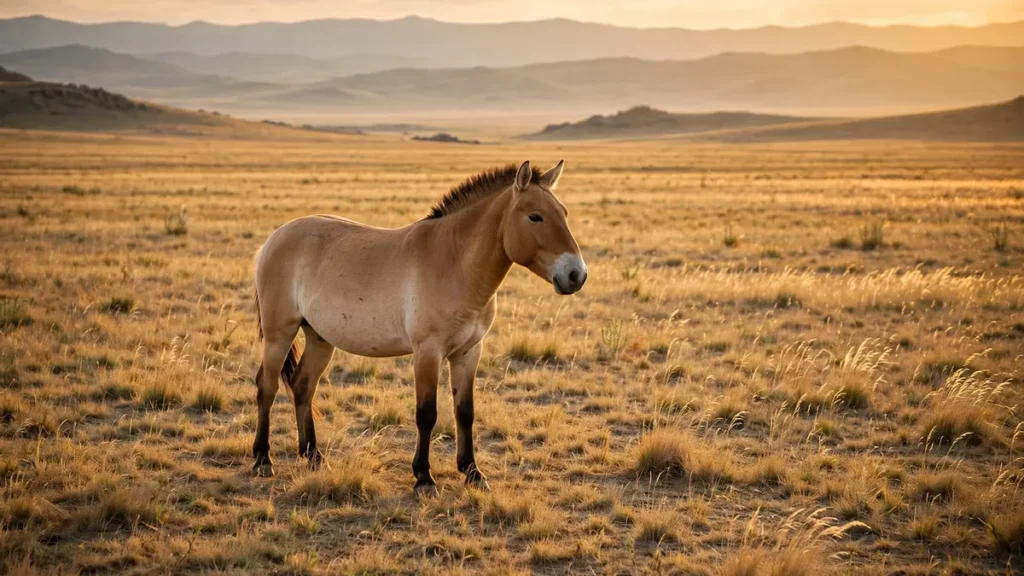
Horse species include just one truly wild horse, Przewalski’s horse, and the domestic horse, which comes in hundreds of breeds from the Arabian to the Shire. If you are wondering how many horse species there are and what makes a horse different from other hoofed animals, the short answer is this: horses are grazing herd animals with a single toe on each foot, built for speed across open grassland, and every domestic horse alive today descends from the extinct wild horse Equus ferus.
Key takeaways
- There is only one living wild horse species, Przewalski’s horse; every other horse is a domestic horse or a breed of it.
- The domestic horse is a domesticated subspecies of the extinct wild horse Equus ferus, and it comes in hundreds of breeds.
- Przewalski’s horse was extinct in the wild and has been reintroduced to Mongolia, where several hundred now live free.
- Horses are grazing herd animals that sleep standing up, run at up to 70 kilometres per hour, and talk with ears, tails and calls.
- Wild horses are best seen on the Mongolian steppe at dawn and dusk, and domestic horses graze in fields and meadows almost everywhere.
What makes a horse a horse
A horse is a large hoofed mammal with a single toe on each foot, protected by a hard hoof, long legs built for running, and a mane and tail of coarse hair. Horses belong to the genus Equus, which also includes zebras, donkeys and wild asses. They are grazers, with teeth that grow throughout life to cope with wearing down on tough grass, and a digestive system built to process large amounts of fibrous plants.
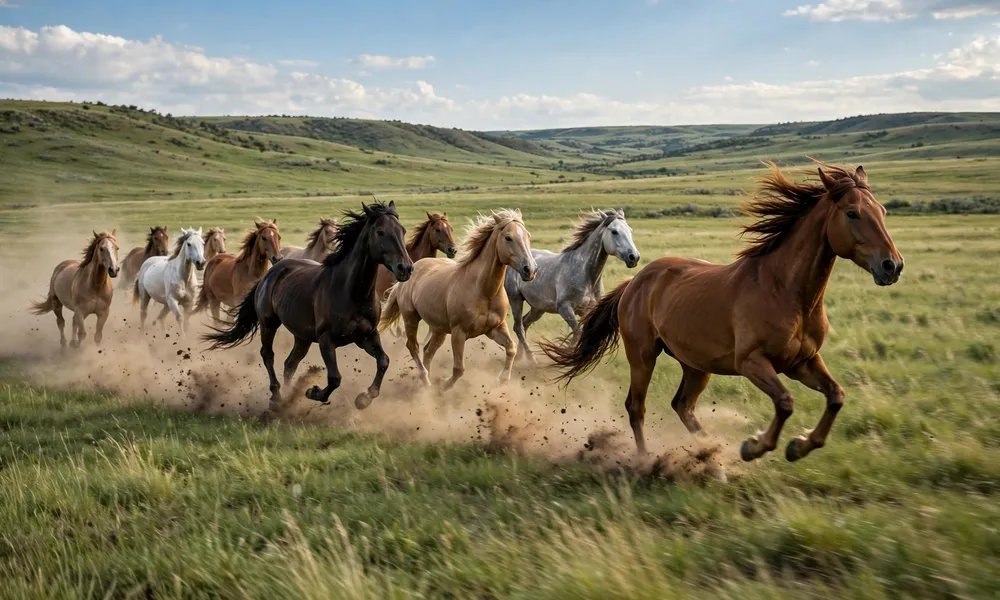
Horses are herd animals, and the herd is the centre of a horse’s life. A wild herd is led by a dominant mare, with a stallion guarding the group, and the animals graze together, groom each other and watch for danger together. Horses can sleep standing up, thanks to a locking mechanism in their legs called the stay apparatus, and they only lie down for short periods of deep sleep when they feel safe. Their eyes sit on the sides of their heads, giving them a wide field of vision, and their ears swivel to catch sounds from every direction.
Horses move in four natural gaits. At a walk they move one foot at a time, at a trot the diagonal pairs of legs move together, at a canter there is a three-beat rocking motion, and at a gallop all four feet leave the ground in a stretched, bounding stride. Some breeds have extra gaits: the Icelandic horse has the tölt, a smooth four-beat gait, and the flying pace, while the American Saddlebred and the Tennessee Walking Horse have their own smooth running walks.
Przewalski’s horse: the only truly wild horse
Przewalski’s horse, also called the takhi, is the only truly wild horse left in the world. It is a stocky, dun-coloured horse with a short, erect dark mane, no forelock, a dark stripe down its back and faintly striped legs, standing about 1.2 to 1.4 metres at the shoulder. It lives on the steppes of Central Asia, and it has never been domesticated.
By the 1960s Przewalski’s horse had disappeared from the wild, and the species survived only in zoos, descended from just 13 or 14 animals. Reintroduction began in Mongolia in the 1990s, in Hustai National Park and other reserves, and several hundred horses now live free on the steppe again. Przewalski’s horse is listed as endangered, and it is a close relative of the domestic horse, with 66 chromosomes compared with 64 in the domestic horse, yet the two can still produce fertile offspring.
The domestic horse and its breeds
The domestic horse was domesticated from the wild horse Equus ferus around 5,500 years ago on the steppes of Central Asia, and people have since bred it into hundreds of breeds for riding, racing, farm work and companionship. The Arabian is one of the oldest breeds, a fast, fine-boned desert horse with a dished face and a high tail, while the Thoroughbred was bred in England for racing and is the fastest horse over middle distances. The Shire is the largest breed, a heavy draught horse that can stand 1.8 metres at the shoulder, and the Shetland pony is one of the smallest, a hardy little horse from the Shetland Islands that is strong enough to carry an adult.
The Icelandic horse is a small, sturdy breed from Iceland, famous for its extra gaits, the tölt and the flying pace, in addition to walk, trot and gallop. Mustangs are not a breed at all but feral domestic horses, descended from horses brought to the Americas by Spanish settlers, which now roam free in the deserts and mountains of the American West. Among the desert animals of the American West, mustangs share the range with coyotes and pronghorn, drinking at desert springs and grazing on sparse grass.
How horses live: herds, grazing and sleep
Horses spend most of their day grazing, eating grass for up to 16 hours, and they need open grassland to thrive. A horse can run at up to 70 kilometres per hour in a gallop, and its long legs and deep chest give it the stamina to cover great distances at a trot. Horses communicate with their ears, tails and posture, and with calls: a whinny carries across a field, a nicker greets a friend, and a snort warns of danger.
In the wild, horses live in small herds called bands, usually a stallion with several mares and their foals, and young horses leave the band to join or form new herds. Mares give birth to a single foal, which can stand and run within hours, and foals stay with their mothers for their first year. Horses drink large amounts of water each day, and in dry country they may travel many kilometres between grazing grounds and water.
Horses come in many colours, from bay and chestnut to black, grey and palomino, and their coats change with the seasons, growing thick and shaggy in winter and shedding to a sleek summer coat in spring. Some horses have white markings on their faces and legs, called blazes, socks and stockings, and no two horses have exactly the same pattern. A horse’s coat is a good guide to its health: a glossy coat means a well-fed horse, while a dull coat can be a sign of illness or poor feeding.
Where horses live
Wild Przewalski’s horses live only on the steppes of Mongolia and China, in grassland reserves where they graze alongside gazelles and marmots. Domestic horses live almost everywhere people do, from the meadows of Europe to the ranches of the Americas and the outback of Australia, where feral horses called brumbies roam. The forest animals of northern Europe include horses grazing in woodland clearings, and the mountain animals of the high valleys include hardy ponies that live out all year. In cities, horses still work as police mounts and carriage horses, and riding schools keep them in stables on the edge of town.
| Horse | Type | Where it lives | Height at the shoulder |
|---|---|---|---|
| Przewalski’s horse | Wild species | Steppes of Mongolia and China | 1.2 to 1.4 metres |
| Domestic horse | Domesticated subspecies | Worldwide, wherever people keep horses | Varies by breed |
| Arabian | Breed | Deserts of Arabia, now worldwide | About 1.5 metres |
| Thoroughbred | Breed | Racecourses and stud farms worldwide | About 1.6 metres |
| Shire | Breed | Britain, now worldwide | About 1.8 metres |
| Shetland pony | Breed | Shetland Islands, now worldwide | About 1.0 metres |
| Icelandic horse | Breed | Iceland, now worldwide | About 1.3 metres |
| Mustang | Feral population | Deserts and mountains of the American West | About 1.5 metres |
Best seasons for horse watching
Spring and autumn are the finest seasons for horse watching. In spring, foals are born on the steppe and in the meadows, and the herds are at their most active in the cool morning light. In autumn, the grass is at its richest before winter, and horses graze hard to build up condition for the cold months.
Summer is the best season for seeing Przewalski’s horses in Mongolia, when the steppe is green and the herds gather at waterholes at dawn and dusk. Winter can also reward patient watchers, when the horses’ thick coats and the bare steppe make them easier to spot against the snow.
Staying safe around horses
Horses are large, strong animals, and they deserve respect. Never approach a horse you do not know, never walk directly behind one, and never feed a horse without its owner’s permission. If a horse approaches you, stand still, speak quietly and let it come to you, and never offer food from your hand to a horse you do not know. Watch wild horses with binoculars or from a vehicle rather than walking closer: a disturbed herd may stampede, so the best view is always the distant one. Keep dogs on a lead near horses, and stay on marked paths.
Horse watching checklist
- Look for herds grazing on open grassland at dawn and dusk.
- Watch for foals in spring, staying close to their mothers.
- Listen for whinnies and nickers carrying across the fields.
- Scan waterholes on the Mongolian steppe for Przewalski’s horses.
- Never approach a horse, never walk behind one, and keep dogs on a lead.
- Leave no trace: take your rubbish home and keep to marked paths.
Frequently asked questions
How many horse species are there?
There is only one living wild horse species, Przewalski’s horse. The domestic horse is a domesticated subspecies of the extinct wild horse Equus ferus, and it comes in hundreds of breeds. The table above shows eight of the best-known: Przewalski’s horse, the domestic horse, the Arabian, the Thoroughbred, the Shire, the Shetland pony, the Icelandic horse and the Mustang.
How is this guide different from the mountain animals guide?
This guide covers only horses, from Przewalski’s horse on the Mongolian steppe to the Arabian, Thoroughbred and Shire. The mountain animals guide covers the whole community of animals that live in the mountains, from ibex and eagles to marmots and snow leopards.
Can Przewalski’s horses breed with domestic horses?
Yes, Przewalski’s horses and domestic horses can breed and produce fertile offspring, even though Przewalski’s horses have 66 chromosomes and domestic horses have 64. The two are close relatives that split from a common ancestor long before horses were domesticated.
How fast can a horse run?
A horse can gallop at up to 70 kilometres per hour, and the Thoroughbred is the fastest breed over middle distances. The fastest recorded speed for a Thoroughbred is just over 70 kilometres per hour in a short sprint. Przewalski’s horses are slower than racehorses, but their stamina lets them cover great distances across the steppe at a trot.
Do horses really sleep standing up?
Yes, horses can sleep standing up thanks to the stay apparatus, a locking mechanism in their legs that lets them rest without falling over. They only lie down for short periods of deep sleep, and only when they feel safe, often with another horse standing guard.
Where is the best place to see a wild horse?
Przewalski’s horses are best in Hustai National Park in Mongolia, at dawn and dusk near the waterholes. Mustangs are best in the deserts and mountains of the American West, where free-roaming herds graze on public land.
Conclusion
Horse species, in the strict sense, number just one wild horse, Przewalski’s horse, alongside the domestic horse and its hundreds of breeds: Arabians and Thoroughbreds built for speed, Shires built for strength, Shetland ponies built for hard weather, and mustangs running free in the American West.
The next step is to pick one horse and one season — a spring morning in a meadow, a summer dawn on the Mongolian steppe, or an autumn afternoon watching mustangs in the desert — and plan your visit around it.














