
Sheep species are the hardy grazers of the high mountains, and there are five wild sheep species in the world, from the bighorn sheep of the Rockies to the Dall sheep of Alaska and the argali of Central Asia. If you are wondering which sheep species exist and what makes a sheep different from a goat, the short answer is this: sheep are flock animals with heavy curled horns, thick woolly coats and a grazer’s life on mountain slopes, and the domestic sheep is descended from the wild mouflon.
Key takeaways
- There are five wild sheep species: the argali, the urial, the bighorn sheep, the Dall sheep and the snow sheep.
- The mouflon is the wild ancestor of the domestic sheep, which now numbers more than a billion animals.
- The argali is the largest wild sheep, with rams weighing up to 185 kilograms and huge curled horns.
- Bighorn rams clash horns in the autumn rut, in contests heard a kilometre away.
- Dall sheep are white, live in Alaska and the Yukon, and are the only thin-horned sheep.
What makes a sheep a sheep
All five wild sheep species belong to the genus Ovis, part of the bovid family with goats, cattle and antelope. Sheep are medium to large hoofed animals with thick coats and horns that grow through life. Rams carry massive curled horns, while the ewes have smaller horns or none at all.
Sheep graze grasses, herbs and low shrubs on mountain slopes and open grassland. Like all ruminants, they chew the cud, swallowing food quickly and bringing it back up to chew it properly while they rest. A sheep spends much of the day feeding and resting in turn.
Sheep are closely related to goats, but there are clear differences. Sheep have no beards, their coats are woolly rather than hairy, and their rams carry heavy horns that curl in a spiral beside the head. Sheep live in flocks on gentler ground, grazing the slopes rather than climbing the cliffs. Among the mountain animals, sheep are the grazers of the open slopes, while goats take the steepest rock.
The sheep of North America
The bighorn sheep is the best-known sheep species in North America. It lives in the Rocky Mountains from Canada to Mexico, a stocky, brown-grey animal with a pale rump patch and massive horns that curl in a full spiral. A ram’s horns can weigh more than 14 kilograms, growing through its life and adding a new ring each year. The desert bighorn of the south-western deserts is smaller and paler, and it can go for days without drinking.
In the autumn rut, bighorn rams clash their horns in contests for dominance. Two rams charge at each other at more than 30 kilometres per hour and meet head-on with a crack heard a kilometre away, their thick skulls absorbing the shock. The contests can last for hours.
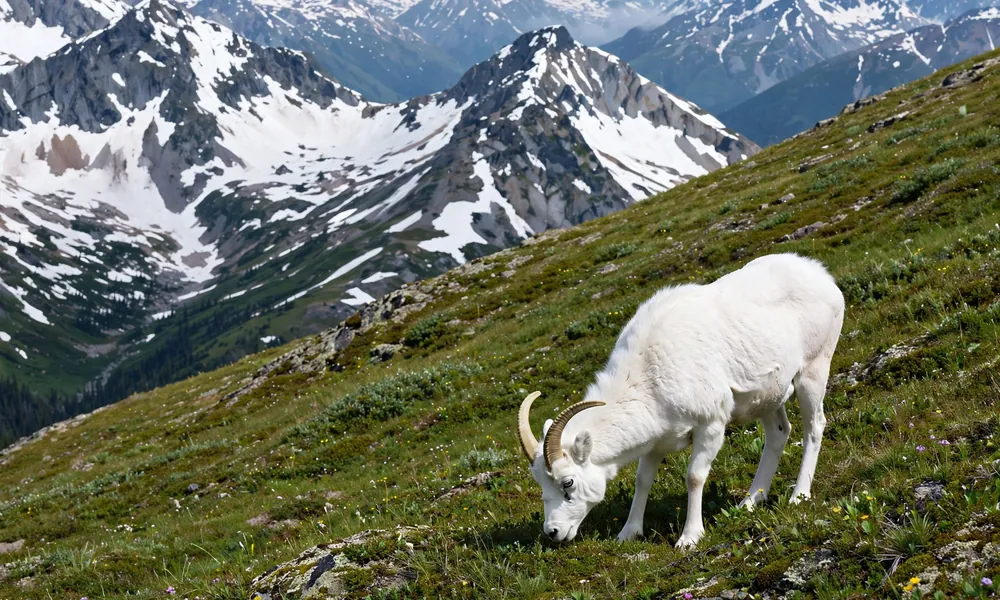
The Dall sheep of Alaska and the Yukon is the only thin-horned mountain sheep. Almost pure white, with slender amber horns, it lives on high alpine ridges above the tree line, where its coat blends with the snow. Dall sheep are smaller than bighorns, enduring long, bitter winters on windswept ridges.
The sheep of Asia
The argali is the largest wild sheep in the world. It lives in the high mountains of Central Asia, and a big ram can weigh up to 185 kilograms, with horns that can reach more than 1.8 metres from tip to tip. The most famous argali is the Marco Polo sheep of the Pamir Mountains, named after the traveller who wrote about its enormous horns seven hundred years ago. Its rams carry the longest horns of any sheep. Argali live in open country, on high plateaus and rolling mountain slopes where they can see danger coming from far away.
The urial lives in the dry hills of Central and South Asia, from Iran to Pakistan and northern India. It is smaller than the argali, with a reddish-brown coat and horns that curve back in a wide arc. It lives in small flocks on steep, grassy slopes, and it is closely related to the domestic sheep.
The snow sheep of north-east Siberia is the hardiest of all wild sheep. It endures winters of deep snow and bitter cold, with a thick, pale coat and a layer of fat. It lives in small groups on high, windswept ridges, grazing the sparse alpine plants between the rocks.
The mouflon and the domestic sheep
The mouflon is the wild ancestor of the domestic sheep. It lives in the mountains of Turkey, Armenia, Azerbaijan and Iran, a small, reddish-brown sheep with short, curved horns in the rams. Tamed in the hills of the Near East more than ten thousand years ago, it gave rise to the domestic sheep, which now numbers more than a billion animals in over ten thousand breeds.
The domestic sheep has changed a great deal from its wild ancestor. Bred for wool, meat and milk, its coat is thick and woolly where the mouflon’s is short and coarse. But the wild instinct remains: domestic sheep still flock together, follow a leader, and graze the hills as their wild ancestors did.
How sheep live and graze
Sheep live in flocks, and the flock is their safety. A single sheep is easy prey, but a flock of fifty sheep, all watching in different directions, is hard to surprise. When danger comes, the flock runs together behind the oldest ewe, who knows the escape routes. The rams stay apart in bachelor groups, joining the ewes only in the rut.
Sheep are sure-footed climbers, though not as bold as goats. They walk steep slopes with ease, and their thick coats protect them from cold and wind. In winter they move to lower slopes, pawing through the snow to find the grass beneath. In summer they climb back to the high meadows, following the fresh grass as it grows up the mountain. Among the predators, wolves are the greatest threat, hunting sheep in packs on the open slopes.
Where sheep live
Wild sheep live in the mountains of North America, Europe and Asia, from the Rocky Mountains and Alaska in the west to the mountains of Siberia and the Himalayas in the east. They live on open slopes, meadows and rocky ridges, where they can graze and watch for danger, avoiding thick forest where predators hide.
Sheep are hardy animals, built for extremes. The Dall sheep endures Alaskan winters, the snow sheep the cold of Siberia, and the desert bighorn the heat of Death Valley. The tundra animals include the Dall sheep at the edge of its range, and the deer species of the same mountains share the meadows with the sheep.
Sheep and people
People have lived with sheep for longer than with almost any other animal. The domestic sheep was one of the first animals ever tamed, giving people wool, milk, meat and leather. Wool is still widely used, and sheep farming is one of the oldest forms of farming. Feral sheep, which have escaped from farms and gone wild, live on islands and mountains around the world.
Wild sheep have not always fared so well. The argali is under pressure from hunting and habitat loss, the Marco Polo sheep is heavily hunted in Central Asia, and the urial is listed as vulnerable. Protection has helped the bighorn sheep recover across much of the Rockies, and the Dall sheep is still common in Alaska and the Yukon.
| Species | Type | Where it lives | Best-known feature |
|---|---|---|---|
| Argali | Species | High mountains of Central Asia | Largest wild sheep, huge curled horns |
| Urial | Species | Dry hills of Central and South Asia | Reddish coat, wide-arcing horns |
| Bighorn sheep | Species | Rocky Mountains, Canada to Mexico | Rams clash horns in the rut |
| Dall sheep | Species | Alaska and the Yukon | White coat, thin amber horns |
| Snow sheep | Species | Mountains of north-east Siberia | Hardiest sheep, deep-snow winters |
| Mouflon | Wild ancestor | Mountains of Turkey, Iran, Caucasus | Ancestor of the domestic sheep |
| Domestic sheep | Domesticated | Farms worldwide | More than ten thousand breeds |
| Marco Polo sheep | Subspecies of argali | Pamir Mountains, Central Asia | Longest horns of any sheep |
Best seasons for sheep watching
Spring and autumn are the finest seasons for sheep watching. In spring, the ewes bring their newborn lambs to the lower meadows, and the flocks graze in the morning light. In autumn, the rut brings the big rams together, and clashing horns carry across the valleys.
In summer, Dall sheep graze the high alpine ridges of Alaska at dawn. In winter they come down to the lower slopes, where their tracks show clearly in the snow.
Staying safe around sheep
Sheep are wild animals, and they deserve respect. Never approach a sheep, never try to touch one, and never leave food or rubbish where wild animals can reach it. Watch with binoculars: a disturbed sheep may abandon its lambs, so the best view is always the distant one. Keep dogs on a lead near sheep flocks.
Sheep watching checklist
- Scan mountain slopes and alpine meadows at dawn, when sheep graze.
- Look for fresh droppings and tracks below the ridges.
- Watch the high ridges of Alaska in summer for white Dall sheep.
- Listen in autumn for the clash of bighorn rams during the rut.
- Never approach a sheep, never feed one, and keep dogs on a lead.
- Leave no trace: take your rubbish home and watch with binoculars.
Frequently asked questions
How many sheep species are there?
There are five wild sheep species in the world: the argali, the urial, the bighorn sheep, the Dall sheep and the snow sheep. The table above shows those five, plus the mouflon, the domestic sheep, and the Marco Polo sheep, a subspecies of the argali.
How is this guide different from the mountain animals guide?
This guide covers only the five wild sheep species, from bighorn horn clashes to Dall sheep in Alaska and the argali of Central Asia. The mountain animals guide covers the whole community of mountain animals, from eagles and snow leopards to marmots and pikas.
What is the difference between a sheep and a goat?
Sheep have no beards, woolly coats, and rams with heavy horns that curl beside the head. Goats have beards and straight or backward-curving horns, and they browse as well as graze. Sheep live in flocks on gentler ground, while goats take the steepest cliffs.
What is the largest wild sheep?
The argali is the largest wild sheep, with rams weighing up to 185 kilograms and carrying huge curled horns that can reach more than 1.8 metres from tip to tip. It lives in Central Asia, and the Marco Polo sheep, a subspecies of the argali, carries the longest horns of any sheep.
Do bighorn rams really clash horns?
Yes, bighorn rams clash their horns in the autumn rut, charging at each other at more than 30 kilometres per hour and meeting head-on with a crack that can be heard a kilometre away. Their thick skulls and horn cores absorb the shock, and the contests can last for hours.
Where is the best place to see a Dall sheep?
Dall sheep are best on the high alpine ridges of Alaska and the Yukon in summer, when the white flocks graze above the tree line at dawn. Denali National Park is one of the finest places to see them.
Conclusion
Sheep species, all five wild ones, are the grazers of the high mountains: bighorn rams in the Rockies, white Dall sheep in Alaska, argali in Central Asia, and the mouflon that gave the world the domestic sheep.
Pick one species and one mountain — a spring morning in the Rockies for bighorn, or a summer dawn in Alaska for Dall sheep — and watch the slopes until the flock appears.














