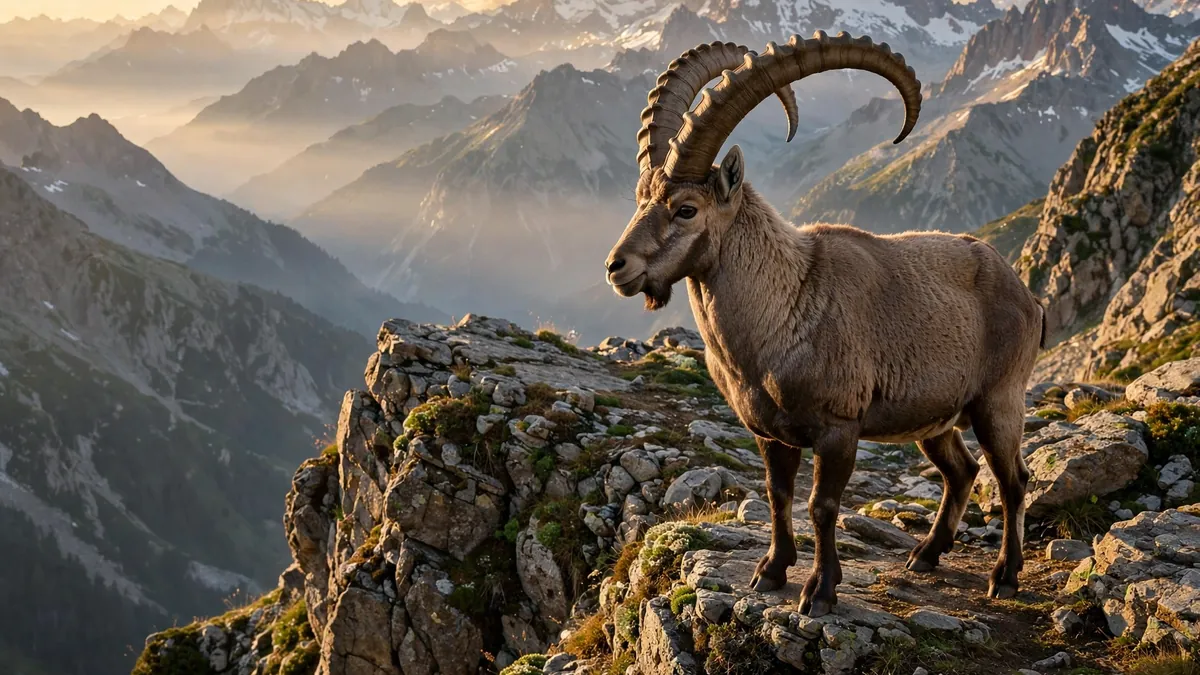
Goat species are the great climbers of the mammal world, and there are nine wild goat species in the genus Capra, from the Alpine ibex of the Alps to the markhor of Pakistan and the wild goat of Turkey and Iran. If you are wondering which goat species exist, the short answer is this: goats are sure-footed mountain animals with beards, backward-curving or spiral horns, and cloven hooves that grip bare rock, living on cliffs where almost no other hoofed animal can follow.
Key takeaways
- There are nine wild goat species in the genus Capra, plus the domestic goat, descended from the wild goat.
- Ibexes, markhors and turs are all true goats, living in steep, rocky mountains in Europe, Asia or North Africa.
- The markhor has long spiral horns and is the national animal of Pakistan.
- Goats climb near-vertical cliffs, using cloven hooves with rough pads that grip the rock.
- The best places to see wild goats are mountain ridges and cliffs at dawn, when they graze.
What makes a goat a goat
All nine wild goat species belong to the genus Capra, part of the bovid family, which also includes cattle, antelope and sheep. Goats are medium-sized hoofed animals with short tails, beards, and horns that grow through life in both sexes, though the male’s are much larger.
The goat’s hoof is the secret of its climbing. Each foot is cloven into two toes, and the soles are rough and rubbery, gripping bare rock like the tread of a climbing shoe. The hard outer edge wedges into cracks and the soft pad grips smooth stone, so a goat can stand on a ledge only a few centimetres wide.
Goats are closely related to sheep, but there are clear differences. Goats have beards and straight or backward-curving horns, while sheep have no beards and their rams carry heavy curled horns. Goats browse as well as graze, and they are far bolder climbers than sheep. Among the mountain animals, goats are the most at home on the steepest ground.
The ibexes of the world
The ibexes are the best-known goat species, and there are five of them. The Alpine ibex lives in the Alps of France, Switzerland, Austria, Germany and northern Italy, a stocky brown animal with huge ridged horns that curve back over its shoulders. Hunted down to about a hundred animals in one Italian valley in the nineteenth century, it has recovered to more than fifty thousand.
The Nubian ibex lives in the deserts and mountains of Egypt, Ethiopia and the Near East, a smaller, paler goat with long, slender horns that sweep back in a graceful curve. It drinks rarely, getting most of its water from the plants it eats. The Siberian ibex is the largest and most widespread ibex, living across the high mountains of Central Asia with horns over a metre long.
The Spanish ibex lives in the mountains of Spain and Portugal, where it was reintroduced after hunting had reduced it to a few small herds, and its horns curve out and back in a lyre shape. The ninth wild goat species is the Walia ibex, which lives only in the Simien Mountains of Ethiopia and is one of the rarest goats in the world, with only a few hundred animals left. Ibexes live in herds that split by sex for much of the year.
Markhor and the turs
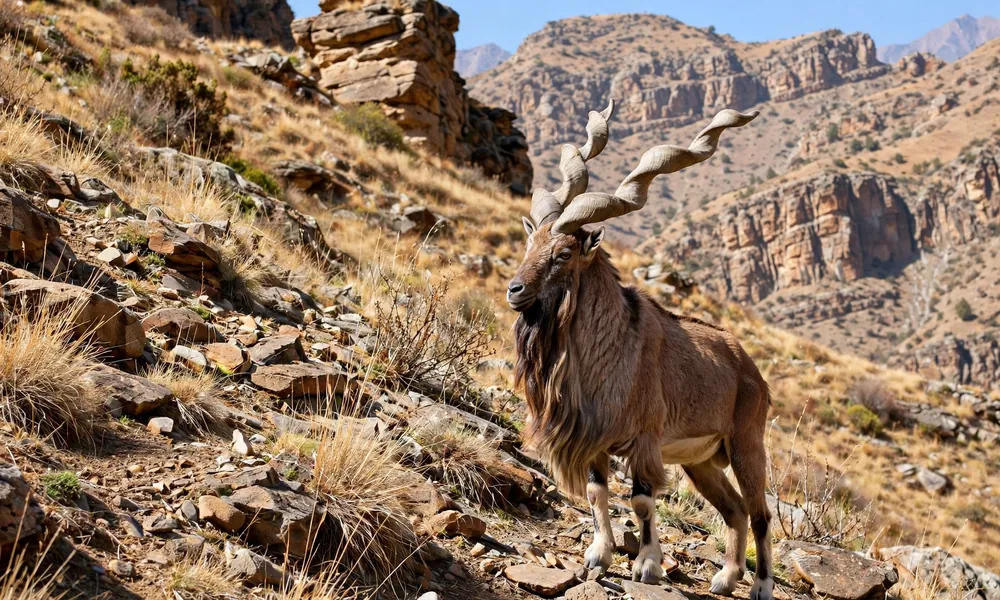
The markhor is the most striking of all goat species. It lives in the mountains of Pakistan, Afghanistan, Tajikistan and northern India, and it is the national animal of Pakistan. Its horns twist into a tight spiral, like a corkscrew, and its coat is long and shaggy, with a thick beard and a mane down its neck.
The turs live in the Caucasus Mountains, between the Black Sea and the Caspian Sea, and there are two of them. The West Caucasian tur lives in the western Caucasus, in Georgia and Russia, and the East Caucasian tur lives further east, in Russia, Georgia and Azerbaijan. Both are stocky goats with thick, ridged horns, living in high alpine meadows above the tree line.
The wild goat, also called the bezoar ibex, is the ancestor of every domestic goat in the world. It lives in the hills and mountains of Turkey, the Caucasus, Iran, Turkmenistan, Afghanistan and Pakistan, a lean, agile animal with a reddish-brown coat and long, scimitar-shaped horns. Tamed in the hills of the Near East more than ten thousand years ago, it gave rise to the domestic goat, which now numbers more than a billion animals.
How goats climb cliffs
A goat on a cliff looks impossible. It walks along ledges no wider than a hand and leaps between rocks that seem to offer no footing at all. The cloven hoof spreads under weight, gripping the rock, and the goat places each foot with care, testing the surface before it trusts it with its weight. Kids begin climbing within days of birth, following their mothers up the rocks.
Climbing is not just a skill for goats; it is their defence. On a cliff, a goat is safe from wolves, leopards and eagles, which cannot follow it onto the steepest rock. When danger comes, the goat runs upwards, where its predators cannot follow. Among the predators of the mountains, only the snow leopard is a true match for a goat on its own ground.
What goats eat
Goats are mixed feeders, eating both grass and browse. In summer they graze the alpine meadows, eating grasses, herbs and wildflowers, and in winter they turn to shrubs, twigs, bark and the leaves of evergreen trees. They can digest tough, fibrous food that other animals cannot.
Like all ruminants, goats chew the cud. They swallow their food quickly, then rest and bring it back up to chew it properly, breaking down the tough plant fibres.
Where goats live
Wild goats live in the mountains of Europe, Asia and North Africa, from the Alps and the Pyrenees in the west to the Himalayas in the east, and from the deserts of Egypt to the high valleys of Siberia. They live between the tree line and the snow line, on rocky slopes, meadows and cliffs where few other animals can live.
Goats are hardy animals, built for extremes. They endure bitter winters at high altitude, with thick winter coats and a layer of fat that carries them through the cold months. The Nubian ibex endures fierce desert heat, and the Siberian ibex lives through Himalayan winters of deep snow. The tundra animals of the far north include few goats, but Central Asia holds some of the largest herds in the world.
Goats and people
People have lived with goats for longer than with almost any other animal. The domestic goat was one of the first animals ever tamed, more than ten thousand years ago, and it gave people milk, meat, hair and leather. Goat milk is widely drunk, and goat hair makes cashmere and mohair.
Wild goats have not always fared so well. The Walia ibex is still critically endangered, and the markhor and the turs are under pressure from hunting and the loss of their mountain habitat. Protection has brought the Alpine ibex back from the brink, and community programmes in Pakistan now protect the markhor, with local people guarding the herds. The deer species of the same mountains face the same pressures.
| Species | Where it lives | Best-known feature | Shoulder height |
|---|---|---|---|
| Wild goat | Turkey, Caucasus, Iran, Central Asia | Ancestor of the domestic goat | 0.9 metres |
| Alpine ibex | Alps of France, Switzerland, Italy, Austria | Huge ridged horns curving back | 1.0 metres |
| Nubian ibex | Deserts of Egypt, Ethiopia, Near East | Long slender horns, desert survivor | 0.8 metres |
| Siberian ibex | High mountains of Central Asia | Longest ibex horns, over a metre | 1.0 metres |
| Spanish ibex | Mountains of Spain and Portugal | Lyre-shaped horns | 0.9 metres |
| Markhor | Mountains of Pakistan and Afghanistan | Spiral horns, national animal of Pakistan | 1.0 metres |
| East Caucasian tur | Greater Caucasus Mountains | Thick ridged horns, high meadows | 1.0 metres |
| West Caucasian tur | Western Caucasus, Georgia and Russia | Stocky build, steep rocky ridges | 1.0 metres |
Best seasons for goat watching
Spring and autumn are the finest seasons for goat watching. In spring, the females bring their newborn kids down to the lower meadows, and the herds are at their most visible, grazing in the morning light. In autumn, the rut brings the big males down from the highest cliffs, and the sound of clashing horns carries across the valleys.
In summer the herds graze the high alpine meadows at dawn, and in winter they come down to the lower slopes, where their tracks show clearly in the snow.
Staying safe around goats
Goats are wild animals, and they deserve respect. Never approach a goat, never try to touch one, and never leave food or rubbish where wild animals can reach it. Watch with binoculars: a disturbed goat may abandon its young, so the best view is always the distant one.
Goat watching checklist
- Scan mountain ridges and cliff faces at dawn, when goats come out to graze.
- Look for fresh droppings and tracks on the trails below the cliffs.
- Watch the high alpine meadows in summer for herds of ibex.
- Listen in autumn for the clash of horns during the rut.
- Never approach a goat, never feed one, and keep to marked paths on steep ground.
- Leave no trace: take your rubbish home and watch with binoculars, not your feet.
Frequently asked questions
How many goat species are there?
There are nine wild goat species in the genus Capra, plus the domestic goat, which is descended from the wild goat. The table above shows eight of them; the ninth is the Walia ibex, which lives only in the Simien Mountains of Ethiopia.
How is this guide different from the mountain animals guide?
This guide covers only the nine wild goat species, from ibex climbing to markhor spiral horns and the turs of the Caucasus. The mountain animals guide covers the whole community of mountain animals, from eagles and snow leopards to marmots and pikas.
What is the difference between a goat and a sheep?
Goats have beards and straight or backward-curving horns, and they are browsers as well as grazers, eating leaves and twigs as well as grass. Sheep have no beards, their rams carry heavy curled horns, and they graze in flocks on gentler ground. Goats are also far bolder climbers than sheep.
Why can goats climb cliffs?
Goats climb cliffs because of their cloven hooves, which have rough, rubbery pads that grip bare rock and hard outer edges that wedge into cracks. Their low centre of gravity and excellent balance let them stand on ledges only a few centimetres wide, and climbing keeps them safe from predators.
Is the markhor really the national animal of Pakistan?
Yes, the markhor is the national animal of Pakistan. It lives in the mountains of Pakistan, Afghanistan and northern India, and it is famous for its long spiral horns and its long shaggy coat. It is protected by community programmes that guard the herds.
Where is the best place to see an Alpine ibex?
Alpine ibexes are best on the high ridges of the Alps at dawn in summer, when the herds graze the alpine meadows above the tree line. The Gran Paradiso in Italy, where the last hundred survived, is one of the finest places to see them.
Conclusion
Goat species, all nine wild ones, are the climbers of the mammal world: Alpine ibexes in Europe, markhors in Pakistan, turs in the Caucasus, and the wild goat that gave the world the domestic goat.
Pick one species and one mountain — a spring morning in the Alps for ibex, or an autumn valley in Pakistan for markhor — and watch the cliffs at dawn until the climbers appear.