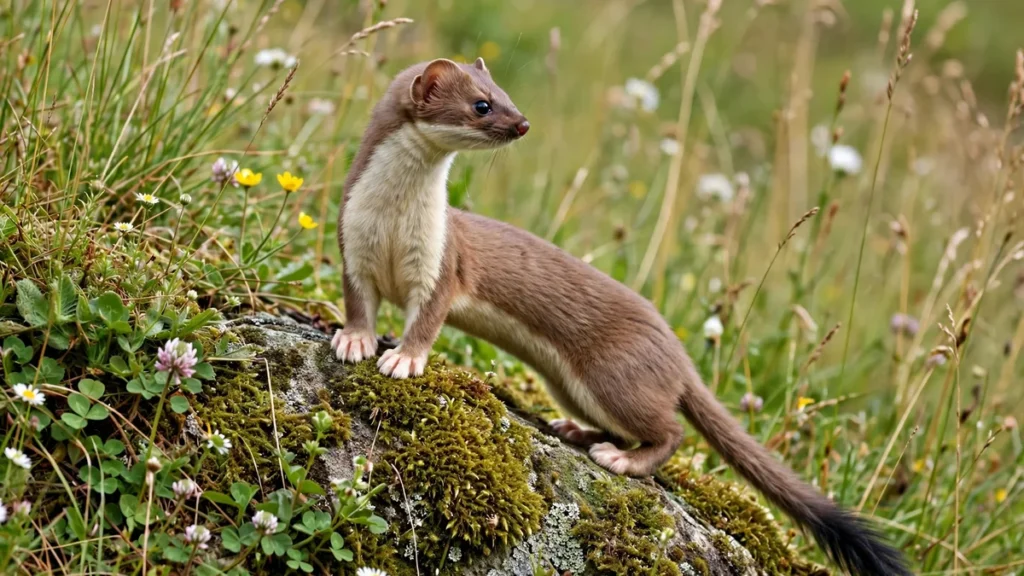
Stoat species is a question with a surprising answer: there is only one stoat species in the world, Mustela erminea, also called the ermine when it wears its white winter coat. If you are wondering how many kinds of stoat there are, what an ermine really is, and how to tell a stoat from a weasel, the short answer is this: the stoat is a single species of small, fierce hunter found right across the cold north of Europe, Asia and North America, turning from chestnut brown in summer to pure white in winter, its tail black-tipped all year round.
Key takeaways
- There is only one stoat species, Mustela erminea, and the ermine is the same animal in its white winter coat, not a separate species.
- A stoat is told from a weasel by its larger size, longer tail and the black tip on the end of that tail.
- Stoats turn white in winter in cold climates, staying hidden against snow, but in mild places such as southern Britain many stay brown all year.
- Stoats are fearless hunters that chase voles, mice and even rabbits, prey bigger than the stoat itself.
- The best way to see a stoat is to watch quietly at a woodland edge, hedgerow or dry stone wall at dawn or dusk in spring and summer.
What makes a stoat a stoat
A stoat is a small mammal with a long, low body, short legs and a long tail, built for slipping through grass and down the burrows of its prey. In summer its back is chestnut brown and its belly creamy white, with a straight line between them along its flank. Its ears are small and rounded, its eyes dark and bright, and its tail always ends in a black tip, the mark that sets it apart from weasels. A stoat measures 17 to 30 centimetres, with a tail of 7 to 12 centimetres, and weighs 100 to 300 grammes, males larger than females.
Stoats are restless, curious animals, active by day and by night, most often seen at dawn and dusk. They move in a bounding run, pausing to rear up and look around, and they can climb trees, swim streams and squeeze through gaps barely wider than their own heads. Their senses are sharp: keen eyesight, a strong sense of smell and whiskers that feel the way through dark burrows.
The one stoat species and its relatives
Scientists recognise just one stoat species, Mustela erminea, and every stoat belongs to it, from Scotland to Siberia and Alaska. Within that single species there are regional forms, called subspecies, that differ slightly in size and winter whitening. The Arctic stoat is one of the largest forms and turns fully white in the long polar winter, while the Haida ermine is a smaller island form of the Pacific coast forests.
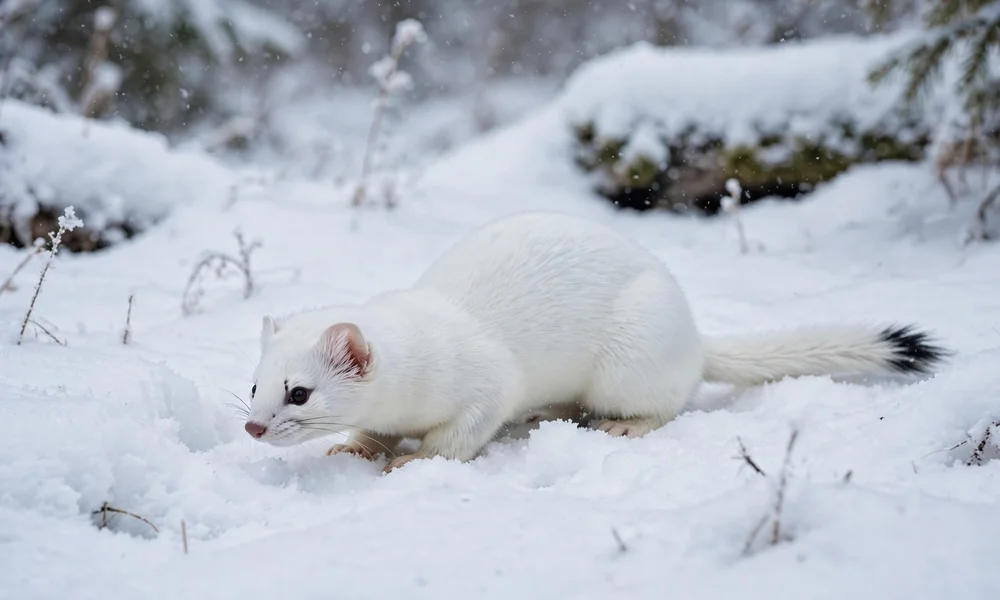
The name ermine causes most of the confusion about stoat species, because it sounds like a different animal. It is not: an ermine is simply a stoat in its white winter coat. The fur was prized for centuries, worn by kings and judges as a mark of rank. Shortening autumn daylight triggers the change to white, so the animal blends in with snow, while the black tail tip stays black; in spring it reverses.
The stoat’s closest relatives are the other mustelids in the table below. The least weasel is the smallest, with a short tail and no black tip, while the long-tailed weasel of North America is closer in size to the stoat and also has a black tail tip. The Siberian weasel is a larger, reddish cousin that never turns white, and the American mink and European polecat are bigger, heavier mustelids with the same taste for riverside hunting.
The difference that matters most in the field is the black tail tip. A weasel has a short tail with no black on it, a stoat a long tail with a black tip, and that single mark will settle most sightings. Size helps too: a stoat is clearly bigger than a least weasel, and its white belly meets its brown back in a straight edge, where the weasel’s is wavy. In winter, when both may be white, the black tail tip is the surest mark of a stoat.
How stoats hunt
Stoats hunt mainly by scent and sound, following the trails of voles and mice through grass and leaf litter and chasing them down burrows. A stoat can hear a vole moving under the snow, and will plunge head first into a snowdrift after it. It kills with a bite to the back of the neck, and can take prey much larger than itself: a stoat of 200 grammes has been seen killing a rabbit five times its weight. Among predators, few are as bold for their size as the stoat.
A stoat needs a great deal of food for its size, because its long, thin body loses heat quickly, so it must eat around a third of its own body weight every day. It takes voles and mice in summer, birds and their eggs in spring, and rabbits in winter when smaller prey is scarce, and it caches surplus food in hidden stores. Stoats also perform a strange dancing display, springing and twisting before a rabbit or bird until it is fixed on the movement and the stoat can dart in close.
Where stoats live
Stoats live across the cold and temperate north, from Ireland and Britain through Europe and Siberia to Alaska and Canada, following the northern forests, moorlands and mountains. They are at home in forest animals country, along woodland edges, hedgerows, stone walls and riverbanks, and they climb into the mountain animals zone, hunting among boulders above the treeline. They avoid open plains and very wet ground, needing cover to hunt in, so they are commonest where fields meet woods.
Stoats and people
People have had a long and mixed relationship with the stoat, admiring its courage while blaming it for taking game birds. White ermine fur was once so prized that wearing it was restricted to royalty and the high nobility. In the 1880s stoats were taken to New Zealand to control rabbits, where they became a disaster for native wildlife, hunting flightless birds that had never met a mammal predator. In Britain and Europe today the stoat is a valued part of the countryside, a sign of a healthy landscape full of voles and mice.
| Animal | Type | Where it lives | Best-known food | Length |
|---|---|---|---|---|
| Stoat (Mustela erminea) | Species | Northern Europe, Asia, North America | Voles, mice, rabbits, birds | 0.17–0.30 metres |
| Least weasel | Close relative | Europe, Asia, North America | Voles, mice, shrews | 0.11–0.26 metres |
| Long-tailed weasel | Close relative | North America | Voles, mice, rabbits, birds | 0.22–0.35 metres |
| Siberian weasel | Close relative | Asia, Siberia to Korea | Voles, mice, pikas, birds | 0.25–0.39 metres |
| American mink | Close relative | North America; introduced in Europe | Fish, voles, frogs, birds | 0.33–0.43 metres |
| European polecat | Close relative | Europe, Britain to Russia | Rabbits, voles, frogs, birds | 0.29–0.46 metres |
| Arctic stoat | Subspecies | Northern North America, Siberia | Lemmings, voles, mice | 0.20–0.32 metres |
| Haida ermine | Subspecies | Haida Gwaii, British Columbia | Voles, mice, birds, eggs | 0.17–0.28 metres |
Best seasons for stoat watching
Spring and summer are the finest seasons for stoat watching, when stoats feed hungry young and hunt in daylight for hours at a time. In spring the female raises her kits in a den, often in a rabbit burrow or a gap in a stone wall, hunting constantly to feed them. By early summer the young are out exploring, chasing each other through the grass, far less wary than the adults, so a patient watcher can enjoy long views.
Winter can also reward the patient watcher, when a white stoat stands out against dark earth, or vanishes against snow until it moves. Autumn is the hardest season, when stoats are moulting between coats and spend more time in cover. The nocturnal animals of the countryside include the stoat, which hunts by night as well as by day, so an evening walk along a hedgerow can be as rewarding as a morning one.
Staying safe around stoats
Stoats are wild animals, and they deserve respect. Never corner a stoat, handle one with bare hands, or block a den entrance. A trapped stoat can bite hard, and handling one causes it great stress. Keep dogs on a lead near den sites, and watch from a distance with binoculars. A stoat left alone will often hunt within a few metres of a quiet watcher, which is the best view of all.
Stoat watching checklist
- Watch woodland edges, hedgerows and stone walls at dawn and dusk.
- Look for a long, low body bounding through the grass, black tip on a long tail.
- Check for stoat tracks in soft mud or snow, in pairs, along a wall or hedge.
- Listen for alarm calls from small birds, which give away a hunting stoat.
- Never corner a stoat, handle one, or block a den entrance.
- Leave no trace: take your rubbish home and keep to marked paths.
Frequently asked questions
How many stoat species are there?
There is only one stoat species, Mustela erminea. Every stoat belongs to it, from Britain to Siberia and Alaska, though there are regional forms such as the Arctic stoat and the Haida ermine. The table above shows the stoat alongside seven close relatives.
How is this guide different from the predator animals guide?
This guide covers only the stoat, the single species Mustela erminea, from summer coat to white winter ermine coat. The predator animals guide covers the whole community of hunters, from foxes and owls to badgers and eagles, and the stoat is only a small part of that story.
Is an ermine a different animal from a stoat?
No, an ermine is a stoat in its white winter coat, not a separate species. In cold climates the stoat’s brown summer fur is replaced by white in autumn, while the black tail tip stays black. The name ermine was once used for the white fur, worn by royalty as a mark of rank.
How can I tell a stoat from a weasel?
A stoat is bigger, with a longer tail that always ends in a black tip, and a straight line between brown back and white belly. A weasel is smaller, with a short tail and no black tip, and the line between brown back and white belly is wavy.
What do stoats eat?
Stoats eat mainly voles, mice and shrews, along with birds and their eggs, and they can kill rabbits much larger than themselves. A stoat must eat around a third of its own body weight every day, and it stores surplus food in hidden caches. It hunts by scent and sound, following prey down burrows and under snow.
Where is the best place to see a stoat?
The best place to see a stoat is a woodland edge, hedgerow or dry stone wall in spring or summer, at dawn or dusk, when stoats are hunting to feed their young. Sit quietly downwind, watch for a long, low body bounding through the grass, and listen for the alarm calls of small birds, which often give a hunting stoat away.
Conclusion
The stoat species, just one of them, Mustela erminea, is one of the boldest small hunters in the wild: brown in summer, white as an ermine in winter, told from a weasel by the black tip on its long tail, and able to take prey far larger than itself.
The next step is to find a quiet hedgerow or stone wall at dawn, sit still, and watch for that bounding run through the grass: the stoat is one of the few wild animals that will hunt within a few metres of a patient watcher.














