
Snake species range from the reticulated python, the longest snake in the world, to the king cobra, the longest venomous snake, and the tiny threadsnake, which is barely longer than a pencil. If you are wondering which snake species exist and what makes a snake different from other reptiles, the short answer is this: snakes are legless reptiles with long, flexible bodies, forked tongues that taste the air, and the ability to swallow prey much wider than their own heads, and around 4,000 species live on every continent except Antarctica.
Key takeaways
- Snake species are legless reptiles: they have no legs, no eyelids and no external ears.
- The python, viper, cobra, rattlesnake, boa, adder and sea snake are the best-known groups.
- The reticulated python is the longest snake in the world, growing to more than six metres.
- Snakes smell with their forked tongues and sense heat with special pits, letting some species hunt in total darkness.
- Tropical forests, deserts, wetlands and warm seas are the best places to see snakes, in the warm months when they are most active.
What makes a snake a snake
A snake is a reptile with a long, limbless body covered in overlapping scales. Snakes evolved from lizards, and they still share many features with them: dry, scaly skin, cold blood and eggs in most species. But snakes have lost their legs entirely, and they move by rippling the muscles along their bodies, pushing against the ground with the edges of their belly scales.
Snakes have no eyelids, so their eyes are covered by a clear scale that protects them, and they have no external ears. Instead, they sense vibrations through their jawbones, which rest on the ground as they move. Their forked tongue flicks in and out, collecting scent particles from the air and carrying them to a special organ in the roof of the mouth, so a snake effectively tastes the air around it.
There are around 4,000 snake species, from the threadsnake at about 10 centimetres to the reticulated python at more than six metres. Snakes live on every continent except Antarctica, in almost every habitat, from tropical forests and deserts to wetlands, grasslands and the warm seas, where sea snakes swim with paddle-shaped tails.
The great snakes of the world
The reticulated python is the longest snake in the world, growing to more than six metres, with a beautiful pattern of dark diamonds on a golden-brown body. It lives in the rainforests and wetlands of Southeast Asia, where it hunts mammals and birds, killing by constriction: wrapping its coils around its prey and squeezing until the animal cannot breathe. The green anaconda of South America is the heaviest snake in the world, growing to more than five metres and weighing over 200 kilograms, and it lives in the rivers and swamps of the Amazon, hunting fish, birds and capybaras.
The king cobra is the longest venomous snake in the world, growing to more than five metres. It lives in the forests of South and Southeast Asia, and it is the only snake that eats mainly other snakes. When threatened, it rears up, spreads its famous hood and hisses loudly, and it can look a person in the eye. The black mamba of Africa is one of the fastest and most feared snakes, a long, slender hunter of the savanna that can move at speeds of more than 15 kilometres per hour.
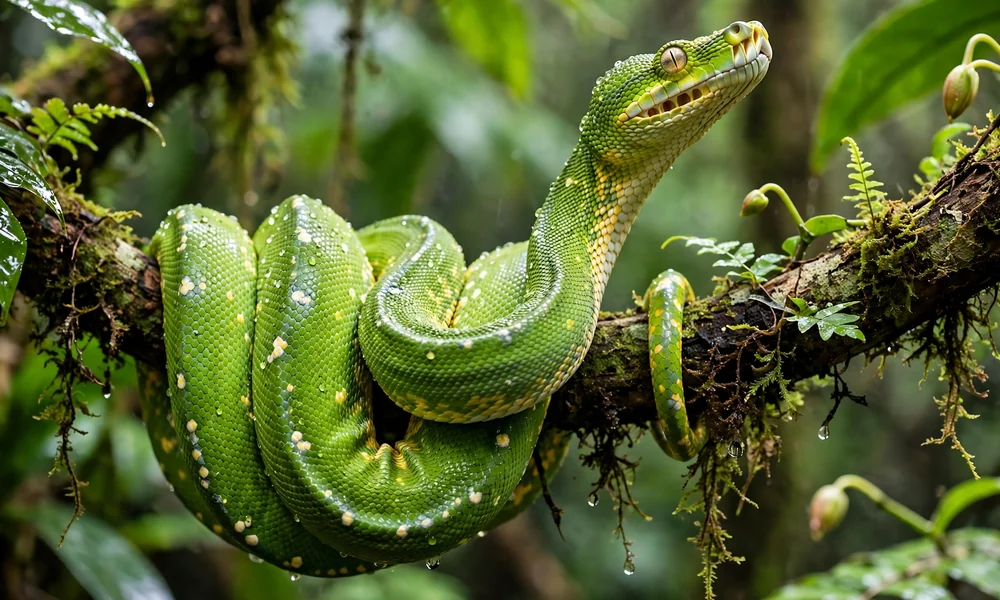
The rattlesnake is the most famous snake of the Americas, a pit viper with a rattle on its tail that buzzes as a warning when the snake is threatened. It lives in the deserts, grasslands and forests of North and South America, hunting rodents and other small animals. The common adder is the only venomous snake native to Britain, a small viper of heathland and moorland that is more likely to flee than to bite.
The boa constrictor is a large, powerful snake of Central and South America, a non-venomous constrictor that hunts mammals and birds in the forests and grasslands. Sea snakes live their whole lives in the warm seas of the Indian and Pacific Oceans, swimming with paddle-shaped tails and surfacing to breathe, and some are among the most venomous snakes in the world, though they rarely bite people.
Venom, constriction and senses: how snakes catch their prey
Snakes catch their prey in two main ways: venom and constriction. Venomous snakes, including vipers, cobras, mambas and rattlesnakes, inject venom through hollow fangs, which kills or paralyses the prey. Vipers have long, hinged fangs that fold back when the mouth is closed, and cobras have shorter, fixed fangs at the front of the mouth.
Constrictors, including pythons, boas and anacondas, kill by wrapping their coils around their prey and squeezing. Each time the prey breathes out, the snake tightens its coils, until the animal cannot breathe. A constrictor can swallow prey much wider than its own head, because its jaws are joined by stretchy ligaments and its skull bones can move apart.
Snakes hunt with senses no mammal has. Pit vipers, including rattlesnakes, have heat-sensing pits on their faces that can detect the warmth of a mouse in total darkness. All snakes smell with their forked tongues, tasting the air for the scent of prey, and they sense vibrations through the ground. Among the predators of the reptile world, snakes are unusual in swallowing their prey whole, and they can go for weeks or months without a meal after a large one.
Where snakes live
Snakes live in almost every habitat on Earth. Pythons and boas live in tropical forests, rattlesnakes live in deserts and grasslands, adders live on moorland and heath, and sea snakes live in warm tropical seas. Snakes are cold-blooded, so they need warm places to bask in the sun, and they are most active in the warm months.
In cold countries, snakes hibernate through the winter, gathering in sheltered dens below the frost line. In the tropics, many species are active all year. The desert animals of the dry lands include rattlesnakes and sidewinders, the rainforest animals of the tropical canopy include pythons and boas, and the wetland animals of the marshes include water snakes and the anaconda.
Snakes and people
Snakes have a fearsome reputation, and some species are genuinely dangerous. Venomous snakebites kill tens of thousands of people each year, mostly in rural areas of Asia and Africa, where people work in fields and walk barefoot at night. But most snakes are harmless, and many are shy, preferring to flee rather than fight.
Snakes are also vital to the balance of nature. They control populations of rats and mice, which carry disease and destroy crops, and they are themselves food for eagles, herons, mongooses and other animals. In many farming regions, snakes are the farmer’s best friend, keeping rodent numbers down without the need for poison.
Snake conservation is now a major effort. Many snake species are threatened by the loss of their habitats, by the trade in skins and pets, and by persecution from people who kill snakes on sight. Protected areas, education programmes and snake rescue teams help people live alongside snakes rather than killing them.
| Species | Where it lives | How it hunts | Length |
|---|---|---|---|
| Reticulated python | Rainforests of Southeast Asia | Constriction | Over 6 metres |
| Green anaconda | Rivers and swamps of the Amazon | Constriction | Over 5 metres |
| King cobra | Forests of South and Southeast Asia | Venom | Over 5 metres |
| Black mamba | Savannas of Africa | Venom | Around 3 metres |
| Rattlesnake | Deserts and grasslands of the Americas | Venom | Around 2 metres |
| Common adder | Heathland and moorland of Europe | Venom | Around 0.6 metres |
| Boa constrictor | Forests of Central and South America | Constriction | Around 3 metres |
| Sea snake | Warm seas of the Indian and Pacific Oceans | Venom | Around 1.5 metres |
Best seasons for snake watching
The warm months are the finest season for snakes, when they bask in the morning sun and hunt in the evening. In Britain, adders are best in spring, when they emerge from hibernation and bask on sunny banks. In the tropics, snakes are active all year, but the dry season is best, when they gather around water.
Summer evenings are the best time for rattlesnakes in the deserts of North America, when they emerge from their daytime shelters to hunt. Sea snakes are best seen by divers on coral reefs in the warm months, when the water is clear.
Staying safe around snakes
Snakes are wild animals, and they deserve respect. Never pick up a snake you cannot identify, never put your hands into rock crevices or hollow logs, and wear boots and long trousers when walking in snake country. If you meet a snake, stand still, give it space, and let it move away. The best view of a snake is always from a respectful distance.
Snake watching checklist
- Look for adders basking on sunny banks in Britain in spring.
- Watch for rattlesnakes on desert trails in North America on summer evenings.
- Look for pythons and boas in the rainforests of Southeast Asia and the Amazon.
- Watch for sea snakes on coral reefs in the warm months.
- Never pick up a snake you cannot identify, and always wear boots in snake country.
- Leave no trace: take your rubbish home and never disturb a basking snake.
Frequently asked questions
What is the longest snake species?
The reticulated python is the longest snake species, growing to more than six metres. The green anaconda is the heaviest snake, at over 200 kilograms, and the king cobra is the longest venomous snake, at more than five metres.
How is this guide different from the predator animals guide?
This is a species-level guide to snakes: it covers pythons, vipers, cobras, rattlesnakes, boas, adders and sea snakes in detail. The predator animals guide is a general roundup of many different predators, including mammals, birds and fish, and does not go into any one group in this depth.
How is this guide different from a lizard guide?
Snakes and lizards are both reptiles, but snakes have no legs, no eyelids and no external ears, while lizards have legs, eyelids and ear openings. Snakes also have a forked tongue and a skull that can open wide to swallow prey whole, which lizards cannot do.
How many snake species are there?
There are around 4,000 snake species, from the threadsnake at about 10 centimetres to the reticulated python at more than six metres. New species are still being discovered, especially in the tropical forests.
Are all snakes venomous?
No, most snakes are not venomous. Only about one in five snake species has venom that is dangerous to people, and many of those prefer to flee rather than bite. Constrictors such as pythons and boas have no venom at all.
Where is the best place to see a python?
Pythons are best in the rainforests and wetlands of Southeast Asia, where reticulated pythons hunt at night, and in the Amazon, where green anacondas live in the rivers and swamps. A guided night walk with a local expert is the best way to find one.
Conclusion
Snake species are the great survivors of the reptile world: reticulated pythons in the rainforest, king cobras in the Asian forests, black mambas on the African savanna, rattlesnakes in the American deserts and sea snakes in the warm tropical seas.
The next step is to pick one species and one season — a spring morning on a British heath for adders, a summer evening in the desert for rattlesnakes, or a guided night walk in Southeast Asia for pythons — and plan your visit around it.














