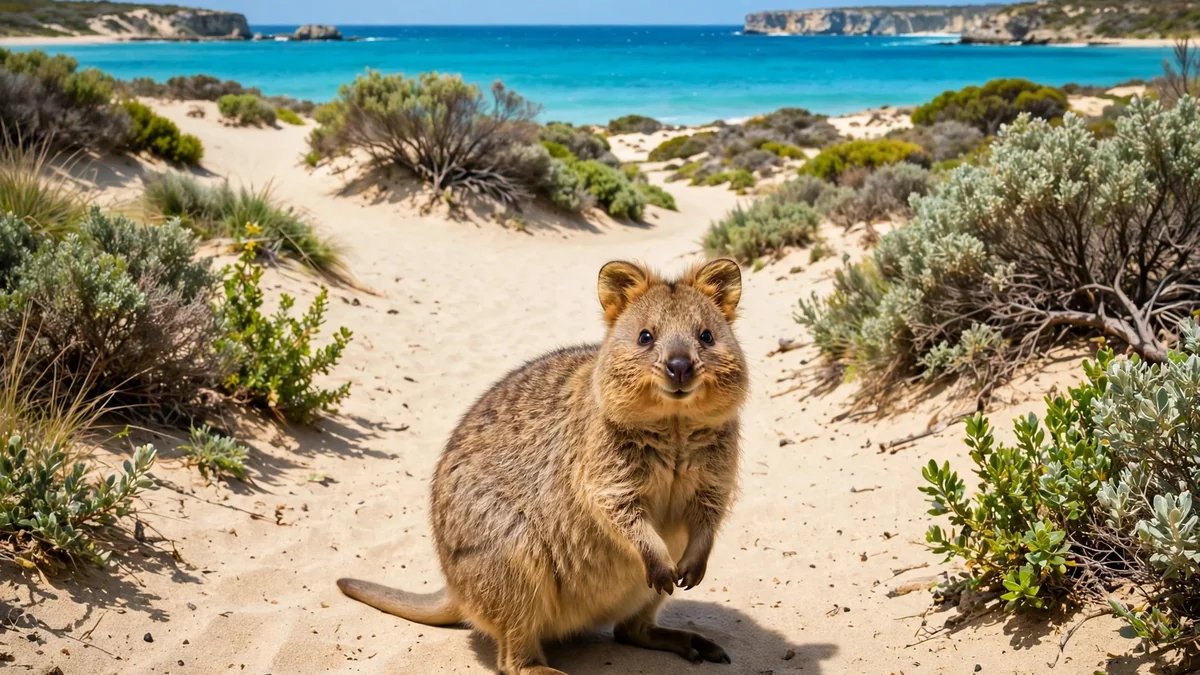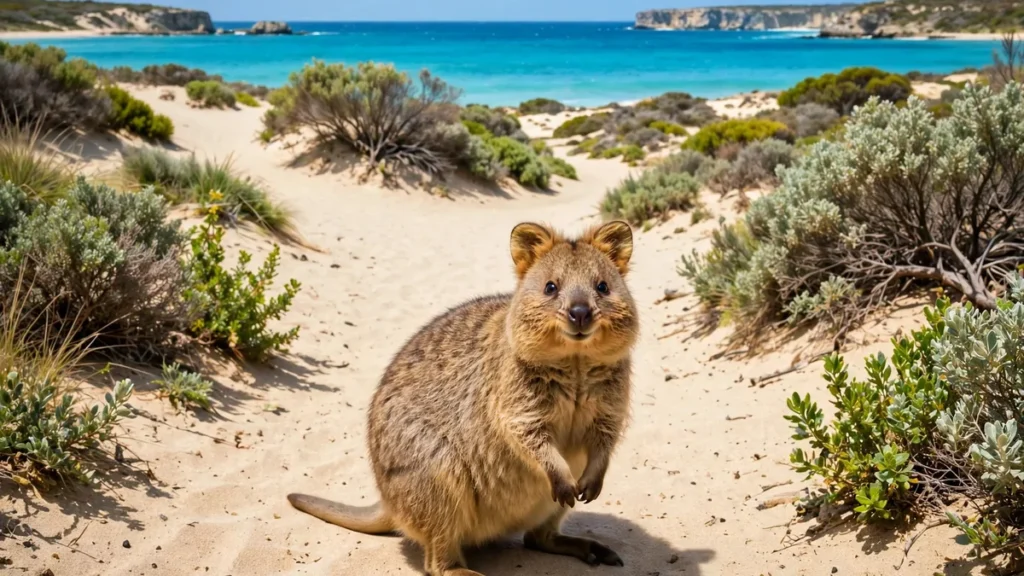
Quokka species are a short list, because there is only one quokka species in the world: Setonix brachyurus, the small wallaby-sized marsupial best known from Rottnest Island off Western Australia. If you are wondering how many quokka species there are, the answer is one, and that single species has become one of the most photographed animals on Earth.
Key takeaways
- There is only one quokka species, Setonix brachyurus, the only living member of its genus.
- Quokkas are small macropods about the size of a domestic cat, weighing 2.5 to 5 kilograms.
- Most quokkas live on Rottnest Island, with a smaller population on Bald Island and scattered groups on the mainland.
- Quokkas are mainly nocturnal, eat leaves, grasses and sedges, and live in family groups.
- The quokka is listed as vulnerable, because foxes, cats and lost shelter have shrunk its mainland range.
What makes a quokka a quokka
A quokka is a small, round-bodied marsupial with coarse brown fur, short rounded ears, a short tail and strong hind legs built for hopping. It measures 40 to 54 centimetres from nose to rump, with a short tail of 25 to 30 centimetres, and an adult weighs 2.5 to 5 kilograms. Its scientific name means short tail.
The quokka is a macropod, a member of the same family as kangaroos and wallabies, and like them it carries its young in a pouch. A single joey is born after a pregnancy of about a month and stays in the pouch for about six months. Quokkas live for about ten years in the wild and can store fat at the base of the tail.
A quokka is famous for its face. The shape of its mouth curves upward at the corners, so a quokka at rest looks as if it is smiling, and photographs of quokkas beside smiling tourists have earned it the nickname of the happiest animal on Earth. That nickname is not a scientific fact, and quokkas do not smile on purpose, but it has made the quokka the best-known animal of Rottnest Island. The kangaroo species guide covers the quokka larger cousins, the red and grey kangaroos, which share its hopping walk and its pouch.
The quokka and its close relatives
The quokka has no sister species, but it has plenty of relatives. As a macropod it belongs to the same family as kangaroos, wallabies and pademelons, more than sixty species that hop across Australia and New Guinea. Its nearest relatives in size are the wallabies, and the tammar wallaby is the closest in looks, a small, grey-brown wallaby of south-western Australia and the islands off the south coast.
The red kangaroo is the largest of the quokka relatives and the largest marsupial alive, a rust-red animal of the dry centre. The western grey kangaroo is a big, grey-brown kangaroo of the south and west. Both are grazers that hop across open ground, while the quokka keeps to thick scrub.
The pademelons are small, shy wallabies of the forest floor, and two of them are close in size to the quokka. The red-necked pademelon lives in the forests and scrub of eastern Australia, while the red-legged pademelon lives in the rainforests of the east coast. Both eat leaves, grasses and fallen fruit, and both hide in dense cover by day, just as the quokka does.
The swamp wallaby is another forest wallaby, a dark, grizzled animal with a pale cheek stripe that lives in the thickets and scrub of eastern and south-eastern Australia. The wombat is a more distant relative, a short-legged, burrowing marsupial of the south-east and Tasmania that eats grasses and roots. Wombats are not macropods, but they share the quokka habit of grazing at night, and the wombat species guide covers the three wombat species in full.
How quokkas live
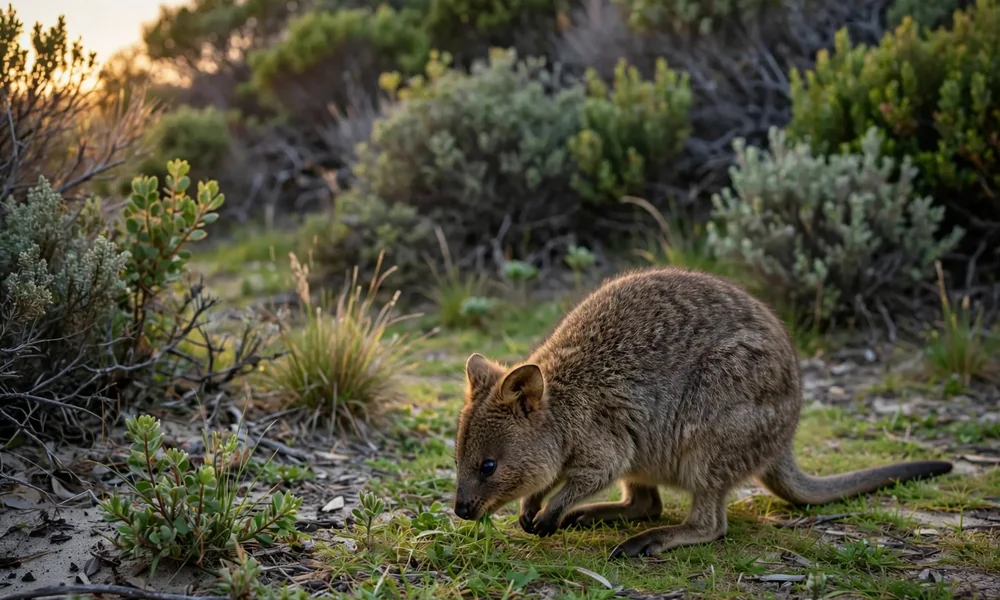
Quokkas are mainly nocturnal. They spend the day resting in the shade of dense, prickly shrubs, and at dusk they come out to feed, moving through the scrub in family groups. A family group is usually a female and her young, with other adults feeding nearby. On Rottnest Island, where there are no foxes or cats, quokkas feed boldly out in the open, but on the mainland they stay close to cover.
Quokkas eat grasses, sedges and the leaves and shoots of shrubs, and they chew their cud like cattle. On Rottnest Island they get most of their water from the plants they eat, especially the succulents near the coast and around the salt lakes. Quokkas can even climb trees up to about a metre and a half high to reach leaves, an unusual trick for a macropod.
The quokka is a social animal, and on Rottnest Island the animals gather in the same feeding areas night after night. Their main defences are the thick scrub they sleep in and their habit of freezing or hopping away at the first sign of danger. Many of the forest animals of Australia live the same way, hiding by day and feeding at night.
Where quokkas live
Quokkas live only in the south-west of Western Australia, in one of the smallest ranges of any Australian mammal. The largest population is on Rottnest Island, known to the Noongar people as Wadjemup, about eighteen kilometres off Fremantle, usually estimated at between eight and twelve thousand animals. A smaller population lives on Bald Island near Albany, and a few thousand more live in scattered groups on the mainland, mostly in the southern forests between Nannup and Denmark.
On the mainland, quokkas need dense ground cover and plenty of rain, living only where six hundred millimetres of rain or more falls each year. They favour swampy ground, creek lines and thickets of tea tree and wattle, where dense shrubs hide them from foxes, cats and dogs. By 1992 the mainland range had shrunk by more than half, and the mainland populations are still falling.
Rottnest Island is free of foxes and cats, and that is why the quokka thrives there. Snakes are the quokka only predator on Rottnest, and the animals roam the whole island, from the semi-arid scrub in the west to the gardens of the settlement in the east. The island rules are strict: never touch a quokka, never pick one up and never feed one, because human food can make quokkas ill. The koala species guide covers another much-loved Australian marsupial that also depends on its trees and shrubs for safety.
| Type | Animal | Where it lives | Best-known food | Length |
|---|---|---|---|---|
| Species | Quokka | Rottnest Island and south-western Australia | Leaves, grasses, sedges | 0.54 metres |
| Close relative | Red kangaroo | Central and western Australia | Grasses and shrubs | 1.60 metres |
| Close relative | Western grey kangaroo | Southern and south-western Australia | Grasses and shrubs | 1.30 metres |
| Close relative | Tammar wallaby | South-western and southern Australia | Grasses, leaves, shrubs | 0.60 metres |
| Close relative | Red-necked pademelon | Forests of eastern Australia | Grasses, leaves, roots | 0.60 metres |
| Close relative | Red-legged pademelon | Rainforests of eastern Australia | Leaves, grasses, fruit | 0.55 metres |
| Close relative | Swamp wallaby | Eastern and south-eastern Australia | Shrubs, ferns, leaves | 0.80 metres |
| Close relative | Wombat | South-eastern Australia and Tasmania | Grasses, roots, bark | 1.15 metres |
Best seasons for quokka watching
Autumn and winter are the finest seasons for quokka watching on Rottnest Island, when the weather is cooler and the animals are in good condition after the winter rains. From April to September the scrub is green and the quokkas are often out in the open in the late afternoon. Spring is also good, because the young leave the pouch and start to explore.
Summer is the hardest season for quokkas on Rottnest, because the island is hot and dry and the plants lose their protein. They still come out to feed at dusk, but they rest longer in the shade during the day and are harder to find. The best watching on any day is at dawn or dusk, when the quokkas leave their shelters and move out to graze.
Staying safe around quokkas
Quokkas are wild animals, and they deserve respect, even though they look friendly. Never try to touch a quokka, never pick one up and never feed one. Quokkas can bite and scratch when cornered, and human food such as chips and bread can cause dehydration and malnutrition. On Rottnest Island, touching or feeding a quokka is against the island rules, and rangers can fine people who break them.
Keep a sensible distance and let the quokka come to you if it chooses, and use a camera with a zoom lens rather than crowding in close. Keep dogs on a lead near quokka country on the mainland, and if you find an injured quokka, call a wildlife rescue group rather than handling it yourself.
Quokka watching checklist
- Look for dense, prickly scrub and shady thickets, where quokkas rest by day.
- Watch at dawn or dusk, and sit still and quiet near a feeding area.
- Look for a small, round, brown shape grazing in the open, with a short tail.
- Watch for quokkas moving in family groups through the scrub at dusk.
- Use binoculars or a zoom lens, and never block a shelter or a feeding path.
- Do not touch, pick up or feed quokkas, and take your rubbish home.
- Leave no trace: keep to marked paths and viewing areas, and keep dogs on a lead.
Frequently asked questions
How many quokka species are there?
There is only one quokka species, Setonix brachyurus, living on Rottnest Island, Bald Island and in scattered groups in south-western Australia.
How is this guide different from the kangaroo species guide?
This guide covers only the single quokka species and its close macropod relatives, with a look at how quokkas live on Rottnest Island, while the kangaroo species guide covers the kangaroos themselves, from the red kangaroo to the grey kangaroos and the tree kangaroos.
Why are quokkas called the happiest animal on Earth?
Quokkas are called the happiest animal on Earth because the shape of their mouth makes them look as if they are always smiling, and photographs of quokkas beside smiling tourists made the nickname famous. It is a nickname, not a scientific fact, and quokkas do not smile on purpose, but the friendly-looking face is real.
Where is the best place to see a quokka?
The best place to see a quokka is Rottnest Island, about eighteen kilometres off Fremantle in Western Australia, where the largest population lives and the animals are easy to find. Take the ferry from Perth or Fremantle, visit at dawn or dusk in autumn or winter, and look near the settlement and the coastal scrub.
What do quokkas eat?
Quokkas eat grasses, sedges and the leaves and shoots of shrubs, and they chew their cud like cattle. On Rottnest Island they get most of their water from the plants they eat, because the island has very little fresh water.
Are quokkas endangered?
Quokkas are not endangered, but they are listed as vulnerable by the IUCN, because their mainland range has shrunk by more than half and their numbers are still falling. The island populations are healthy, but mainland quokkas are threatened by foxes, cats, dogs, land clearing and fire.
Conclusion
Quokka species, all one of them, are a reminder that a small animal can carry a big reputation: a single species that lives in one small corner of Western Australia, survives on leaves and grasses and sleeps by day in prickly scrub.
The next step is to take the ferry to Rottnest Island, walk quietly through the coastal scrub at dusk and watch for the small, round shape of a quokka, the only one of its kind in the world.