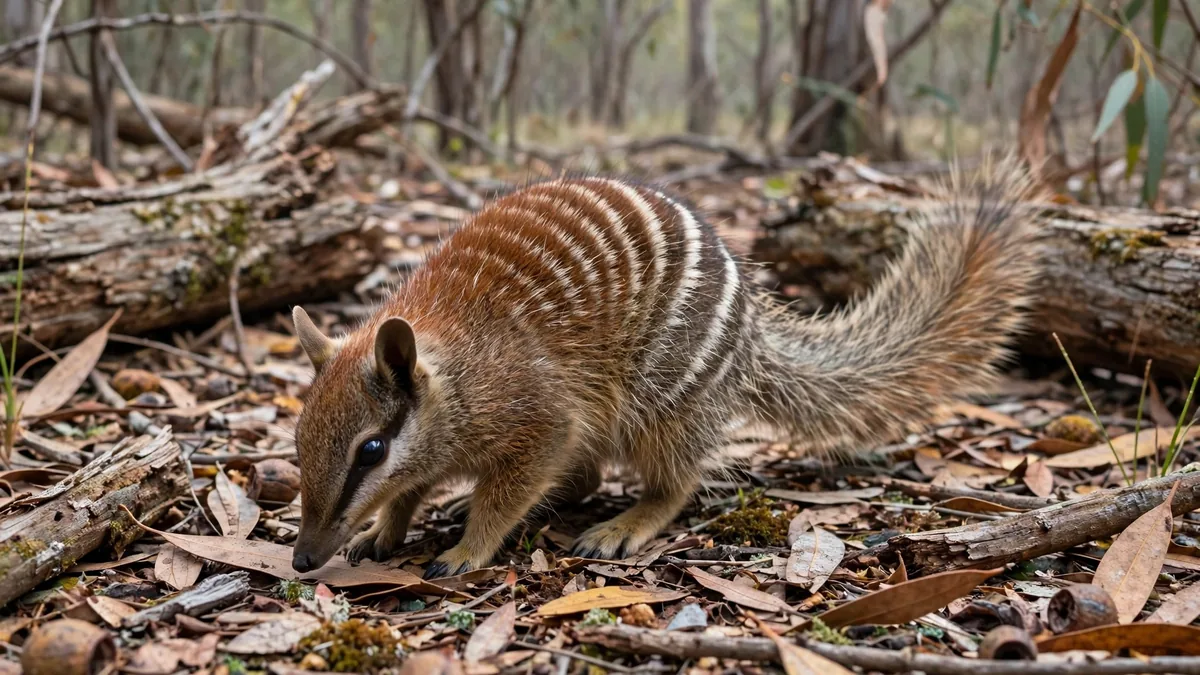
Numbat species are a short list, because there is only one numbat species in the world: Myrmecobius fasciatus, the striped, termite-eating marsupial of south-western Australia. If you are wondering how many numbat species there are, the answer is one, and that single species is the only marsupial that hunts by day and eats nothing but termites.
Key takeaways
- There is only one numbat species, Myrmecobius fasciatus, and it is the only living member of its family, Myrmecobiidae.
- Numbats are the only marsupials that are fully active by day, because their termite food is active in daylight.
- An adult numbat can eat up to 20,000 termites in a single day, about a tenth of its own body weight.
- Numbats live only in the woodlands of south-western Australia, mainly around Dryandra Woodland and the Perup Nature Reserve.
- Fewer than 1,000 numbats are thought to remain in the wild, and the species is listed as endangered.
What makes a numbat a numbat
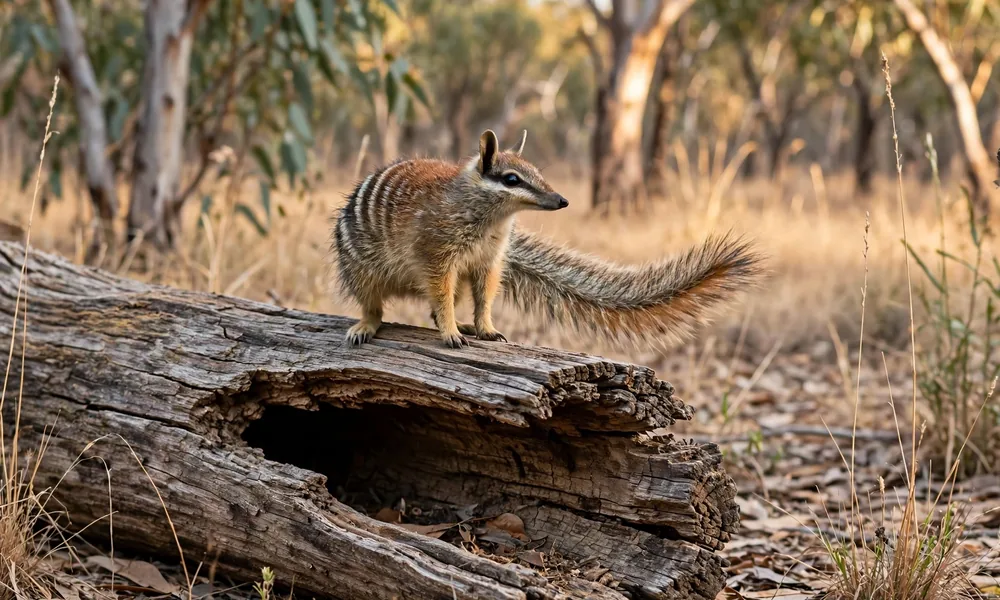
A numbat is a small, brightly marked marsupial, about 35 to 45 centimetres long from nose to tail tip, with a reddish-brown coat, seven or eight white stripes across its lower back and rump, a finely pointed snout and a long, bushy tail about as long as its body. It weighs between 280 and 700 grams, and its striped back is unmistakable: no other Australian mammal wears white bars like these.
The numbat is built for one job, eating termites. It has a long, narrow snout, a mouth full of small, peg-like teeth, and an exceptionally long, sticky tongue that can stretch at least five centimetres beyond the tip of its nose. It finds termites by scent, digs them from shallow underground galleries and scratches them from under bark and rotting wood, then licks them up with quick flicks of its tongue.
Most marsupials are creatures of the night, but the numbat breaks the rule. It is the only marsupial that is fully active by day, which sets it apart from the nocturnal animals of the Australian bush, because termites are active in daylight and the numbat must follow their hours. In winter it feeds from mid-morning to mid-afternoon, and in summer it rises early, shelters through the heat of the day and feeds again in the late afternoon.
The numbat and its termite-eating counterparts
The numbat has no sister species, because its family holds only this one animal. It is not closely related to the other ant- and termite-eaters of the world, but it shares their way of life, and the animals below are its ecological counterparts, fellow specialists that eat ants and termites for a living, not its kin.
The closest thing to a numbat in Australia is the short-beaked echidna, a spiny, egg-laying mammal that also licks up ants and termites with a long, sticky tongue. The echidna is a monotreme, not a marsupial, and it curls into a ball of spines when threatened, while the numbat is a fast, daytime runner that relies on keen eyesight and speed to escape foxes and birds of prey.
The giant anteater of Central and South America is the largest of the ant-eaters, a shaggy animal with a very long snout, huge curved front claws and a tongue that can reach 60 centimetres. It eats up to 30,000 ants and termites a day and, like the numbat, relies entirely on its tongue. Its smaller cousin, the silky anteater, is a tiny golden-furred animal of the rainforest canopy, no bigger than a squirrel.
The aardvark of Africa is a night animal with a long, pig-like snout, powerful digging claws and a long, sticky tongue, and it can eat 50,000 termites in a single night. It digs deep burrows for shelter, just as the numbat shelters in hollow logs and burrows, but the aardvark works in darkness while the numbat works in daylight.
Two pangolins belong in this company as well. Temminck’s pangolin, the ground pangolin of southern and eastern Africa, is a scaly, armour-plated animal that rolls into a ball when threatened and laps up ants and termites with a tongue longer than its body. The Sunda pangolin of South-East Asia does the same work in the forests of the region, and both pangolins are now threatened by hunting and the trade in their scales.
The last counterpart is the giant armadillo of South America, a huge, burrowing animal with powerful claws that digs open termite mounds and ant nests. It is the largest armadillo alive, and like the numbat it is solitary, but it digs its food out with brute strength where the numbat scratches at the surface.
How numbats live: a day of termite hunting
A numbat day starts well after dawn. The animal leaves its nest in a hollow log or a burrow and spends most of the day walking slowly through the woodland, nose to the ground, searching for termites by scent. It digs at shallow galleries and scratches at bark and decaying wood, and it never breaks into the big termite mounds themselves.
Feeding is almost constant. A numbat may eat up to 20,000 termites a day, roughly a tenth of its body weight, because termites are small and soft and the numbat digests them quickly, so it must keep eating through its waking hours, and the day is timed to the termites.
Numbats are solitary and territorial, and each adult defends a home range of up to 1.5 square kilometres against others of the same sex. The female is unusual among marsupials because she has no pouch: her four young cling to her teats and are carried on her belly for months, then left in the nest while she hunts. In cold weather, numbats can enter torpor, a short, deep sleep that saves energy for up to fifteen hours.
Where numbats live
Numbats once ranged across southern Australia, from the woodlands of Western Australia to north-western New South Wales, living in eucalypt forests, mulga woodland and spinifex sandplains. Since European settlement, foxes, changes in fire patterns and the clearing of land have shrunk that range to a few small pockets of south-western Australia.
Today the two remaining natural populations live in the jarrah forest and woodland of the south-west: one at Dryandra Woodland near Narrogin and the other at Perup Nature Reserve near Manjimup. Both are places of forest animals country, eucalypt woodland with hollow logs for shelter, plenty of termites in the soil and the leaf litter, and careful fox control, because a single fox can kill a numbat in seconds.
Conservation teams have also returned numbats to fenced reserves in South Australia and New South Wales, where foxes and cats are kept out, and the animals are breeding in their new homes. These reintroductions are slow, careful work, but they matter, because fewer than 1,000 numbats are thought to remain in the wild, and the species is listed as endangered. Numbats are the faunal emblem of Western Australia.
| Type | Animal | Where it lives | Best-known food | Length |
|---|---|---|---|---|
| Species | Numbat | South-western Australia | Termites | 0.45 metres |
| Close relative | Short-beaked echidna | Australia and New Guinea | Ants and termites | 0.45 metres |
| Close relative | Giant anteater | Central and South America | Ants and termites | 1.80 metres |
| Close relative | Silky anteater | Central and South American rainforests | Ants | 0.45 metres |
| Close relative | Aardvark | Sub-Saharan Africa | Termites and ants | 1.30 metres |
| Close relative | Temminck’s pangolin | Southern and eastern Africa | Ants and termites | 1.00 metres |
| Close relative | Sunda pangolin | South-East Asia | Ants and termites | 1.00 metres |
| Close relative | Giant armadillo | South America | Termites and ants | 1.50 metres |
Best seasons for numbat watching
Winter and spring are the finest seasons for numbat watching in south-western Australia, from about June to November, when the animals feed through the middle of the day and are easier to find in the open woodland.
In summer, from December to February, numbats feed early in the morning and again in the late afternoon, so the best watching is at those cooler hours, when the light is soft and the animals move slowly through the leaf litter.
Staying safe around numbats
Numbats are wild animals, and they deserve respect. Never try to catch a numbat, never put your hand into a hollow log or a burrow, and never handle one. If you find an injured numbat, call a wildlife rescue group and keep your distance.
Keep dogs on a lead in numbat country, because dogs can chase and kill numbats, just as foxes do. Keep a sensible distance, sit still and quiet, and use binoculars to watch up close. Do not feed numbats or disturb their logs and burrows, because a frightened numbat may abandon its nest, and its young may not survive without it.
Numbat watching checklist
- Look for open eucalypt woodland with hollow logs, fallen branches and plenty of leaf litter.
- Watch in the middle of the day in winter, or early morning and late afternoon in summer.
- Look for a small, striped shape moving slowly through the leaf litter, nose to the ground.
- Watch for scratch marks in the soil and under bark, where a numbat has been digging for termites.
- Use binoculars to watch from a distance, and never block a log or burrow entrance.
- Keep dogs on a lead, and do not touch numbats, logs or burrows.
- Leave no trace: take your rubbish home and keep to marked paths and viewing areas.
Frequently asked questions
How many numbat species are there?
There is only one numbat species, Myrmecobius fasciatus, and every numbat alive today belongs to that single species, the only living member of its family, Myrmecobiidae.
How is this guide different from the anteater species guide?
This guide covers only the single numbat species and its fellow termite-eaters, the animals that share its way of life, while the anteater species guide covers the true anteaters of the Americas, from the giant anteater to the tiny silky anteater, in their own right.
Why are numbats active during the day?
Numbats are active during the day because their food is: termites are active in daylight, and the numbat is the only marsupial that is fully diurnal. In winter it feeds from mid-morning to mid-afternoon, and in summer it feeds in the early morning and late afternoon.
How many termites does a numbat eat each day?
An adult numbat can eat up to 20,000 termites each day, roughly a tenth of its body weight. It finds them by scent, digs them from shallow galleries and scratches them from under bark and rotting wood, then licks them up with its long, sticky tongue.
Where is the best place to see a numbat?
The best place to see a numbat is Dryandra Woodland near Narrogin or Perup Nature Reserve near Manjimup, both in south-western Australia. Go in winter or spring and watch in open eucalypt woodland in the middle of the day, when the numbats are out feeding.
Are numbats endangered?
Yes, numbats are endangered. Fewer than 1,000 are thought to remain in the wild, living in only a few small pockets of south-western Australia, with extra populations in fenced reserves in South Australia and New South Wales. Foxes, land clearing and changes in fire patterns are the main threats, and numbats are protected by law.
Conclusion
Numbat species, all one of them, are a reminder that the animal kingdom still holds surprises: a single striped marsupial that hunts by day, eats nothing but termites and has no pouch for its young, living in the woodlands of south-western Australia.
The next step is to visit Dryandra Woodland or Perup Nature Reserve on a cool, quiet day, sit still among the eucalypts and watch the leaf litter for the small, striped shape of a numbat, the only one of its kind in the world.