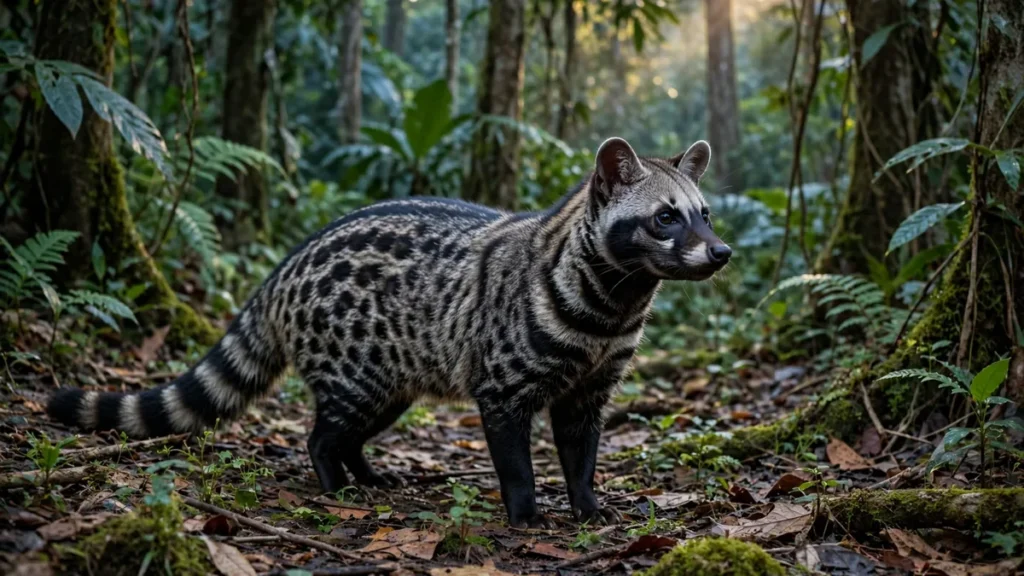
Civet species are some of the least understood small carnivores in the world, long-bodied, short-legged animals of Africa and Asia. If you are wondering how many civet species there are, the answer is about 35, counted across the family Viverridae, and this guide introduces the eight best-known of them, from the African civet to the fruit-eating palm civets of Asia.
Key takeaways
- There are about 35 civet species in the family Viverridae, across Africa and southern and south-east Asia.
- Civets are mostly nocturnal, solitary hunters with a strong sense of smell and scent glands near the tail.
- Palm civets are skilled climbers that eat fruit and help forests by spreading seeds.
- The Asian palm civet is the animal behind kopi luwak, coffee made from beans that have passed through a civet.
- Several civet species are rare and threatened, including the otter civet, the golden palm civet and Owston’s palm civet.
What makes a civet a civet
A civet is a small to medium-sized carnivore with a long body, short legs, a pointed face and a long tail. Most civets measure roughly 40 to 85 centimetres in body length, with a tail of a similar length, and weigh between about 2 and 20 kilogrammes. Their coats are usually grey or brown with spots, stripes or bands.
Civets belong to the family Viverridae, an old family of cat-like carnivores that also includes the genets and the linsangs. The family is counted at about 35 species in total, spread across Africa and Asia. The binturong, sometimes called the bearcat, is the largest member of the family, but it has its own guide in this series.
The feature that gives civets their name is scent. Civets carry scent glands near the base of the tail, and the strong-smelling secretion they produce, once known as civet musk, was used in perfumes. Civets use scent to mark their territory, rubbing the glands on branches and rocks as they travel.
The ground civets of Africa and Asia
The African civet is the largest ground civet, a boldly marked animal of sub-Saharan Africa with a grey coat splashed with black spots and stripes. Its scientific name is Civettictis civetta, and at roughly 7 to 20 kilogrammes it is the heaviest civet of all. It lives in forests, woodland and savanna, and eats rodents, birds, frogs, insects, eggs, fruit and carrion.
The large Indian civet, Viverra zibetha, is the Asian counterpart of the African civet, a heavy, grey animal with dark stripes and spots that lives in the forests of South and South-East Asia, from Nepal to the Malay Peninsula. It walks the forest floor at night, and it is often caught in snares set for other animals, so its numbers have fallen across much of its range.
The small Indian civet, Viverricula indica, weighs only about 2 to 4 kilogrammes, with a slender body, a grey-brown coat marked with dark spots, and a long, banded tail. It lives across South and South-East Asia, from India to Indonesia, in forests, grassland, scrub and farmland, often near people. It hunts rats, mice, birds, frogs and insects, and eats fruit and carrion too, which makes it useful to farmers.
The palm civets of the trees
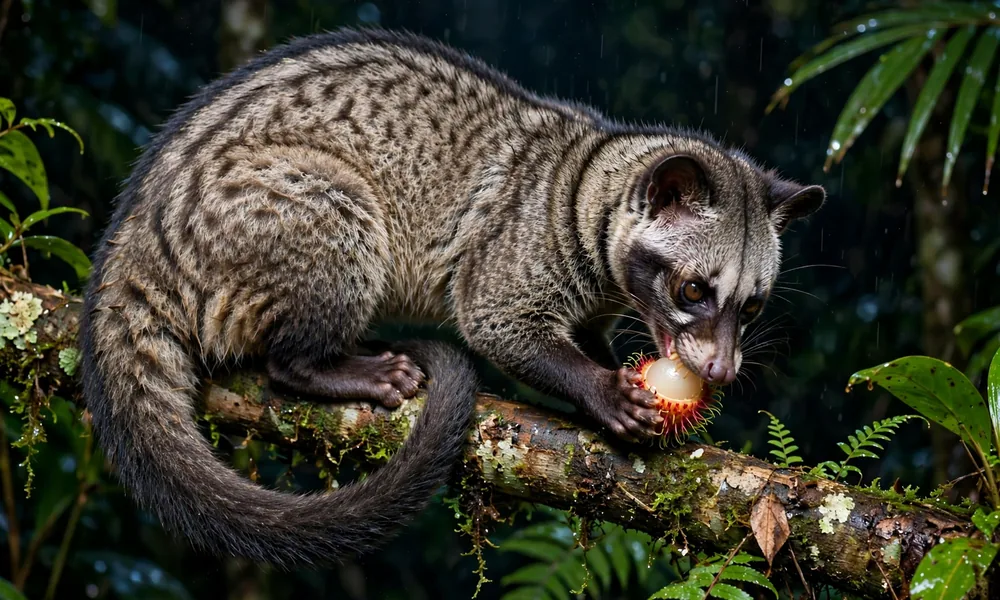
The Asian palm civet, Paradoxurus hermaphroditus, is the civet most people have heard of, because it is the animal behind kopi luwak. It is a grey-brown climber of South and South-East Asia, about the size of a house cat, with a dark face mask and a long tail it uses for balance. Palm civets sleep in hollows by day and move through the canopy at night, eating figs, bananas and mangoes, as well as insects.
The masked palm civet, Paguma larvata, takes its name from the pale mask across its dark face. It is a larger, heavier palm civet of the forests of South, East and South-East Asia, from the Himalayas through China to Japan and the islands of South-East Asia. It eats fruit, leaves, small mammals, birds and insects, and it is often seen near villages and farms, where it raids fruit trees and chicken coops.
The golden palm civet, Paradoxurus zeylonensis, lives only in Sri Lanka, and it is one of the rarest civets in this guide. Its coat ranges from golden brown to dark brown, and it lives in the island rainforests, feeding on fruit, insects and small animals. It is endangered, because the forests it depends on have shrunk to scattered fragments.
The specialists: otter civet and Owston’s palm civet
The otter civet, Cynogale bennettii, is the strangest civet of all, a semi-aquatic animal of the swamps and slow rivers of Borneo, Sumatra and the Malay Peninsula. It has a broad, flat muzzle, webbed toes and dense brown fur, and it swims and dives for fish, crabs, frogs and molluscs, much like a true otter. It is listed as endangered, because its lowland wetlands are being drained for farming and plantations.
Owston’s palm civet, Chrotogale owstoni, lives only in the forests of Vietnam, Laos and southern China. It has a grey coat crossed by dark bands, a narrow muzzle and a long, dark tail, and it eats mainly earthworms, insects and other small animals from the forest floor. It is listed as endangered, after a decline of more than half its population, driven by hunting and the loss of its forest home.
How civets live
Civets are mostly nocturnal: they rest by day in a hollow tree, a burrow or a thick tangle of vegetation, and become active at dusk, hunting through the night and returning to shelter before dawn. They are generally solitary, and each animal holds a territory that it marks with scent.
Most civets are omnivores, eating small mammals, birds, frogs, insects, eggs, fruit and carrion, and the balance changes with the season and the species. Palm civets eat the most fruit, ground civets eat the most meat, and the otter civet eats the most fish.
The best-known story about civets is kopi luwak, the coffee made from beans eaten by the Asian palm civet. The civet eats ripe coffee cherries, and the beans pass through its gut before being collected from its droppings, washed, dried and roasted. Much of the kopi luwak on sale today comes from civets kept in small cages and fed only coffee cherries, and many wildlife groups advise against buying caged civet coffee at all.
Where civets live
Civets live across a wide band of the Old World tropics, from sub-Saharan Africa through India and South-East Asia to southern China and Indonesia. The African civet is the only civet of Africa south of the Sahara, while Asia holds all the rest, with the most species in the rainforests of Borneo, Sumatra and the Malay Peninsula.
Within that range, civets use many kinds of country. The rainforest animals of South-East Asia include the palm civets of the canopy, the otter civet of the swamp forests, and the ground civets of the forest floor. The forest animals of the drier woodlands include the African civet and the Indian civets, which cope with seasons of heat and drought that the rainforest species never face.
| Type | Animal | Where it lives | Best-known food | Length |
|---|---|---|---|---|
| Species | African civet | Sub-Saharan Africa | Rodents, birds, fruit, carrion | 1.20 metres |
| Species | Asian palm civet | South and South-East Asia | Fruit, insects, small animals | 1.00 metres |
| Species | Small Indian civet | South and South-East Asia | Rats, mice, birds, insects | 0.85 metres |
| Species | Large Indian civet | South and South-East Asia | Rodents, birds, frogs, fruit | 1.10 metres |
| Species | Masked palm civet | South, East and South-East Asia | Fruit, small mammals, birds | 1.10 metres |
| Species | Golden palm civet | Sri Lanka only | Fruit, insects, small animals | 0.90 metres |
| Species | Otter civet | Borneo, Sumatra, Malay Peninsula | Fish, crabs, frogs, molluscs | 0.95 metres |
| Species | Owston’s palm civet | Vietnam, Laos, southern China | Earthworms, insects | 1.00 metres |
Best seasons for civet watching
The dry season is usually the best time to look for civets, because the animals gather where food and water remain, and the thinner vegetation makes them easier to spot. In much of South-East Asia the dry months run from about November to April, while in Africa the dry season falls at different times in the east and the west. The wet season brings more fruit, but heavy rain and thick foliage make watching much harder.
Night is the time that matters most. Civets leave their dens at dusk, and the first two hours after sunset are often the best, when they are moving and feeding. A second, shorter burst of activity often comes just before dawn.
Staying safe around civets
Civets are wild animals, and they deserve respect and distance. Never try to catch a civet, never reach into a hollow tree or a burrow, and never corner one, because a frightened civet can bite and scratch. Civets can carry rabies in some regions, so any bite or scratch needs prompt medical attention.
Keep a sensible distance and use binoculars or a torch with a red filter. Do not feed civets, because fed animals lose their fear of people and come into conflict with them. If you find an injured civet, call a local wildlife rescue group rather than handling it yourself.
Civet watching checklist
- Look for forest edges, fruiting fig trees and slow rivers, where civets come to feed.
- Watch at dusk and in the first two hours after sunset.
- Listen for rustling in the canopy and watch for eye shine.
- Look for droppings full of seeds and scent marks on branches.
- Use binoculars and a red-filter torch, and keep away from dens.
- Do not feed civets, and do not touch them or their dens.
- Leave no trace: take your rubbish home and keep to marked paths.
Frequently asked questions
How many civet species are there?
There are about 35 civet species in the family Viverridae, counting the civets, genets and linsangs together. The eight best-known true civets are listed in the table above.
How is this guide different from the mongoose species guide?
This guide covers only the civets of the family Viverridae, the long-bodied, scent-marking animals of Africa and Asia, while the mongoose species guide covers the mongooses, a different family of small carnivores that are mostly active by day.
What is kopi luwak, and is it cruel?
Kopi luwak is coffee made from beans that an Asian palm civet has eaten and passed in its droppings, and genuine wild-collected kopi luwak is rare. Much of it comes from civets kept in small cages, which wildlife groups regard as cruel, so buyers should avoid caged civet coffee.
Are civets cats?
No, civets are not cats, although they look cat-like and belong to the same broad group of carnivores. Civets belong to the family Viverridae, while true cats belong to the family Felidae.
Are civets nocturnal?
Yes, civets are mostly nocturnal, resting by day in hollow trees, burrows or thick vegetation and hunting at night. They are among the nocturnal animals of the African and Asian forests.
Where is the best place to see a civet?
The best place to see a civet is a quiet forest edge or fruiting tree in Africa or South-East Asia, at dusk, in the dry season. Sit still near a fig tree or a slow river, use a red-filter torch, and be patient.
Conclusion
Civet species, about 35 of them across Africa and Asia, are a reminder that the small carnivores of the night do as much work as the famous ones: they control rats, spread the seeds of fruit trees, and keep their forests healthy, all while most people are asleep.
The next step is to find a quiet forest edge at dusk, sit still beneath a fruiting tree, and watch for a civet moving through the dark.














