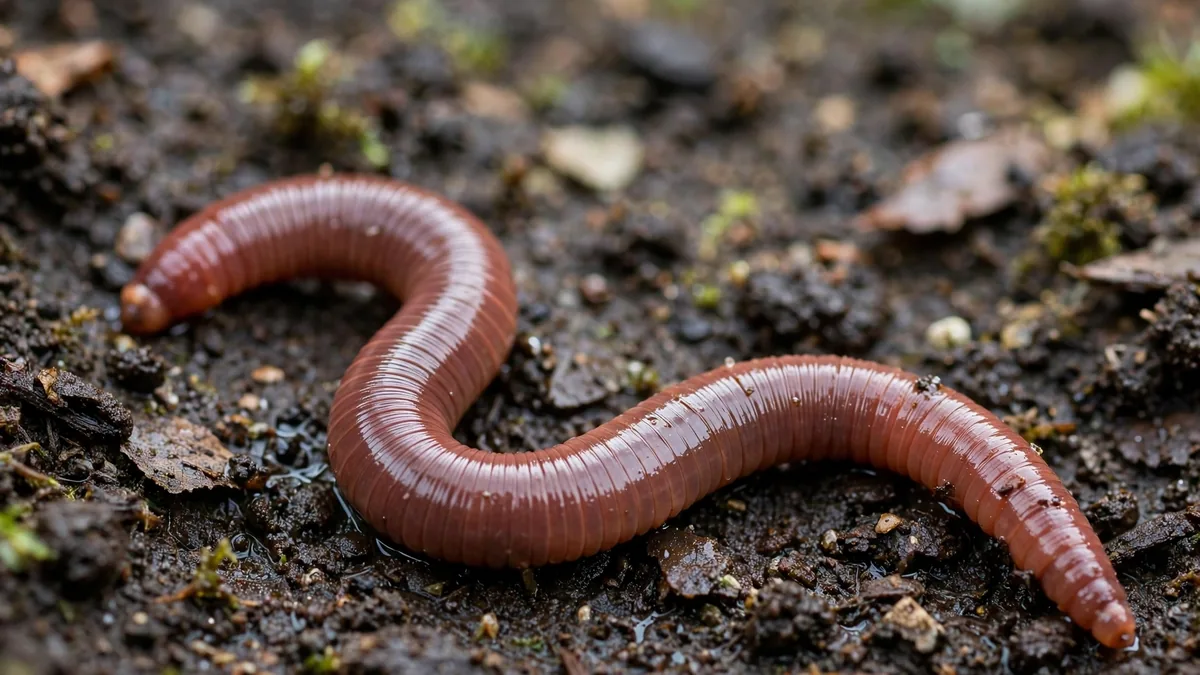
The earthworm species are the quiet engineers of the soil, soft, segmented worms that spend their lives burrowing through the ground beneath our feet, eating dead leaves and decaying matter, and leaving behind tunnels and castings that keep the soil alive. If you are asking what an earthworm is, the short answer is a segmented worm of the order Crassiclitellata, led here by the common earthworm, Lumbricus terrestris, a reddish-brown worm typically 11 to 20 centimetres long that lives in a deep vertical burrow, surfaces at night to drag fallen leaves underground, and breathes through its moist skin. More than 6,000 earthworm species have been described worldwide, found in almost every soil on Earth, from garden beds to rainforest floors.
What makes the earthworm so fascinating is how much it achieves without eyes, without lungs, without legs, and without a single hard part in its body. A worm that most people think of as fishing bait is in fact one of the most important animals in the history of the world, in the words of Charles Darwin, who wrote his last book about them in 1881. This guide follows the whole animal: how it looks, where it lives, what it eats, how it behaves, how it breeds, and why the soil beneath your feet would be a poorer place without it.
Key takeaways
- The earthworm species covered here are the true earthworms of the family Lumbricidae, led by the common earthworm, Lumbricus terrestris, also called the nightcrawler or lob worm.
- A common earthworm is typically 11 to 20 centimetres long, with 120 to 170 ringed segments, and the largest individuals reach 35 centimetres and weigh about 11 grammes.
- More than 6,000 earthworm species have been described worldwide, and the common earthworm is native to Western Europe but is now widespread across North America and western Asia.
- Earthworms are detritivores that eat dead leaves and decaying organic matter, and a common earthworm can eat up to a third of its body weight in a day.
- The common earthworm has not been assessed by the International Union for Conservation of Nature, while the giant Gippsland earthworm is listed as Endangered.
The earthworm species and their relatives
Earthworms belong to the phylum Annelida, the segmented worms, and within it they sit in the class Clitellata, named for the clitellum, the band that produces the cocoon in which their young develop. They are members of the order Crassiclitellata, the true earthworms, and the family Lumbricidae, the family that holds the familiar earthworms of Europe and North America. The genus Lumbricus holds the large, reddish, deep-burrowing earthworms, and the species Lumbricus terrestris, described by Carl Linnaeus in 1758, was the first earthworm species ever given a scientific name. Like the ants in our ant guide, earthworms live close together in good soil without ever forming a colony, and they are among the hardest-working animals in the soil, moving and mixing more earth in a year than any other animal of their size.
The lead species of this guide is Lumbricus terrestris, the common earthworm, also called the nightcrawler in North America, the lob worm in Britain, and the dew worm in older books. It is the largest naturally occurring earthworm through much of Europe, typically 11 to 20 centimetres long when extended, and about 7 to 10 millimetres across, with around 120 to 170 segments, most often 135 to 150. It is pinkish to reddish-brown above and paler below, and it is an anecic earthworm, which means it lives in a deep, permanent vertical burrow and surfaces to feed, rather than tunnelling through the soil for its food. It is native to Western Europe, and it is now abundant in North America and western Asia, carried around the world in soil, in plant pots, and in fishing bait.
| Type | Animal | Where it lives | Best-known food | Length or Weight |
|---|---|---|---|---|
| Family | Earthworms (Lumbricidae) | Soils worldwide | Dead leaves and decaying matter | Most 6 to 30 cm long |
| Genus | Common earthworms (Lumbricus) | Temperate soils of Europe and North America | Dead leaves and soil organic matter | Typically 11 to 20 cm long |
| Species | Common earthworm (Lumbricus terrestris) | Gardens and fields, Europe and North America | Dead leaves and decaying matter | Typically 11 to 20 cm, up to 35 cm |
| Species | Red earthworm (Lumbricus rubellus) | Leaf litter and surface soil | Decaying leaves and organic matter | About 6 to 13 cm long |
| Species | Grey worm (Aporrectodea caliginosa) | Fields and gardens, shallow soil | Soil and decaying organic matter | About 6 to 10 cm long |
| Species | Giant Gippsland earthworm (Megascolides australis) | South Gippsland, Victoria, Australia | Leaf litter and soil organic matter | Typically about 1 m, up to 3 m reported |
The closest relatives of Lumbricus terrestris are the other earthworms of the genus Lumbricus, and the red earthworm, Lumbricus rubellus, is the one most often found beside it. Lumbricus rubellus is smaller, about 6 to 13 centimetres long, and it lives in the leaf litter and the surface soil rather than in a deep burrow, feeding on decaying leaves where they fall. The grey worm, Aporrectodea caliginosa, is a pale, shallow-soil earthworm about 6 to 10 centimetres long, common in fields and gardens, where it eats its way through the soil itself. The most remarkable relative is the giant Gippsland earthworm, Megascolides australis, which lives only in a small area of South Gippsland in Victoria, Australia, and typically reaches about 1 metre long, with reports of individuals up to 3 metres that researchers consider exaggerated, and the average adult weighs about 200 grammes.
What earthworms look like
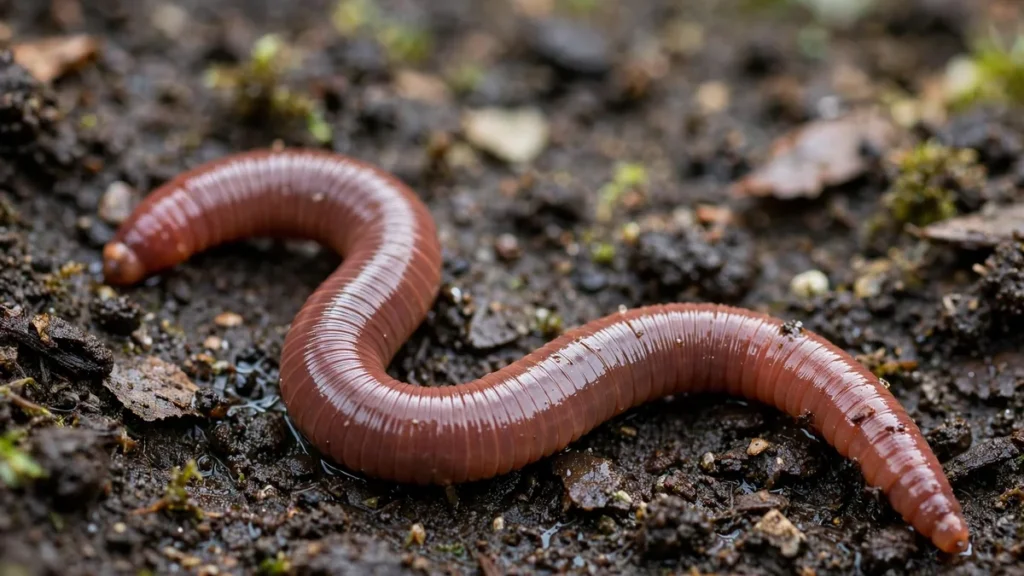
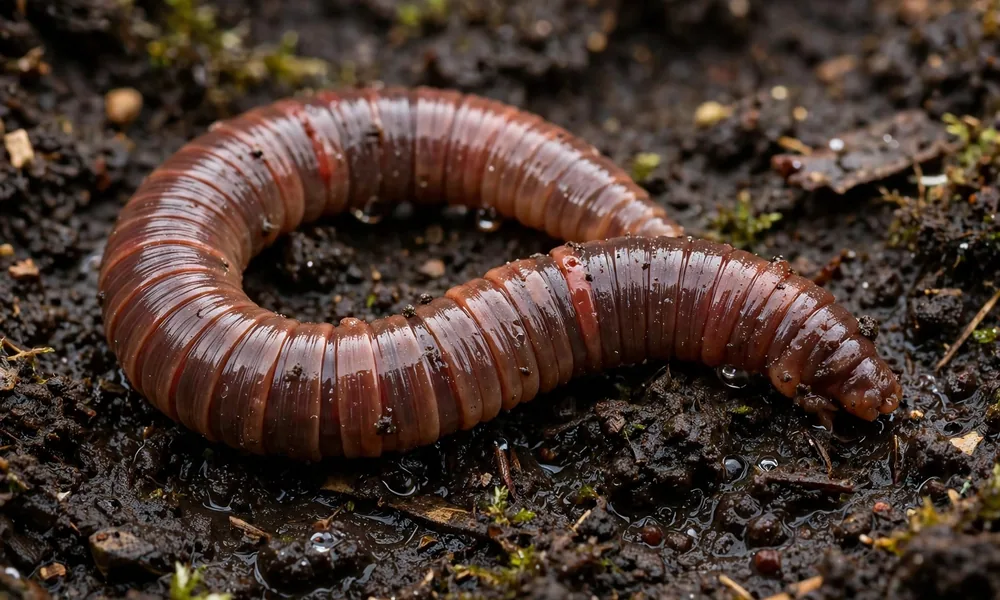
An earthworm looks like a long, soft tube divided into rings, and the rings are the whole story of its body. The body is made up of ring-like segments called annuli, each one a short, muscular ring, joined so the worm can stretch and contract like a concertina, doubling its length when it is relaxed and pulling itself short when it is disturbed. The colour of the common earthworm is pinkish to reddish-brown above and yellowish or pale below, and the front end is darker and slightly pointed, while the tail end is paler and flatter. There are no eyes, no legs, no antennae, and no hard parts at all, and the only features on the outside are the tiny bristles called setae that grip the soil, and the clitellum, the smooth band near the front third of the body that marks an adult worm.
The size of an earthworm depends on the species, and the difference across the group is enormous. A common earthworm is typically 11 to 20 centimetres long when extended, and about 7 to 10 millimetres across, and the largest individuals reach 35 centimetres, about 14 inches, and weigh up to about 11 grammes. The giant Gippsland earthworm is typically about 1 metre long and 2 centimetres across, with 300 to 500 segments, and the average adult weighs about 200 grammes, which makes it roughly twenty times the weight of a common earthworm. At the other end of the scale, the small compost worms are only a few centimetres long. The young look like small, pale copies of the adults, with fewer segments and no clitellum, and a newly hatched earthworm is only a few millimetres long.
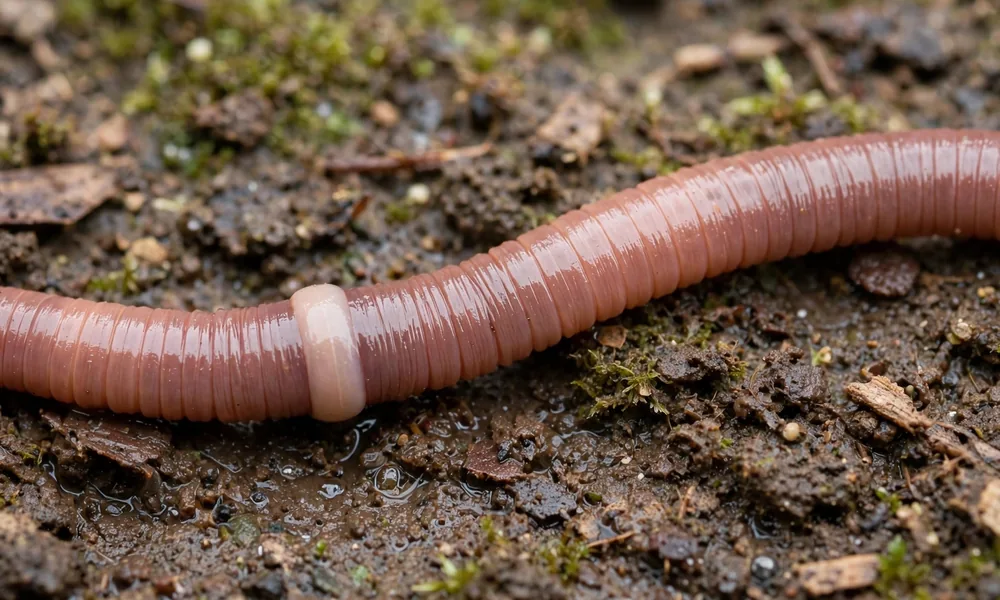
The inside of an earthworm is as simple and as well made as the outside. There are no lungs, and the worm breathes through its moist skin, taking in oxygen from the air in the soil, which is why an earthworm must stay damp. There are no teeth, and the food is ground up in a muscular gizzard, with the help of small stones the worm has swallowed. The worm has five pairs of aortic arches, often called its five hearts, which pump blood around its body, and the blood is red, because it carries haemoglobin, just as human blood does. The worm senses light, touch and vibration through its skin, though it cannot hear and it cannot see.
It is easy to overlook an earthworm, and that is the point of its design. The long body slips through the soil, the bristles grip the burrow walls, and the moist skin lets it breathe without ever coming up for air. The clitellum is the one part that advertises itself, a pale band that appears when the worm is old enough to breed. The colour is camouflage of the quietest kind, the pinkish brown of damp soil and dead leaves, and an earthworm on the surface at night is almost invisible until it moves, which is what it needs, because the surface is where the birds and the toads wait.
Where earthworms live
Earthworms live in the soil, and they are found in almost every soil on Earth that is moist, rich in organic matter, and not too acid and not too cold. The common earthworm is native to Western Europe, and it is now widespread across North America and western Asia, carried there in soil and plant pots, and it lives in gardens, fields, woodland and parks, wherever the soil is deep enough to burrow in and the surface is covered in leaves. They are absent from very sandy soils, from bare rock, and from acid peat, and cold limits them, because the common earthworm is not frost tolerant, spending winter deep in the soil, below the frost line. A single garden can hold thousands of them, most of them never seen, working the soil day and night.
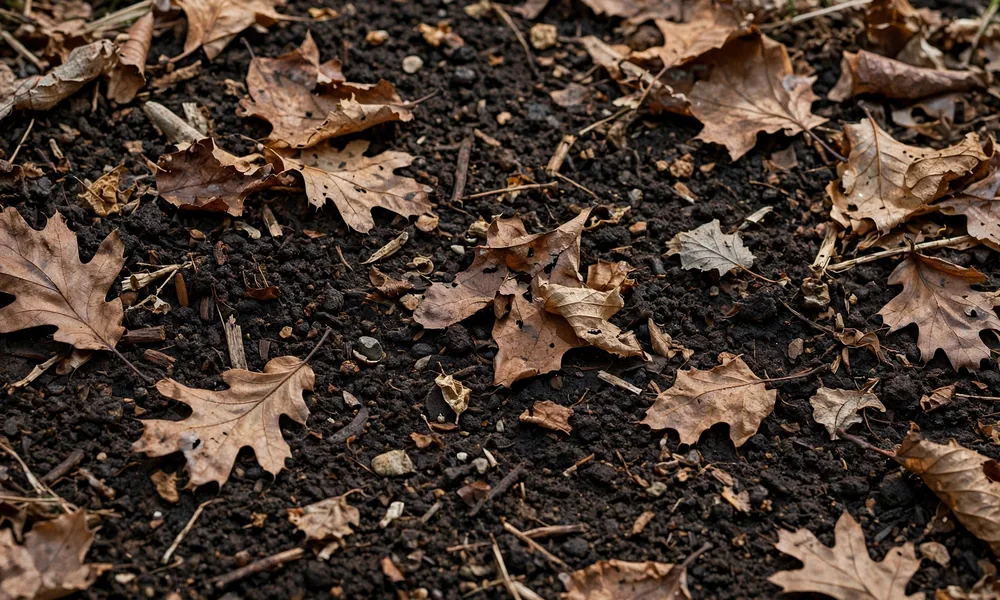
The habitat the common earthworm chooses is a deep, permanent vertical burrow, and it is the burrow that defines its whole life. The worm digs down as deep as 2 metres, about 6.5 feet, lining the walls with its castings, and it lives there for months or years, leaving only at night to feed, always keeping its tail anchored in the burrow mouth so it can pull itself back in an instant. The worm drags fallen leaves down into the burrow, plugging the entrance with leaf stalks, and feeds on them as they soften and rot. Other earthworms live differently: the red earthworm lives in the leaf litter, the grey worm in shallow burrows in the topsoil, and the giant Gippsland earthworm lives in deep clay tunnels that can span several hundred metres.
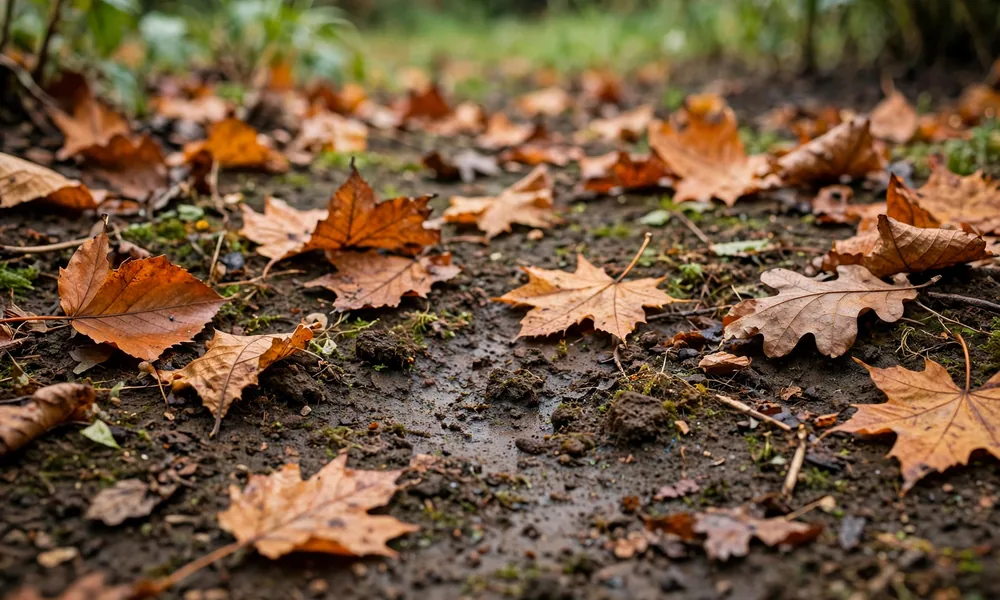
The range of each species is a story of soil and history. The common earthworm is a European animal that has become a world traveller, and in North America it is an introduced species, spread through gardens and farmland across the continent. In the northern hardwood forests of North America, where no native earthworms survived the last ice age, the introduced worms are changing the forest floor, eating the thick leaf litter that native plants and animals depend on, so the gardener’s friend in a field can be a problem in a forest that never had worms. The giant Gippsland earthworm is the opposite story, an animal found nowhere else on Earth, confined to about 40,000 hectares of South Gippsland, in moist clay soils near creeks and under grassland.
What earthworms eat
Earthworms are detritivores, which means they eat dead things: the dead leaves and decaying organic matter of the soil. The common earthworm feeds mainly on dead leaves from the soil surface, which it drags down into its burrow, and on the soil of the upper layers, from which it extracts the nutrients in the decaying matter. It prefers fresh litter, pulling a leaf down by its stalk and leaving it to soften in the burrow before eating it, feeding on the fungi and bacteria that grow on the leaf as much as on the leaf itself. An earthworm can eat up to a third of its body weight in a day, and its waste, the castings, is rich in nutrients, carrying them from deep in the soil back to the surface.
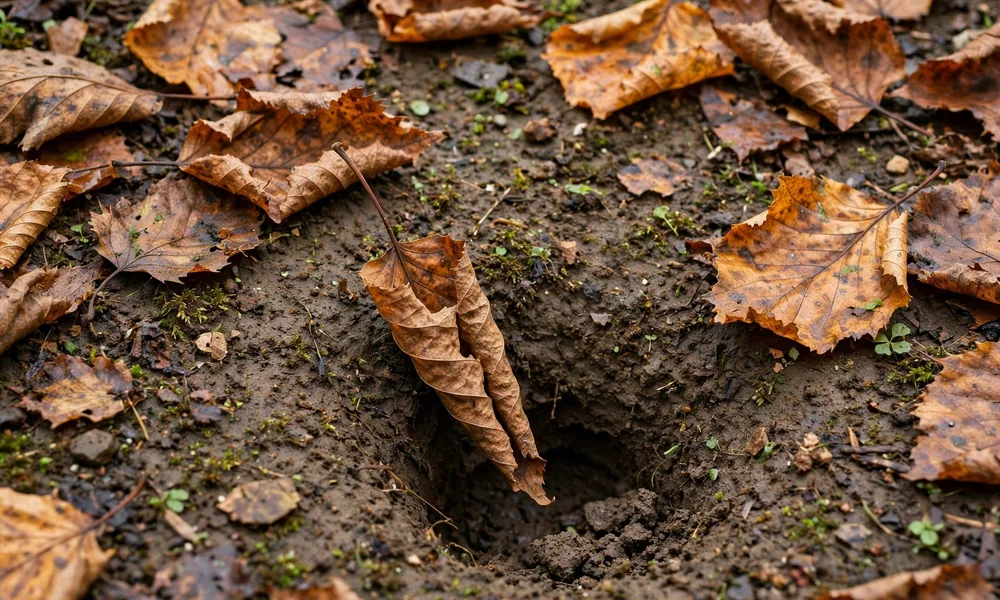
How an earthworm eats is as simple as what it eats. The worm has no teeth, and it swallows soil and leaf fragments whole, grinding them in its muscular gizzard with the help of small stones, and the ground-up food passes through a long gut where the nutrients are absorbed. As the worm burrows it consumes soil, extracting the nutrients from the decomposing matter, and the rest is passed out as castings, the small, dark piles that appear on lawns after rain. Feeding is also digging, and every mouthful is a mouthful moved, which is how earthworms can turn over the whole topsoil of a garden in a few years, mixing leaf litter down and minerals up.
How earthworms behave
Earthworms are night animals, and their behaviour is ruled by light, by damp and by the need to stay out of sight. The common earthworm is called the nightcrawler because it feeds above ground at night, burrowing during the day and coming up only when it is dark and the soil is damp. It is sensitive to light, and it will retreat into its burrow at the first touch of a torch beam, and it is sensitive to vibration, which is why a bird stamping on the lawn can bring worms to the surface. They do not form groups, and each worm lives in its own burrow, though a good patch of soil can hold many burrows close together, and the worms meet only when they mate.
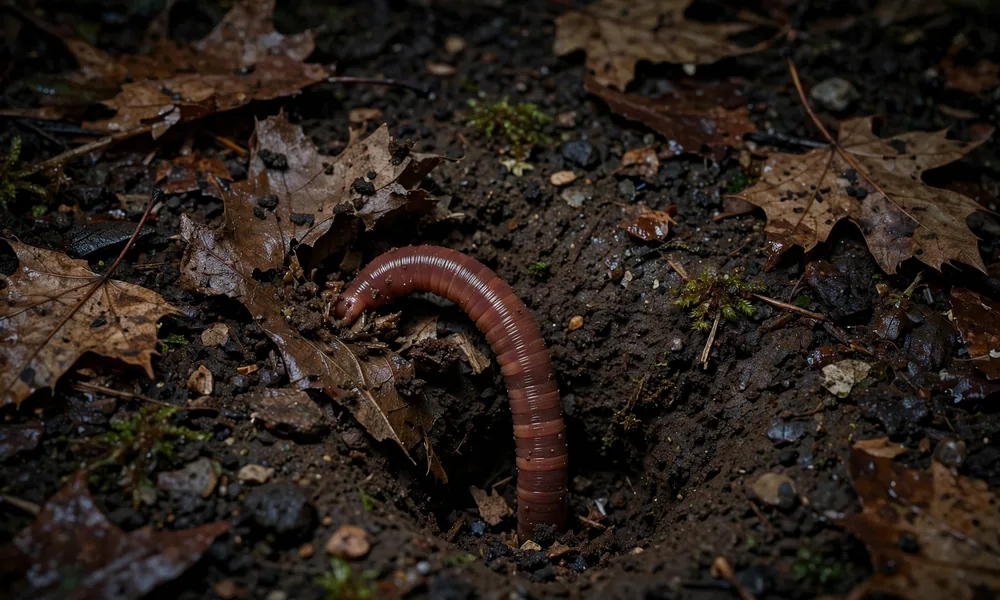
The most remarkable behaviour in an earthworm is the way it moves, and it is a small masterpiece of soft engineering. The worm moves by stretching and contracting its segments, anchoring itself with the tiny bristles called setae, and pulling itself forward in a wave that runs along its body. The setae grip the burrow walls, the muscles push the front forward, and the back is drawn up behind it, slow and steady, without any legs at all. It can also anchor its tail in the burrow mouth while it stretches out to feed, so it can snap back underground in an instant if a bird comes near. The movement looks simple, but it lets the worm push through soil that would stop almost any other animal of its size.
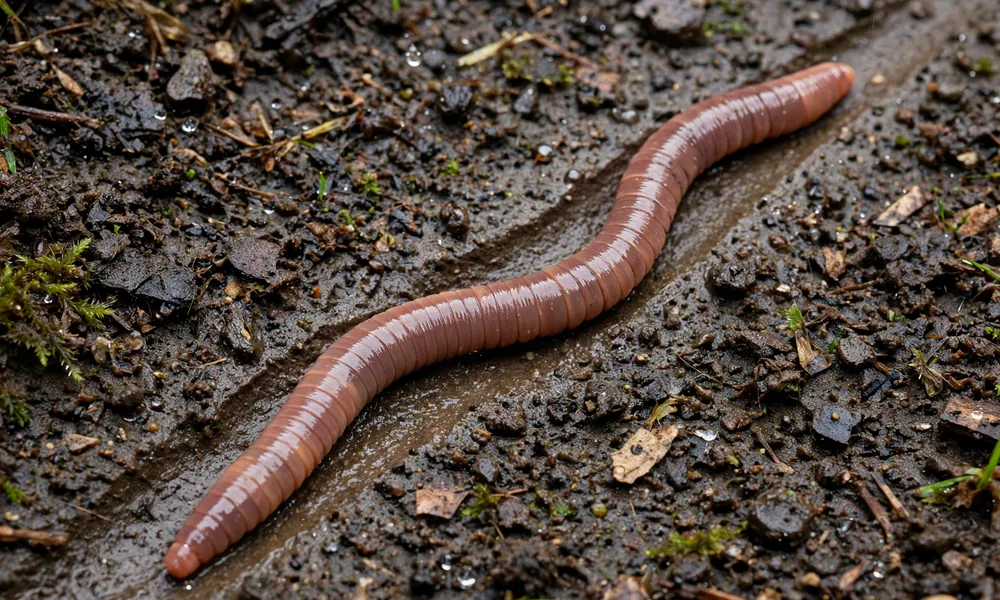
Earthworms are a source of food for many animals, and their behaviour on the surface is a constant balance between feeding and being eaten. Birds, rats, toads, moles, hedgehogs and beetles all eat earthworms, and the centipede that hunts in the leaf litter is another of the soil’s predators, as our centipede guide shows. A worm on the surface is easy prey, and its only defences are speed, darkness and the burrow, and it will pull itself down at the first sign of danger, sometimes so fast that a bird is left with only a beakful of tail. Worms often appear on the surface after heavy rain, but the common earthworm can survive in oxygenated water for weeks, so the rain brings them up for the damp and the easy feeding, and the risk is the price of a good meal.
Breeding and life cycle
Earthworms breed in the damper parts of the year, mainly in spring and early summer, and the common earthworm mates on the soil surface at night. Every earthworm is a hermaphrodite, which means it has both male and female reproductive organs, but it cannot fertilise itself, and it must mate with another worm. Two worms meet on the surface, lying head to tail, and they exchange sperm, and they do it while staying anchored in their own burrows, so that each of them can pull itself back underground if danger comes. Mating is frequent, roughly every 7 to 11 days in the breeding season, and the worms tend to seek out the largest mate available, because a larger mate can produce more young.
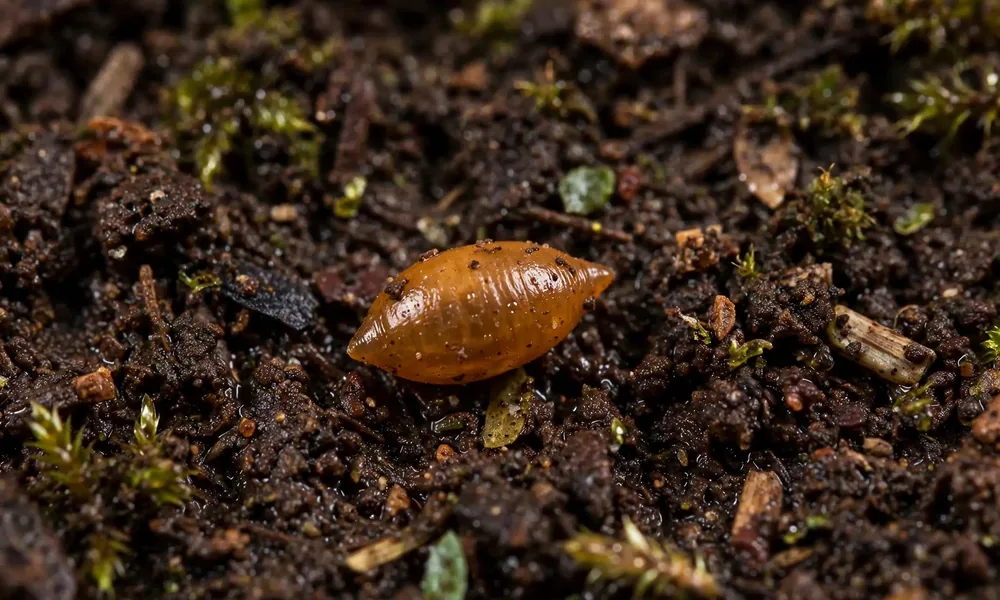
After mating, each worm forms a tiny, lemon-shaped cocoon from a liquid secreted by its clitellum, the swollen band near the front third of the body, and the sperm and the eggs are deposited inside the cocoon, which is then buried in a small chamber in the soil beside the parent’s burrow. Sperm can be stored for as long as 8 months, and a mated worm can go on producing cocoons for up to a year afterwards, with fertilisation taking place inside the cocoon. After two to four weeks the young worms emerge and begin to feed in the soil at once, though they do not yet dig the deep vertical burrows of the adults. A worm lays only a few cocoons in a year, and each holds one or a few young, so a population grows slowly, and a garden full of worms is the work of years.
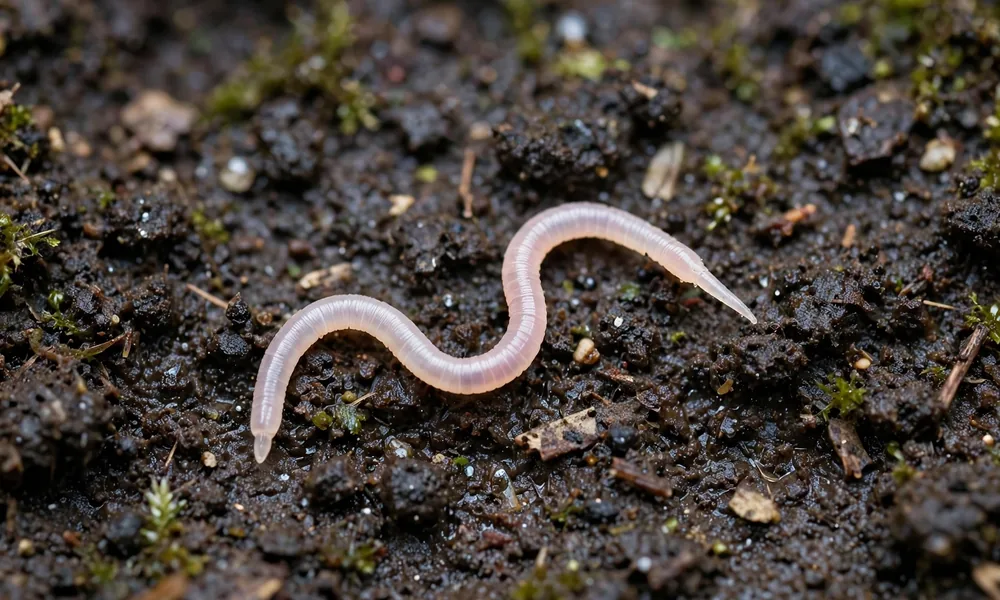
A common earthworm that survives its first year has a good chance of a long life. It takes about a year to reach adulthood, and reproductive maturity is reached in its second year, when the clitellum appears. The natural lifespan in the wild is unknown, though individuals have lived for six years in captivity, and in a garden without pesticides and without too much digging, a worm can live for several years, digging the same burrow and feeding in the same patch of soil. The young are independent from the day they hatch, and they must survive the birds and the beetles and the dry spells of their first summer, and the ones that do will spend the rest of their lives in the soil, turning leaves into castings and keeping the ground alive.
Conservation status
The conservation status of the common earthworm is, on paper, a blank. Lumbricus terrestris has not been evaluated by the International Union for Conservation of Nature, and its population trend is unknown, because the animal is so common and so widespread that nobody has tried to count it. That is not the same as saying it is safe, and the worm is thought to be declining in places, blamed on the way we farm and garden, not on any single disaster. The giant Gippsland earthworm is the exception in the family, and it is listed as Endangered by the International Union for Conservation of Nature, because it lives in only one small area and that area is being broken up by farming and building.
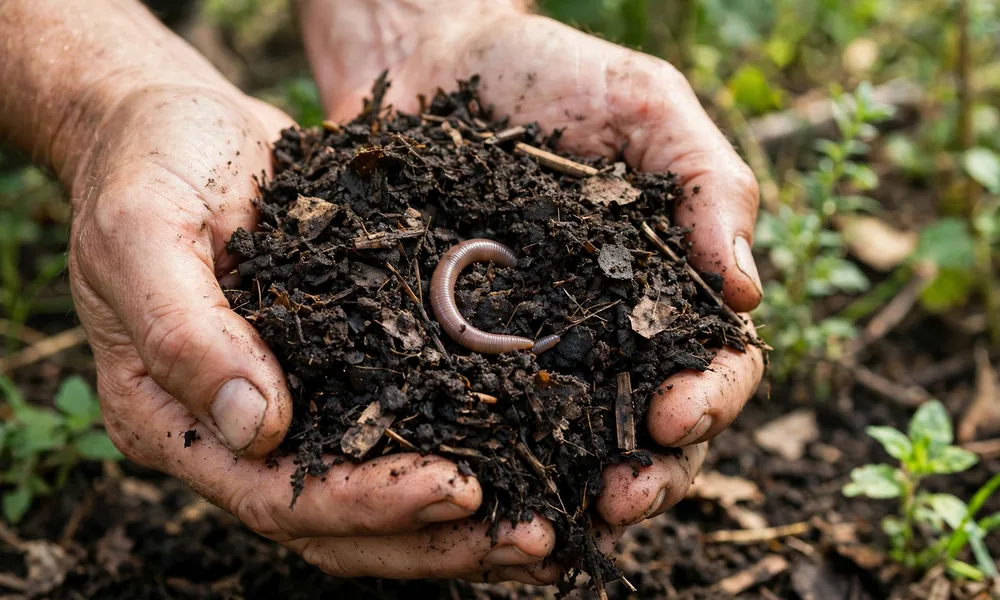
The main pressure on earthworms is the way we treat the soil. Pesticides kill worms directly, and ploughing and heavy machinery compact the soil and destroy burrows that take a worm months to dig. Cleared gardens and bare fields take away the leaf litter the worms depend on, and plastic pollution and drying soils in hot summers make the ground harder to live in. Invasive flatworms are a newer threat, and the New Zealand flatworm and the Obama flatworm, both of them predators that eat earthworms, are spreading through gardens in Europe and eating the worms they find. In North America, the story is reversed, and the introduced European earthworms are themselves the invaders, eating the leaf litter of forests that never had worms and changing the forest floor for the plants and animals that live there.
The answer is not a single fix, and it is the slow work of looking after the soil rather than the worm. Leaving leaf litter, avoiding pesticides, digging as little as possible, and keeping the soil damp and covered will all help the worms in a garden, and the soil too, because the worms keep it open, crumbly and full of nutrients. Charles Darwin calculated 53,767 earthworms per acre in the soil he studied, and his book on worms, published in 1881, was the first to show that a small, soft animal could change the land itself. The earthworm does not need a rescue, and it needs something quieter: soil that is left alone enough for it to do its work.
Best seasons for earthworm watching
The best time to look for earthworms is spring and autumn, when the soil is damp and the worms are at their most active. The worms are present in the soil all year round, but they are easiest to see in the mild, wet months, when they come to the surface at night to feed on fallen leaves, and after rain, when the ground is soft and the worms are moving. In spring, the worms are feeding hard after the winter, and in autumn the fallen leaves bring them to the surface in numbers, and a torch on a damp autumn night will show them stretched out on the lawn, half out of their burrows, dragging leaves down. The worms are at their busiest in April and May, before the dry summer slows them down.
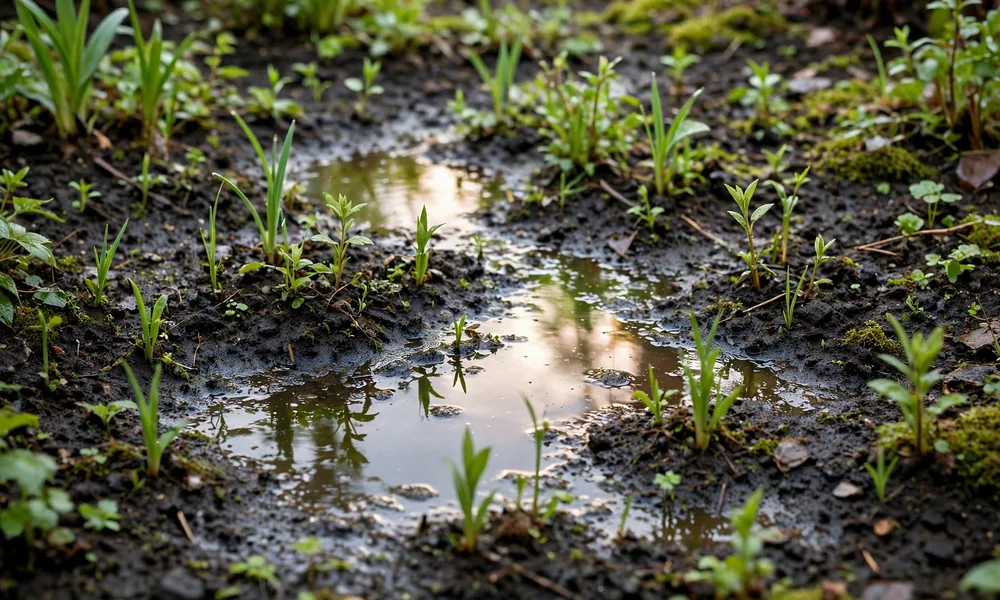
The best hours are the hours after dark, when the worms are out feeding, and the best conditions are damp and mild, after rain, with no frost and no bright light. In the heat of summer the worms go deep below the dry topsoil, and in the cold of winter they go deep below the frost line, waiting out the weather in the bottom of their burrows. Go out on a mild, damp night in spring or autumn, with a dim torch, and look for worms stretched out on the lawn, and for the small piles of castings that mark the burrow mouths by day. A garden with leaf litter, with no pesticides, and with soil that is left alone will have more worms than a garden that is dug and sprayed, and the worms are the sign that the soil is healthy.
Staying safe around earthworms
An earthworm is not dangerous to people, and there is no safety warning that belongs to the animal itself. It has no venom, it does not bite, and a worm that is picked up will simply wriggle and try to get back to the soil. The safety rule is a simple one, and it is about the soil, not the worm: wash your hands after handling earthworms or digging in the soil, because soil can carry bacteria, and keep the worms in the garden where they belong. Do not release worms bought as fishing bait or for composting into woodland or into the wild, because they may not be native there, and an introduced worm in a forest that never had worms can do real harm to the leaf litter and the plants that depend on it.
Earthworm watching checklist
A little preparation turns a damp night in the garden into a real chance of seeing earthworms at their best, out on the surface among the fallen leaves.
- Go out on a mild, damp night in spring or autumn, when the worms are at their most active and the soil is soft.
- Take a dim torch, and keep the beam low, because a bright light will send the worms back into their burrows.
- Look on the lawn and the path after rain, where the worms stretch out to feed on fallen leaves.
- Look for the small piles of castings that mark the mouths of the burrows by day, and for leaves plugged into the burrow entrances.
- Learn the shape before you watch, so you can tell a common earthworm from a red earthworm by its size and its colour.
- Leave the leaf litter on the ground, so the worms have food to drag down into their burrows.
- Respect the worms and the soil, washing your hands after handling them, and leaving every worm in the garden where you found it.
Frequently asked questions
How big do earthworms get?
A common earthworm is typically 11 to 20 centimetres long and about 7 to 10 millimetres across, with 120 to 170 segments, and the largest individuals reach 35 centimetres and weigh up to about 11 grammes. The giant Gippsland earthworm is far bigger, typically about 1 metre long and 2 centimetres across, with 300 to 500 segments, and the average adult weighs about 200 grammes, though reports of up to 3 metres are disputed, because a stretched worm can more than double its relaxed length.
How many earthworm species are there?
More than 6,000 earthworm species have been described worldwide, and roughly 3,000 to 3,500 of them are recognised as valid species, with new ones still being described as researchers sample soils that have never been studied. The common earthworm, Lumbricus terrestris, was the first earthworm species ever given a scientific name, described by Carl Linnaeus in 1758, and it is one of the most widespread earthworms in the world, native to Western Europe and now abundant in North America and western Asia.
What do earthworms eat?
Earthworms eat dead leaves and decaying organic matter, and the common earthworm feeds mainly on dead leaves from the soil surface, which it drags down into its burrow, and on the soil of the upper layers, from which it extracts the nutrients in the decaying matter. An earthworm can eat up to a third of its body weight in a day, and it has no teeth, grinding its food in a muscular gizzard with the help of small stones it has swallowed. The waste it leaves behind, the castings, is rich in nutrients and carries them from deep in the soil back to the surface.
Do earthworms have hearts?
Earthworms have five pairs of aortic arches, often called their five hearts, which pump blood around their bodies, and the blood is red, because it carries haemoglobin, just as human blood does. They have no lungs, and they breathe through their moist skin, which is why an earthworm must stay damp, and they have no eyes, sensing light and touch and vibration through their skin instead. They also have no teeth, and no hard parts at all in their bodies.
How long do earthworms live?
The natural lifespan of the common earthworm in the wild is unknown, though individuals have lived for six years in captivity. It takes about a year for a young worm to reach adulthood, and reproductive maturity is reached in its second year, when the clitellum appears and the worm can breed. In a garden without pesticides and without too much digging, a worm can live for several years, digging the same burrow and feeding in the same patch of soil.
How is this guide different from the dumbo octopus guide?
This guide covers the earthworm, a soft, segmented worm of the soil that lives in a deep burrow beneath gardens and fields, breathes through its moist skin, and eats dead leaves and decaying matter, while our dumbo octopus guide covers a finned deep-sea octopus that lives on the cold, dark seafloor between 1,000 and 7,000 metres down, swims by flapping a pair of ear-like fins, and swallows tiny crustaceans whole. One is a humble worm that builds the soil under your feet, and the other is a deep-sea octopus that has never seen the sun, and this guide stays with the earthworm itself for its whole length, following Lumbricus terrestris from its ringed segments and five hearts through its burrows, its leaf-litter diet, its night feeding and its cocoons to the unassessed status that leaves its soil as the thing most worth protecting.
Conclusion
The earthworm species are a reminder that an animal does not need to be big, or fast, or fierce to be unforgettable. A soft, blind worm with no legs and no lungs, that spends its life in the dark eating dead leaves, has done more for the land than almost any other animal, turning the soil over, mixing the nutrients down and up, and keeping the ground open and alive for the plants that grow in it.
If you go looking for one, go out on a damp night in spring or autumn, with a dim torch, and look for the worm stretched out on the lawn among the fallen leaves, half out of its burrow, dragging a leaf down into the dark. Find the animal that Darwin called one of the most important in the history of the world, and you will have met the earthworm, the quiet engineer of the soil, and one of the most useful animals on Earth. Look, and leave the leaf litter where it lies.