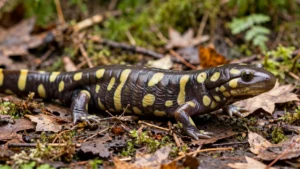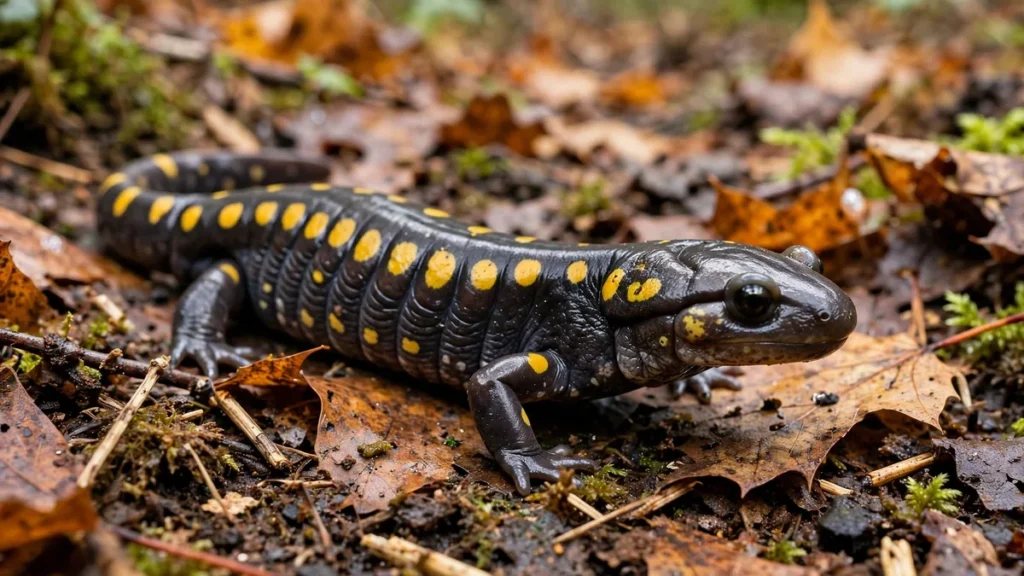
The spotted salamander species is a handsome black salamander with two rows of bright yellow spots that spends almost its whole life hidden underground in the forests of eastern North America. If you are asking what a spotted salamander is, the short answer is a mole salamander, Ambystoma maculatum, about 15 to 25 centimetres long and weighing about 12 to 24 grams, that lives in burrows and under logs in mature deciduous forest and emerges for a single night each spring, on the first warm rainy night, to breed in a fishless vernal pool. It is secretive, long-lived and rarely seen, yet it is one of the most remarkable amphibians in North America, because its eggs host a green alga inside the embryo itself, the only known case of a vertebrate carrying a photosynthetic partner in its own cells.
What makes the salamander so fascinating is the contrast between its hidden life and its one loud night a year. For eleven months it is a creature of darkness, hunting worms and slugs under the leaf litter and sleeping through the winter in a burrow, and a person can walk through a forest full of spotted salamanders and never see one. Then, on a rainy night in late winter or early spring, hundreds or even thousands of them emerge at once and walk to the same pool their parents used, following the same routes year after year, and the pool fills with courting salamanders and jelly egg masses that slowly turn green with algae. This guide follows the whole animal: how it looks, where it lives, what it eats, how it behaves, how it breeds, and why the vernal pools it needs are so easy to lose.
Key takeaways
- The spotted salamander species is Ambystoma maculatum, a mole salamander of the family Ambystomatidae, found in mature deciduous forests across eastern North America.
- Adults are about 15 to 25 centimetres long and weigh about 12 to 24 grams, with two rows of yellow or orange spots running from the head to the end of the tail.
- The salamander spends most of its life underground in burrows, emerging mainly at night to feed and for one mass breeding migration to a vernal pool each spring.
- Females lay about 100 to 200 eggs each year in jelly masses, and the eggs host the green alga Oophila amblystomatis, which supplies the embryos with oxygen.
- The species is listed as Least Concern by the International Union for Conservation of Nature, but it depends on intact forest and fishless vernal pools, and it is threatened by pool destruction, forest fragmentation and road deaths on rainy spring nights.
The spotted salamander species and their relatives
Spotted salamanders belong to the family Ambystomatidae, the mole salamanders, a family of stout, burrowing salamanders that occurs across North America, and the family sits in the order Urodela, alongside the newts, the lungless salamanders and the giant salamanders. The mole salamanders of the family Ambystomatidae range from about 90 millimetres to about 330 millimetres long, and they share the features that make a life underground possible: stout bodies, short strong limbs, broad rounded snouts for pushing through soil, and smooth, moist skin that has to stay damp. Within the family, the spotted salamander sits in the genus Ambystoma, a genus of about 30 species of mole salamanders that live from Canada to Mexico, and the genus as a whole ranges from about 90 millimetres to about 330 millimetres long.
The spotted salamander, Ambystoma maculatum, is the lead species of this guide, and it is the salamander that defines the whole mole-salamander group in most people’s minds, largely because it is the most widespread and the most strikingly marked of them all. It lives in mature deciduous forests across eastern North America, from Nova Scotia and the Gaspe Peninsula west to the northern shore of Lake Superior and south to southern Georgia and eastern Texas, and it grows to about 15 to 25 centimetres long, with females tending to be larger than males, and it weighs about 12 to 24 grams, with an average mass of about 12.84 grams. It is listed as Least Concern by the International Union for Conservation of Nature, and its skin carries poison glands, mostly on the back and the tail, which make it taste bitter to a predator that bites down. Like the axolotl, the spotted salamander is an amphibian of the genus Ambystoma that begins life as an aquatic larva with feathery gills, but the axolotl is a fully aquatic salamander that keeps its gills and never leaves the water, while the spotted salamander metamorphoses into a land animal that spends its adult life underground.
| Type | Animal | Where it lives | Best-known food | Length or Weight |
|---|---|---|---|---|
| Family | Mole salamanders (Ambystomatidae) | North America | Earthworms, slugs and insects | About 90 mm to 330 mm long |
| Genus | Mole salamanders (Ambystoma) | Canada to Mexico | Earthworms, slugs and insects | About 90 mm to 330 mm long |
| Species | Spotted salamander (Ambystoma maculatum) | Eastern North America | Earthworms, slugs and insects | Up to 250 mm long |
| Species | Tiger salamander (Ambystoma tigrinum) | North America | Worms, snails, slugs and insects | Up to 330 mm long |
| Species | Marbled salamander (Ambystoma opacum) | Eastern United States | Earthworms, slugs and insects | About 90 mm to 120 mm long |
| Species | Jefferson salamander (Ambystoma jeffersonianum) | Northeastern North America | Earthworms, slugs and insects | About 110 mm to 180 mm long |
The closest relatives of the spotted salamander are the other mole salamanders of the genus Ambystoma, and they sort themselves by size, by pattern and by the ponds they breed in. The tiger salamander, Ambystoma tigrinum, is one of the largest terrestrial salamanders in North America, usually growing to about 15 to 20 centimetres long, with the longest found reaching 33 centimetres, and it is dark grey, brown or black with brownish-yellow markings, and it lives for around 12 to 15 years. The marbled salamander, Ambystoma opacum, is a smaller cousin at about 9 to 12 centimetres long, black with white or silvery bands across its back, and it is unusual among mole salamanders because it breeds in autumn rather than spring, laying its eggs in dry pond basins that fill with rain. The Jefferson salamander, Ambystoma jeffersonianum, is a salamander of northeastern North America at about 11 to 18 centimetres long, dark grey or brown with small pale blue flecks on its sides, and it breeds in the same vernal pools as the spotted salamander, often on the same rainy nights.
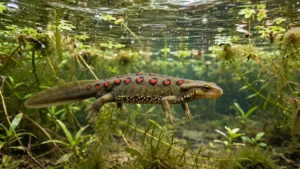
Within the genus, the spotted salamander is the one with the yellow spots, and the spots are the field mark that separates it from every other mole salamander at a glance. The tiger salamander wears yellow blotches and bars rather than neat rows of round spots, the marbled salamander wears white bands rather than yellow spots, and the Jefferson salamander wears only a dusting of pale blue flecks, so a black salamander with two neat rows of round yellow spots, running from the head to the end of the tail, is a spotted salamander. The spots vary from yellow to orange, and a few salamanders have no spots at all, though those are very rare, and the number of spots is usually between 24 and 45, with the spots on the head tending to be yellow and the spots on the tail tending to be orange.
What spotted salamanders look like
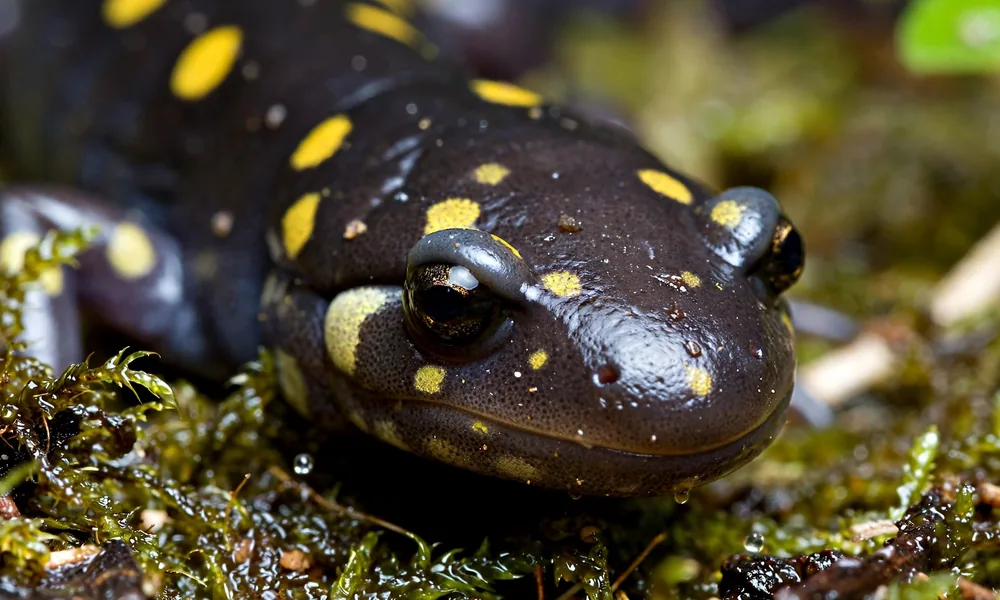
A spotted salamander looks like a small, stout lizard that has been painted black and yellow, though it is not a lizard at all. The body is thick and sturdy, with a broadly rounded snout, strong legs and a long tail, and the back is black, dark brown or dark grey, while the belly is a pale greyish blue. The sides of the head are often swollen at the back of the jaw, the legs are large and strong with four toes on the front feet and five on the hind feet, and the skin is smooth and slimy, with costal grooves running down the sides that help keep the skin moist. The spots are the animal’s signature: two parallel rows of round yellow or orange spots that run from the head to the end of the tail, bright against the dark back, and visible even in the dim light of a rainy night.
The size of a spotted salamander depends on the sex and on the place, and the range is wide for such a secretive animal. Adults are about 15 to 25 centimetres in total length, including the tail, and females tend to be larger than males, and the weight is about 12 to 24 grams, with an average of about 12.84 grams, which is less than a coin. The larvae hatch at only about 12 to 13 millimetres long, with feathery gills and only their front legs present, and they grow quickly in the pond, reaching about 49 to 60 millimetres by the time they metamorphose. A salamander that survives to adulthood is one of the larger salamanders in North America, and it is a sturdy, heavy-bodied animal that feels solid in the hand, though it should never be picked up without wet hands.
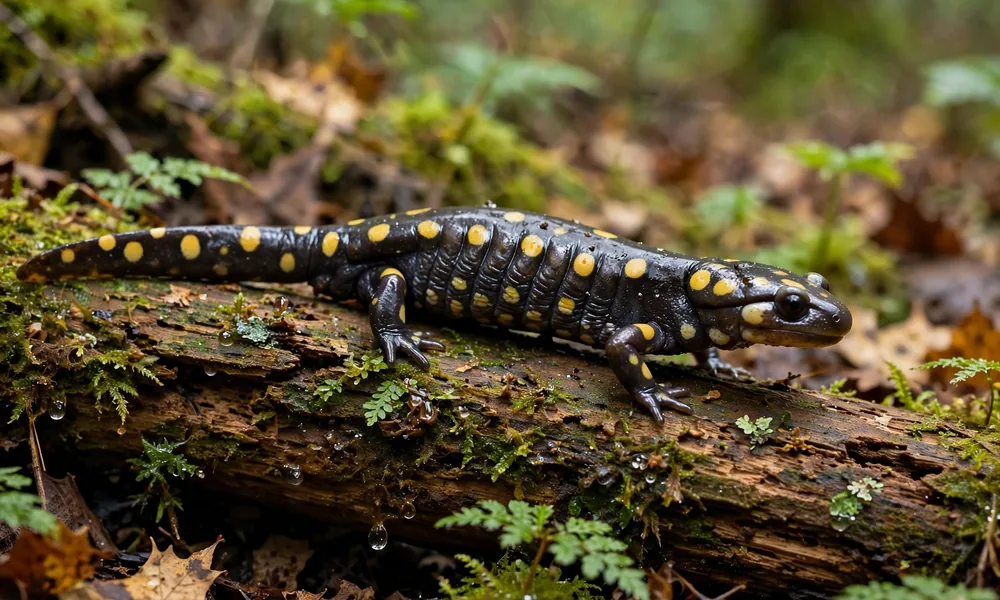
The bright spots are not decoration, and they are not an accident. They are a warning, a form of aposematism, and they tell any predator that looks twice that this animal is not worth eating. The skin carries poison glands, mostly on the back and the tail, and a predator that bites down gets a bitter, burning mouthful and drops the salamander, usually before the salamander is fatally injured. The spots also help the salamander hide, which sounds like a contradiction but is not: on a forest floor dappled with sunlight and fallen leaves, a black body broken up by yellow spots is harder to see than a plain black body, and a salamander that sits still in the leaf litter can disappear into the pattern of light and shade.
Where spotted salamanders live
Spotted salamanders live in the mature deciduous forests of eastern North America, and they are found nowhere else on Earth in the wild. Their range extends from Nova Scotia and the Gaspe Peninsula west to the northern shore of Lake Superior and south to southern Georgia and eastern Texas, though they are absent from most of southern New Jersey, the Prairie Peninsula in Illinois, eastern North Carolina and the Delmarva Peninsula. They live in forests, near ponds where they can lay their eggs, and they need mature forest with a deep leaf litter, fallen logs and damp soil, because a young forest without logs and litter is a forest without anywhere for a salamander to hide. They are not often seen, because they spend most of their time hiding in dead leaves, under logs or in tunnels underground.
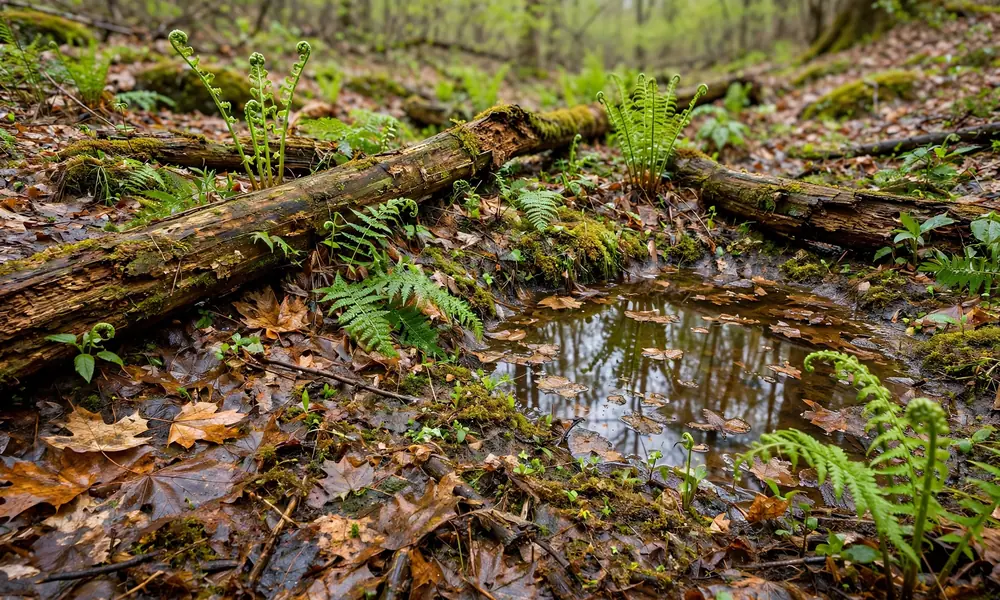
The habitat they choose is the forest floor and the soil beneath it, and they rarely climb or swim except to breed. An adult spotted salamander lives in a home range of only about 8 to 15 square metres, and it usually stays within about 100 metres of its breeding pond, rarely travelling more than 250 metres, so a salamander can spend its whole life in a patch of forest no bigger than a garden. They hide under logs, rocks and leaf litter, and they use the burrows of small mammals, and some individuals have been found as deep as 1.3 metres underground. They need to lay their eggs in freshwater ponds that do not have fish in them, and those ponds are often small pools that form when the snow melts in spring and dry up in autumn, which is exactly what a vernal pool is.
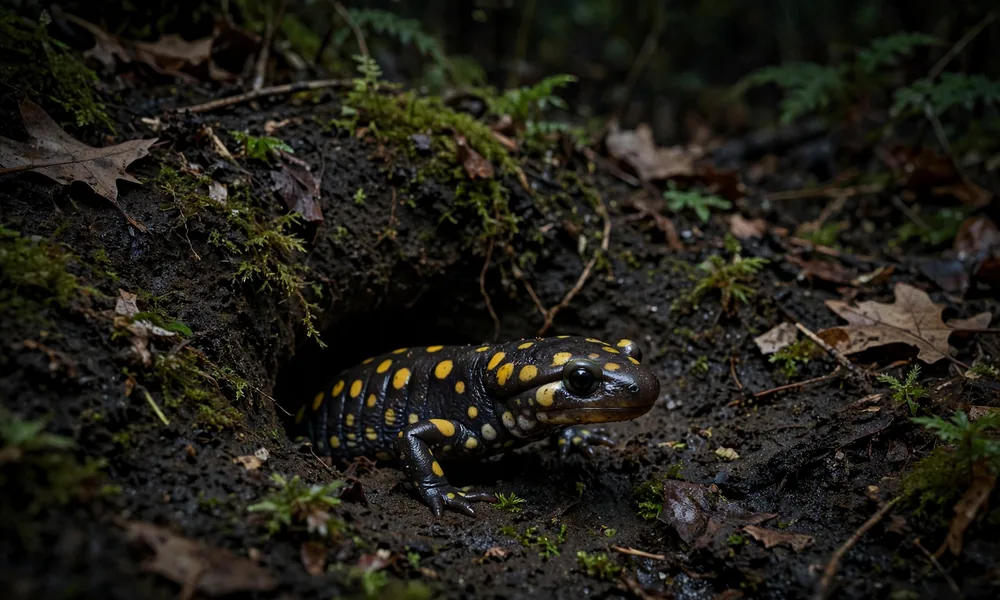
What spotted salamanders eat
Spotted salamanders are hunters, and their diet is written on the forest floor itself. The everyday food is earthworms, slugs, snails, spiders, millipedes and insects, and the adults use their sticky tongues and their quick jaws to capture whatever they can catch and swallow on the damp leaf litter at night. They eat almost anything they can catch and swallow, including slugs, insects, worms, snails, spiders and millipedes, and they hunt by smell and by sight in the dark, snapping at movement on the ground. They are nocturnal feeders, and they emerge from their burrows at night to forage, and they eat many small animals rather than a few large ones, because a salamander the length of a hand cannot swallow anything big. The larvae feed differently, eating small crustaceans and insect larvae in the pond, and some larvae eat other larvae, which is why a pond with too many larvae in it produces fewer adults.
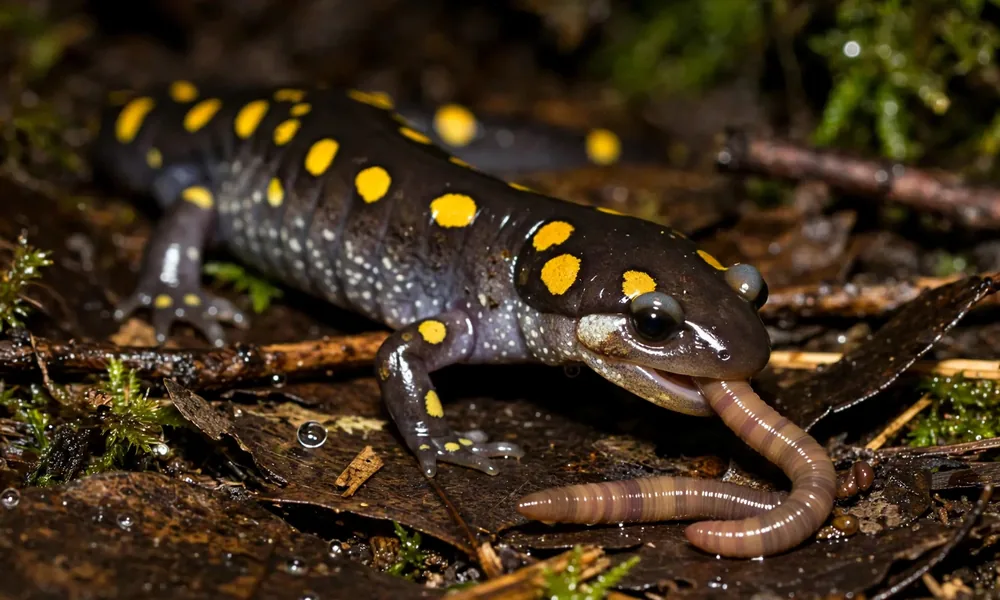
What the salamander eats changes as it grows, and the change is a complete one. The larvae are aquatic, and they feed on small crustaceans, insect larvae and other tiny animals in the pond water, and they grow quickly, reaching about 49 to 60 millimetres before they metamorphose. The adults, by contrast, eat only on land, and only at night, and a salamander that has climbed out of the pond never goes back to eat in the water again. The adults also help the forest in a quiet way: by eating slugs and insects they help control the small animals of the leaf litter, and by eating mosquito larvae in their ponds the larvae help control the mosquitoes that breed there.
How spotted salamanders behave
Spotted salamanders are night animals, and their year is split cleanly in two: hidden by day and by winter, active by night and in spring. They spend most of their lives underground, hiding beneath leaf litter and hibernating in burrows during the winter, and they emerge at night only to feed and to mate. They are solitary for most of the year, and they do not form groups or colonies, and each salamander keeps to its own small home range, though they can be aggressive to other spotted salamanders within that range. They are secretive creatures that spend most of the year below the surface, which allows them to escape high temperatures and dry air, and after heavy rains they can be seen walking on wet ground at night.
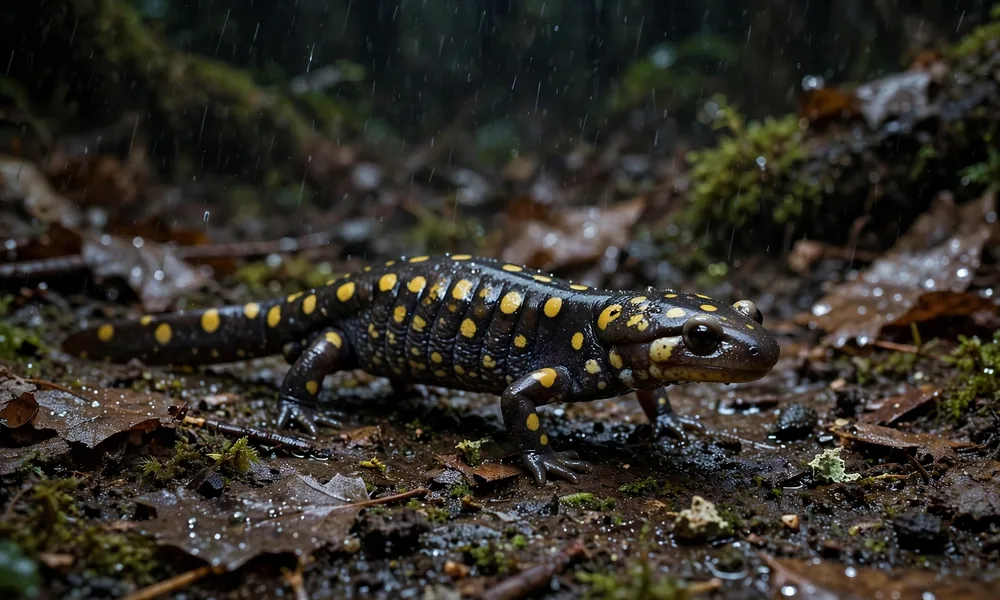
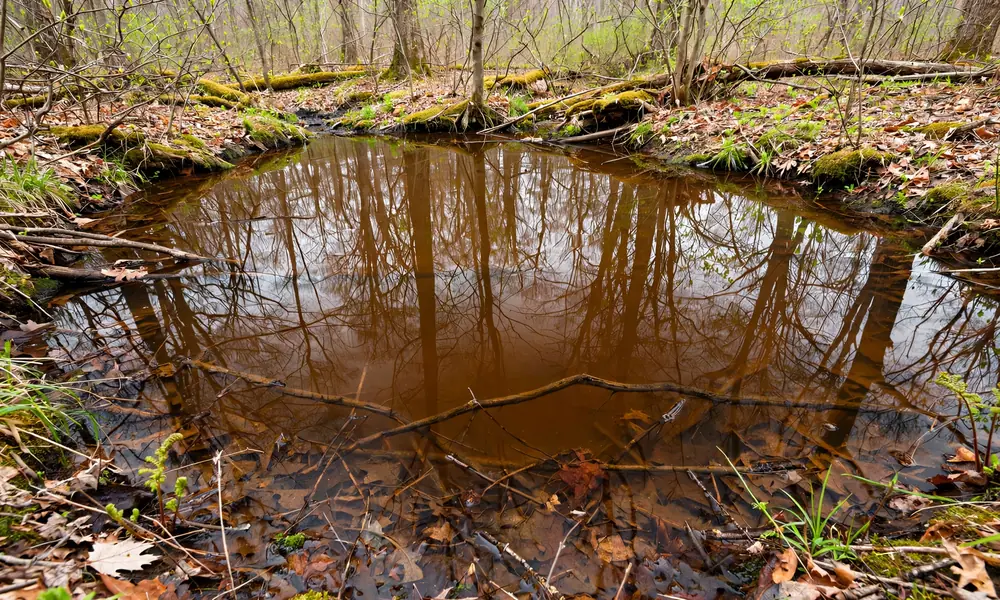
The most famous behaviour in the spotted salamander is the mass migration, and it is a sight that has made the species famous among naturalists. On the first warm rainy night of spring, often in March or April, hundreds or even thousands of salamanders emerge at once and walk to the same vernal pool, following the same routes year after year, using landmarks and chemical cues to find the pond in which they were originally laid. Males arrive at the pool first, and the females follow, and the pool fills with courting salamanders, and the migration is so predictable that volunteers in many states stand by on rainy spring nights to help the salamanders cross roads safely. The salamanders may not breed in consecutive years, and an individual has only about a 50 per cent chance of breeding more than once in its lifetime, which makes each migration a rare and precious event.
Breeding and life cycle
Spotted salamanders breed in the spring, in vernal pools, and the timing is set by the rain. The breeding season is typically March to April, triggered by warm, rainy nights, and the males arrive at the vernal ponds first, depositing spermatophores, small packets of sperm, on the pond bottom, and the females pick up the packets and fertilise their eggs internally. A female then attaches her eggs to submerged sticks or plants, laying compact egg masses that are covered in thick, clear or milky-white jelly, and each female lays about 100 to 200 eggs per year, in several separate masses, with reported averages of about 200 eggs per female per year. The egg masses are round, jelly-like clumps that are usually about 6.4 to 10.2 centimetres long, and they swell in the water into fist-sized masses that cling to the underwater plants.
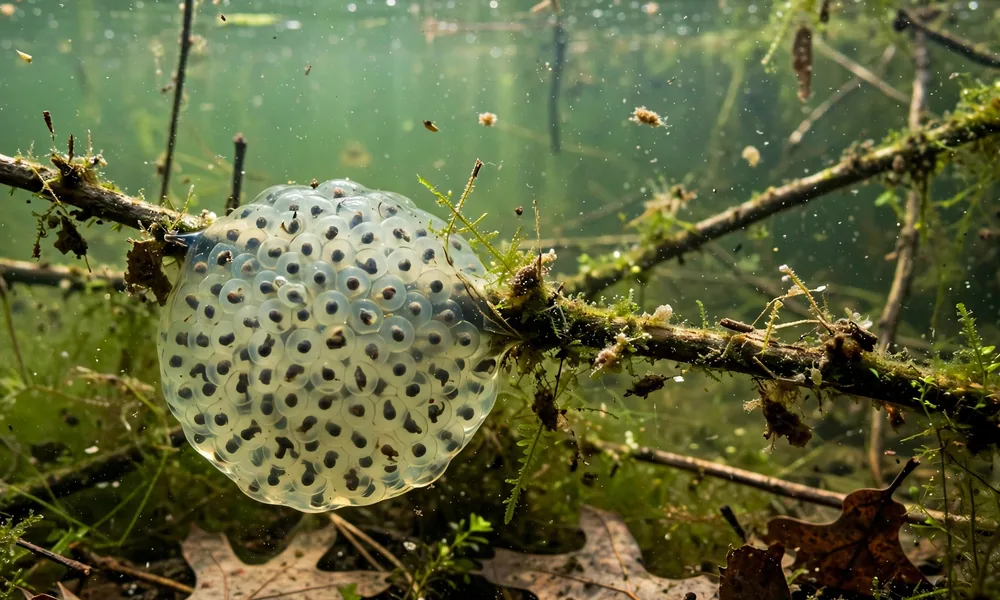
What makes the spotted salamander famous in biology is the alga that lives in its eggs. The eggs of the spotted salamander have a symbiotic relationship with the green alga Oophila amblystomatis, and the alga lives in and around the developing embryos, the only known example of a vertebrate hosting a photosynthetic partner inside its own cells. The jelly coating prevents the eggs from drying out, but it inhibits the diffusion of oxygen that the embryo needs to develop, and the alga photosynthesises and produces oxygen in the jelly, while the developing salamander metabolises the oxygen and produces carbon dioxide, which the alga then consumes. The egg masses often turn visibly green as they are colonised by the alga, and embryos raised with algae develop faster and survive better than those raised without, which is why the widely used herbicide atrazine, which kills the algae, has been found to lower hatching success.
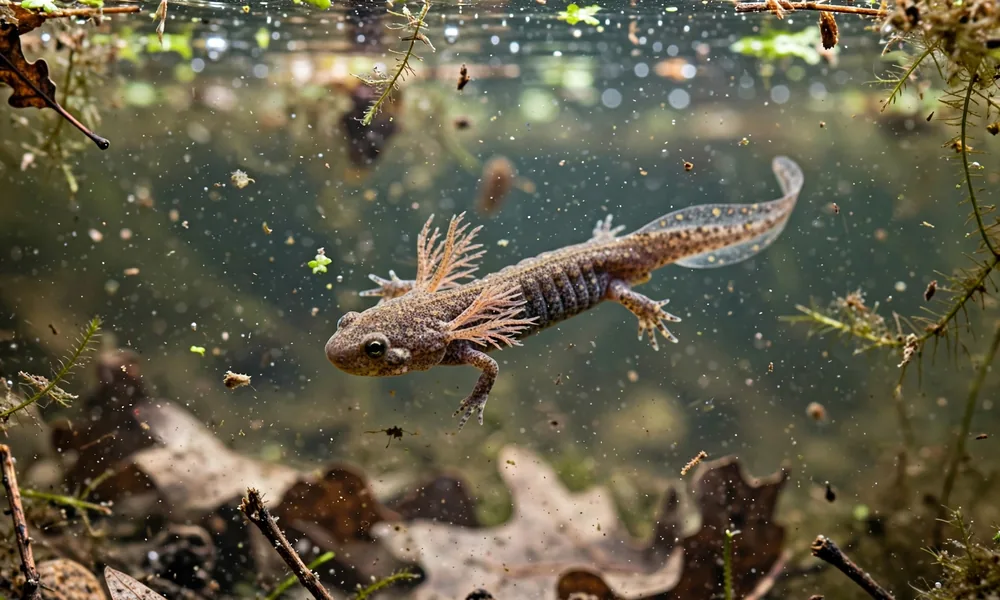
The larvae hatch about four to eight weeks after the adults have departed, and they are entirely aquatic creatures at first, with feathery gills for taking oxygen from the water, weak legs and a broad tail for swimming. They feed and grow in the water, and they transform within two to four months after hatching, metamorphosing into a juvenile form with lungs and strong legs, and the juveniles live on land, and after two to three years they mature into adults that can reproduce. Over 90 per cent of spotted salamander young perish due to predation, disease and drying ponds, and a larva that survives to adulthood has beaten long odds. In the wild the salamander lives typically 20 to 25 years, with some documented over 32 years, and a salamander that survives its first years underground has a good chance of seeing many breeding seasons.
Conservation status
The conservation status of the spotted salamander is, on paper, a good one. The species is listed as Least Concern by the International Union for Conservation of Nature, assessed in 2014 on the basis of its wide distribution, its presumed large population and the absence of evidence that it is declining fast enough to qualify for a more threatened category. It is a fairly common species overall, and it carries no special protection under the United States Endangered Species Act, and it is not listed under CITES, and it remains common in the intact forests of eastern North America. The listing is honest, and it is also incomplete, because a species can be common across a continent and still be losing ground in most of the places it lives.
The main pressure is the destruction of vernal pools. When a vernal pool is filled in for housing or for farming, or when a forest is cut into pieces by roads, the salamanders that bred in that pool have nowhere to go, and a salamander that lives within 100 metres of its pond cannot walk to a new one. The second pressure is road mortality, and it is a cruel one: on the first warm rainy night of spring, hundreds of salamanders cross roads to reach their pools, and many are killed by cars, and a single night of traffic can wipe out a generation. The third pressure is acid rain, which lowers the pH of breeding pools and kills developing eggs, and the fourth is the herbicide atrazine, which kills the algae the eggs depend on for oxygen.
Best seasons for spotted salamander watching
The best time to look for spotted salamanders is the spring migration, on the first warm rainy night, when hundreds of them emerge at once and walk to the vernal pools to breed, though no season will show you one from a garden. The salamanders are present in the forest all year round, so there is no wrong season in the strict sense, but the migration nights, from about March to April, are the time when the forest floor is wettest and the salamanders are most active, and a visit on a rainy night in early spring will show you males and females walking to the pools together. In the summer the salamanders retreat underground, into burrows and under logs, and they are harder to find.
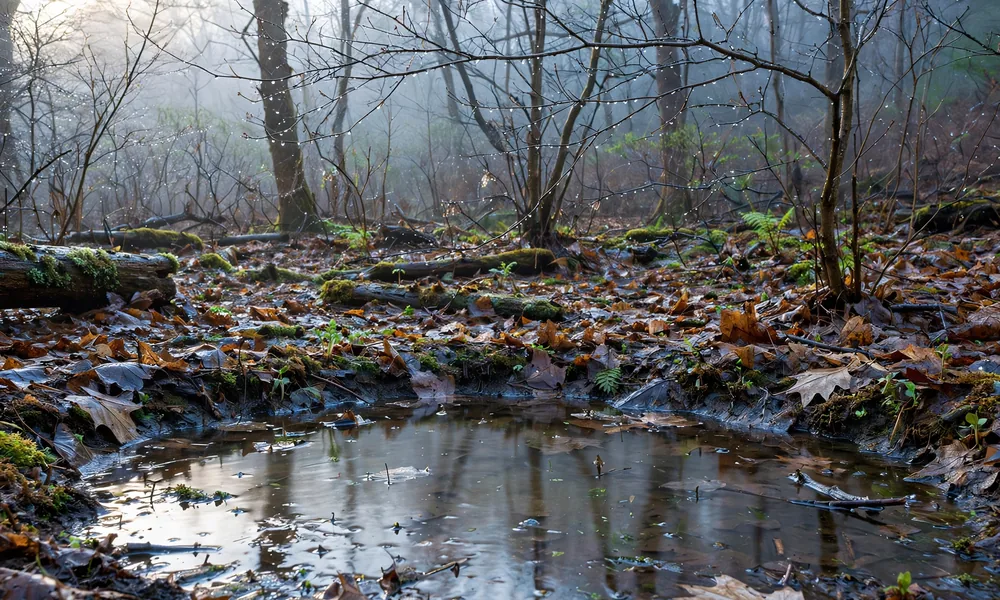
The best hours are the first hours after dark on a rainy night, when the salamanders are out walking to the pools and the air is still damp from the rain. From about dusk until midnight, the salamanders are at their most active, walking, courting and laying eggs, and they are at their most visible then, crossing paths and roads where a careful observer with a torch can see the yellow spots shine back. The salamander’s fame is such that National Geographic keeps a live profile of the spotted salamander, and a guided walk with a local naturalist, on a rainy night in early spring, is the best way to see one in the wild.
Staying safe around spotted salamanders
A spotted salamander is not dangerous to people who leave it alone, and there is no safety warning that belongs to the salamander itself beyond the obvious one: do not touch it, and do not eat it. The skin of a salamander carries poison glands, mostly on the back and the tail, and the toxin is bitter and irritating if it gets into a cut, into the eyes or into the mouth, which is why researchers handle salamanders with wet hands, wear gloves where the work requires it, and wash their hands afterwards. A salamander will not chase or threaten a person, and it will not bite, because it lives underground and it will never meet a swimmer in the way a pond frog might. The real safety concern is the road itself: never stand in a road on a rainy night to watch salamanders, and always watch from the verge, with a torch and a high-visibility jacket, and let the volunteers do the crossing.
Spotted salamander watching checklist
A little preparation turns a rainy night in a deciduous forest into a real chance of seeing a spotted salamander at its best, bright on the wet leaf litter.
- A guided walk with a local naturalist on a rainy night in early spring, when the salamanders are migrating to the vernal pools.
- An evening walk after dark, when the salamanders are out walking to the pools and their yellow spots shine back in a torch beam.
- Sturdy boots and long sleeves, so you can walk the slippery forest paths without slipping and without mosquito bites.
- A torch with a red filter or a gentle beam, so you can find the salamanders without blinding them.
- Binoculars and a camera that works in low light, so you can watch the vernal pool without crowding the salamanders.
- A field guide to the salamanders of eastern North America, so you can tell a spotted salamander from a Jefferson salamander.
- Respect for the salamanders and the forest, keeping your distance, keeping your hands off the salamanders, and leaving the forest as you found it.
Frequently asked questions
How big do spotted salamanders get?
Spotted salamanders measure about 15 to 25 centimetres from snout to tail, and a good salamander weighs only a few grams. A typical adult is about 15 to 25 centimetres long and weighs about 12 to 24 grams, with an average mass of about 12.84 grams, and females tend to be larger than males, so a spotted salamander fits comfortably in the palm of a hand, and most of them are shorter than a ruler. The larvae hatch at only about 12 to 13 millimetres long, and they grow to about 49 to 60 millimetres before they metamorphose into juveniles.
What do spotted salamanders eat?
A spotted salamander eats earthworms, slugs, snails, spiders, millipedes and insects, which it takes on the damp leaf litter at night with a sticky tongue and quick jaws. The everyday food is earthworms and slugs, and the salamander hunts by smell and by sight in the dark, snapping at whatever comes within reach. The larvae eat differently, feeding on small crustaceans and insect larvae in the pond water, and the adults never go back to eat in the water once they have climbed out of it.
Are spotted salamanders poisonous?
Yes, in the sense that the skin of a spotted salamander carries poison glands, mostly on the back and the tail, but no, in the sense that they will not attack you. A predator that bites down gets a bitter, burning mouthful and drops the salamander, which is why the yellow spots are a warning, and the toxin is dangerous only if it gets into a cut, into the eyes or into the mouth, so the sensible rule is to look, to photograph, and not to touch.
Where do spotted salamanders live?
Spotted salamanders live in the mature deciduous forests of eastern North America, from Nova Scotia and the Gaspe Peninsula west to the northern shore of Lake Superior and south to southern Georgia and eastern Texas. They live in forests, near ponds where they can lay their eggs, and they need mature forest with a deep leaf litter, fallen logs and damp soil, because a young forest without logs and litter is a forest without anywhere for a salamander to hide. They spend most of their lives underground, in burrows and under logs, and they usually stay within about 100 metres of their breeding pond.
Can you keep a spotted salamander as a pet?
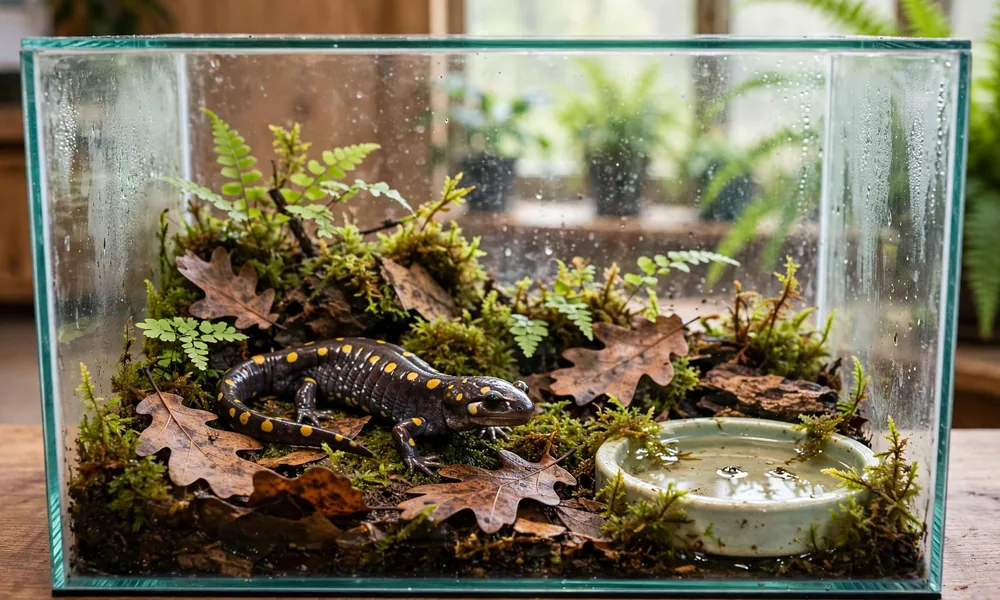
You can, but only a captive-bred one, and only with the right setup, and most people should think carefully before they try. Spotted salamanders are kept in captivity, where they need a cool, humid terrarium with deep soil to burrow in, damp leaf litter and a shallow dish of water, and a diet of small live insects and worms. They are nocturnal and secretive, so they are most active when their keeper is going to bed, and they are not a salamander for a beginner, and a salamander that escapes into the wild must never be released where it does not belong, because it could carry disease to the local salamanders.
How is this guide different from the red-eyed tree frog guide?
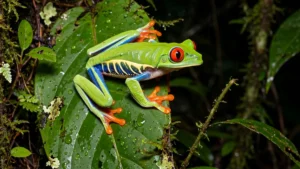
This guide covers the spotted salamander, a single species, Ambystoma maculatum, a black-and-yellow mole salamander of eastern North America that spends most of its life underground and emerges for one rainy night each spring to breed in a vernal pool, while our red-eyed tree frog guide covers a single species too, Agalychnis callidryas, a green nocturnal tree frog of Central American rainforests that sleeps on leaves by day, hunts insects by night and lays its eggs on leaves above ponds. One is a salamander you meet on the wet forest floor in the dark of a spring night; the other is a frog you meet on a leaf in the damp canopy, with red eyes shining back in your torch beam.
Conclusion
The spotted salamander species is a reminder that an animal does not need to be seen to be unforgettable. Black skin, two neat rows of yellow spots, a life underground in the damp soil of a deciduous forest, a single rainy night each spring when hundreds of salamanders walk to the same pool, and eggs that host a green alga inside the embryo itself have made the spotted salamander one of the most remarkable amphibians in North America, at home in the mature forests from Nova Scotia to Texas.
If you go looking for one, go on a guided walk on a rainy night in early spring, go after dark, and walk slowly through the forest with your eyes on the wet leaf litter beside the vernal pools. Find the pool with no fish in it, watch for a black shape with yellow spots crossing the path, and wait for the salamander to move, and you will have met the spotted salamander that turns a quiet stretch of forest into a place of sudden, bright excitement.