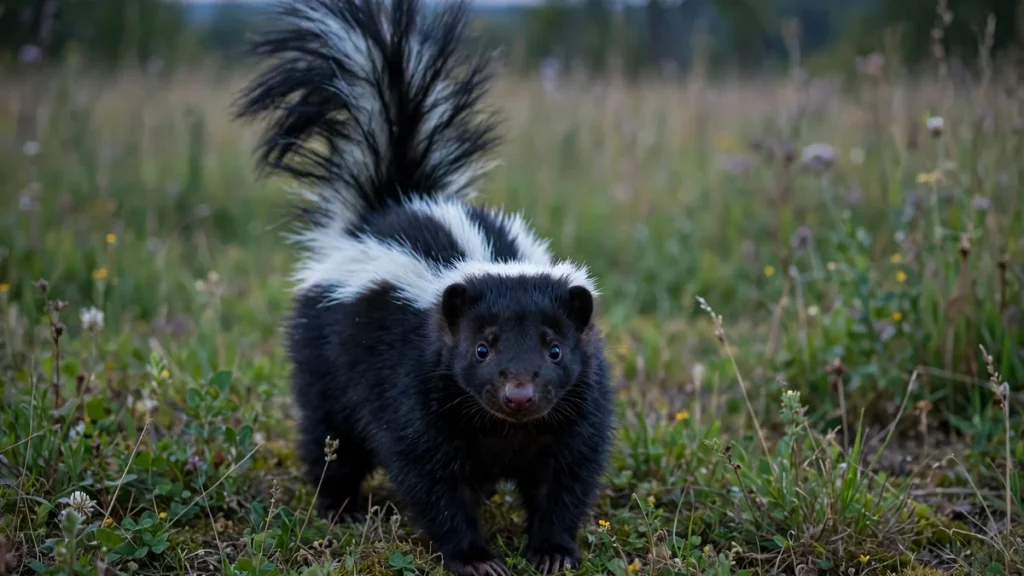
Skunk species are the black-and-white warning signs of the mammal world, and there are 12 skunk species in the family Mephitidae, from the striped skunk of North American gardens to the pygmy spotted skunk of Mexico. If you are wondering which skunk species exist and how these small animals defend themselves against animals many times their size, the short answer is this: skunks spray a foul-smelling musk from glands near the base of the tail, they warn an attacker first with foot-stomping, tail-raising and even handstands, and they are mainly nocturnal.
Key takeaways
- There are 12 skunk species in the family Mephitidae, living across the Americas and South-East Asia.
- Skunks spray a foul-smelling musk from anal glands, but they warn first with foot-stomping, tail-raising and handstands.
- The striped skunk is the best-known species, while spotted skunks are smaller and famous for their handstand warning.
- Hog-nosed skunks use a long, bare nose to root through soil for grubs and insects.
- Skunks are mainly nocturnal, and you are more likely to smell one than to see one.
What makes a skunk a skunk
A skunk is a small mammal built around one remarkable defence: a pair of glands near the base of the tail that can spray a foul-smelling musk with surprising accuracy. The spray is a yellowish oil that clings to fur, skin and clothing, and its smell can linger for days. It stings the eyes and makes the mouth water, which is why most predators learn to leave skunks alone after a single encounter.
Skunks advertise their defence with bold black-and-white markings. The white stripes, spots and patches stand out against dark fur and work as a warning signal that predators can see even in dim light, so a skunk rarely needs to use its spray. Most skunks are about the size of a house cat, with a pointed face, small ears, a bushy tail and strong claws for digging. They are omnivores, eating almost anything they can find.
The skunks of the world
The striped skunk is the skunk most people know, and the one most often seen in gardens, fields and woodland edges across North America, from Canada to Mexico. It is black with two white stripes running from its head along its back to its large bushy tail, although some are almost all white or almost all black. It weighs two to six kilogrammes, and it is the skunk most likely to wander into a garden at night in search of grubs or fallen fruit.
The hooded skunk lives in the south-western United States, Mexico and Central America, and it looks like a striped skunk wearing a longer, softer coat. Its fur is longer and fluffier, and it often has a single broad white stripe. It lives in rocky canyons, desert scrub and open woodland.

The spotted skunks are the smallest and liveliest members of the family. The western spotted skunk lives across the western United States and Mexico, the eastern spotted skunk lives in the central and eastern United States, the southern spotted skunk lives in Mexico and Central America, and the pygmy spotted skunk, the smallest of all, lives only in western Mexico. All four are black with broken white spots and stripes, and all four are famous for the handstand warning: when threatened, a spotted skunk rises onto its front paws and lifts its hind legs and tail into the air.
The hog-nosed skunks are the largest skunks, named for the long, bare, pig-like nose they use to root through soil. The American hog-nosed skunk lives across the southern United States and Mexico, the striped hog-nosed skunk lives in South America, Molina’s hog-nosed skunk lives in South America too, from Brazil and Bolivia to Argentina, and Humboldt’s hog-nosed skunk lives in southern South America. All four have a single broad white stripe and powerful front claws for digging.
Finally, the family includes two animals that are skunks by family but stink badgers by name. The Sunda stink badger lives in the forests of Borneo, Sumatra and Java, and the Palawan stink badger lives only on Palawan in the Philippines. They look more like badgers than skunks, with dark fur and a pale stripe, and they spray the same foul musk when threatened. They are honest members of the family Mephitidae, but they are stink badgers, not true skunks, and together with the eight species above they bring the family total to 12.
How skunks spray and warn
A skunk does not spray at once. When it feels threatened, it gives a series of warnings first: it raises its tail, stamps its front feet, hisses, and turns its back towards the threat. A spotted skunk goes further, rising into a handstand so its bright markings and raised tail are impossible to miss. Only if the warnings are ignored does the skunk spray, and it can hit a target several metres away.
The spray itself is made in two small glands beside the anus, and it is a mix of sulphur compounds that smell of rotten eggs, garlic and burnt rubber all at once. The smell is strong enough to be noticed from hundreds of metres away on a still night, and it clings to fur and fabric long after the skunk has gone. Dogs are the most frequent victims, because they rush in without reading the warnings, and few predators are willing to attack a skunk twice.
Where skunks live
Skunks live almost entirely in the Americas, from the forests of Canada to the grasslands of Argentina, with the two stink badgers as the only members of the family in Asia. They are adaptable animals, at home in woodland, grassland, desert scrub and farmland, and they are happy to live near people, under sheds and beneath garden decks. The nocturnal animals of the garden include the striped skunk, which often visits at night without ever being seen, and the urban animals of towns and suburbs include skunks that have learned to find food in bins and compost heaps.
Skunks do not dig their own burrows as often as people think. Many move into burrows dug by other animals, or into hollow logs, rock crevices and the spaces under buildings. They are not true hibernators, but in cold winters they sleep for long stretches in the den. In warmer regions they stay active all year.
Skunks and people
People have had a mixed relationship with skunks for centuries. Farmers value them because they eat grubs, mice and insects that damage crops. Yet skunks can also dig up lawns, raid bins and hen houses, and their spray is a misery for any dog that meets one. They can carry rabies in some regions, so a skunk seen wandering in daylight should be left alone and reported rather than approached. The best way to live alongside skunks is to remove the reasons they visit: keep pet food indoors at night, secure bins with tight lids, and block gaps under sheds and decks with wire mesh.
| Species | Where it lives | Best-known feature | Weight |
|---|---|---|---|
| Striped skunk | North America, Canada to Mexico | Two white stripes, bushy tail | 2 to 6 kilogrammes |
| Hooded skunk | South-western United States to Central America | Long fluffy fur, white hood | 1 to 4 kilogrammes |
| American hog-nosed skunk | Southern United States and Mexico | Long bare nose for rooting | 2 to 4 kilogrammes |
| Striped hog-nosed skunk | South America | Single broad white stripe | 2 to 5 kilogrammes |
| Western spotted skunk | Western United States and Mexico | Handstand warning pose | 0.5 to 1 kilogramme |
| Eastern spotted skunk | Central and eastern United States | Broken white spots and stripes | 0.5 to 1 kilogramme |
| Southern spotted skunk | Mexico and Central America | Small size, spotted coat | 0.5 to 1 kilogramme |
| Pygmy spotted skunk | Western Mexico only | Smallest skunk of all | 0.3 to 0.5 kilogrammes |
Best seasons for skunk watching
Spring and autumn are the finest seasons for skunk watching, when the nights are mild and skunks are out foraging for hours after dark. In spring, mothers lead their young out of the den at dusk. In autumn, skunks feed hard to build up fat for winter, and they visit gardens and woodland edges more often.
Summer is the easiest season to smell a skunk, because warm, still nights carry the musk for a long way. Winter is the quietest season, when skunks in cold regions sleep for days at a time.
Staying safe around skunks
Skunks are wild animals, and they deserve respect. Never try to approach, corner or handle a skunk, never block a burrow entrance, and never let a dog run up to one. Give a skunk a clear escape route, and it will almost always walk away without spraying. If you meet one on a path at night, stand still, speak softly, and let it move off on its own.
Skunk watching checklist
- Watch at dusk and after dark, when skunks leave the den to forage.
- Look for small cone-shaped holes in lawns where skunks have dug for grubs.
- Check dusty paths for five-toed tracks with claw marks.
- Use a red-filtered torch, which disturbs animals less than white light.
- Keep dogs on a lead near woodland edges, sheds and log piles after dark.
- Leave no trace: take your rubbish home and keep to marked paths.
Frequently asked questions
How many skunk species are there?
There are 12 skunk species in the family Mephitidae. The best-known eight are the striped, hooded, American hog-nosed, striped hog-nosed, western spotted, eastern spotted, southern spotted and pygmy spotted skunks. The other four are Molina’s and Humboldt’s hog-nosed skunks, both of South America, and the two stink badgers, the Sunda and Palawan stink badgers, which are stink badgers rather than true skunks.
How is this guide different from the nocturnal animals guide?
This guide covers only the 12 skunk species of the family Mephitidae. The nocturnal animals guide covers every animal that is active at night, from owls and bats to foxes and badgers.
Do all skunks spray?
Yes, all 12 species in the family Mephitidae can spray a foul-smelling musk from glands near the base of the tail, including the two stink badgers. They all warn first, with tail-raising, foot-stomping and hissing, and spotted skunks add a handstand. A skunk sprays only when the warnings are ignored.
What do skunks eat?
Skunks are omnivores and eat almost anything they can find: grubs, beetles, crickets, mice, eggs, fallen fruit, nuts, fungi and carrion. Hog-nosed skunks root through soil with their long bare noses to find insects and grubs, and striped skunks dig cone-shaped holes in lawns for beetle grubs.
Are skunks dangerous?
Skunks are not aggressive, and they would rather warn and walk away than spray or bite. The spray stings the eyes and smells terrible, but it is not poisonous. The real risk is rabies, which skunks can carry in some regions, so never approach a skunk that is out in daylight or unafraid of people, and report it instead.
Where is the best place to see a skunk?
The best place to see a skunk is a woodland edge, garden or farmland margin at dusk, where striped skunks come out to search for grubs and fallen fruit. Look for small cone-shaped holes in the lawn and five-toed tracks in soft ground, and keep your distance.
Conclusion
Skunk species, all 12 of them, are far more than their famous spray: striped skunks patrolling gardens at night, spotted skunks rising into handstands, hog-nosed skunks rooting through South American soil, and stink badgers in the forests of South-East Asia.
The next step is to go out at dusk — a garden edge, a woodland path, a quiet field margin — and look for the small cone-shaped holes and five-toed tracks that say a skunk has been there.














