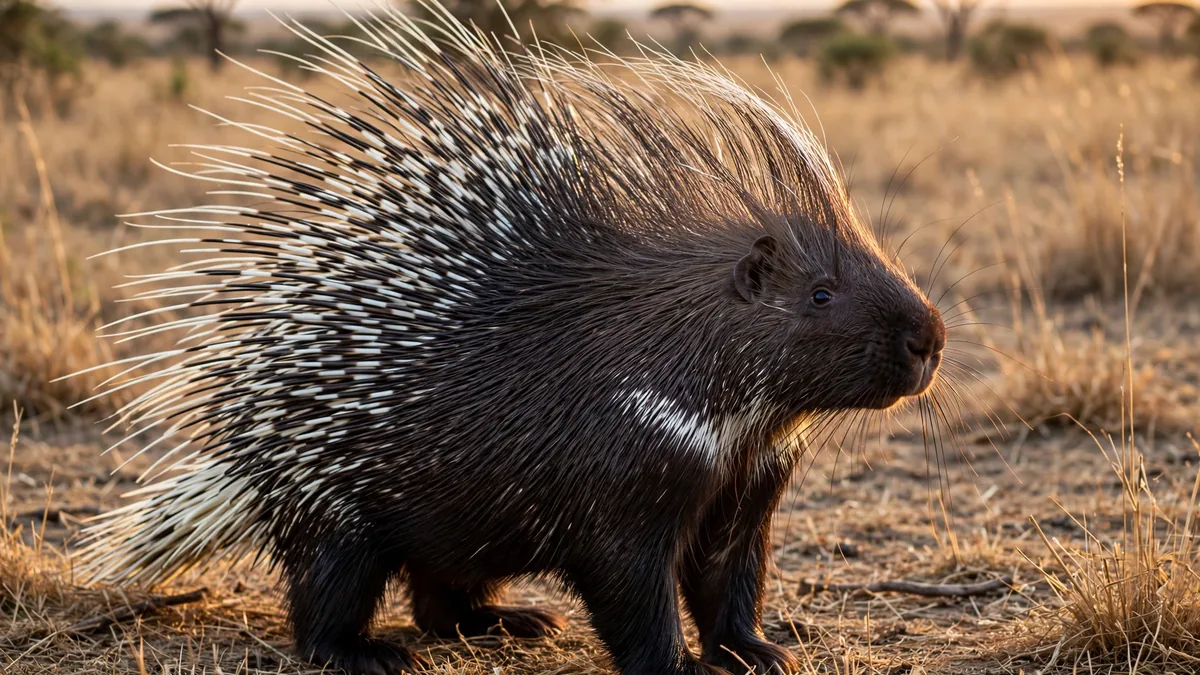
Porcupine species are the prickliest rodents on Earth, and there are about 29 porcupine species in two families, Old World porcupines and New World porcupines. If you are wondering which porcupine species exist and whether porcupines really shoot their quills, the short answer is this: they do not shoot quills at all, and the quills detach on contact when a predator touches them, so a porcupine defends itself simply by turning its back and letting its attacker learn the lesson.
Key takeaways
- There are about 29 porcupine species in two families: Old World porcupines and New World porcupines.
- Old World porcupines, about 11 species, live in Africa and Asia and spend their lives on the ground.
- New World porcupines, about 18 species, live in the Americas and many of them climb trees.
- Porcupines do not shoot quills; the quills detach on contact and grow back after they are lost.
- The North American porcupine climbs trees to eat bark and leaves, while the crested porcupine forages on the ground at night.
What makes a porcupine a porcupine
A porcupine is a large, slow-moving rodent covered in sharp quills, which are stiff, hollow hairs with barbed tips. Beneath the quills it has soft fur, a blunt face and strong legs with sharp claws for digging or climbing. Porcupines are among the largest rodents in the world, and the biggest species can weigh more than 25 kilograms.
Quills are a porcupine’s whole defence, and they work without speed, because few predators will risk a face full of quills. When threatened, a porcupine turns its back, raises its quills, stamps its feet and rattles the hollow quills on its tail. If the warning is ignored, the quills come away in the attacker’s skin, where their barbs hold them fast, and lost quills grow back over the following weeks.
The porcupines of the world
The crested porcupine is the best-known porcupine of all, and the largest of the Old World porcupines. It lives across North Africa and Italy, in rocky hills, dry grassland and farmland, and it is easy to recognise by the crest of long black and white bristles along its neck and back. At night it feeds on roots, bulbs, bark and fallen fruit, and it can gnaw through bones to get the minerals inside.
The Indian crested porcupine is a close cousin of the crested porcupine, living across India, the Middle East and parts of Central Asia. It is a little smaller, with a shorter crest, and it digs deep burrows in dry, rocky ground, often with several entrances. It feeds at night on roots, tubers, crops and fallen fruit, and a single porcupine can damage a vegetable garden in one night.

The Malayan porcupine lives in the forests and farmland of South East Asia, from Nepal and India through Thailand, Malaysia and Indonesia. It is a sturdy, short-tailed animal with black quills banded in white, and it lives happily in lowland forest, hills and cultivated land. It shelters in burrows and rock crevices by day and forages at night for roots, tubers, bark and fallen fruit.
The African brush-tailed porcupine is the smallest of the Old World porcupines, and one of the most unusual. It lives in the rainforests of West and Central Africa, and it is named for the brush of flat, bristly quills at the tip of its tail, which it rattles when alarmed. It spends most of its time on the forest floor, eating fallen fruit, roots and bark.
The North American porcupine is the best-known porcupine of the Americas, and the only porcupine in Canada and the northern United States. It is a heavy, slow animal with dark brown fur and pale quills, and a superb climber. In winter it eats the inner bark of pines, spruces and other trees, and in summer it comes down to feed on leaves, buds, berries and garden plants.
The Brazilian porcupine, also called the coendou, lives in the rainforests of South America, from Brazil and the Amazon to the Andes foothills. It is a tree-dweller through and through, with a long prehensile tail that grips branches like a fifth limb. It feeds at night on leaves, fruit, buds and bark, and its quills are shorter and paler than those of its northern cousin, hidden among longer hairs.
The Mexican hairy dwarf porcupine lives in the forests of Mexico and Central America, and it is one of the smallest New World porcupines. It is named for the long, soft hairs that cover its body and hide its quills almost completely, so it looks more like a shaggy ball of fur than a porcupine. It climbs well, sleeps curled in tree hollows by day, and feeds at night on leaves, fruit and buds. The Andean porcupine lives in the cloud forests of the Andes, from Colombia to Ecuador.
How porcupines defend themselves
A porcupine’s quills are its only real weapon, and they work without the animal having to attack. Each quill has a sharp, barbed tip, and about 30,000 of them cover a North American porcupine’s back and tail. When a predator presses against the quills, they detach and lodge in the attacker, and the barbs stop them sliding out. The pain teaches most predators to leave porcupines alone after a single encounter.
The idea that porcupines shoot their quills is a myth, repeated for centuries but never true. A porcupine cannot throw its quills. The quills only come loose when something touches them, which is why a porcupine’s defence is to stand its ground, turn its back and let the attacker come to it. Among the predators of the wild, only a few, such as the fisher in North America, have learned to flip a porcupine over and attack the soft belly where there are no quills.
Where porcupines live
Porcupines live on every continent except Australia and Antarctica, in habitats from African grassland and Asian rainforest to the cold forests of Canada and the high cloud forests of the Andes. Old World porcupines are ground-dwellers, living in burrows, rock crevices and dense undergrowth, while New World porcupines are climbers, living in trees. The forest animals of the world include several porcupine species, and the nocturnal animals of the night include almost all of them, since most porcupines feed after dark.
Porcupines and people
People have lived alongside porcupines for thousands of years, and the relationship is a mixed one. Farmers dislike porcupines for raiding crops and gnawing the bark off young trees, and their quills are a danger to dogs that chase them, yet porcupines do little real harm, and their quills have been used for centuries in crafts, jewellery and decoration. The best way to live with porcupines is simple: give them space, keep dogs on a lead at night, and protect young trees with guards where porcupines are common.
| Species | Type | Where it lives | Length |
|---|---|---|---|
| Crested porcupine | Old World | North Africa and Italy | 0.85 metres |
| Indian crested porcupine | Old World | India and the Middle East | 0.80 metres |
| Malayan porcupine | Old World | South East Asia | 0.70 metres |
| African brush-tailed porcupine | Old World | West and Central Africa | 0.55 metres |
| North American porcupine | New World | Canada and northern United States | 0.85 metres |
| Brazilian porcupine | New World | Rainforests of South America | 0.65 metres |
| Mexican hairy dwarf porcupine | New World | Mexico and Central America | 0.45 metres |
| Andean porcupine | New World | Cloud forests of the Andes | 0.55 metres |
Best seasons for porcupine watching
Autumn and winter are the finest seasons for porcupine watching, when the trees are bare and a North American porcupine is easy to spot in the branches, gnawing bark high above the ground. Look for fresh gnaw marks on pine and spruce trunks, piles of bark chips at the base of a tree, and round droppings on the forest floor.
Spring and summer are the hardest seasons, when thick leaves hide the animals in the canopy and they feed high in the trees at night. In warm countries, the dry season is the best time to look for Old World porcupines, when they come out at dusk to feed on fallen fruit and roots along field edges.
Staying safe around porcupines
Porcupines are wild animals, and they deserve respect. Never try to touch a porcupine, never corner one, and never let a dog approach it, because a dog that noses a porcupine will come away with quills in its face and need a vet to remove them. Keep your distance, watch from a path or a car, and remember that a porcupine that raises its quills and stamps its feet is warning you to back away.
Porcupine watching checklist
- Look for fresh gnaw marks and bark chips at the base of pine and spruce trees.
- Scan bare winter branches for a dark, hunched shape high in the canopy.
- Check forest paths at dawn for round droppings and fallen fruit.
- Watch at dusk near burrows and rocky ground, where Old World porcupines come out to feed.
- Keep dogs on a lead at night and never let them approach a porcupine.
- Leave no trace: take your rubbish home and keep to marked paths.
Frequently asked questions
How many porcupine species are there?
There are about 29 porcupine species in two families: Old World porcupines, about 11 species in the family Hystricidae, and New World porcupines, about 18 species in the family Erethizontidae. The table above shows eight: the crested, Indian crested, Malayan and African brush-tailed porcupines from the Old World, and the North American, Brazilian, Mexican hairy dwarf and Andean porcupines from the New World.
How is this guide different from the nocturnal animals guide?
This guide covers only the porcupine species of the two porcupine families, from the crested porcupine to the Brazilian porcupine. The nocturnal animals guide covers the whole community of animals that are active at night, from owls and bats to badgers and foxes, while this guide stays with one prickly family of rodents.
Do porcupines shoot their quills?
No, porcupines do not shoot their quills. A porcupine cannot throw its quills at all. The quills detach on contact when a predator presses against them, and the barbed tips lodge in the attacker’s skin. A porcupine defends itself by turning its back and raising its quills, and lost quills grow back over the following weeks.
What do porcupines eat?
Porcupines eat mainly plants. North American porcupines eat bark, buds, leaves, berries and garden plants, and in winter they live almost entirely on the inner bark of trees. Old World porcupines eat roots, bulbs, tubers, bark and fallen fruit, and they gnaw bones for minerals.
Do all porcupines climb trees?
No, not all porcupines climb trees. New World porcupines, such as the North American porcupine and the Brazilian porcupine, are strong climbers that spend much of their lives in trees. Old World porcupines, such as the crested porcupine, are ground-dwellers that live in burrows and never climb.
Where is the best place to see a porcupine?
The best place to see a porcupine is a northern forest in autumn or winter, where a North American porcupine sits in the bare branches of a pine or spruce, gnawing bark. Look for fresh gnaw marks and bark chips at the base of the tree. In Africa or Asia, watch field edges and rocky ground at dusk, where crested porcupines come out of their burrows to feed.
Conclusion
Porcupine species, all about 29 of them, are the prickliest rodents in the wild: crested porcupines digging burrows in African grassland, North American porcupines gnawing bark high in northern forests, and Brazilian porcupines swinging through the Amazon on prehensile tails.
The next step is to look up into a bare winter tree, or watch a rocky field edge at dusk, and look closely for the dark, hunched shape of a porcupine, because beneath those quills is one of the gentlest animals in the wild.