
There are four olingo species, and all four are nocturnal fruit-eaters that live in the cloud forests of Central and South America. This olingo species guide covers the northern, western lowland, eastern lowland and Andean olingos in full: how to tell them apart, how to tell them from their famous lookalike, the kinkajou, and where to look for them at night.
How many olingo species are there? The answer is four, settled by a revision of the genus Bassaricyon in 2013 that split what was once thought to be a single species into four distinct animals. Before that revision, field guides listed one olingo; since then, the count has been four.
Key takeaways
- There are exactly four olingo species: northern, western lowland, eastern lowland and Andean.
- All four live in cloud forests and moist lowland forests of Central and South America.
- Olingos are nocturnal fruit-eaters, though they also take nectar, insects and small vertebrates.
- The Andean olingo, or olinguito, was the first new carnivore species described in the Americas in 35 years.
- Olingos look like kinkajous, but they have shorter tails, rounder faces and no prehensile tail.
What makes an olingo an olingo
An olingo is a small, slender, tree-dwelling carnivore of the raccoon family, Procyonidae. Adults measure 35 to 48 centimetres from head to body, with a tail of 35 to 48 centimetres, and weigh 0.9 to 1.5 kilogrammes. The coat is soft and dense, golden-brown to grey-brown above and paler below, with a bushy tail ringed in darker brown.
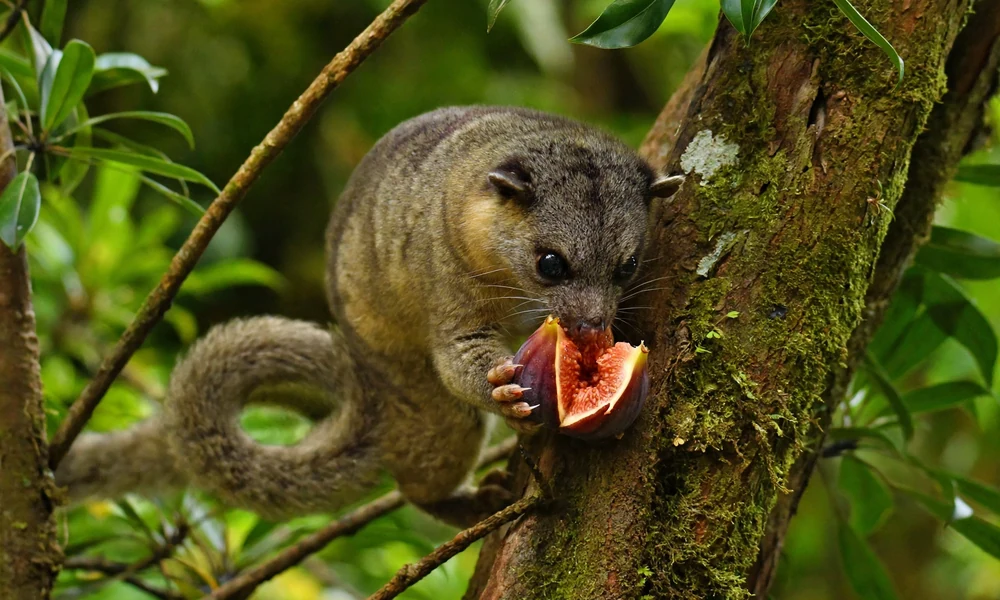
The face is the best field mark. Olingos have a short, rounded muzzle, large dark eyes and small rounded ears, giving them a gentle, almost teddy-bear look. The tail is long and bushy but not prehensile: an olingo cannot hang from it, and it uses it for balance instead.
Olingos belong to the genus Bassaricyon, which holds only these four species, in the raccoon family Procyonidae. They are close relatives of the kinkajou, another nocturnal fruit-eater of the same forests, and of the coatis and raccoons. The four species are very similar in appearance, and telling them apart in the field is hard: range and altitude are usually more useful than looks.
The olingo species and their relatives
The four olingo species are separated mainly by geography. The northern olingo lives in Central America, from Nicaragua to Panama. The western lowland olingo lives west of the Andes, from Panama to Ecuador. The eastern lowland olingo lives east of the Andes, across the Amazon basin. The Andean olingo, the olinguito, lives high in the cloud forests of Colombia and Ecuador, at altitudes of 1,500 to 2,750 metres.
The kinkajou is the olingo’s closest lookalike and its most famous confusion species. A kinkajou is larger, with a longer, fully prehensile tail that it uses to hang from branches, and a longer, more pointed face. An olingo is smaller, with a shorter tail that it cannot hang from and a rounder face. At night, the tail is the quickest way to tell them apart: if it is curled around a branch, it is a kinkajou.
The table below sets out the four olingo species alongside four of their closest relatives.
| Type | Animal | Where it lives | Best-known food | Length |
|---|---|---|---|---|
| Species | Northern olingo | Central America, Nicaragua to Panama | Fruit and nectar | 35–48 cm |
| Species | Western lowland olingo | West of the Andes, Panama to Ecuador | Fruit and nectar | 35–48 cm |
| Species | Eastern lowland olingo | East of the Andes, Amazon basin | Fruit and nectar | 35–48 cm |
| Species | Andean olingo (olinguito) | Cloud forests of Colombia and Ecuador | Fruit and nectar | 35–48 cm |
| Close relative | Kinkajou | Central and South America | Fruit and nectar | 40–60 cm |
| Close relative | White-nosed coati | Central America and southwestern United States | Fruit and invertebrates | 42–68 cm |
| Close relative | South American coati | South America | Fruit and invertebrates | 42–68 cm |
| Close relative | Raccoon | North and Central America | Almost anything | 40–70 cm |
How olingos live
Olingos are solitary and strictly nocturnal, spending the day curled up in a tree hollow or a dense tangle of vines, and emerging at dusk to feed. They are among the most nocturnal animals of the cloud forest, and their large eyes are built for low light. Like other forest animals, they rarely come to the ground.
Fruit makes up most of the diet, especially figs, and olingos play an important role as seed dispersers: seeds pass through their gut unharmed and are deposited far from the parent tree. They also take nectar, flowers, insects and small vertebrates, and they will raid bird nests for eggs.
Olingos are agile climbers, moving through the canopy on all fours and leaping between branches. They use their long tail for balance, not for gripping, and they can jump gaps of a metre or more. They are quiet animals, communicating with soft whistles and chitters that are easy to miss in the noise of the forest at night.
Little is known about olingo breeding. Females give birth to a single young after a gestation of about 70 days, in a tree hollow lined with leaves. The young stays with its mother for several months. In captivity an olingo can live for more than 20 years; in the wild the lifespan is unknown but probably shorter.
Where olingos live
All four olingo species live in Central and South America, but each occupies a different part of the map. The northern olingo ranges from Nicaragua through Costa Rica to Panama. The western lowland olingo lives on the Pacific slope of the Andes, from Panama to Ecuador. The eastern lowland olingo lives on the Amazonian slope, across Colombia, Ecuador, Peru, Bolivia and Brazil. The Andean olingo lives only in the cloud forests of the northern Andes in Colombia and Ecuador, at altitudes where mist rolls through the trees every night.
All four need intact forest with tall trees, dense canopy and plenty of fruiting trees. They are most common in cloud forest and moist lowland forest, and they are scarce or absent where forest has been cleared. The Andean olingo is the most restricted of the four, living only in a narrow band of high cloud forest, and it is the species most at risk from habitat loss.
Olingos are listed as Least Concern by the IUCN, except that the Andean olingo is listed as Near Threatened, because its cloud-forest habitat is shrinking. All four species are threatened by deforestation, and by the pet trade in some areas, though they are protected by law in most range countries.
Best seasons for olingo watching
The dry season is the best time to look for olingos, when fruiting trees are easier to find and the forest is less muddy. In Costa Rica and Panama, the dry season runs from December to April. In the Colombian and Ecuadorian Andes, the drier months are June to September, though cloud forest is wet year-round and a rain jacket is always needed.
Time of night matters as much as season. Olingos emerge at dusk and feed through the night, with peaks of activity in the first hours after sunset and again before dawn. Look for them in fruiting fig trees, where they feed noisily and drop fruit to the forest floor. A red-filtered torch disturbs them less than white light, and a local guide who knows the fruiting trees will save you many empty nights.
Staying safe around olingos
Olingos are shy, gentle animals that pose no danger to people. They are small fruit-eaters that avoid humans and flee at the first sign of disturbance. If you meet one, keep your distance and enjoy the sighting. Do not approach it, do not try to feed it, and do not shine a bright white light directly into its eyes.
Like all wild animals, an olingo can bite if it is handled or cornered, so never try to touch one. Keep dogs on a lead in olingo country, so they cannot chase an olingo into the canopy. If an olingo is feeding in a tree above you, stand clear: it may drop fruit and branches as it feeds.
Olingo watching checklist
- Visit in the dry season, when fruiting trees are easier to find and trails are passable.
- Go out at dusk, when olingos emerge to feed, and again before dawn.
- Look in fruiting fig trees, where olingos feed noisily and drop fruit below.
- Bring binoculars with good low-light performance, and a red-filtered torch.
- Move quietly, and listen for soft whistles and the sound of falling fruit.
- Wear a rain jacket and closed shoes: cloud forest is wet and muddy year-round.
- Record the time, place and behaviour of any sighting for the local reserve.
Frequently asked questions
How many olingo species are there?
There are four olingo species: northern, western lowland, eastern lowland and Andean. The count was settled by a revision of the genus Bassaricyon in 2013, which split what was once thought to be one species into four.
What is the difference between an olingo and a kinkajou?
An olingo is smaller, with a shorter, non-prehensile tail and a rounder face. A kinkajou is larger, with a longer, fully prehensile tail that it uses to hang from branches, and a longer, more pointed face. At night, the tail is the quickest way to tell them apart.
How is this guide different from the kinkajou species guide?
This guide covers the four olingo species in depth, while the kinkajou species guide covers the single kinkajou species. The two guides compare the animals directly, so you can tell them apart in the field.
Are olingos dangerous to people?
No, olingos are not dangerous to people. They are small, shy fruit-eaters that avoid humans and flee at the first sign of disturbance. They may bite if handled or cornered, but attacks on people are not recorded.
What is the olinguito?
The olinguito is the common name for the Andean olingo, Bassaricyon neblina. It was described as a new species in 2013, the first new carnivore species described in the Americas in 35 years, and it lives only in the cloud forests of Colombia and Ecuador.
Where is the best place to see an olingo in the wild?
Cloud forest reserves in Costa Rica, Panama, Colombia and Ecuador offer the best chances, because they hold good olingo numbers in intact forest with guided night walks. Go at dusk in the dry season, look in fruiting fig trees, and ask local guides about recent sightings.
Conclusion
Four species, one quiet life in the trees. The olingos are the night fruit-eaters of the cloud forest, small, gentle and easily missed, yet they carry seeds across the forest and keep its trees fruiting. They are not kinkajous, though they are often mistaken for them, and their story, four species where one was once thought to live, is a reminder that the forest still holds surprises.














