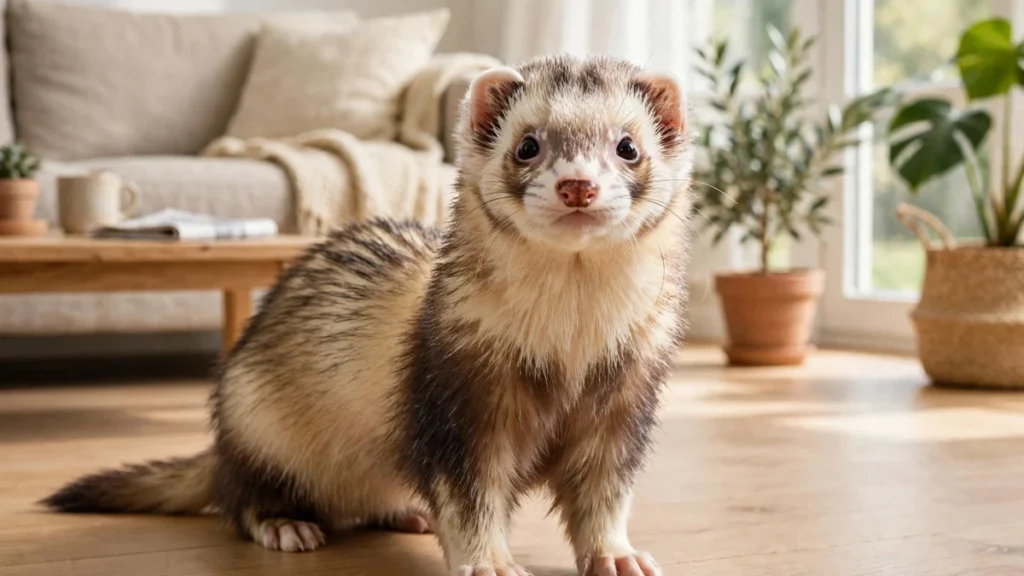
Ferret species are among the most misunderstood members of the mustelid family, and the word ferret covers a small group: the domestic ferret, its wild polecat cousins, and the rare black-footed ferret of North America. If you are wondering how many ferret species there are and whether a pet ferret is a wild animal, the short answer is this: there is only one domestic ferret, Mustela putorius furo, a tame form of the European polecat, and it is not a separate wild species at all, while its closest wild relatives are the European polecat, the steppe polecat and the black-footed ferret, all slender, quick hunters of burrows and grassland.
Key takeaways
- The domestic ferret is Mustela putorius furo, a domesticated form of the European polecat, not a separate wild species.
- The wild ferret relatives are the European polecat, the steppe polecat and the black-footed ferret, with the marbled polecat as a close relative.
- Ferrets are mustelids, related to weasels, stoats and badgers, with long, flexible bodies built for hunting inside burrows.
- The black-footed ferret was once thought extinct, and has been brought back by captive breeding and reintroduction.
- Domestic ferrets are playful, curious pets that need plenty of space, company and supervised time outside the cage.
What makes a ferret a ferret
A ferret is a small, long-bodied mammal with short legs, a pointed face, small rounded ears and a thick, bushy tail. Its body is so flexible that it can turn around inside a tunnel barely wider than itself, and it bounds along in a series of springy hops. Ferrets have sharp teeth, strong claws and a keen sense of smell, and they are famous for their curiosity, squeezing into every hole they find.
Ferrets belong to the mustelid family, which also includes weasels, stoats and badgers. Like their cousins, ferrets are hunters, with quick reflexes and a taste for meat. The domestic ferret is the only ferret that has been tamed, kept by people for thousands of years to hunt rabbits and rats, and now kept just as often as a pet. The wild ferrets live the same hunting life, but without any help from people.
The ferret family
The domestic ferret is the ferret most people know, a playful pet with cream, sable or albino fur, a dark mask across the eyes and a habit of stashing toys in hiding places. It is Mustela putorius furo, a domesticated form of the European polecat, bred over centuries to be smaller, tamer and more varied in colour than its wild ancestor. A pet ferret is not a wild animal, and it cannot survive long on its own outdoors, because it has lost much of the wariness and hunting skill of a wild polecat.
The European polecat is the wild ancestor of the domestic ferret, and it lives across Europe, from Britain to Russia, in woodland, farmland and river valleys. It is a dark, chocolate-brown animal with a pale face mask, a little larger than a pet ferret, and much shyer. Polecats hunt rabbits, rats, frogs and birds, mostly at night, slipping through hedgerows and along stream banks in search of prey.
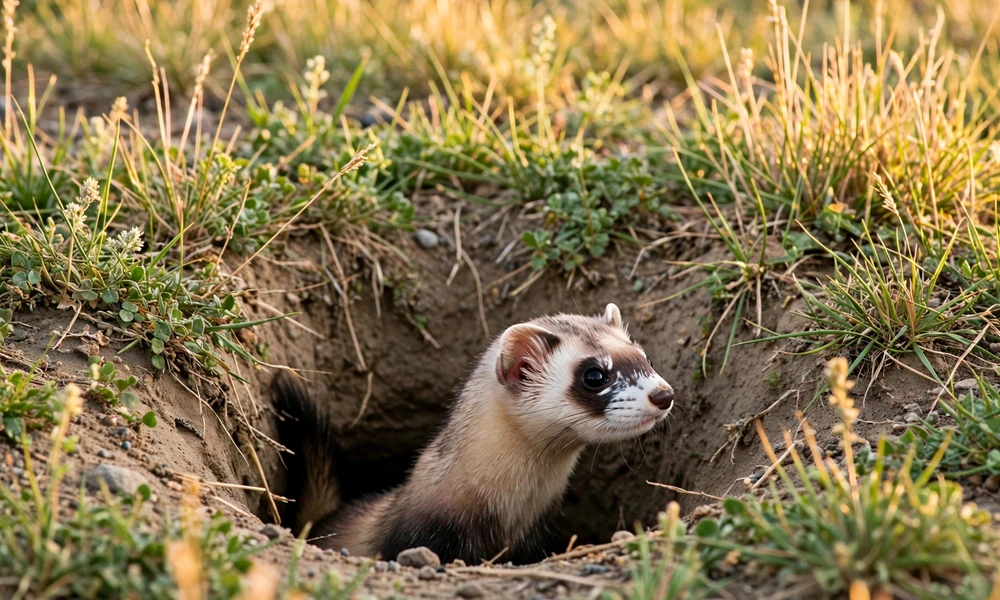
The steppe polecat lives on the grasslands of Central Asia and Eastern Europe, from Ukraine and Russia across to Mongolia and northern China. It is paler than the European polecat, with sandy-yellow fur and a dark mask, and it hunts ground squirrels and hamsters on the open steppe. Steppe polecats are strong diggers and bold hunters, and they sometimes take over the burrows of animals they catch.
The black-footed ferret is the rarest of the ferret family, and one of the great comeback stories of wildlife conservation. It lives only in the prairie dog towns of the western United States, where it hunts prairie dogs and sleeps in their burrows. By the 1980s it was thought to be extinct, until a small group was found in Wyoming, and captive breeding has since returned it to the wild. Black-footed ferrets are pale tan with black feet, a black tail tip and a black mask, and they are almost entirely nocturnal.
The marbled polecat is a close relative rather than a true ferret, a patterned animal with marbled cream, brown and black fur, living from Eastern Europe across Central Asia to China. It is smaller than a polecat and hunts gerbils and ground squirrels in dry grassland and desert edges. Two other close relatives, the striped polecat and the Saharan striped polecat of Africa, wear bold black and white stripes and spray a foul smell when threatened, like a skunk.
How ferrets hunt and move
Ferrets hunt by scent and sound, following the smell of prey into burrows and tunnels where larger hunters cannot go. Their long, narrow bodies slide easily underground, and they kill with a quick bite to the neck. Wild polecats hunt rabbits, rats, voles and frogs, while the black-footed ferret depends almost entirely on prairie dogs, eating them and living in their burrows. Among the predators of the animal world, ferrets are unusual in hunting prey inside its own home, in the dark, underground.
On the ground, ferrets move with a bounding, weasel-like gait, arching their backs as they run and pausing to stand upright and look around. They climb and swim well, and they dig quickly with strong front claws. Domestic ferrets show the same moves in play, chasing, pouncing and wrestling, and the famous ferret war dance, a sideways hopping jig with an arched back and puffed-up tail, shows pure excitement. The nocturnal animals of the grassland include the black-footed ferret, which hunts mostly in the dark.
Where ferrets live
Ferrets and polecats live across Europe, Asia and North America, in grassland, woodland edges and farmland, wherever there are burrows to hunt in and prey to catch. European polecats favour damp places near streams and ponds, steppe polecats prefer open dry grassland, and black-footed ferrets live only where prairie dogs thrive. The forest animals of Europe include the European polecat, which hunts along woodland edges where rabbits and rats shelter.
Ferrets and people
People have kept ferrets for thousands of years, first to hunt rabbits and rats, and later as pets. Ferreting, sending a ferret down a rabbit burrow, is still practised in parts of Britain, and ferrets were once common working animals on farms. Today, most domestic ferrets are pets, loved for their playful character, but they need committed owners: a ferret lives for six to ten years, needs a large cage, several hours of play outside it every day, and company, from people or from another ferret.
| Species | Type | Where it lives | Best-known food | Length |
|---|---|---|---|---|
| Domestic ferret | Domesticated form | Kept as a pet worldwide | Meat, pet food, eggs | 0.50 metres |
| European polecat | Wild species | Europe, from Britain to Russia | Rabbits, rats, frogs, birds | 0.45 metres |
| Steppe polecat | Wild species | Grasslands of Central Asia | Ground squirrels, hamsters | 0.52 metres |
| Black-footed ferret | Wild species | Prairies of western North America | Prairie dogs | 0.55 metres |
| Marbled polecat | Close relative | Eastern Europe to China | Gerbils, ground squirrels | 0.35 metres |
| Striped polecat | Close relative | Africa, south of the Sahara | Rodents, birds, insects | 0.38 metres |
| Saharan striped polecat | Close relative | North Africa and the Sahel | Rodents, lizards, insects | 0.35 metres |
Best seasons for ferret watching
Spring and early summer are the finest seasons for ferret watching, when polecats are raising their young and hunting in the long evenings. At dusk, a European polecat may be seen crossing a country lane or slipping along a hedgerow, and black-footed ferrets emerge from their burrows as the light fades. The young of the year are at their most active in late summer.
Winter can also reward the patient watcher, when polecat tracks show clearly in snow or soft mud. Autumn is the hardest season, when the nights draw in and polecats grow secretive, though fresh tracks and droppings near burrows still tell their story.
Staying safe around ferrets
Wild ferrets and polecats are shy animals, and they deserve respect. Never try to catch a wild polecat or reach into a burrow, never handle one with bare hands, and never corner one: a frightened polecat can bite hard and spray a foul-smelling scent when threatened. Pet ferrets are tame, but they still nip when excited, so wash your hands after handling one and always supervise children. Watch wild ferrets from a distance, with binoculars, and let the animal carry on undisturbed.
Ferret watching checklist
- Look for polecat tracks in soft mud or snow along stream banks and hedgerows.
- Watch at dusk, when polecats and black-footed ferrets leave their burrows to hunt.
- Check rabbit burrows and prairie dog towns for signs of ferret activity.
- Carry binoculars and keep your distance from any wild ferret you spot.
- Never reach into a burrow or try to handle a wild ferret.
- Leave no trace: take your rubbish home and keep to marked paths.
Frequently asked questions
How many ferret species are there?
There is only one domestic ferret, Mustela putorius furo, and it is a domesticated form of the European polecat, not a separate wild species. The closest wild ferret species are the European polecat, the steppe polecat and the black-footed ferret, and the marbled polecat is a close relative in the genus Vormela. The table above lists all seven, each labelled honestly as a domesticated form, a wild species or a close relative.
How is this guide different from the predator animals guide?
This guide covers only the ferret family, from the domestic ferret to the black-footed ferret and the marbled polecat. The predator animals guide covers the whole world of hunting animals, from lions and eagles to sharks and spiders.
Is a domestic ferret a wild animal?
No, a domestic ferret is not a wild animal. It is Mustela putorius furo, a domesticated form of the European polecat, bred over centuries to be tame, and it cannot survive long on its own outdoors. An escaped pet ferret needs to be found quickly, because it has lost much of the wariness and hunting skill of its wild ancestor.
What do ferrets eat?
Wild ferrets and polecats eat meat: rabbits, rats, voles, frogs and birds for the European polecat, ground squirrels and hamsters for the steppe polecat, and prairie dogs for the black-footed ferret. Pet ferrets eat a high-protein diet of meat-based food and eggs, and they should never be fed dog food or sugary treats.
Are black-footed ferrets really back from extinction?
Yes, the black-footed ferret was thought to be extinct, until a small group was found in Wyoming in the 1980s. Captive breeding has since reintroduced it to prairie dog towns across the western United States, and it is still endangered, depending on healthy prairie dog colonies for food and shelter.
Where is the best place to see a wild ferret?
The best place to see a wild ferret is a European woodland edge or hedgerow at dusk, where polecats hunt rabbits and rats, or a prairie dog town in the western United States, where black-footed ferrets emerge as the light fades. You will need patience and binoculars, because all wild ferrets are shy and mostly nocturnal.
Conclusion
Ferret species, from the playful domestic ferret to the wild polecats and the rare black-footed ferret, are slender, clever hunters of burrows and grassland. The domestic ferret is a tame form of the European polecat, not a wild species, and its wild cousins show how much variety fits into one small family, from the marshes of Europe to the prairies of North America.
The next step is to look for a ferret at dusk, along a hedgerow, a stream bank or the edge of a prairie dog town, and watch quietly: the quickest glimpse of a masked face at a burrow mouth is one of the finest sights in the wild.














