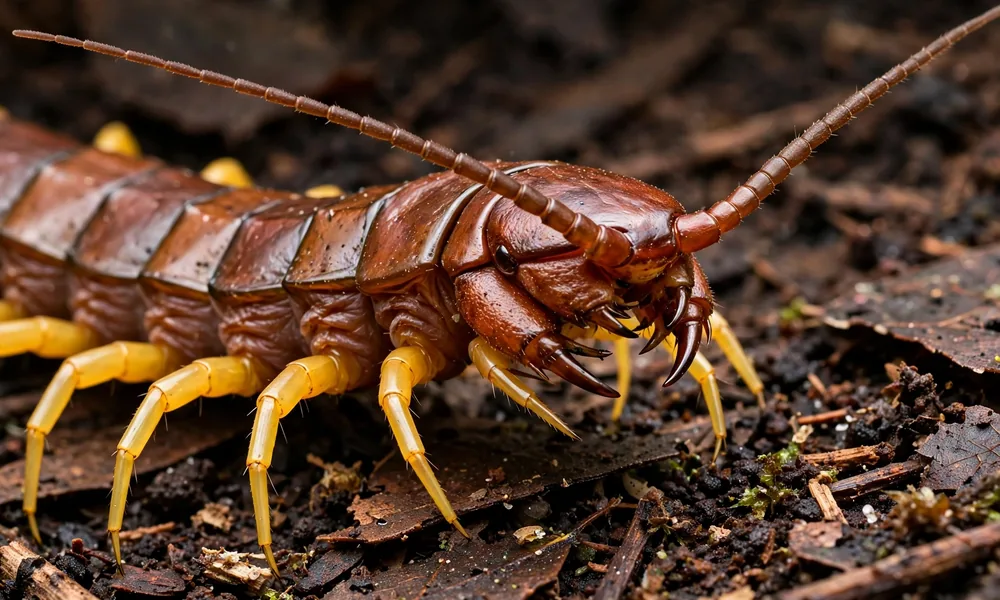
The giant centipede species are the largest centipedes in the world, and the biggest of them, the Amazonian giant centipede, Scolopendra gigantea, is a hunter a foot long that lives in the rainforests of northern South America. If you are asking what a giant centipede is, the short answer is a fast, venomous, many-legged predator, usually 26 to 30 centimetres long, that hunts at night under leaf litter and logs, eats insects, spiders, frogs, lizards, mice and even bats, and bites with a pair of venom claws that can put a person in hospital. It is not a worm, and it is not a millipede: it has one pair of legs on every body segment, it is a carnivore through and through, and it is the top invertebrate predator of its forest floor.
What makes the giant centipede so unsettling is how much animal is packed into something most people think of as a garden pest. A house centipede is a few centimetres of legs and hurry; a giant centipede is as long as a ruler, as thick as a finger, and strong enough to climb a cave ceiling and snatch a bat out of the air. Its bite is famously painful, its venom is strong enough to kill the small mammals it eats, and at least one human death has been blamed on it. Yet it is also a shy animal that hides by day, a careful mother that coils around her eggs for weeks, and a hunter that keeps the forest floor in balance.
Key takeaways
- The giant centipede species are led by the Amazonian giant centipede, Scolopendra gigantea, the largest centipede in the world, growing to about 30 centimetres long, with 21 or 23 pairs of legs.
- Giant centipedes live in the tropical and subtropical forests of northern South America and the southern Caribbean, under leaf litter, rocks and logs, and in caves, and they climb trees as readily as they crawl on the ground.
- They are solitary, nocturnal carnivores that eat insects, spiders, scorpions, snails, frogs, lizards, snakes, birds, mice and bats, killing prey with venom delivered through a pair of modified legs called forcipules.
- The bite is acutely painful and can cause swelling, fever and weakness, and at least one human death, a four-year-old child in Venezuela in 2014, has been attributed to Scolopendra gigantea.
- The species has not been assessed by the International Union for Conservation of Nature, and there is no sign that it is endangered, though it depends entirely on damp, undisturbed forest floor to survive.
The giant centipede species and their relatives
Giant centipedes belong to the family Scolopendridae, the family of the large tropical centipedes, in the order Scolopendromorpha. They are true centipedes, animals of the class Chilopoda, with a flattened body, a head, and a trunk of segments, each carrying exactly one pair of legs. They share the features that make a life of hunting on the forest floor possible: long antennae for feeling the way, poor eyesight, a hard shell, and a pair of venom claws tucked under the head.
The Amazonian giant centipede, Scolopendra gigantea, is the lead species of this guide, and it is the giant centipede that defines the whole group, largely because it is the largest, the most famous and the most feared of them all. It lives in northern South America and the southern Caribbean, in Colombia and Venezuela, in Brazil, and on Trinidad, Margarita Island, Curacao and Aruba, in tropical and subtropical rainforest and in tropical dry forest, and it grows to about 30 centimetres long, with most adults measuring 26 to 30 centimetres, and it weighs only a few dozen grams. It has not been assessed by the International Union for Conservation of Nature, and its body is dark reddish-brown with yellow legs. Like the octopus, the giant centipede is a hunter that relies on cunning rather than speed alone, but the octopus grabs prey with eight arms and a beak, while the giant centipede wraps its prey in its legs and bites with venom claws.
| Type | Animal | Where it lives | Best-known food | Length or Weight |
|---|---|---|---|---|
| Family | Giant centipedes (Scolopendridae) | Warm countries worldwide | Insects and small vertebrates | Up to about 30 cm long |
| Genus | Giant centipedes (Scolopendra) | Tropics and warm regions | Insects and small vertebrates | Up to about 30 cm long |
| Species | Amazonian giant centipede (Scolopendra gigantea) | Northern South America and southern Caribbean | Bats, mice, frogs and lizards | Up to about 30 cm long |
| Species | Giant desert centipede (Scolopendra heros) | South-western United States and northern Mexico | Insects, lizards and mice | Up to about 20 cm long |
| Species | Vietnamese centipede (Scolopendra subspinipes) | Tropical Asia, Australia and Hawaii | Insects and small vertebrates | Up to about 20 cm long |
| Species | Waterfall centipede (Scolopendra cataracta) | Laos, Thailand and Vietnam | Aquatic invertebrates | Up to about 20 cm long |
The closest relatives of the Amazonian giant centipede are the other giant centipedes of the genus Scolopendra, a large genus of fast, venomous hunters that live in warm countries around the world. The giant desert centipede, Scolopendra heros, is the largest centipede in the United States, a striking animal of the arid south-west with a red or black head, yellow legs and a dark tail, that grows to about 20 centimetres long and hunts insects, lizards and mice under rocks and in burrows. The Vietnamese centipede, Scolopendra subspinipes, is a centipede of tropical Asia, Australia and Hawaii, with a dark green-brown body, a red head and yellow legs, that grows to about 20 centimetres long and is famous for a very painful bite. The waterfall centipede, Scolopendra cataracta, is a greenish-black centipede of Laos, Thailand and Vietnam, up to about 20 centimetres long, that is the first centipede known to swim. The Galapagos centipede, Scolopendra galapagoensis, is a thick-bodied centipede of the Galapagos Islands that grows to about 28 centimetres long and eats birds, reptiles, snakes and bats.
What giant centipedes look like
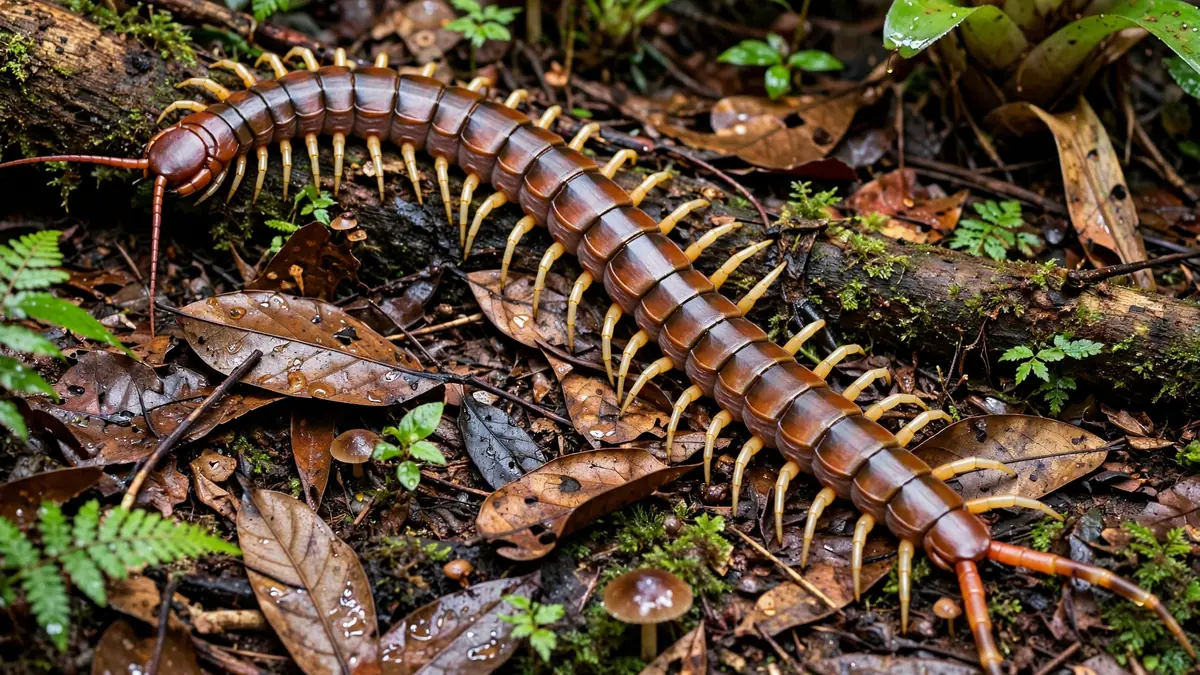
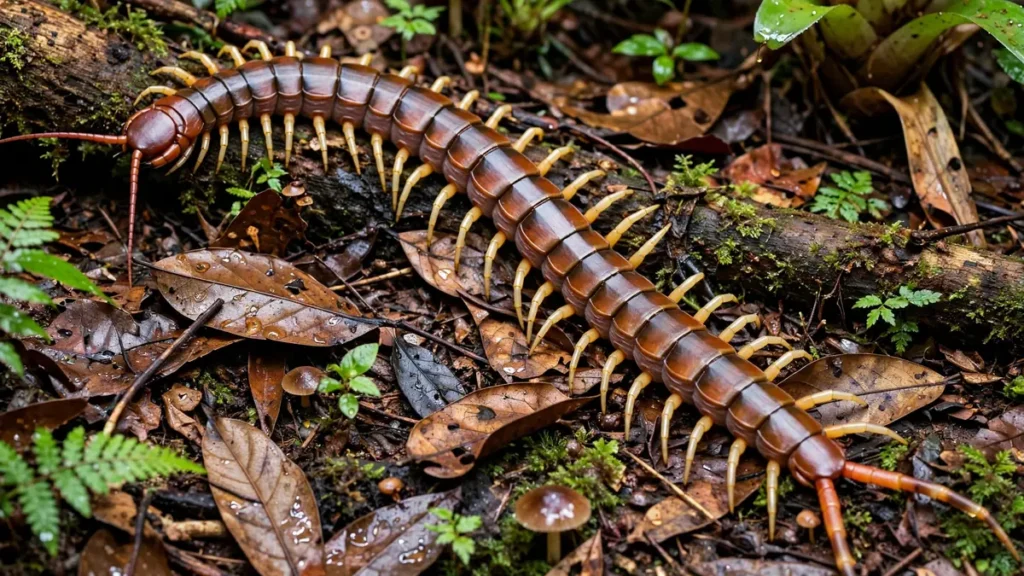
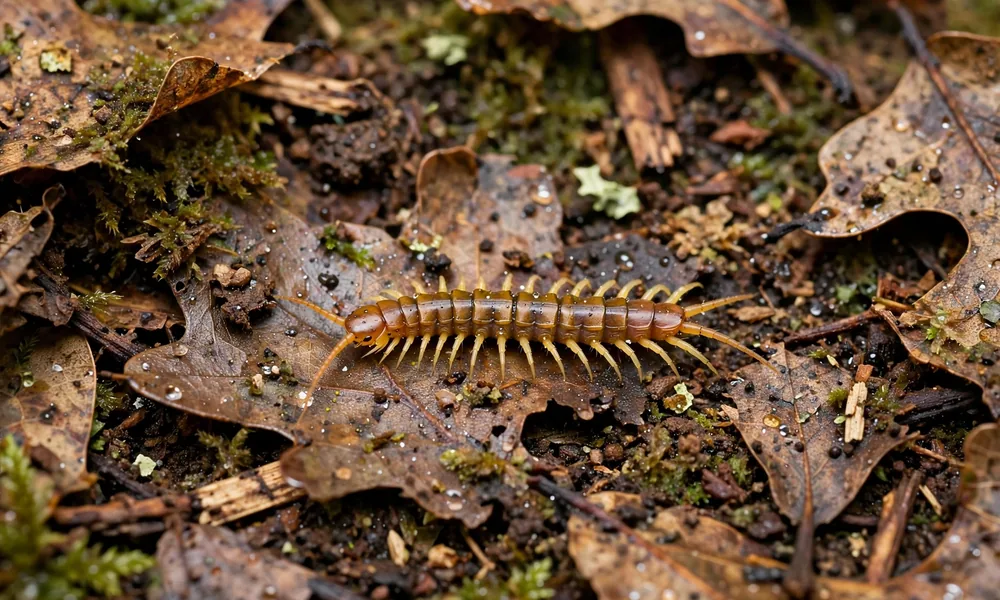
A giant centipede looks like a length of armoured rope that has learned to run. The body is long and flattened, divided into 21 or 23 segments, and every segment carries one pair of legs, so the animal moves in a rippling wave, and it can run fast enough to catch a lizard, climb a tree, or disappear under a log before you have finished blinking. The head is dark brown to reddish-brown, and it carries a pair of long antennae with many joints, clusters of simple eyes on each side that see very little, and mouthparts for tearing prey. Behind the head, on the first trunk segment, sits the weapon that defines the animal: a pair of curved, claw-like legs called forcipules, joined at the base, each ending in a sharp point with a hole near the tip through which venom flows from a gland inside the leg.
The size of a giant centipede depends on the species. The smallest giant centipedes are only a few centimetres long, while the Amazonian giant centipede grows to about 30 centimetres, about 12 inches, and most adults measure 26 to 30 centimetres. The giant desert centipede is typically 16 to 20 centimetres, the Vietnamese centipede is usually 10 to 20 centimetres, and the waterfall centipede reaches about 20 centimetres. The weight is small to match: a large Amazonian giant centipede weighs only a few dozen grams, because most of its body is a hollow shell of armour and muscle, and the legs, though numerous, are thin. A newly hatched giant centipede is only a few millimetres long, a pale thread of an animal that must grow through a whole forest of dangers before it reaches adult size.
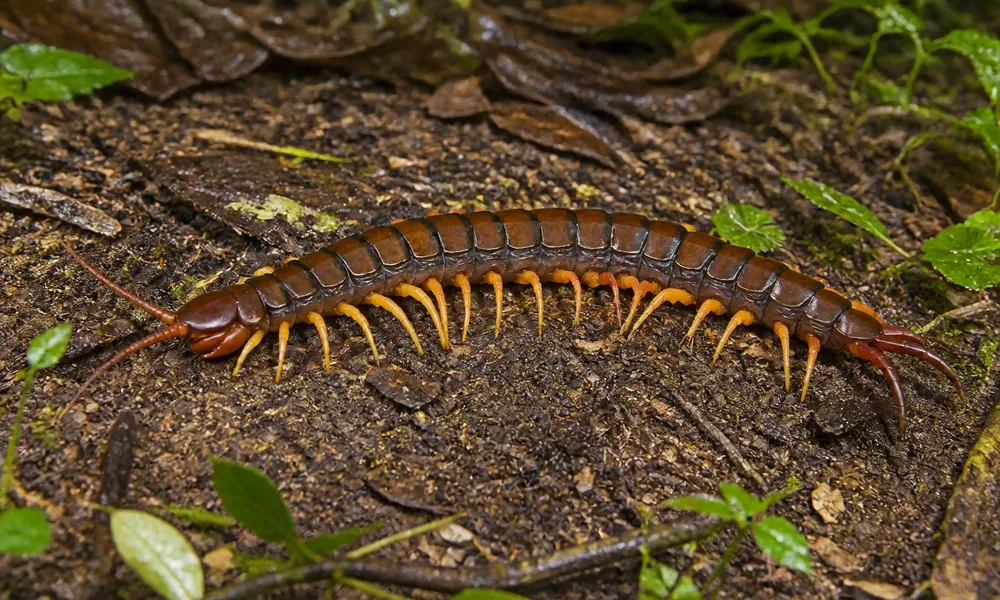
The colour is the first thing most people notice, and it is the best way to tell a giant centipede from the many smaller centipedes that share its forest. In the Amazonian giant centipede the head ranges from dark brown to reddish-brown, the body segments are dark reddish-brown, and the legs are olive-green with yellow claws, a combination that stands out against dark leaf litter and damp wood. The giant desert centipede is more vivid still, with a red or black head, a dark body and bright yellow legs. The last pair of legs is different from all the rest: long, thick and antenna-like, held out behind the animal like a second pair of feelers, and used to sense what is coming up behind it and to grip a surface while it climbs. A centipede has no sting in its tail, whatever the old stories say, and the danger is all at the front, in the forcipules under the head.
Where giant centipedes live
Giant centipedes live in warm, damp places, and they are found nowhere cold or dry in the wild. Their range centres on the tropical and subtropical forests of northern South America, from Colombia and Venezuela across to Brazil, and on the islands of the southern Caribbean, Trinidad, Margarita Island, Curacao and Aruba, with other giant centipedes filling the same role in the warm countries of Asia, Africa, Australia and the south-western United States. They live in tropical rainforest and in tropical dry forest, in leaf litter, under rocks and logs, in rotting wood, in the soil, and in the dark, moist places that other animals overlook. They climb readily, and they will use hiding spaces under bark in trees, in crevices in walls, and in the crawl spaces under buildings when houses are built near their forest.
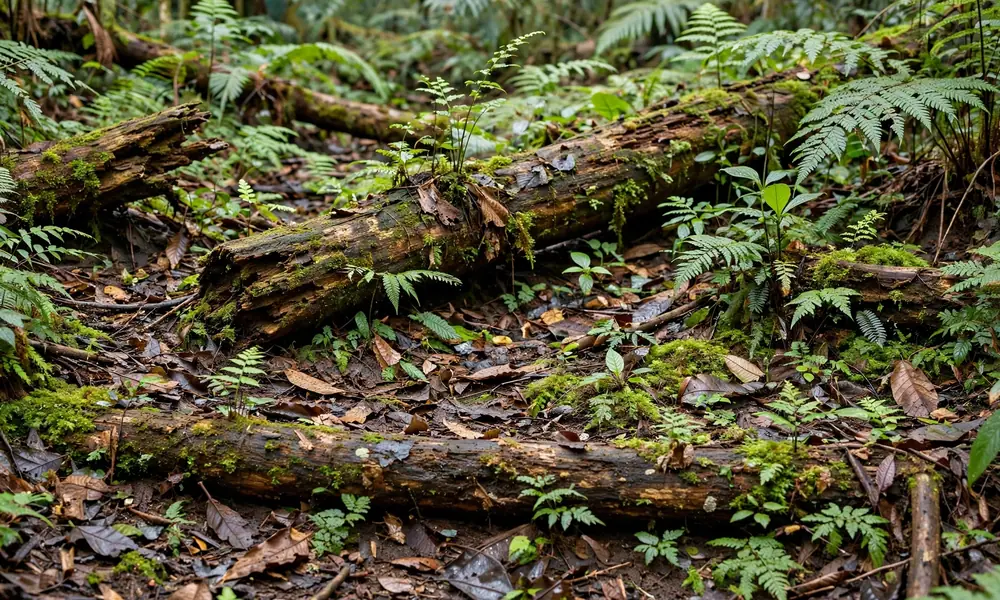
Some giant centipedes go further than the forest floor, and the most famous of them live in caves. In Venezuela, a population of Amazonian giant centipedes was found living in caves, climbing the cave ceilings and hanging upside down to catch bats as they flew past, holding on with only a few legs and using the rest to grab their prey. Giant centipedes also turn up in gardens, in plant pots, in piles of rubbish and rubble, and in the moist rooms of houses near the forest, and it is in houses, at night, in the dry season, that most bites happen.
What giant centipedes eat
Giant centipedes are hunters, and their diet is written on the forest floor itself. The everyday food is whatever they can overpower and kill: large insects, worms, snails, spiders, millipedes, scorpions and even tarantulas, and then, for the biggest centipedes, small vertebrates as well, small lizards, frogs up to 9.5 centimetres long, snakes up to 25 centimetres long, sparrow-sized birds, mice and bats. They hunt by scent and by touch, and they need a living animal to recognise food, so they will not eat dead prey.
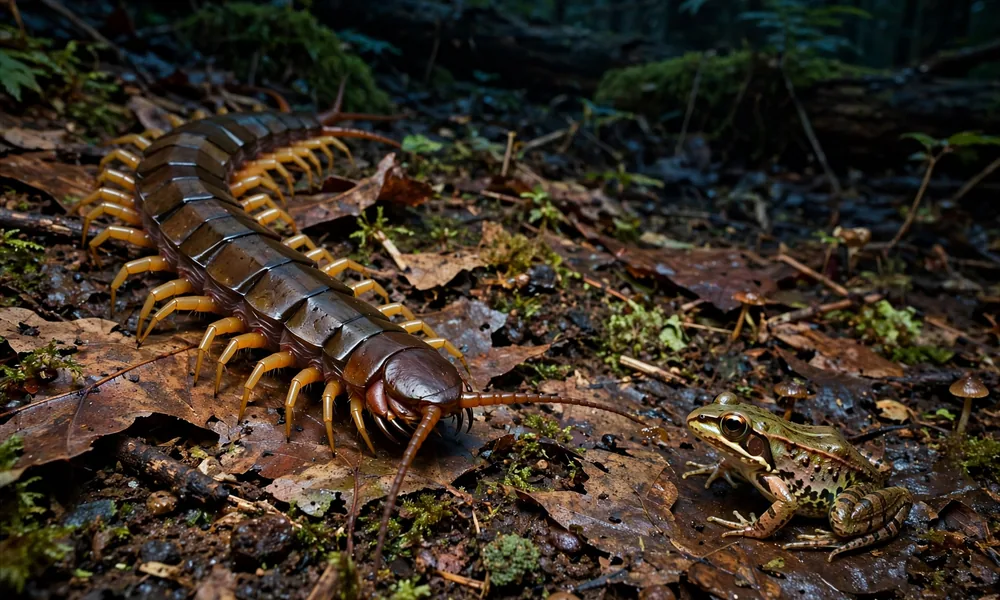
What the centipede eats changes as it grows. The young feed on tiny insects and small animals in the leaf litter, and as they grow they take larger prey, until an adult can take a frog nearly a third of its own length, or a snake 25 centimetres long, or a mouse, or a bat. A giant centipede does not chase its prey far, because its venom does the work: it wraps its legs around the victim, bites with the forcipules, and the venom paralyses the prey in seconds, and the centipede then tears it apart and eats it slowly, and may rest for days before it hunts again.
The bat hunting is the most extraordinary part of the diet, and it shows what a centipede can do when it puts its mind to it. In a Venezuelan cave, researchers watched Amazonian giant centipedes climb the cave ceiling, hang upside down, and wait for bats to fly past, then grab them out of the air with their legs, bite them, and hold them while the venom worked, using only a few legs to stay attached to the ceiling while the rest held the bat. It is the only known case of a centipede hunting flying prey in this way. The bats are not the everyday food of the forest centipedes, and most giant centipedes never see a bat, but the cave hunters prove that there is very little a hungry giant centipede will not try to eat.
How giant centipedes behave
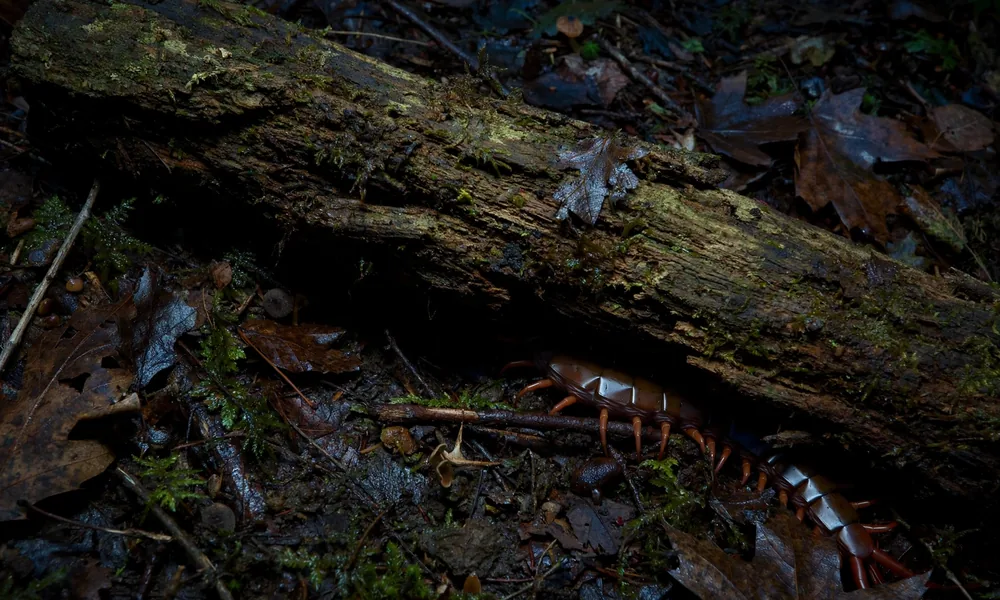
Giant centipedes are night animals, and their day is split cleanly in two: hidden by day, hunting by night. They spend the daylight hours under leaf litter, under a log or a rock, in a burrow or a crevice, and they are so still and so well hidden that a person can walk straight past a giant centipede and not see it. As night falls they emerge and begin to crawl across the forest floor, feeling the way with their antennae, hunting, and looking for a mate. They are solitary, and each centipede keeps to its own patch of ground.
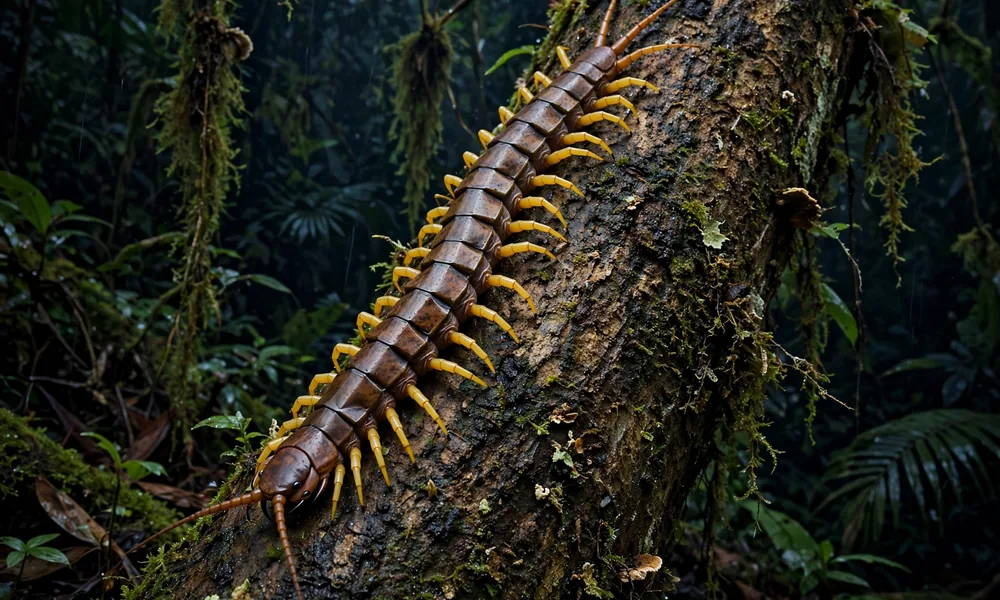
The most famous behaviour in the giant centipede is the bite, and it works because the centipede is so good at holding on first. When prey comes within reach, the centipede wraps its front legs around it, bites with the forcipules, and injects venom in a fraction of a second, and the prey is paralysed almost at once. The venom is a cocktail of chemicals, including acetylcholine, histamine and serotonin, that blocks nerve signals and causes pain, swelling and paralysis, and it is strong enough to kill a mouse or a bat. The centipede then holds the prey while the venom works, tears it apart, and eats it, and it may spend hours over a large meal. A giant centipede will also bite in defence, and it will bite a hand that picks it up, a foot that steps on it, or a finger that reaches into a dark place where it is hiding.
Giant centipedes are not blind, but they see very little, and they live by touch and by smell. The antennae on the head tap the ground ahead, tasting the air for the scent of prey, and the long rear legs tap the ground behind, feeling for anything coming up from the rear, and as soon as one of them touches prey, the centipede turns and attacks. It can move quickly backwards as well as forwards, and it can run away from light, which is why a torch beam will send a centipede scuttling for cover. It is not aggressive for the sake of it, and it will not chase a person, because a person is far too big to eat, but it will defend itself if it is cornered, and it will bite if it is grabbed.
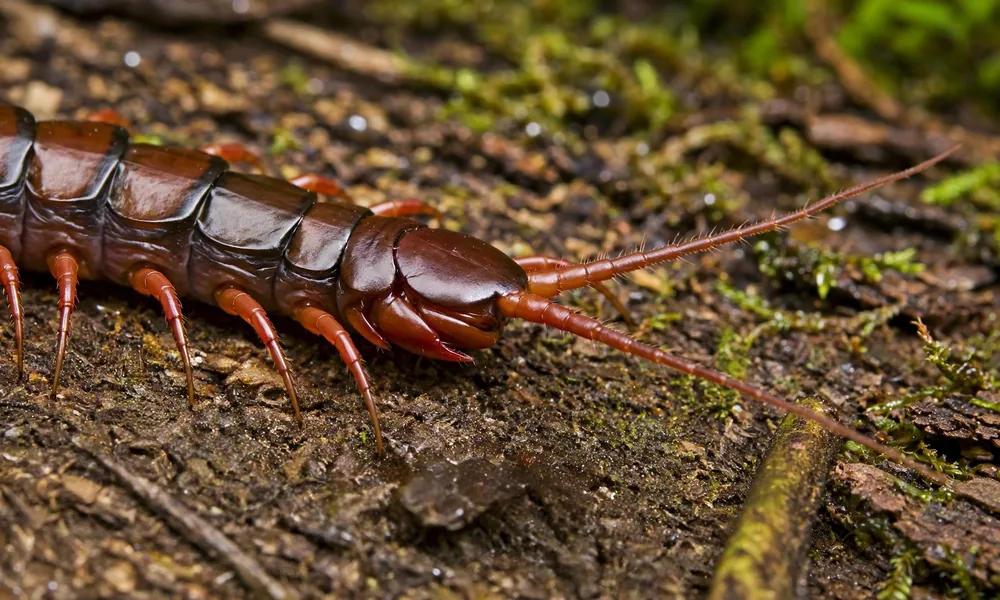
The venom itself is the real marvel, and it is what makes the giant centipede both feared and respected. Each species makes its own cocktail of toxins, and a single centipede may carry dozens of different chemicals in its venom, each aimed at a different target in the nerves and muscles of its prey. In a person, a bite brings acute, very painful swelling, tingling and redness that can last for hours, and in some cases chills, fever and weakness, and the pain is often compared to a bee sting, only much worse and much longer lasting. At least one human death has been attributed to Scolopendra gigantea, a four-year-old child in Venezuela in 2014 who died after being bitten by a giant centipede hidden inside an open soda can.
Breeding and life cycle
Giant centipedes breed in the warm, wet months, when the forest floor is at its dampest and food is plentiful, and they may breed twice a year. Males and females meet on the forest floor at night, and mating is a strange, indirect affair, because the male has no copulatory organs at all. He spins a small silk pad on the ground and deposits his sperm on it, and the female picks the sperm up and uses it to fertilise her eggs.
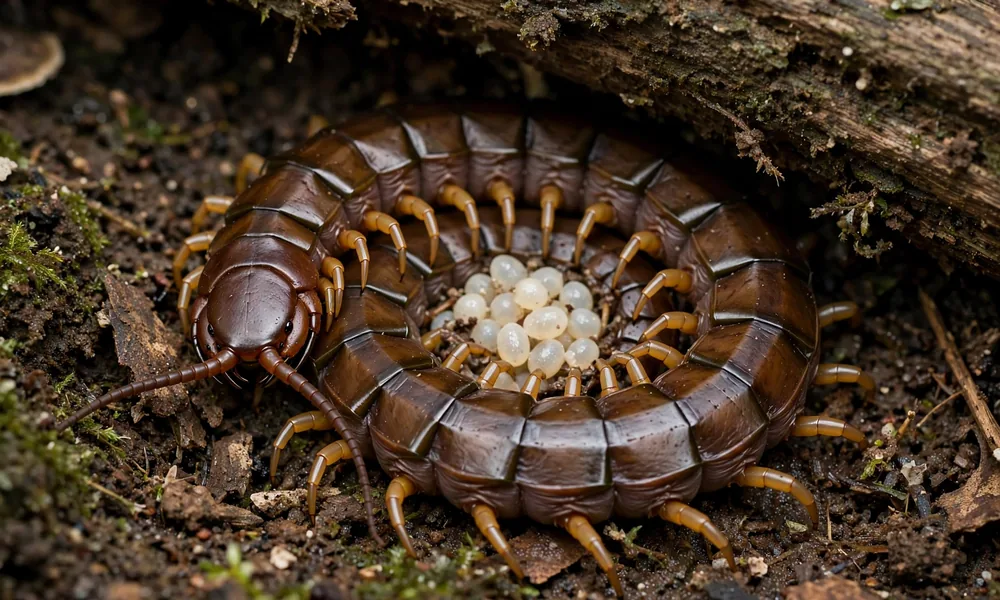
Under normal conditions the female lays 15 to 50 eggs in moist soil or rotting wood, in a pile, and then she coils around them and stays with them, guarding them from predators and licking them clean to stop fungus growing on them. She does not eat while she guards, and she will stay coiled around the clutch until the eggs hatch, and then stay with the young for a while after they hatch, carrying them on her underside and wrapping herself around them. It is a form of parental care that is rare among invertebrates, and it is the reason the young have a chance at all, because a pile of eggs left alone on the forest floor would be eaten in a night.
The young are independent once they leave their mother, crawling across the leaf litter as tiny centipedes with working venom claws already in place, and they must feed and grow through a whole forest of predators before they reach adult size. They grow by moulting, shedding the old shell and growing a new, larger one, and they moult many times on their way to adult size. How long a giant centipede lives in the wild is not perfectly measured, but a normal lifespan of about 10 years is given for Scolopendra gigantea, which is a long life for an invertebrate, and a large centipede is a slow-growing animal that has survived many seasons on the forest floor.
Conservation status
The conservation status of the giant centipede is, on paper, a blank page. Scolopendra gigantea has not been assessed by the International Union for Conservation of Nature, and there is no Red List category for it, and no population figure, because nobody has measured the population across its whole range. The Animal Diversity Web notes that there is no indication that the species is in any way endangered, and it has no special status on any federal list and no status under the Convention on International Trade in Endangered Species of Wild Fauna and Flora.
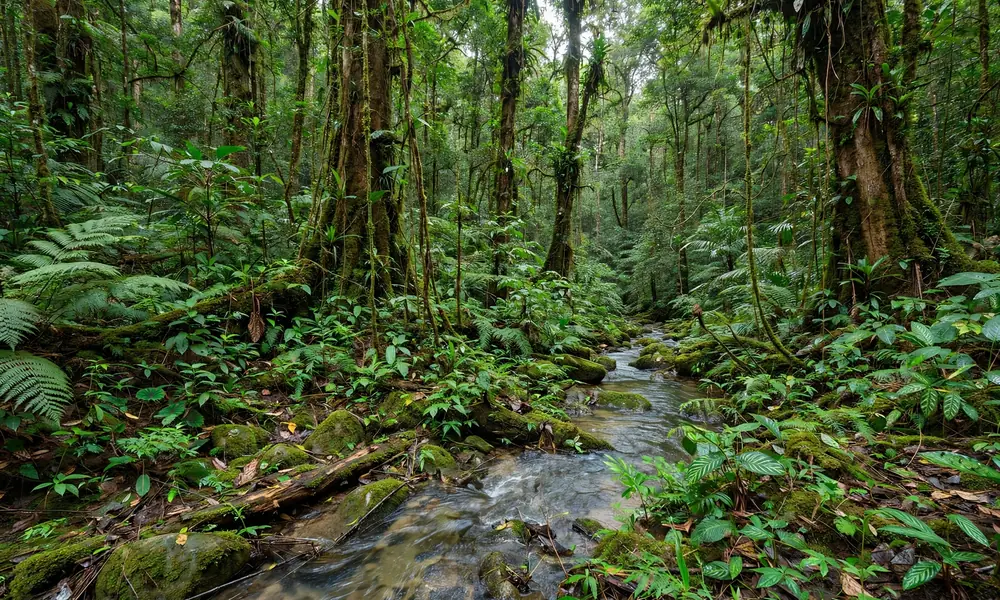
The lack of a listing is honest, and it is also incomplete, because a species can be common across a continent and still be losing ground in most of the places it lives. The main pressure is the loss of the forest itself. When a forest is cleared for farming, for building or for logging, the leaf litter goes, the rotting wood is cleared away, and the damp, dark places the centipede needs disappear, and a centipede that lives its whole life on one patch of forest floor has nowhere to go when that patch is ruined. The second pressure is the drying of the forest, and a forest that is opened up to the sun dries out, and a centipede that loses water fast cannot live in a dry forest. The third pressure is the one that comes with people: centipedes are killed on sight in houses and gardens, and collected for the pet trade.
Best seasons for giant centipede watching
The best time to look for giant centipedes is the wet season, when the forest floor is at its dampest and the centipedes are out hunting in the open, though no season will show you one from a hotel balcony. The centipedes are present in the forest all year round, but the wet months are the time when the leaf litter is wettest and the centipedes are most abundant, and a visit then will show you centipedes crawling across the leaf litter at night. In the dry season the centipedes retreat into the dampest places, under logs and in burrows, and they are harder to find, and bites in houses are more common then, because the centipedes come indoors looking for damp.
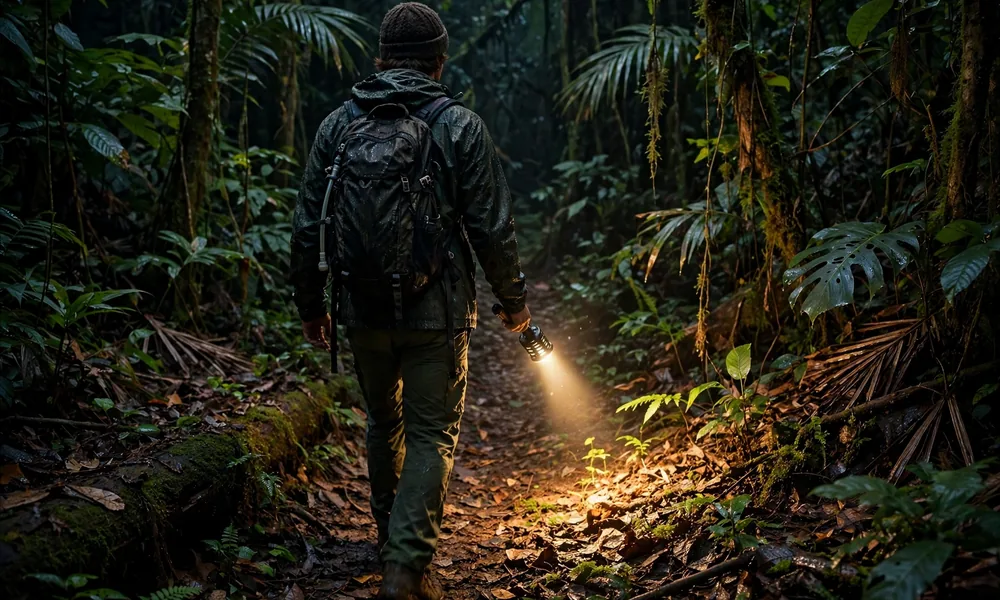
The best hours are the first hours after dark, when the centipedes are out hunting on the forest floor and the air is still warm and damp from the day. From about dusk until midnight, the centipedes are at their most active, crawling, feeling the way with their antennae and striking at prey, and they are at their most visible then, moving across the leaf litter where a careful observer with a torch can see the reddish-brown body and the yellow legs. A guided night walk with a local guide, in the wet season, is the best way to see one in the wild.
Staying safe around giant centipedes
A giant centipede is dangerous to people who pick it up, or step on it, or put a hand where it is hiding, and the safety warning is a simple one: never pick up a giant centipede, never put your hand into a log, a rock pile or a dark crevice you cannot see inside, and never walk barefoot at night in the forest. The bite is delivered through the forcipules under the head, which can pierce skin, and the venom brings acute, very painful swelling, tingling and redness that can last for hours, with chills, fever and weakness in some cases. There is no antivenom for a centipede bite, and treatment is for the pain and the swelling, so a bite, especially a bite to a child, needs medical attention at once. Shake out shoes and clothes left on the floor before putting them on, and keep children away from logs and rock piles.
Giant centipede watching checklist
A little preparation turns a night in the forest into a real chance of seeing a giant centipede at its best, patterned on the leaf litter in the warm, damp dark.
- A guided night walk with a local guide in the wet season, when the forest floor is damp and the centipedes are most active.
- An evening walk after dark, when the centipedes are out hunting on the leaf litter and their reddish-brown bodies show in a torch beam.
- Sturdy closed boots and long trousers, so you can walk the forest floor without putting a bare foot where a centipede is hiding.
- A torch with a gentle beam, so you can find the centipedes without blinding the forest wildlife.
- Gloves for lifting logs, and a rule never to put a bare hand into a log, a rock pile or a dark crevice you cannot see inside.
- A field guide to the centipedes of South America, so you can tell an Amazonian giant centipede from a giant desert centipede.
- Respect for the centipedes and the forest, keeping your hands off every animal, keeping your distance, and leaving the forest as you found it.
Frequently asked questions
How big do giant centipedes get?
Giant centipedes range from a few centimetres to about 30 centimetres long, and the Amazonian giant centipede, Scolopendra gigantea, is the largest of them all, growing to about 30 centimetres, about 12 inches, with most adults measuring 26 to 30 centimetres. The giant desert centipede grows to about 20 centimetres, the Vietnamese centipede grows to about 20 centimetres, and the waterfall centipede reaches about 20 centimetres. A newly hatched giant centipede is only a few millimetres long, and it must moult many times before it reaches adult size.
What do giant centipedes eat?
A giant centipede eats whatever it can overpower and kill: large insects, worms, snails, spiders, millipedes, scorpions and even tarantulas, and then, for the biggest centipedes, small vertebrates as well, small lizards, frogs up to 9.5 centimetres long, snakes up to 25 centimetres long, sparrow-sized birds, mice and bats. The centipede does not chase its prey far, because the venom paralyses the prey in seconds. In a Venezuelan cave, Amazonian giant centipedes have been seen hanging from the cave ceiling and catching bats out of the air.
Are giant centipedes dangerous to people?
Yes, giant centipedes are dangerous to people who pick them up or step on them, and the bite is acutely painful, bringing swelling, tingling and redness that can last for hours, and in some cases chills, fever and weakness. The venom is delivered through a pair of modified legs called forcipules under the head, and it is strong enough to kill a mouse or a bat. At least one human death has been attributed to Scolopendra gigantea, a four-year-old child in Venezuela in 2014 who died after being bitten by a giant centipede hidden inside an open soda can. There is no antivenom, and a bite, especially a bite to a child, needs medical attention at once.
Where do giant centipedes live?
Giant centipedes live in warm, damp places, above all in the tropical and subtropical forests of northern South America, from Colombia and Venezuela across to Brazil, and on the islands of the southern Caribbean, Trinidad, Margarita Island, Curacao and Aruba. They live in tropical rainforest and in tropical dry forest, in leaf litter, under rocks and logs, in rotting wood, in the soil, and in caves, and they climb trees as readily as they crawl on the ground. They spend nearly their whole lives on the forest floor, hidden under a log or a rock by day and crawling across the ground by night.
Can you keep a giant centipede as a pet?
You can, in places where it is legal, but you should think hard before you do, and you must never handle one with bare hands. Giant centipedes are venomous, and a bite from an Amazonian giant centipede is acutely painful and can put a person in hospital. They are also difficult to keep, needing a warm, damp enclosure, live prey and deep leaf litter, and they are nocturnal, so they are most active when their keeper is going to bed. A giant centipede that escapes must never be released where it does not belong, because it could harm the local wildlife, and a pet centipede should be kept alone, because they are solitary and will fight.
How is this guide different from the fire ant guide?
This guide covers the giant centipede, a solitary, nocturnal hunter a foot long, Scolopendra gigantea and its relatives, that lives alone under leaf litter and logs in South American rainforests, hunts by itself with venom claws, and eats frogs, lizards, mice and even bats, while our fire ant guide covers tiny social insects a few millimetres long that live in colonies of thousands, work together, and sting in groups when their nest is disturbed. One is a single animal the length of a ruler, hunting alone in the dark; the other is a crowd of tiny insects that only makes sense as a colony, and the two could hardly be more different in size, in how they live, and in how you meet them.
This guide also goes well beyond our general centipede guide, which covers centipedes as a whole, the small house and garden centipedes most people meet, their shared body plan and their place in the animal kingdom. Where that guide gives the broad picture, this one stays with the giants: the Amazonian giant centipede at about 30 centimetres, its named relatives the giant desert centipede, the Vietnamese centipede and the waterfall centipede, the bat hunting in Venezuelan caves, the mother coiled around her eggs, and the watching and safety advice for a venomous hunter a foot long. If you want to know what a centipede is, read the general guide; if you want to know the largest centipede in the world, read this one.
Conclusion
The giant centipede species are a reminder that a centipede does not need to be small, or harmless, or forgettable to be fascinating. A body a foot long, a pair of legs on every segment, venom claws under the head, a mother that coils around her eggs for weeks, and a hunt that can end with a bat caught out of the air have made the giant centipede the most famous hunter of the forest floor, at home in the warm, damp forests from Colombia to Trinidad.
If you go looking for one, go on a guided night walk in the wet season, go after dark, and walk slowly over the leaf litter with your eyes on the ground. Find the fallen logs and the damp leaf litter, watch for a reddish-brown body and yellow legs moving in the torch beam, and you will have met the giant centipede that turns a quiet stretch of forest into a place of sudden, beautiful danger. Look, and do not touch.