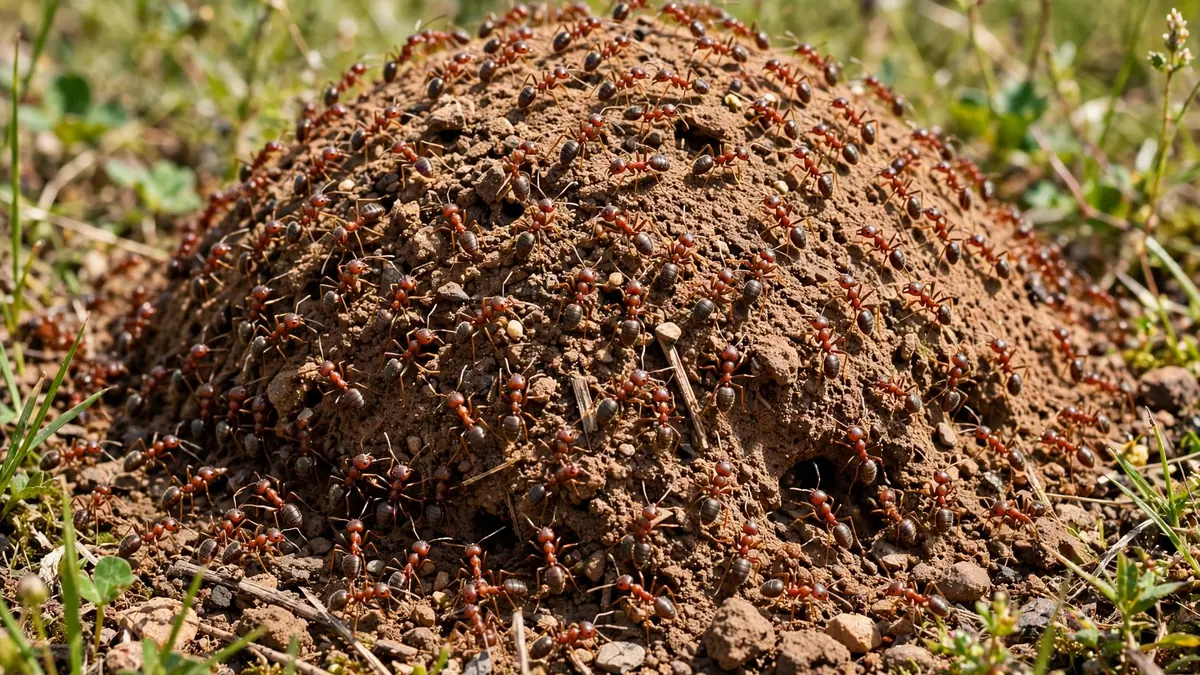
The fire ant species is a small reddish-brown ant with a sting that burns like fire, and the red imported fire ant, Solenopsis invicta, is the most famous of them all. If you are asking what a fire ant is, the short answer is a tiny ant, only about 2.4 to 6 millimetres long, that lives in huge colonies of tens of thousands, builds dome-shaped mounds of soil in sunny open ground, and defends its nest by swarming onto anything that disturbs it, biting to hold on and stinging again and again with a venom that raises a burning welt and, a day later, a white pustule. It is small enough to overlook and numerous enough to change whole landscapes.
What makes the fire ant so remarkable is not its size but its success. A single queen can lay up to 1,500 eggs a day, a mature colony can hold up to 240,000 workers, and a colony that floods can link its bodies into a living raft and float away to dry ground. From its home on the floodplains of central South America, the red imported fire ant has spread, by accident and by trade, across the southern United States and on to Australia, China and Taiwan, becoming one of the most costly invasive insects on Earth.
Key takeaways
- The fire ant species in this guide is the red imported fire ant, Solenopsis invicta, a small reddish-brown ant from South America with polymorphic workers about 2.4 to 6 millimetres long.
- A mature colony holds typically about 80,000 workers and up to 240,000, living in a dome-shaped soil mound up to about 40 centimetres high, with a single queen or, in some colonies, hundreds of queens.
- The sting burns because the venom is about 95 per cent solenopsin, a family of alkaloids, and a white pustule usually appears at each sting site about a day later.
- Fire ants are omnivores, eating seeds, insects, small vertebrates and honeydew, and they forage at soil temperatures between about 12 and 51 degrees Celsius.
- The species is one of the world’s worst invasive insects, spreading from South America to the southern United States in the 1930s and now found on several continents, where it costs billions of dollars a year.
The fire ant species and their relatives
Fire ants belong to the family Formicidae, the great family of ants that occurs on every continent except Antarctica, and the family sits in the order Hymenoptera, alongside the bees and the wasps. Ants are social insects, and the family holds more than 12,000 described species, from tiny garden ants a few millimetres long to giant hunting ants several centimetres long, all of them living in colonies built around a queen. Within the family, the fire ant sits in the subfamily Myrmicinae, one of the largest subfamilies of ants, and in the genus Solenopsis, a group of small stinging ants that includes the fire ants and the tiny thief ants that steal food from the nests of other ants.
The red imported fire ant, Solenopsis invicta, is the lead species of this guide, and it is the ant that defines its whole group, largely because it is so much more aggressive and so much more widespread than any of its relatives. It is native to the floodplains of central South America, in Brazil, Argentina, Paraguay and Uruguay, and it was carried to the United States by accident in the 1930s, arriving in ship ballast at Mobile, Alabama, from where it spread across the whole of the southern United States. Like the ant in general, the fire ant is a social insect that lives in a colony built around a queen, but the ordinary garden ant is a shy creature of lawns and pavements that runs away from trouble, while the fire ant is an aggressive defender that swarms and stings anything that touches its mound.
| Type | Animal | Where it lives | Best-known food | Length or Weight |
|---|---|---|---|---|
| Family | Ants (Formicidae) | Worldwide except Antarctica | Seeds, insects and honeydew | About 2 mm to 30 mm long |
| Genus | Fire ants (Solenopsis) | The Americas, now worldwide | Seeds, insects and small animals | About 2 mm to 6 mm long |
| Species | Red imported fire ant (Solenopsis invicta) | South America, southern USA and beyond | Seeds, insects and honeydew | About 2.4 mm to 6 mm long |
| Species | Black imported fire ant (Solenopsis richteri) | South America and the southern USA | Seeds, insects and honeydew | About 3 mm to 6 mm long |
| Species | Tropical fire ant (Solenopsis geminata) | The Americas and the tropics | Seeds, insects and honeydew | About 3 mm to 6 mm long |
| Species | Thief ant (Solenopsis molesta) | North America | Food stolen from other ants | About 1.5 mm to 2 mm long |
The closest relatives of the red imported fire ant are the other fire ants of the genus Solenopsis, a group of small stinging ants that share its reddish colour, its two-segmented waist and its habit of building soil mounds. The black imported fire ant, Solenopsis richteri, is its nearest cousin, a darker ant from the same part of South America that was also carried to the United States, and the two species have even hybridised where their ranges meet in the southern states. The tropical fire ant, Solenopsis geminata, is the native fire ant of the southern United States and Mexico, and it was the common fire ant of the region before the red imported fire ant arrived and pushed it out of much of its range. The tiny thief ant, Solenopsis molesta, only about 1.5 to 2 millimetres long, lives by stealing food from the nests of larger ants.
What fire ants look like
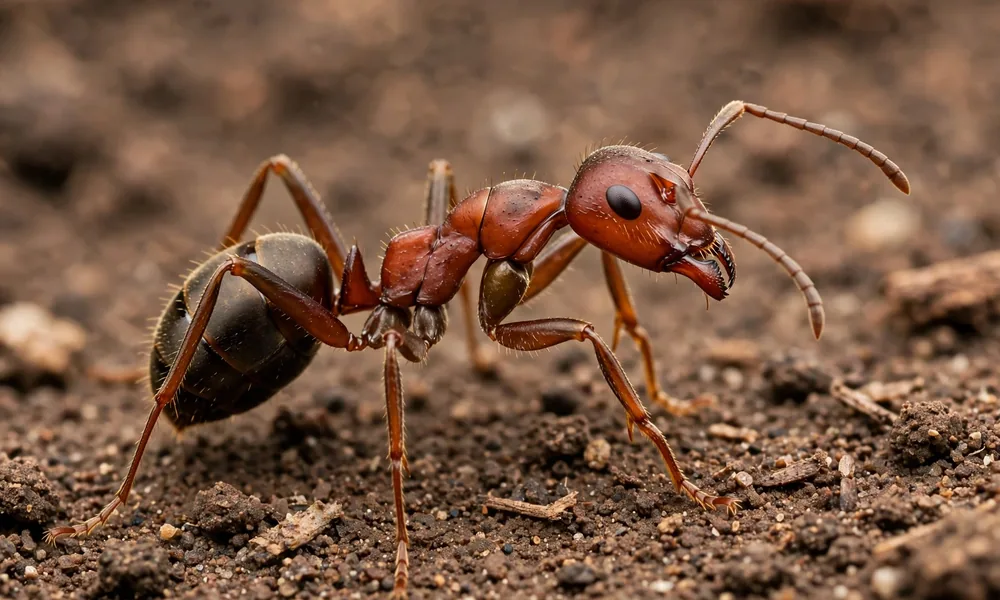
A red imported fire ant is a small ant, and it is easy to walk past without noticing, which is part of the danger. The workers are polymorphic, which means they come in many sizes within a single colony, from tiny minor workers about 2.4 millimetres long to large major workers about 6 millimetres long, with every size in between, and the size of a worker decides its job, with the small workers tending the brood and the large workers defending the nest and cracking open seeds. The body is reddish-brown, with a darker, almost black gaster, or rear end, and the whole ant is covered in fine hairs that give it a slightly fuzzy look under a lens.
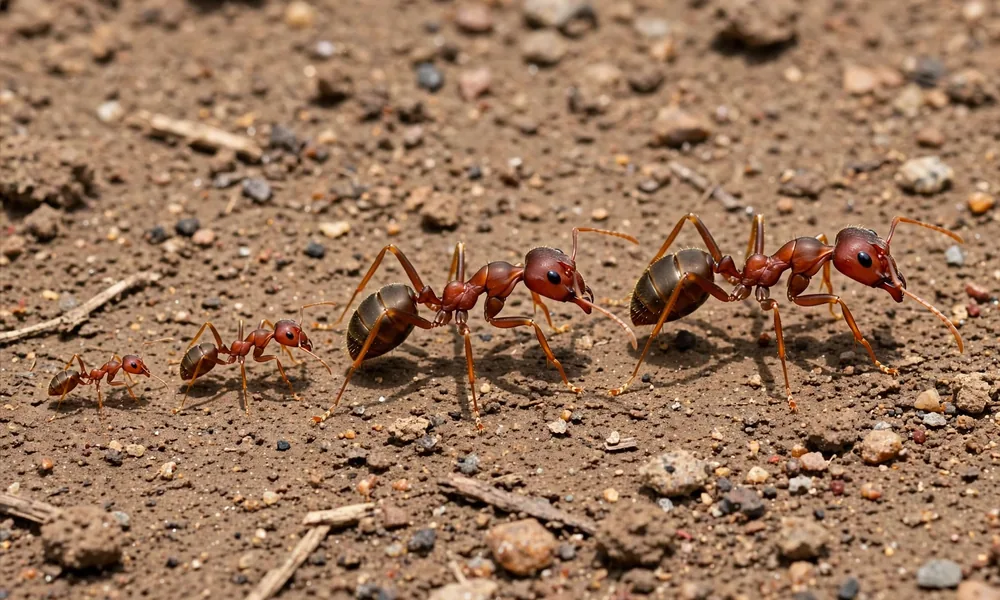
The details are what give the fire ant away to anyone who looks closely. The antennae have ten segments and end in a two-segmented club, the mandibles have four distinct teeth, and the waist has two segments, which is the mark of the subfamily Myrmicinae. The sting sits at the tip of the gaster, and it is the ant’s real weapon, a sharp needle that injects venom into anything the ant can hold onto with its jaws. The queens are larger than the workers, about 8 to 9 millimetres long, with a darker reddish-brown body and wings before their mating flight, which they shed afterwards, and the males are black, winged, and short-lived, dying soon after they mate.
Where fire ants live
Fire ants are animals of open, sunny ground, and their home is a mound of soil that is hard to miss once you know what to look for. The red imported fire ant is native to the floodplains of central South America, where it lives in open grassland and along riverbanks, but it has spread far beyond that home, and it now lives across the southern United States, from Florida and Texas to California and Virginia, and in parts of Australia, China, Taiwan and the Caribbean. It is a creature of warm climates, and it does best where the winters are mild and the ground stays warm for much of the year.
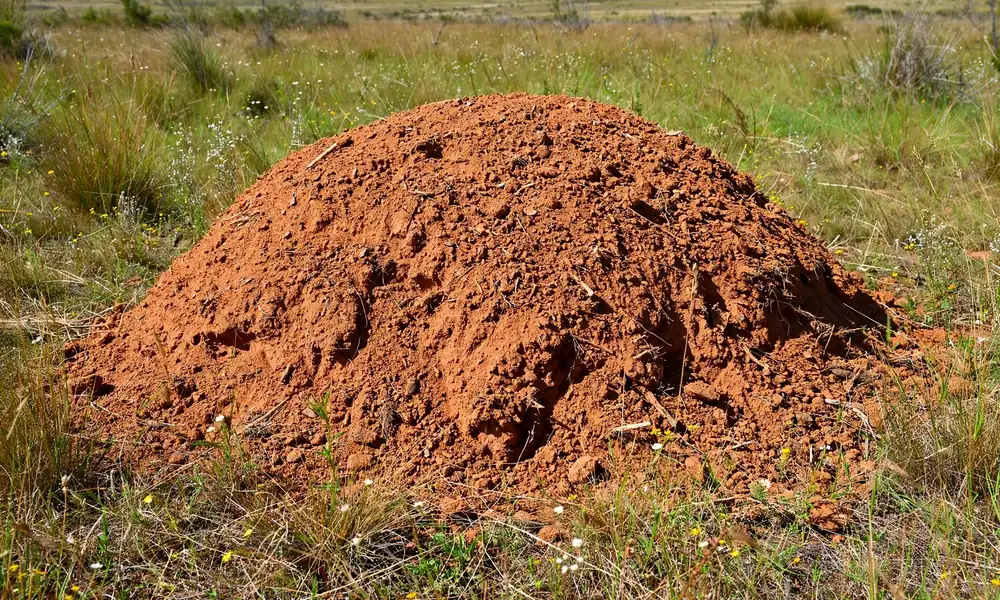
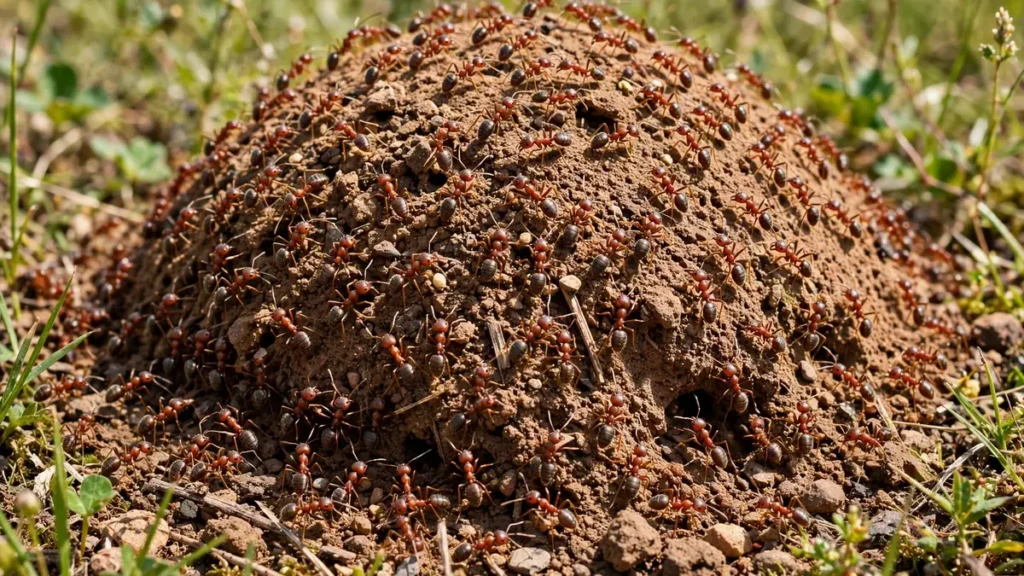
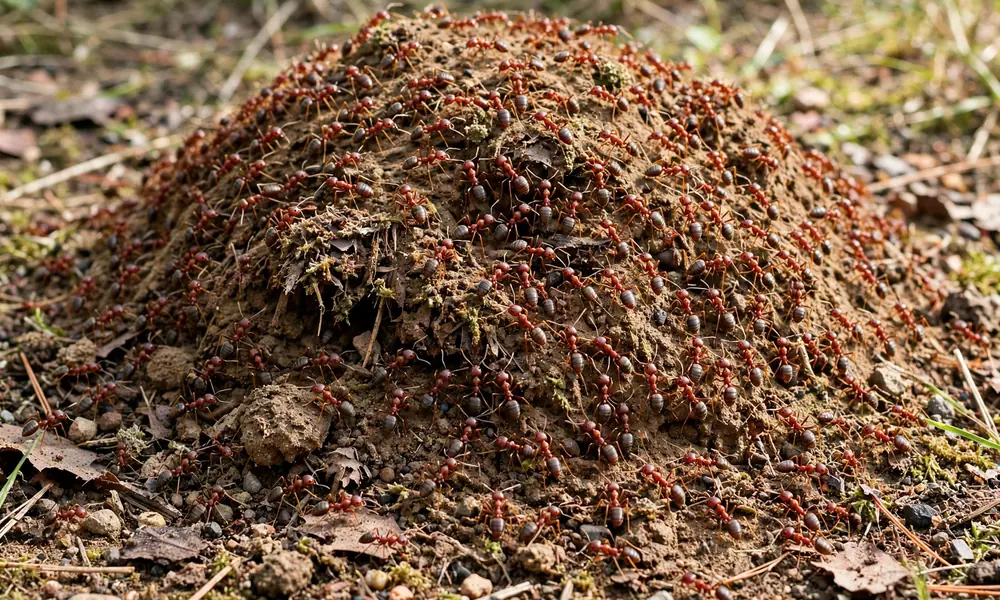
The mound is the most visible part of the colony, and it is a remarkable piece of building. It is a dome of loose soil, up to about 40 centimetres high and seldom wider than about 46 centimetres across, built up from the earth the workers dig out of the tunnels below, and it has no visible entrance, since the foraging tunnels open out onto the surface well away from the mound, and the workers come and go through them. The mound works like a solar heater, and on a cool morning the queen and the brood are moved up into it to warm, while on a hot afternoon they are moved down into the cooler tunnels below.
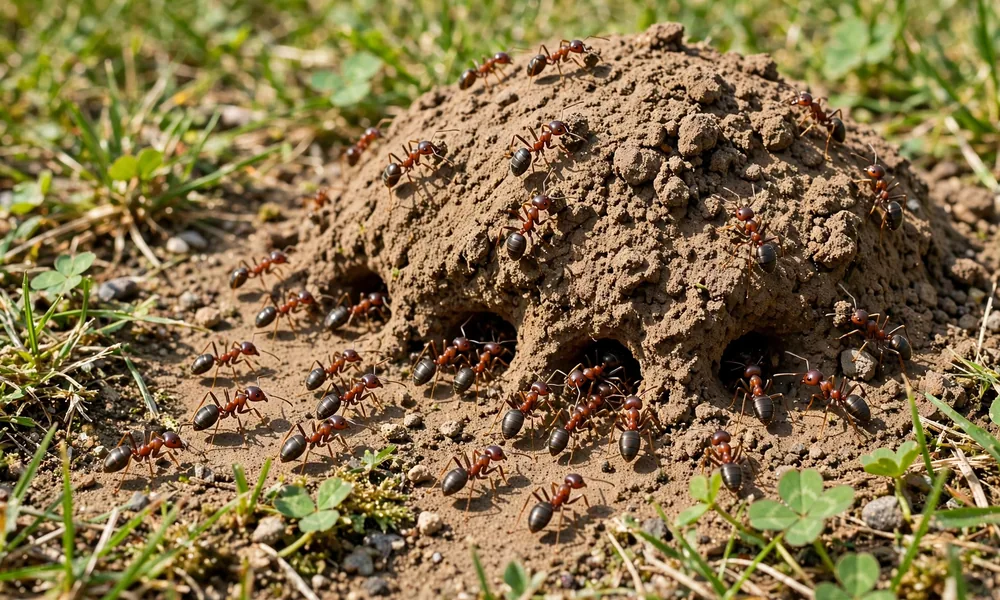
Underground, the colony is far larger than the mound suggests. The tunnels and chambers run down a metre or more into the soil, with nurseries for the brood, stores for seeds, and chambers for the queen, and the whole nest is built to be rebuilt, since a mound that is kicked apart or flooded can be raised again in days. Fire ants also nest under stones, logs, pavements and the foundations of buildings, and in cities they will nest in electrical boxes, in pot plants and under patio slabs, anywhere the soil is warm and undisturbed. A single colony can have several mounds close together, and in areas with many queens the mounds can crowd so thickly that the ground seems to belong to the ants alone.
The range of the red imported fire ant is still growing, and it is watched closely wherever it appears. It reached the United States in the 1930s, in ship ballast unloaded at Mobile, Alabama, and from there it spread by road, by rail and by the movement of soil and pot plants, until it covered the south. It reached Australia in 2001, and it has since been found in China, Taiwan and several Pacific islands, where every new arrival sets off a costly eradication effort. The ants are listed among the world’s worst invasive alien species, and the damage they do runs to billions of dollars a year.
What fire ants eat
Fire ants are omnivores, and they eat almost anything they can find, carry or kill. Their diet is a mix of seeds, which they collect and store in the nest, insects and other small invertebrates, which they hunt and scavenge, and the sweet honeydew that aphids and other sap-feeding insects produce, which they collect by tending the aphids on plants. They also eat small vertebrates when they can, along with human food waste and pet food left out in a garden or a kitchen. Like the centipede, the fire ant is a hunter of the soil surface, but where a centipede hunts alone and takes one prey at a time, a fire ant colony hunts as a swarm, and a hundred workers can strip a dead insect in minutes.
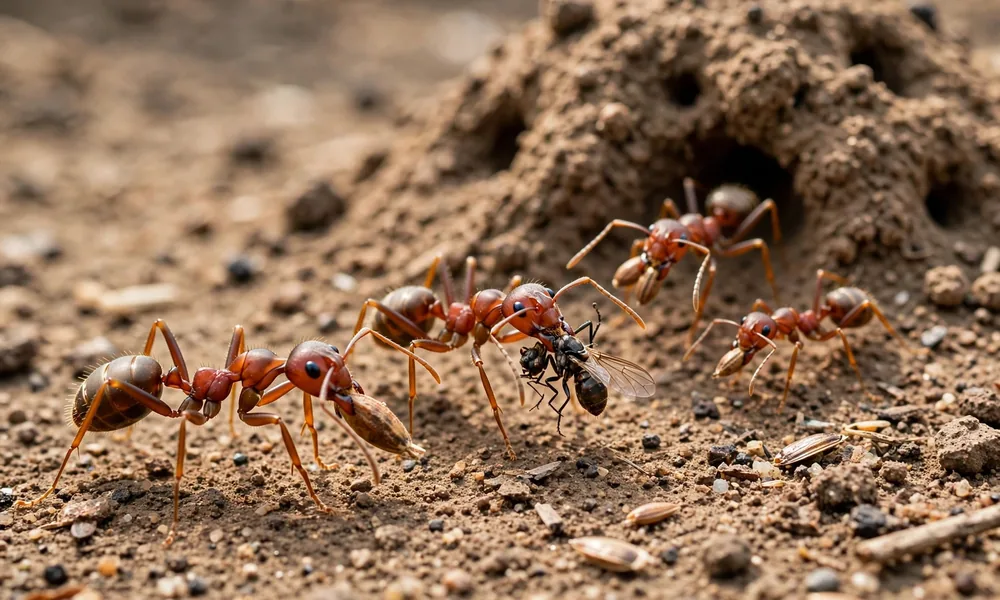
Foraging is done by the workers, and it is done mostly at ground level, along chemical trails that the first ant to find food lays down for the others to follow. The ants forage at soil surface temperatures between about 12 and 51 degrees Celsius, which means they are out for most of the day in warm weather, but they slow down in the heat of the afternoon and in the cold of winter, and they do their heaviest foraging in the morning and the evening. A forager that finds food too big to carry will lay a trail and call in nestmates, until there are enough ants to cut it into pieces and carry it home.
How fire ants behave
Fire ants are aggressive, and their aggression is the first thing anyone who disturbs a mound will learn. When a mound is kicked, stepped on or even brushed against, the workers pour out of the tunnels in seconds, climbing onto whatever touched the nest and stinging it again and again. Each ant bites first, gripping the skin with its mandibles, and then curves its gaster down to inject venom, and it can pivot around its jaws to sting several times without letting go, so a person who stands on a mound can collect dozens of stings before they have time to move away. The alarm spreads fast, since a disturbed worker releases an alarm pheromone that brings nestmates running within seconds.
The venom is what makes the sting burn, and it is chemically unlike the venom of most other ants. About 95 per cent of fire ant venom is solenopsin, a family of oily alkaloid compounds that are not soluble in water and that damage the cells they touch, while the remaining 5 per cent is made up of proteins that cause the allergic reactions some people suffer. The sting hurts at once, with a sharp burning pain, and within minutes the site swells into a red welt that itches fiercely, and about a day later a white pustule, or blister, forms at each sting site, which is the mark of a fire ant sting and nothing else. The pustule is caused by the venom, not by germs, though it can become infected if it is scratched open.
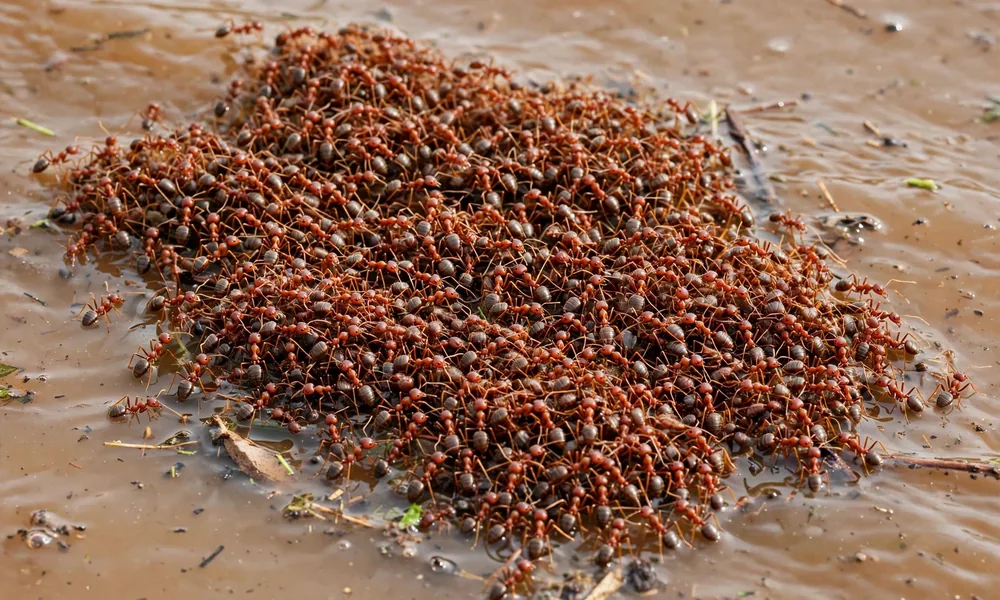
One of the most extraordinary behaviours of the fire ant is rafting, and it is a behaviour that comes straight from its home on the floodplains of South America. When floodwater rises over the nest, the workers link themselves together, leg to leg and jaw to jaw, into a flat living raft, with the queen and the brood carried safely in the middle, and the whole colony floats away on the water until it finds dry ground. The raft can float for days, with air trapped between the bodies keeping the submerged ants alive, and it is one of the reasons the ants are so hard to drown out of a flooded field.
Fire ant colonies come in two social forms, and the difference shapes everything about them. In a monogyne colony there is a single queen, and the workers will kill any other queen that tries to join, while in a polygyne colony there are many queens, sometimes hundreds, and the workers accept them all. Polygyne colonies build more mounds, spread faster and are harder to kill, since killing one queen leaves many more, and they are the form that causes the most trouble in the southern United States. The workers of a polygyne colony are also less aggressive towards neighbouring colonies, so the mounds can crowd together thickly.
Breeding and life cycle
Fire ant colonies grow from a single mated queen, and the start of a colony is one of the most dangerous moments in an ant’s life. After the mating flight, which takes place on warm, humid days in spring and summer, the new queen lands, sheds her wings, and digs a small chamber in the soil, sealing herself inside. Within a day of mating she lays her first eggs, between 10 and 15 of them, which hatch in eight to ten days, and by the time they hatch she has laid 75 to 125 more. She feeds the first larvae from the reserves in her own body, breaking down her wing muscles to nourish them, and she raises the first workers entirely alone.
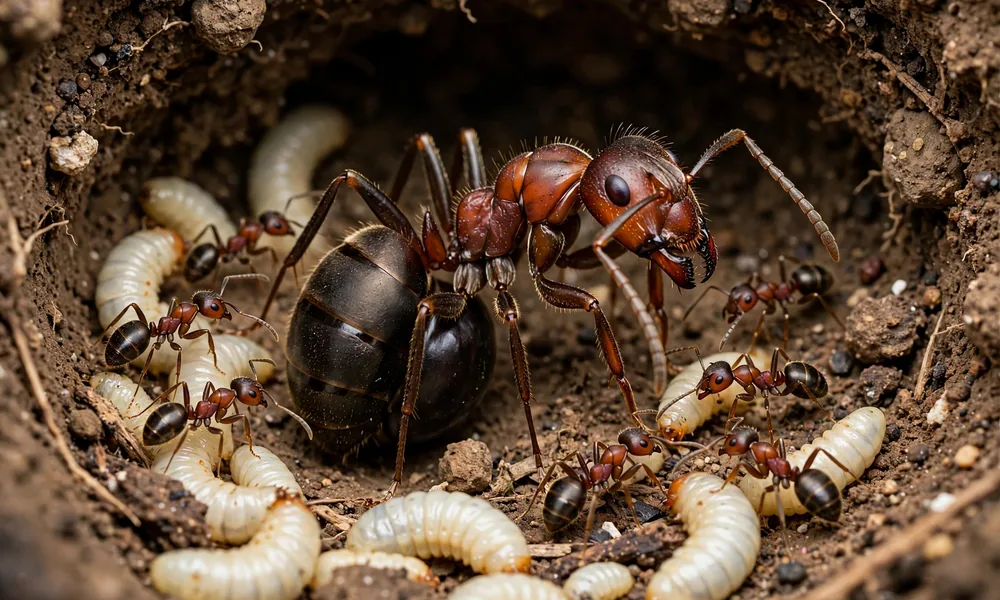
The first workers are small, since the queen can only feed them from her own reserves, but once they are grown they take over the work, digging the mound, foraging for food and tending the brood, and the queen settles into a life of laying eggs. Within a month the colony is producing larger workers, and within six months it holds several thousand workers and the mound can be seen above the ground. A colony reaches full size after a few years, with typically about 80,000 workers and up to 240,000, and it begins to produce its own winged queens and males after about a year, sending them out on mating flights that can carry them for kilometres on the wind.
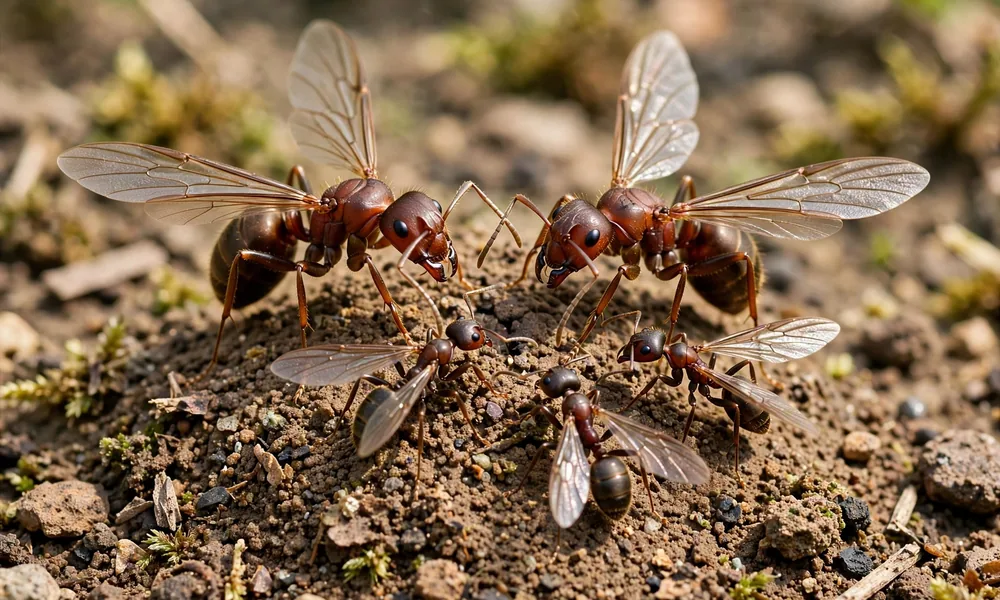
Life in the colony is short for most ants and long for the queen. Minor workers live for about 30 to 60 days, median workers for 60 to 90 days, and major workers for 90 to 180 days, while the queen can live for two to six years, laying eggs for most of that time. The males live only long enough to mate, dying soon after the mating flight, and the winged queens that survive the flight and the founding of a new nest become the queens of the next generation. A single colony can produce as many as 97,000 queens per acre of infested land in a year, which is one reason the ants spread so fast once they arrive in a new place.
The mating flights are the main way new colonies are founded, but they are not the only way. In polygyne colonies, a group of workers and queens can simply walk away from the old nest and found a new one nearby, a process called budding, and this is how the ants spread across a field or a garden, mound by mound, without ever taking to the air. Budding is also how the ants survive control efforts, since a colony that is poisoned may split into several smaller colonies, each with its own queen, and the ants come back stronger than before. It is a slow way to spread, but it is a sure one, and it is why killing fire ants is so difficult.
Conservation status
The red imported fire ant has not been given an IUCN Red List assessment, and it does not need one, since it is not a species in danger of disappearing. It is, instead, one of the most successful invasive species on Earth, and it is listed among the world’s worst invasive alien species, a list drawn up to warn countries about the animals and plants that do the most damage when they arrive somewhere new. The problem with the fire ant is not that it might vanish, but that it is almost impossible to get rid of once it has arrived, and that it pushes out the native ants, insects and small animals that were there before it.
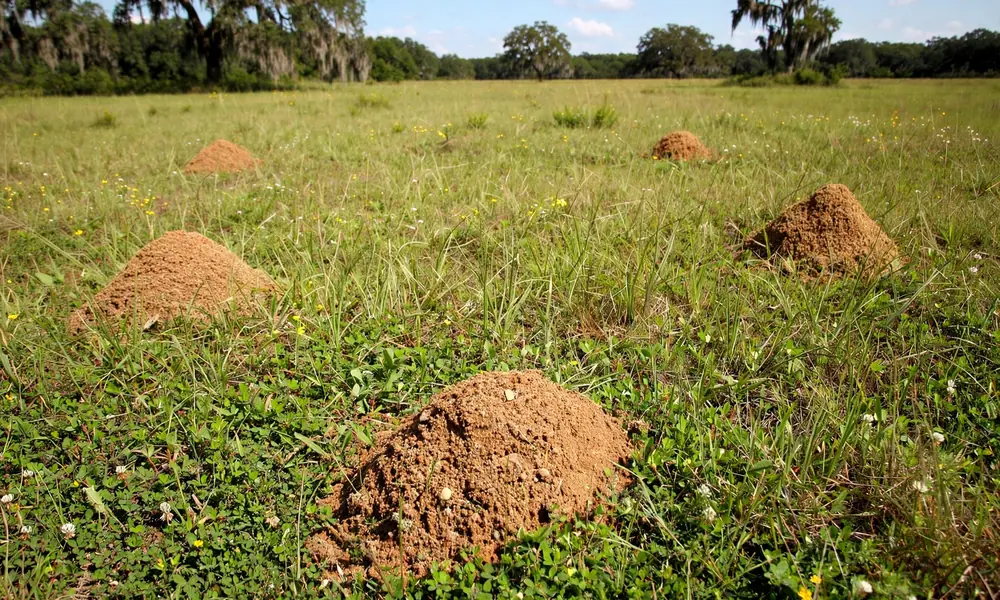
The damage the fire ant does is measured in billions of dollars a year in the United States alone, and it falls on farmers, on homeowners and on wildlife. The ants damage crops by eating seeds and by tending the aphids that damage plants, they sting farm workers and livestock, they invade electrical equipment and cause short circuits, and they kill the native ants, the ground-nesting birds and the small reptiles that share their ground. In Australia, where the ants arrived in 2001, the government has spent hundreds of millions of dollars trying to eradicate them, and the effort is still going on.
Best seasons for fire ant watching
Fire ants are active for most of the year in warm climates, but the best time to watch them is spring and summer, when the colonies are at their busiest and the mounds are at their tallest. In the southern United States the ants are out foraging from early spring, when the soil warms up, through to late autumn, and the mating flights, which are the most dramatic event in the colony’s year, take place on warm, humid days between spring and autumn, usually after rain, when the winged queens and males rise from the mounds in clouds. A colony produces six to eight mating flights a season, each with up to 4,500 winged ants.
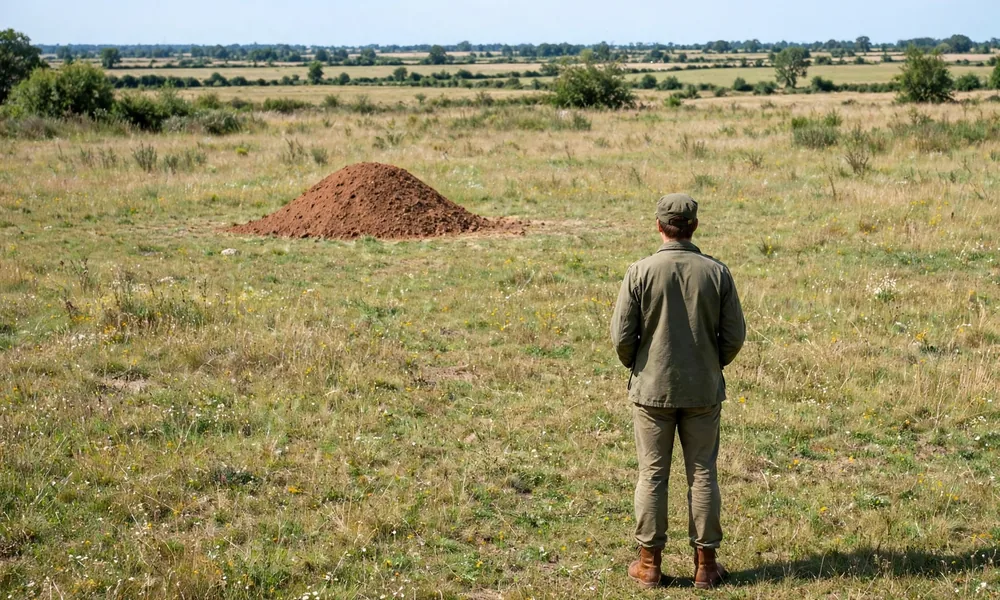
The time of day matters as much as the season. Fire ants forage at soil surface temperatures between about 12 and 51 degrees Celsius, and they are at their busiest in the morning and the evening, when the ground is warm but not baking, and they slow down in the heat of the afternoon, retreating into the cooler tunnels below the mound. The best watching is done in the morning, when the workers are streaming out of the mound in long trails, and after rain, when the ants are out in force, repairing the mound and foraging for the food the rain has brought out. In winter, in the cooler parts of their range, the ants stay deep underground and the mounds go quiet until spring.
Staying safe around fire ants
Fire ants are dangerous in a way that a single ant never is, and the danger comes from numbers. One sting hurts, but a hundred stings can make a healthy adult ill, and a thousand can kill a small animal, so the first rule of staying safe is never to stand on, sit on or lean against a mound, and never to put your hands into one. Wear closed boots, long trousers tucked into your socks, and gloves when you work in a garden or a field where fire ants live, and watch where you step, since a mound can be hidden in long grass or under a pile of leaves.
If you are stung, move away from the mound and brush the ants off with a glove or a cloth, since they will keep stinging as long as they are on you. Do not jump into water, since the ants can float and will sting you there too. Wash the stings with soap and water, keep the skin clean, and do not scratch the pustules open, since that can lead to infection. A cold cloth will help with the pain and the itching, and an antihistamine can help with the swelling, but anyone who develops swelling of the face or lips, difficulty breathing, dizziness or a spreading rash should seek medical help at once, since these are signs of anaphylaxis, a severe allergic reaction that can kill.
Between about 0.6 and 6 per cent of people stung by fire ants develop anaphylaxis, depending on the group studied, and more than 80 deaths have been reported, most of them caused by fewer than five stings. Anyone who knows they are allergic should carry an adrenaline auto-injector, and children, older people and anyone who cannot move quickly away from a mound should be kept well away from it.
Fire ant watching checklist
Use this checklist before you go looking for fire ants in a sunny field or garden, and tick each item off as you prepare.
- Learn what a fire ant mound looks like before you go, so you can spot one from a few metres away and give it a wide berth.
- Wear closed boots, long trousers tucked into your socks, and gloves, and carry insect repellent and drinking water.
- Go in the morning, when the ants are busy foraging, and take binoculars so you can watch the mound from a safe distance.
- Never stand on, sit on or lean against a mound, and never put your hand into one, even if it looks quiet.
- Keep children and pets well away from any mound, and watch where they step in long grass.
- Carry a small first aid kit with soap, a cold pack and antihistamines, and know where the nearest medical help is.
- Leave every mound exactly as you found it, and report any new mound in an uninfested area to the local authorities.
Frequently asked questions
How big do fire ants get?
Red imported fire ant workers are polymorphic, ranging from about 2.4 to 6 millimetres long, with the small minor workers tending the brood and the large major workers defending the nest and cracking seeds. The queens are larger, about 8 to 9 millimetres long, and the males are black and winged. They are small ants, and a single worker is easy to overlook, but a colony can hold up to 240,000 of them, and it is the colony, not the individual, that matters.
What do fire ants eat?
Fire ants are omnivores, and they eat seeds, insects, spiders and other small invertebrates, along with the honeydew that aphids produce, and they will take small vertebrates such as newborn mice and lizards when they can. They also eat human food waste, pet food and anything sweet or fatty left out in a garden or a kitchen. The foragers carry food back to the nest along chemical trails, and the larvae turn solid food into a liquid that feeds the workers and the queen.
How painful is a fire ant sting?
A fire ant sting burns at once, with a sharp pain that comes from the solenopsin in the venom, and within minutes the site swells into a red welt that itches fiercely. About a day later a white pustule forms at each sting site, which is the mark of a fire ant sting. The pain fades in a few hours for most people, but the pustule can last for days, and scratching it open can lead to infection. A small percentage of people, between about 0.6 and 6 per cent in different studies, develop anaphylaxis, a severe allergic reaction that needs medical help at once.
Where do fire ants live?
Red imported fire ants are native to the floodplains of central South America, in Brazil, Argentina, Paraguay and Uruguay, and they now live across the southern United States, from Florida and Texas to California and Virginia, as well as in parts of Australia, China, Taiwan and the Caribbean. They live in open, sunny ground, building dome-shaped mounds of soil up to about 40 centimetres high, and they also nest under stones, pavements and buildings. They reached the United States in the 1930s, in ship ballast unloaded at Mobile, Alabama.
Can you keep fire ants as a pet?
You should not, and in many places you must not. Fire ants are a regulated invasive pest, and keeping them is illegal in several countries and in parts of the United States and Australia, where any colony found is destroyed. They are also dangerous to keep, since a colony can hold a quarter of a million stinging workers, and an escaped queen can found a new colony that spreads into the wild. Anyone who loves ants would do far better with a colony of native ants, which are fascinating, safe to keep and legal to own.
How is this guide different from the emperor scorpion guide?
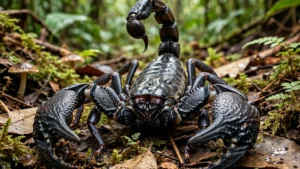
This guide covers the fire ant, a single species, Solenopsis invicta, a tiny reddish-brown ant of about 2.4 to 6 millimetres that lives in colonies of up to 240,000 workers, builds dome-shaped soil mounds in sunny open ground, and defends its nest by swarming and stinging with a burning alkaloid venom, while our emperor scorpion guide covers a large glossy black scorpion of West African rainforests that grows to about 20 centimetres long, lives alone or in small groups in a burrow in damp soil, hunts insects at night with its huge pincers, and stings only rarely, since its venom is mild. One is a tiny ant you meet by the thousand on a sunny lawn; the other is a great armoured hunter you meet alone on the rainforest floor after dark.
This guide also goes further than our general ant guide, which covers ants as a whole, from garden ants to leafcutter ants to army ants. That guide is the place to start if you want to know what an ant is, while this guide stays with one species for its whole length, following the red imported fire ant from its place among the fire ants and its South American home through its mounds and its rafts, its burning sting and its two kinds of colony, its mating flights and its long-lived queen, to the seasons and the checklist that will help you watch it safely.
Conclusion
The fire ant species is a reminder that the smallest animals can do the most damage, and that a creature only a few millimetres long can change a whole landscape. A tiny reddish-brown ant with a burning sting, a queen that lays up to 1,500 eggs a day, a colony that can hold a quarter of a million workers and float away on a flood, it has spread from the floodplains of South America to the lawns and pastures of the world, and it asks for nothing more than warm ground, open sun and food to carry home.
If you live where fire ants live, learn what a mound looks like, give it a wide berth, and wear your boots when you walk the grass. Do that, and the fire ant will stay what it has always been, a fierce and fascinating insect of the open ground, doing its busy work in the sun while you watch from a safe distance.