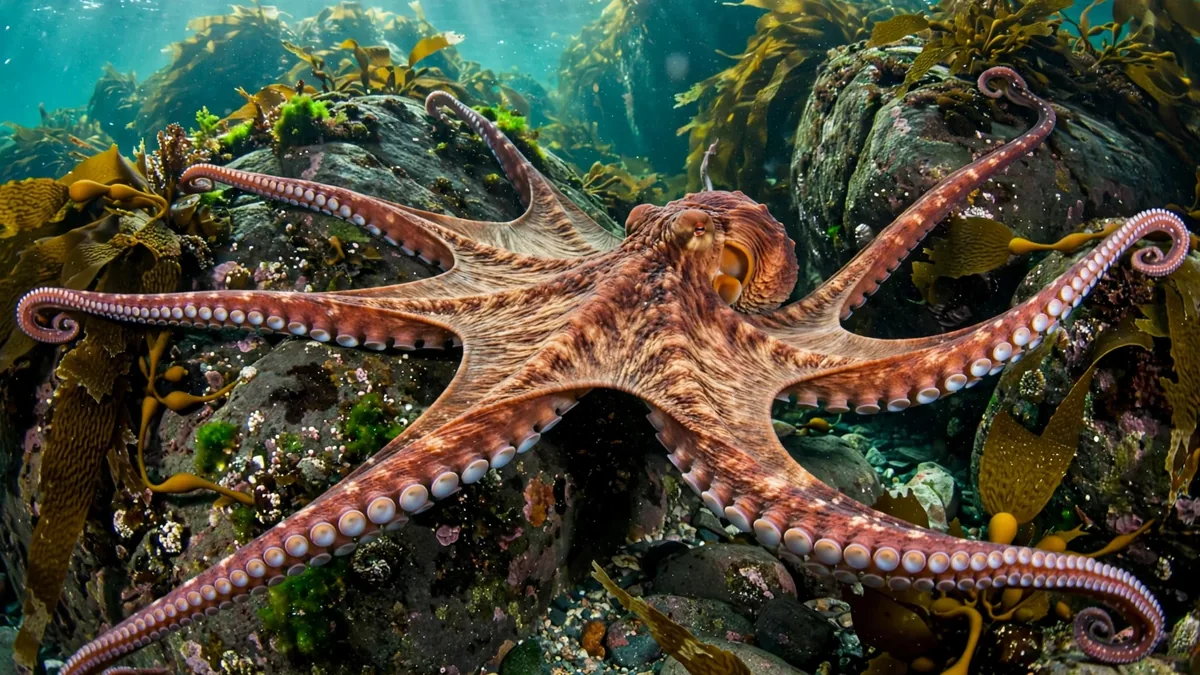
The giant Pacific octopus species is the largest octopus in the world, a reddish-brown hunter of the cold North Pacific that can weigh around 15 kilogrammes as an adult, stretch its eight arms across 4.3 metres, and still live for only three to five years. If you are asking what a giant Pacific octopus is, the short answer is a single species, Enteroctopus dofleini, that lives on rocky reefs from Baja California to Alaska and across to Japan and Korea, hunts crabs and clams at night, and dies after a single breeding season.
What makes this octopus so remarkable is not size alone. It is an animal with three hearts, blue blood, and a beak as its only hard part, and it can pour a body the weight of a large dog through a gap the size of an orange. It changes colour and skin texture in a blink, opens jars from the inside, and remembers the keepers who feed it. The giant Pacific octopus is clever, strong, and short-lived, and that combination is what this guide follows from the tide pools of the Pacific Northwest to the deep reefs off Japan.
Key takeaways
- The giant Pacific octopus species is Enteroctopus dofleini, the largest octopus in the world, with typical adults weighing around 15 kilogrammes and an arm span of up to 4.3 metres.
- The largest verified specimen weighed 71 kilogrammes, or 156 pounds, measured by Canadian researchers, while older claims of 272 kilogrammes and a span of 9.8 metres have never been verified.
- Giant Pacific octopuses live around the cold North Pacific, from Baja California to Alaska and the Aleutian Islands, and across to Kamchatka, Japan and Korea, from the intertidal zone down to 2,000 metres.
- They are nocturnal hunters that eat shrimp, crabs, clams, scallops, lobsters, fish and other octopuses, cracking shells with a parrot-like beak and tasting prey with the suckers on their arms.
- They live for three to five years, breed only once, and are listed as Least Concern, though local numbers can fall where fishing and habitat damage press hard on rocky reefs.
The giant Pacific octopus species and their relatives
Giant Pacific octopuses belong to the phylum Mollusca, and within it they sit in the class Cephalopoda, alongside the squid, the cuttlefish and the nautilus. They are true octopuses of the order Octopoda, and they belong to the family Enteroctopodidae, the giant octopuses, a family recognised in its present form since 2014. The genus Enteroctopus was established in 1998, when anatomical studies showed that these large octopuses differed enough from common octopuses to deserve a genus of their own. Like the animals in our octopus guide, giant Pacific octopuses have eight arms, a beak and a soft body with no shell, but they have taken that plan further than any other octopus, growing larger and living longer than the rest of their family.
The lead species of this guide is Enteroctopus dofleini, described in 1910 by the German zoologist Gerhard Wülker and named in honour of the German zoologist Franz Theodor Doflein, who had studied cephalopods in Japan. The species had been known under other names before that date, and an American naturalist had described it as Octopus punctatus as early as 1862, but Wülker gave it the name that stuck. Enteroctopus dofleini is the largest and best-known member of its genus, and it is the octopus that most aquariums on the Pacific coast of North America keep on display.
| Type | Animal | Where it lives | Best-known food | Length or Weight |
|---|---|---|---|---|
| Family | Giant octopuses (Enteroctopodidae) | Cool temperate oceans | Crabs, molluscs and fish | Most 15 kg, span 4.3 m |
| Genus | Giant octopuses (Enteroctopus) | Cool temperate oceans | Crustaceans, molluscs and fish | Typical 15 kg; largest verified 71 kg |
| Species | Giant Pacific octopus (Enteroctopus dofleini) | North Pacific | Shrimp, crabs, clams and fish | About 15 kg, span up to 4.3 m |
| Species | Southern red octopus (Enteroctopus megalocyathus) | Coasts of southern South America | Crabs and molluscs | Smaller than Enteroctopus dofleini |
| Species | Southern giant octopus (Enteroctopus magnificus) | Coasts of southern Africa | Crabs and molluscs | Smaller than Enteroctopus dofleini |
| Species | New Zealand octopus (Enteroctopus zealandicus) | Coasts of New Zealand | Crabs and molluscs | Smaller than Enteroctopus dofleini |
The closest relatives of Enteroctopus dofleini are the other giant octopuses of the genus Enteroctopus, and the genus holds four recognised species. Enteroctopus megalocyathus, the southern red octopus, lives on the coasts of southern South America. Enteroctopus magnificus, the southern giant octopus, lives on the coasts of southern Africa. Enteroctopus zealandicus lives around New Zealand. Each of them is a large, cold-water octopus, and each is smaller than the giant Pacific octopus, which is the biggest of the four by a clear margin.
What giant Pacific octopuses look like
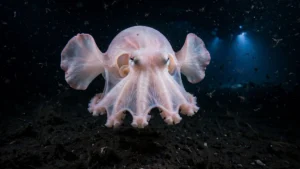
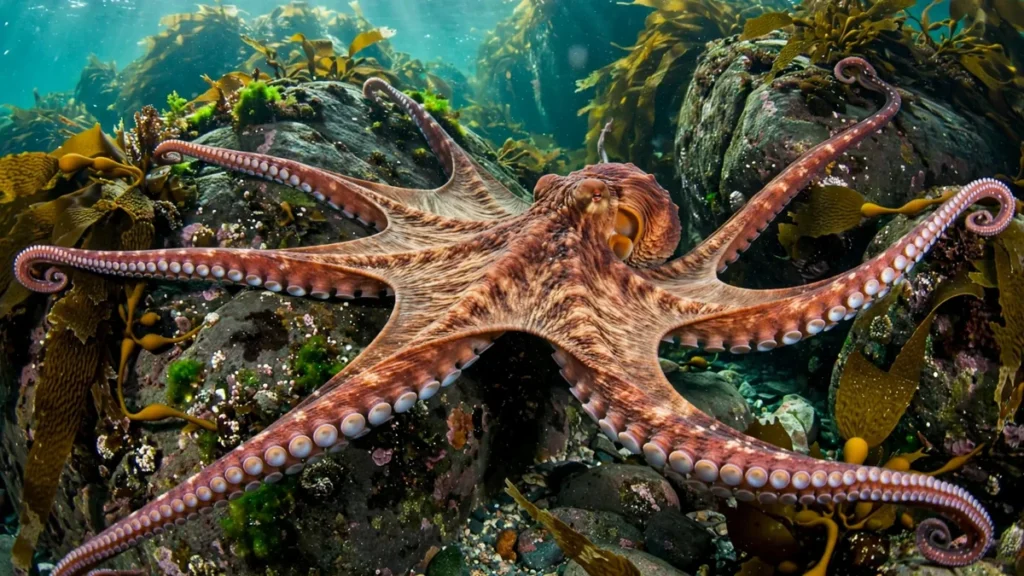
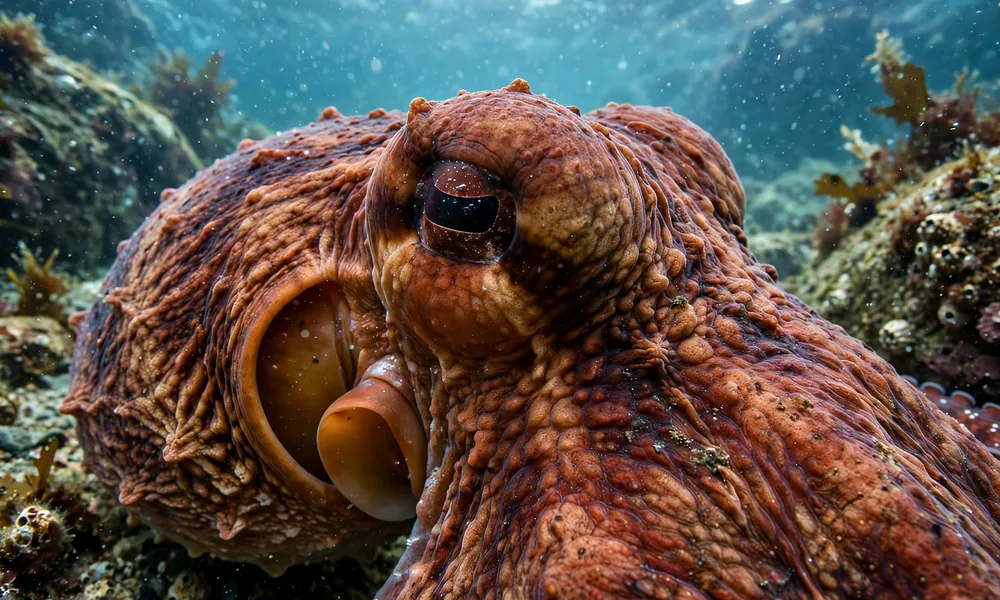
A giant Pacific octopus looks like a great reddish-brown sack of muscle that has learned to flow over rock. The body is soft and boneless, with a large, bulbous mantle that holds the brain, the three hearts, the stomach and the gills, and eight long, muscular arms that spread from the head like the spokes of a wheel. The skin is usually reddish-brown, though it can turn pale grey, dark red or almost white, and it can raise itself into bumps and ridges that match the rock beneath it. The eyes are large and dark, set on either side of the head, and they give the animal a watchful look that visitors to aquariums notice at once.
The size of a giant Pacific octopus depends on age, sex and food, though most adults fall in a familiar range. A typical adult weighs around 15 kilogrammes, about 33 pounds, and its arms can span up to 4.3 metres, about 14 feet, from tip to tip. Larger animals are common in cold, food-rich water, and adults of 10 to 50 kilogrammes are reported regularly. The largest specimen ever verified weighed 71 kilogrammes, or 156 pounds, and it was measured by Canadian researchers. Older stories tell of animals of 272 kilogrammes and spans of 9.8 metres, but no such animal has ever been measured by a scientist. A newly hatched giant Pacific octopus is the size of a grain of rice, and it grows to its full weight in about five years.
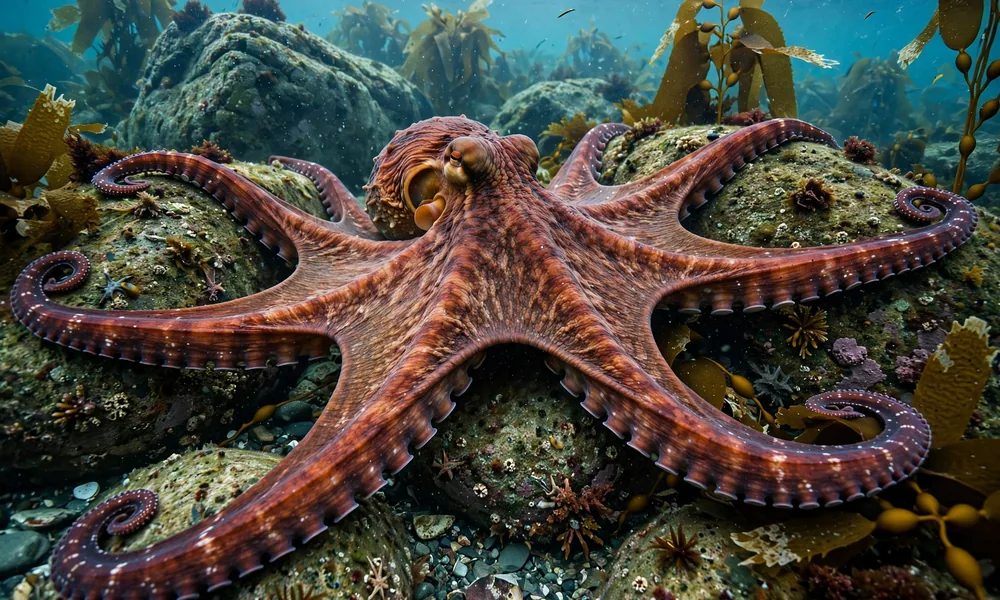
The details of the arms are what make the giant Pacific octopus such a formidable hunter. Each arm carries two rows of suckers, about 280 suckers on a single arm, and 2,140 to 2,240 suckers on the whole animal, according to counts by the Alaska Department of Fish and Game. Each sucker is a disc of muscle that can grip, taste and smell, and the largest sucker on an adult is about 6.4 centimetres across and can support a pull of 16 kilogrammes. The beak sits at the centre of the arms, and it is a sharp, parrot-like structure of chitin, the only hard part of the whole body. Because the beak is the only rigid part, an octopus can squeeze through any gap its beak can pass, and a 23-kilogramme animal has been known to fit through a hole the size of an orange.
It is easy to see why the giant Pacific octopus has become the most famous octopus in the world, and the fame is not just about size. The skin changes colour through cells called chromatophores, which open and close like tiny umbrellas to show red, brown, yellow or black, while deeper layers reflect blue and green light. The animal can also change the texture of its skin, raising papillae to look like a rock or smoothing itself to look like sand. National Geographic notes that the giant Pacific octopus grows bigger and lives longer than any other octopus species. The charm is real, but it hides a tough animal, one that hunts in cold water and squeezes into rocky dens.
Where giant Pacific octopuses live
Giant Pacific octopuses live around the rim of the North Pacific, and their range is set by cold water rather than by latitude alone. They are found from southern California and Baja California, north along the coasts of Oregon, Washington and British Columbia to Alaska and the Aleutian Islands, and across the northern Pacific to Kamchatka and the Sea of Okhotsk, then south through the Sea of Japan to Japan and the Korean Peninsula. The Salish Sea, between Vancouver Island and the mainland of Washington and British Columbia, is one of the best-known places for them, because its cold, oxygen-rich water and rocky reefs suit the species so well.
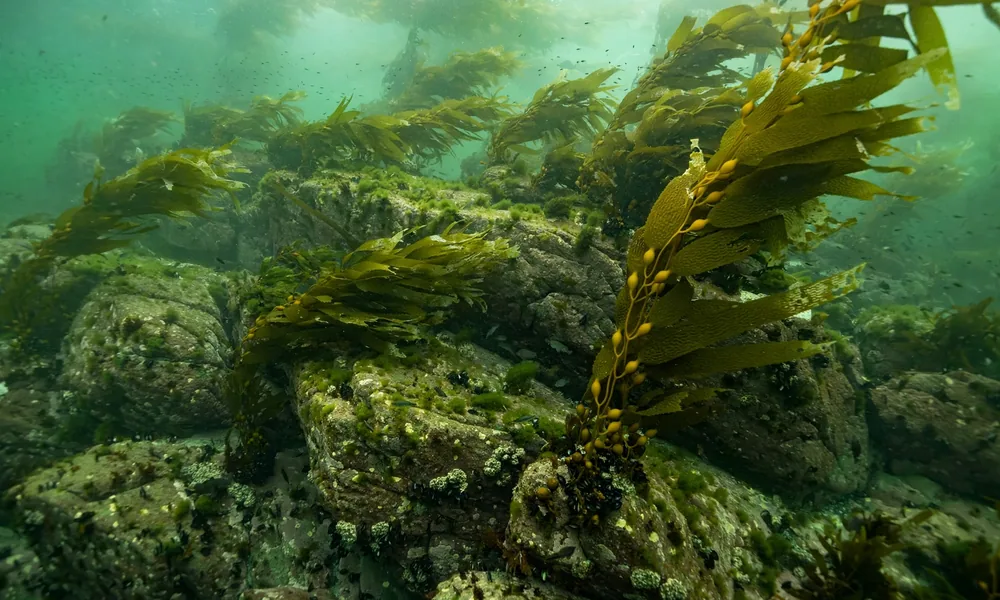
The habitat they choose is the rocky reef, and the depth they favour changes with the latitude. In the cold northern parts of the range, giant Pacific octopuses live in shallow water, from the intertidal zone down to about 100 metres, and they are common on reefs, in kelp forests, and on rocky shores that are uncovered at low tide. In the warmer southern parts of the range, they go deeper to stay in cold water, and they have been recorded from the shallow subtidal down to 1,000 or 1,500 metres, with the deepest records reaching 2,000 metres. They need a den, and a den is usually a crevice in rock, a hollow under a boulder, or a hole in a wreck, somewhere dark and sheltered where a large soft animal can rest in safety by day.
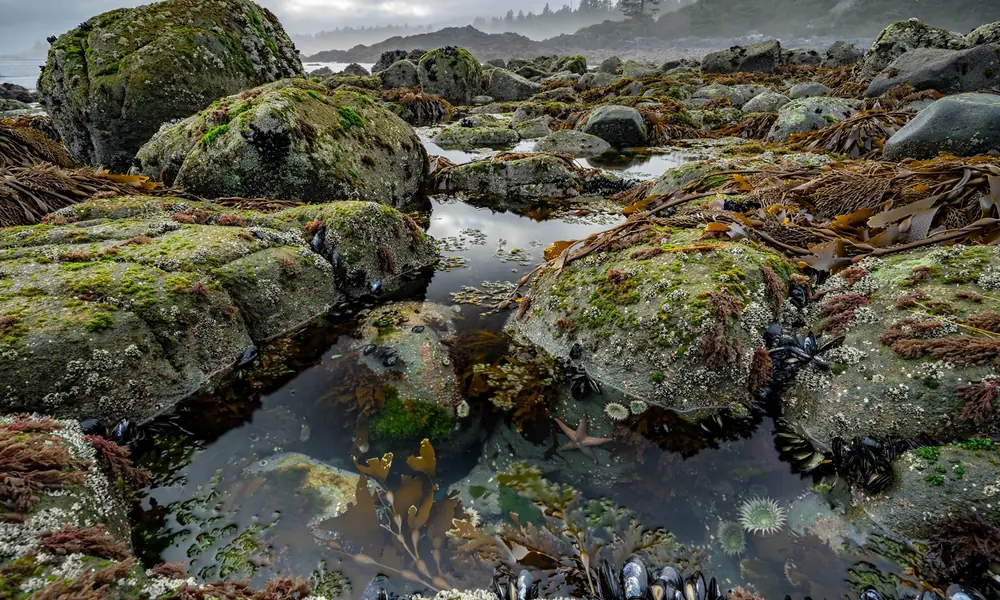
The range of the species is so wide that local animals can differ in habit, and the most interesting difference is in Japan. There the giant Pacific octopus migrates seasonally between shallow and deep water, moving inshore when the water is cool and offshore when it warms, and it is the most commercially important octopus in the country, with annual catches of around 20,000 tonnes, most of them from the coastal waters of Hokkaido. In the eastern North Pacific there is no such seasonal movement, and there is no directed fishery for the species, though animals are caught as bycatch. The species is common across its whole range, and it is the octopus most often met by divers and fishermen in Alaska.
What giant Pacific octopuses eat
Giant Pacific octopuses are carnivores, and their diet is written in the shellfish of the rocky reef. They eat shrimp and crabs, scallops, abalones, cockles, snails, clams and lobsters, and they take fish, squid and other octopuses when they can catch them. They are generalist predators, which means they will eat almost anything they can overpower, and they have even been known to attack small sharks and to drown seabirds that stray within reach of their arms. A photograph taken in 2012 showed a wild giant Pacific octopus attacking a seagull at the surface.
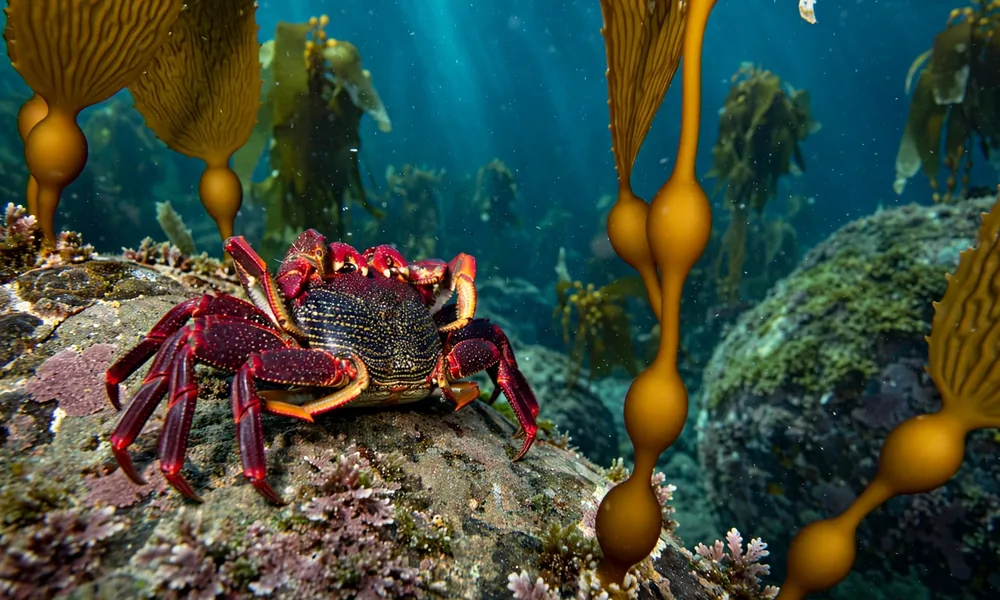
How a giant Pacific octopus eats is as interesting as what it eats. It hunts mostly at night, leaving its den after dark and feeling its way across the reef with the suckers on its arms, which can taste as well as grip. When it finds a crab, it wraps its arms around it and bites it with its beak. When it finds a clam or a scallop, it has two ways of opening it. It can pull the shell apart with its arms, using suckers that together can lift far more than the animal weighs, or it can drill a neat hole in the shell with its radula, the tooth-like ribbon in its mouth, and inject a venom that loosens the muscle inside. The octopus then eats the soft flesh and leaves the empty shell outside its den, and a pile of clean shells is the surest sign that one lives nearby.
How giant Pacific octopuses behave
Giant Pacific octopuses are solitary, intelligent animals, and their behaviour is the behaviour of an animal that has a great deal to think about and very little time to do it in. They spend the day in a den, resting with their arms curled beneath them, and they come out at night to hunt, returning to the same den for weeks or months at a time. They do not form groups, and each animal lives alone on its patch of reef, meeting another of its kind only when it is time to mate. They move by crawling over rock on their arms, and they can swim by jetting water through their funnel, though they rarely do, because crawling is cheaper and the reef is full of handholds.
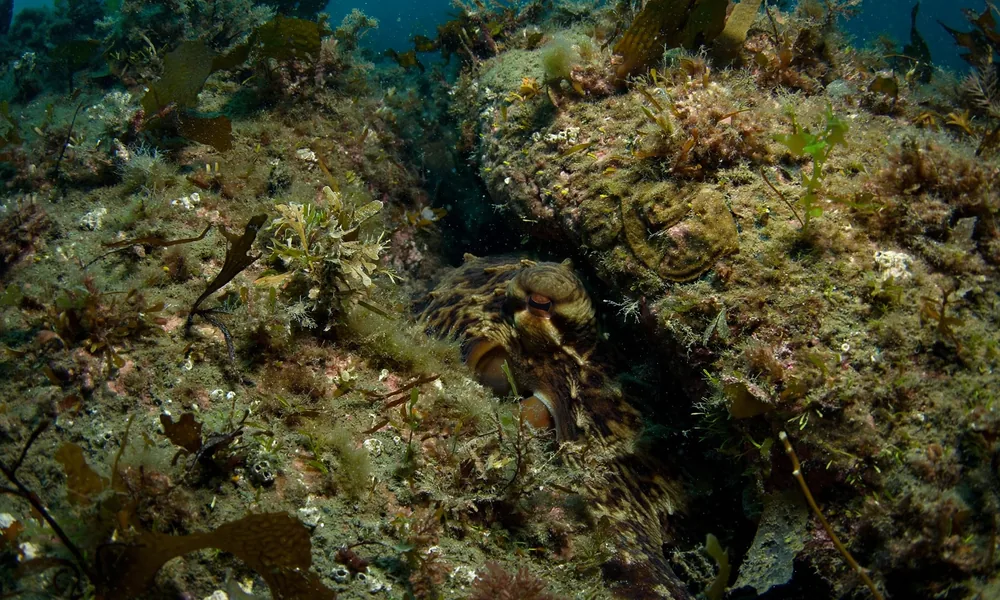
The most remarkable behaviour in a giant Pacific octopus is its intelligence, and the evidence for it comes from aquariums as much as from the wild. Captive animals have learned to open jars from the inside, to unscrew lids, to solve mazes, and to recognise individual keepers by sight, coming to the glass for one person and hiding from another. In the wild, the same cleverness shows in the way an octopus chooses a den and remembers where the good hunting is. The animal carries most of its nerve cells in its arms rather than in its central brain, and each arm can taste, touch and act almost on its own. Octopuses are the only invertebrates named in the Cambridge Declaration on Consciousness, and the giant Pacific octopus is the best-known example of why that honour was given.
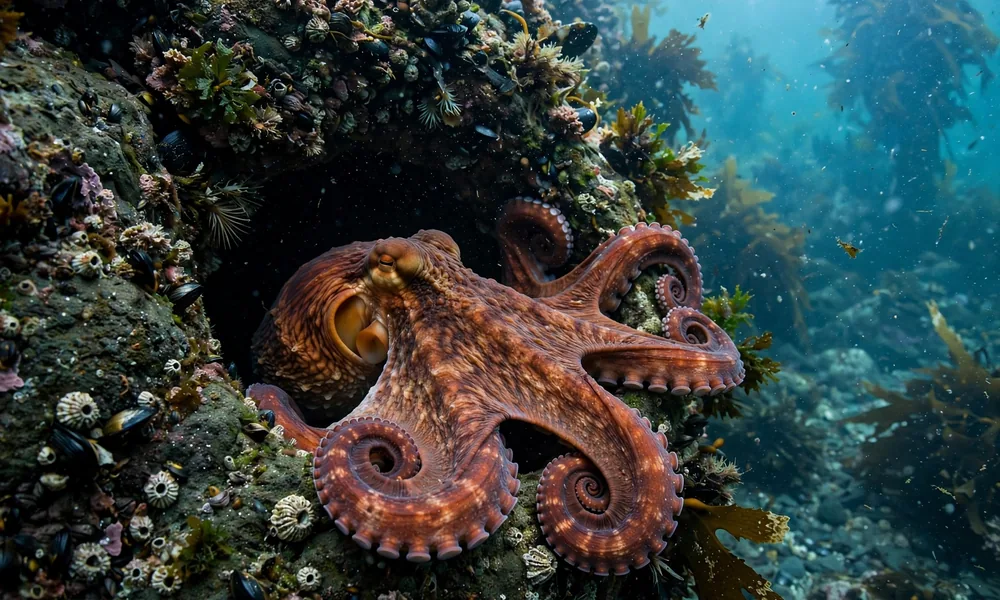
Predators are a real threat to a giant Pacific octopus, because it is a large, soft, and very edible animal. Sea otters, harbour seals, sharks and large fish all eat them, and a big octopus that leaves its den in daylight is taking a risk. The octopus defends itself first by hiding, using colour and texture to vanish against the reef, and then by squirting a cloud of sepia ink when it is threatened, which confuses the predator while the octopus jets away. If it is caught, it can lose an arm to escape, and the arm grows back. The greatest defence of all is the den itself, because an octopus in a crevice can brace its suckers against the rock and hold on with a force that few predators can beat.
Breeding and life cycle
Giant Pacific octopuses breed only once in their lives, and the breeding season is the end of the story for both sexes. A male finds a female near the end of his life and passes a spermatophore, a packet of sperm more than a metre long, into her mantle, using a specialised arm called the hectocotylus, which is the third arm on his right side and has a tip without suckers. The female stores the sperm until she is ready to lay her eggs, and the male dies within a few weeks of mating, worn out and wandering, easy prey for anything that finds him. Mating happens in late winter and early spring in many parts of the range, and in the Gulf of Alaska it is thought to happen mainly in spring and summer.
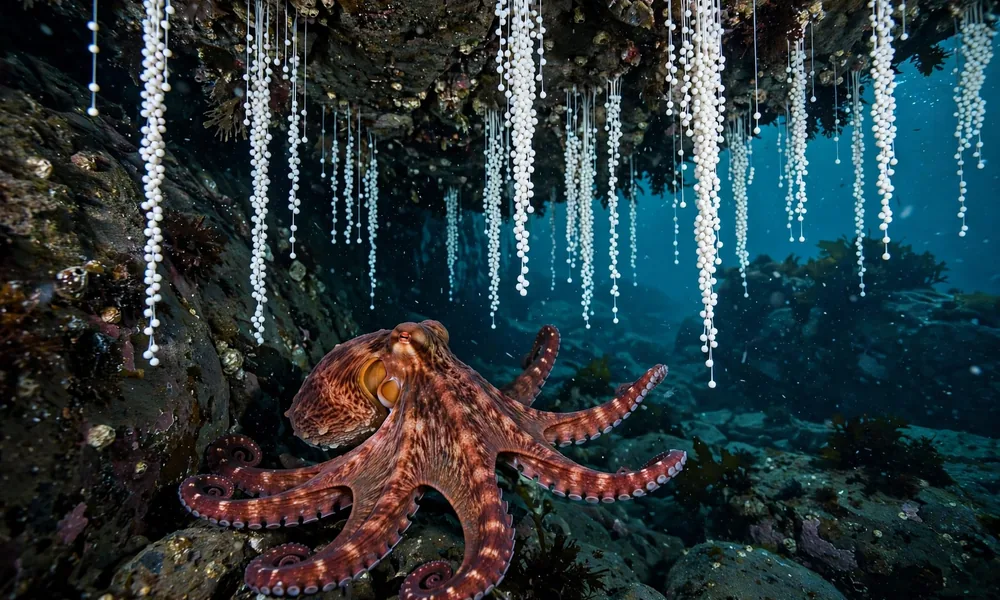
The female lays her eggs about 40 days after mating, and she lays a great many of them. The number most often quoted is between 120,000 and 400,000 eggs, laid in long strings that she attaches to the roof and walls of her den, and she stays with them for about six months, blowing water over them to bring them oxygen and grooming them with her arms to keep algae and parasites away. She does not leave the den, and she does not eat, and she lives on her own body fat until the eggs hatch. The eggs take five to seven months to hatch in water of 9 to 14 degrees Celsius, and when they do hatch, the female dies, starved and spent, within days. She has given her whole life to a single brood, and there is no second chance.
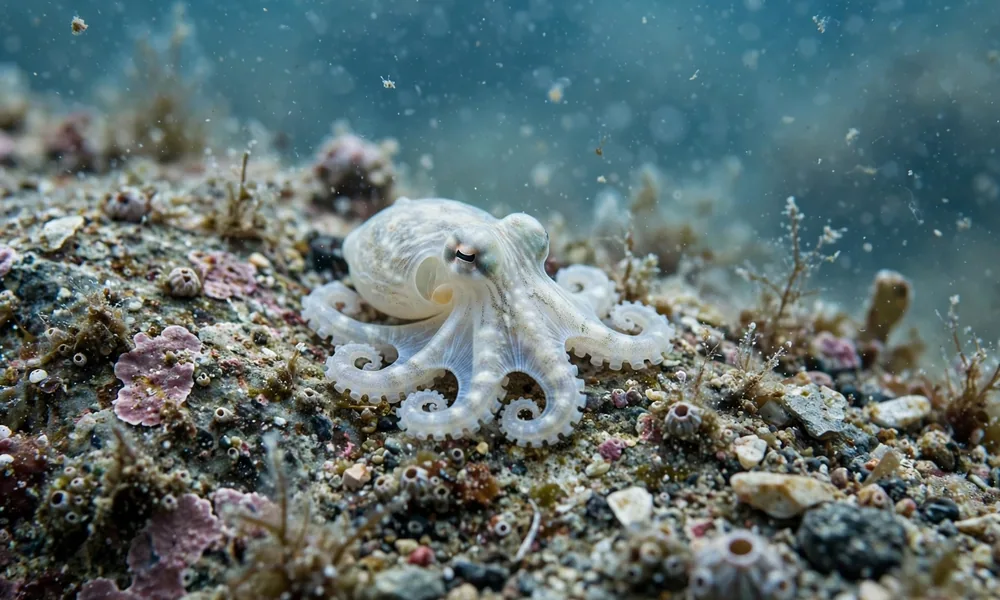
The young that hatch from those eggs are paralarvae, tiny animals the size of a grain of rice that drift in the plankton for several weeks before they settle on the seafloor. They are eaten by a great many things, from zooplankton and filter feeders to small fish, and very few of them survive to settle. Those that do settle grow fast, with a faster growth period from July to December and a slower one from January to June, and they reach sexual maturity at one to two years of age. A giant Pacific octopus that survives its youth has a long life ahead of it by octopus standards, three to five years, and the oldest animals are thought to live for about five years, which is the longest life of any octopus. The optic gland, the only endocrine gland known in octopuses, drives the change, and when it is removed in the laboratory, a female stops brooding and starts feeding again.
Conservation status
The conservation status of the giant Pacific octopus is, on paper, a reassuring one. The International Union for Conservation of Nature lists Enteroctopus dofleini as Least Concern, a judgment based on its wide range and its large population, and it does not appear on any list of endangered or vulnerable animals. The population trend is unknown, because nobody counts octopuses across the whole North Pacific, and the animals are solitary, secretive and hard to survey. That is not the same as saying they are safe everywhere, and it is not the same as saying they are in danger, and it is simply an honest statement of how little we know about an animal that lives in dens and hunts at night.
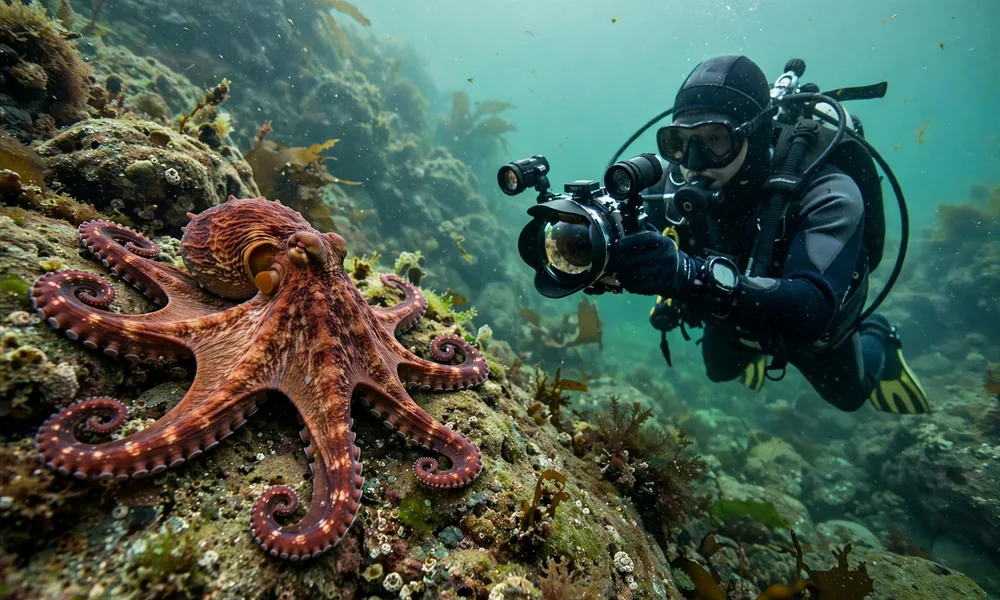
The main pressure on the giant Pacific octopus is fishing, and the pressure is uneven across the range. In Japan the species is the most commercially important octopus, and in South Korea it is also fished, while in the eastern North Pacific there is no directed fishery and the animals are taken only as bycatch. Habitat damage is a second pressure, because a giant Pacific octopus needs a rocky reef with dens to live in, and trawling and coastal building can destroy that reef. The blood of the octopus is copper-based rather than iron-based, which carries oxygen well in cold water but makes the animal sensitive to falling ocean pH.
The answer is not a single fix, and it is the slow work of protecting rocky reefs before they are damaged, rather than trying to repair them afterwards. Marine protected areas that cover reef habitat, limits on trawling over rocky ground, and careful management of the fisheries in Japan and Korea would all help the giant Pacific octopus, and they would help the thousands of other species that share its reef. Research matters too, and every diver who photographs an octopus adds to a record that is still thin. The giant Pacific octopus does not need a rescue, and it needs something quieter: a cold, rocky reef that is left alone.
Best seasons for giant Pacific octopus watching
There is no single season for watching a giant Pacific octopus, because the animals are present on their reefs all year round, and they do not migrate in the eastern North Pacific, they do not gather in one place at one time of year, and they do not come to the surface. A diver can meet one in any month, and a visitor to an aquarium can meet one on any day, which makes this one of the easiest large sea animals to see. The animals hunt at night, so a night dive is the best way to see one out of its den, and a day dive is the best way to see one resting in a den, with a pile of shells outside the entrance giving the spot away.
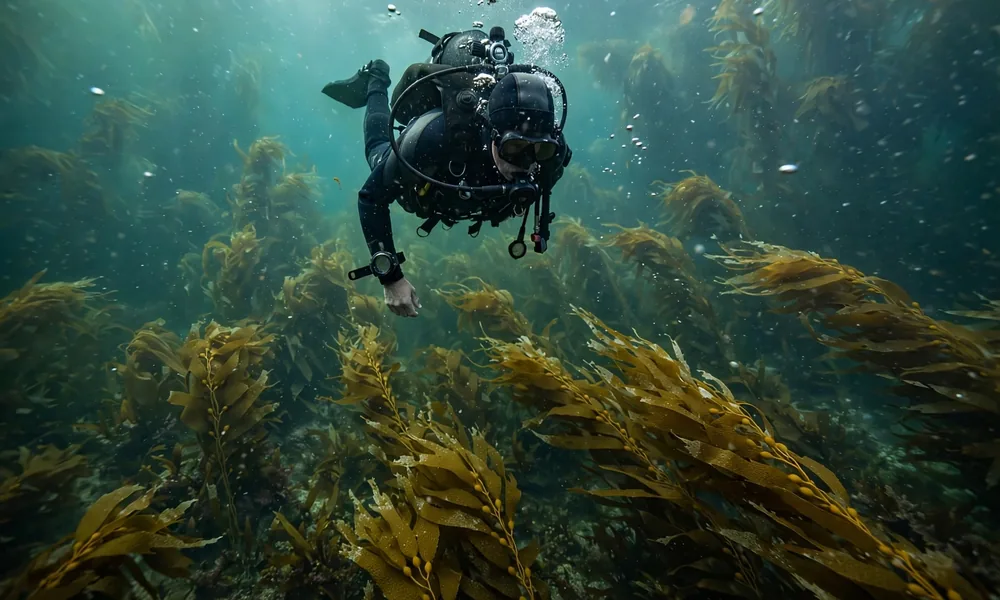
For most people, the best place to start is an aquarium, and the aquariums of the Pacific Northwest keep giant Pacific octopuses on display all year, with feeding times that are often listed on their websites. For divers, the Salish Sea and the coasts of British Columbia are the best-known waters, and the cooler months are often favoured, because the water is coldest then and the animals are most active in the shallows. Tide pools are a third option, and a careful search of rocky shores at low tide can turn up a young octopus in a pool, though the animal will be small and very well hidden.
Staying safe around giant Pacific octopuses
A giant Pacific octopus is not dangerous to people in the way a shark or a stingray is dangerous, and there is no record of one killing a person. It has a beak that can give a painful bite, and it has a venom that it uses on crabs and clams, but it does not hunt people, and it would far rather hide than fight. A diver who reaches into a den or grabs an octopus can be bitten, and the bite can be painful and can become infected, so the rule is simple: do not put your hands where you cannot see, and do not try to pull an octopus out of its den. The animal can also hold on with suckers that together can lift far more than its own weight. The real safety rule is the one that protects the animal, not the person: do not touch it, do not chase it, and do not disturb the den it lives in.
Giant Pacific octopus watching checklist
A little preparation turns a dive or an aquarium visit into a real chance of seeing a giant Pacific octopus at its best, arms spread over the reef in the dark.
- Look for a pile of empty crab and clam shells outside a crevice, which is the surest sign that a giant Pacific octopus lives in the den behind it.
- Dive at night when you can, because giant Pacific octopuses leave their dens after dark and are far easier to find hunting on the open reef.
- Check aquarium feeding times before you visit, since a feeding octopus is an active octopus and far more interesting to watch than a resting one.
- Search tide pools at low tide in the northern parts of the range, where a young octopus may be hiding under a rock in water shallow enough to wade in.
- Bring a torch with a red filter for night dives, so you can see the octopus without startling it with bright white light.
- Learn the shape before you go, so you can tell a giant Pacific octopus from smaller octopuses by its size, its reddish-brown skin and its large, bulbous mantle.
- Respect the den, and never reach inside it or try to pull an octopus out, because the animal you are watching has nowhere else to live.
Frequently asked questions
How big do giant Pacific octopuses get?
Most giant Pacific octopuses weigh around 15 kilogrammes, about 33 pounds, and their arms span up to 4.3 metres, about 14 feet, from tip to tip. Larger animals of 10 to 50 kilogrammes are reported regularly in cold, food-rich water, and the largest verified specimen weighed 71 kilogrammes, or 156 pounds, measured by Canadian researchers. Older claims of 272 kilogrammes and a span of 9.8 metres have never been verified by a scientist, and they should be treated as fishermen tales rather than facts.
How long do giant Pacific octopuses live?
Giant Pacific octopuses live for three to five years in the wild, which makes them the longest-lived octopuses known, since most octopus species live for only a year or two. They grow fast, reach maturity at one to two years of age, and breed only once. The male dies within a few weeks of mating, and the female dies soon after her eggs hatch.
What do giant Pacific octopuses eat?
A giant Pacific octopus eats shrimp, crabs, scallops, abalones, cockles, snails, clams, lobsters, fish, squid and other octopuses, and it has been known to attack small sharks and seabirds. It hunts at night, feeling its way across the reef with suckers that can taste as well as grip, and it opens shellfish by pulling the shell apart or by drilling a hole in it. The empty shells it leaves outside its den are the best sign that an octopus lives nearby.
Are giant Pacific octopuses dangerous to people?
No, not in any serious way, and there is no record of a giant Pacific octopus killing a person. The animal has a sharp beak and a venom it uses on crabs and clams, so a bite can be painful, and its suckers can hold on very hard, but it does not hunt people and it would far rather hide than fight. Divers should not reach into a den or try to pull an octopus out. The danger in the water belongs to the cold, the current and the depth, not to the octopus.
How many hearts does a giant Pacific octopus have?
A giant Pacific octopus has three hearts, like every other octopus. Two of the hearts pump blood to the gills, and the third pumps blood to the rest of the body, and the blood itself is blue, because it is based on copper rather than iron. The copper-based blood carries oxygen well in cold water, which suits an animal that lives in the cold North Pacific. The three hearts stop beating when the animal swims, which is one reason octopuses prefer to crawl rather than swim.
How is this guide different from the giant clam guide?
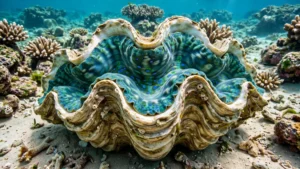
This guide covers the giant Pacific octopus, a fast, intelligent hunter, Enteroctopus dofleini, that roams the rocky reefs of the cold North Pacific on eight arms, changes colour and skin texture in a blink, cracks crabs and clams with a parrot-like beak, and lives for only three to five years before breeding once and dying, while our giant clam guide covers a still, sun-fed bivalve a metre across, Tridacna gigas, that sits fixed to a coral reef in the warm Indo-Pacific for more than a hundred years, opens its shell by day to show a brightly coloured mantle, and feeds mostly on the sugars made by algae living in its own flesh. One is a roaming predator you meet by torchlight on a reef at night; the other is a sessile reef animal you meet by snorkelling over it in daylight, and the two could hardly be more different in where they live, how they feed, and how long they live.
This guide also goes further than our general octopus guide, which covers the whole octopus family in a single broad sweep, from the reef octopuses that hide in dens and squirt ink to the deep-sea species that live beyond the reach of sunlight. That guide is the place to start if you want to know what an octopus is, while this guide stays with the giant Pacific octopus itself for its whole length, following Enteroctopus dofleini through its North Pacific reefs, its shellfish diet, its night hunting and its single breeding season to the Least Concern status that leaves its cold, rocky home as the thing most worth protecting.
Conclusion
The giant Pacific octopus species is a reminder that an animal does not need a long life to live a remarkable one. A reddish-brown octopus the weight of a large dog, with three hearts and blue blood, has made its home in the coldest, rockiest reefs of the North Pacific, and it survives there not by being fierce, but by being clever and patient.
If you go looking for one, go to the reef at night, go to the aquarium at feeding time, and watch for the pile of empty shells outside a crevice, because that is where the biggest octopus in the world is resting. Find the animal that can open a jar from the inside, change colour in a blink, and pour itself through a hole the size of an orange, and you will have met the giant Pacific octopus, the largest and longest-lived octopus in the sea. Look, and leave the den alone.