Poland animals range from European bison in the ancient forest of Bialowieza to brown bears in the Carpathian mountains, and the country holds some of the best large-mammal watching in Europe. If you are wondering which animals live in Poland and where to see them, the short answer is this: bison, wolves, lynx and brown bears survive in the forests and mountains, moose, red deer and wild boar roam the lowlands, and the wetlands and coasts host white storks, white-tailed sea eagles and grey seals.
Poland is one of the best places in Europe to watch large mammals, because so much of the country is forest, marsh and mountain. This guide covers the species you are most likely to meet, where each one lives and the best seasons to see them.
Key takeaways
- Poland’s most iconic land animals are the European bison, grey wolf, Eurasian lynx, brown bear, moose, red deer and wild boar.
- The European bison is Poland’s largest land mammal, and the Bialowieza Forest is the best place in the world to see it in the wild.
- Poland holds one of the largest breeding populations of white storks in Europe, and the birds nest on rooftops and poles across the countryside.
- The Carpathian mountains hold bears, wolves and lynx, while the Biebrza marshes are among the best birdwatching sites in Europe.
- Early morning and late evening are the best times to spot large mammals, and spring is the best season for storks and migrating birds.
What makes Poland’s wildlife special
Poland stretches from the Baltic coast in the north to the Carpathian and Sudeten mountains in the south. That range covers temperate forest, primeval woodland, wetlands, dunes and high mountains, so the country holds species from several habitats at once.
Poland has no endemic mammals, and that honesty matters: the country has no land mammal found nowhere else. What it has instead is something rarer in modern Europe — large, connected forests where big animals still live in the wild. The Bialowieza Forest, shared with Belarus, is the last large remnant of the primeval forest that once covered much of lowland Europe, and the Biebrza valley holds one of the largest natural river marshes on the continent.
One small exception lives in the high Tatras: the Tatra pine vole is found only in the Tatra mountains, which Poland shares with Slovakia. It is a small, shy rodent of the high meadows, and it is almost never seen by visitors.
The great mammals of Poland
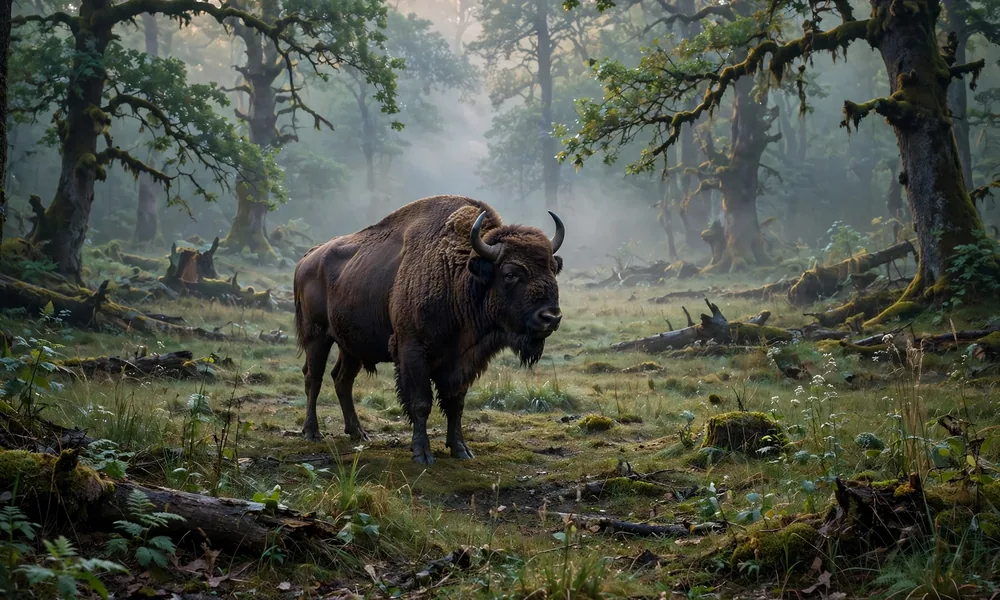
The European bison, or wisent, is Poland’s largest land mammal and the animal most visitors hope to see. Bison were brought back from the edge of extinction in the last century, and the free-roaming herds of the Bialowieza Forest are now the best-known in the world. Bison graze in forest clearings and meadows, and they are most often seen in the early morning or late evening.
Moose are the largest deer in Poland, spread across the forests and marshes of the north-east, especially around the Biebrza valley, and most active at dawn and dusk. Red deer live in forests across the country, roe deer are widespread in farmland and forest edges, and wild boar root through the woodland floor in family groups.
Among the predators, the grey wolf lives in the forests of the east and in the Carpathian mountains, hunting deer and wild boar in packs. The Eurasian lynx is rarer and shyer, hunting roe deer in the forests of the east and the mountains of the south. Brown bears live in the Carpathians, mainly in the Tatras and the Bieszczady mountains.
Beavers have returned to many Polish rivers and lakes, and their dams now shape wetlands for frogs, dragonflies and water birds. Otters hunt along the same rivers, and badgers and pine martens are common in the forests.
Birds of the Polish forests, marshes and coasts
The white stork is Poland’s best-loved bird, and its return each spring is one of the great moments of the Polish year. White storks nest on rooftops, chimneys and specially built poles across the countryside, and Poland holds one of the largest breeding populations in Europe.
The white-tailed sea eagle is Poland’s largest bird of prey, and it is the country’s national bird. It breeds along the coasts, around the big lakes and along the great rivers, and it is often seen from a boat or a lakeside hide. Golden eagles hunt over the mountains of the south instead.
The Biebrza marshes in the north-east are among the best birdwatching sites in Europe. In spring the flooded meadows fill with waders, ducks and geese, and the rare great snipe and aquatic warbler breed in the sedge marshes. Cranes pass through in large numbers in spring and autumn.
Seals, otters and life in the rivers and the Baltic
Poland’s rivers hold their own wildlife, and the beaver is the most visible of all. Beavers have spread back across the country, and their lodges and dams are easy to find along slow rivers and lake shores. Otters are shyer but live on many of the same waters, hunting fish at dawn and dusk.
Along the Baltic coast, grey seals haul out on sandbanks and rocky islets, and harbour porpoises are rare visitors to Polish waters. The seals are best seen from a boat in summer, and the coast around the Hel Peninsula is among the best places to look for them.
The great rivers — the Vistula, the Oder and the Bug — are corridors for wildlife. Their floodplains hold beavers, otters, deer and a rich mix of water birds, and the middle Vistula is one of the last large wild rivers in Europe.
Smaller animals and the wildlife of the mountains
Not all of Poland’s wildlife is large. The Tatra chamois lives on the high rocky slopes of the Tatras, a goat-antelope that is sure-footed on cliffs and snowfields. Marmots whistle from the alpine meadows, and the mountain hare turns white in winter. In the forests, red squirrels, dormice and pine martens are common.
The Bieszczady mountains in the south-east are the wildest corner of Poland, with old beech forest, bears, wolves and lynx, and meadows where red deer graze at dawn. Like the forest animals of northern Europe, these species depend on quiet, connected woodland.
Where to see Poland’s wildlife
European bison are easiest in the Bialowieza Forest, where guided walks and viewing areas give the best chance of a sighting, especially in the early morning. Wolves and lynx live in the same forest and in the Carpathians, though both are far harder to see than bison. Brown bears are best looked for in the Bieszczady mountains, with a local guide.
Moose are best in the Biebrza valley, white storks in the villages of the east, and white-tailed sea eagles along the coast and the great lakes of the north. The Biebrza marshes in spring are the single best birding destination in the country, and the Tatras are the place for chamois, marmots and golden eagles.
| Species | Where to look | Best season | How likely is a sighting |
|---|---|---|---|
| European bison | Bialowieza Forest clearings and meadows | All year, early morning and evening | Good with a guide |
| White stork | Villages and farmland across the east | April to August | Good in season |
| Moose | Biebrza valley marshes and forests | Spring and autumn, dawn and dusk | Fair |
| Brown bear | Bieszczady and Tatra mountains | May to October | Low |
| White-tailed sea eagle | Baltic coast, large lakes and the Vistula | All year | Good from a boat or hide |
| Grey seal | Baltic coast sandbanks and the Hel Peninsula | Summer | Fair from a boat |
| Great snipe | Biebrza marshes | May, at dusk | Low, needs a guide |
Best seasons for wildlife watching
Spring is the finest season. The white storks return to their nests, the Biebrza marshes flood and fill with waders and geese, and the bears leave their dens. It is also the most sensitive season, so keep to paths, keep dogs on a lead and give every animal more space than you think it needs.
Summer is the easiest season for bison and moose. The days are long, and the animals are out in the clearings at dawn and dusk. Autumn brings the deer rut, when red deer stags are at their most visible and vocal, and bears feed hard on berries and nuts before they den for the winter.
Winter is the quiet season, and the hardest for watching, but bison are easier to find against the snow, wolf and lynx tracks show clearly in the forest, and the Baltic coast holds wintering ducks and geese in large numbers.
Staying safe around Poland’s wildlife
Poland’s large animals are usually calm, but they deserve respect. Keep your distance from bison, bears, wolves and moose, never approach a moose calf or walk between a cow and her calves, and never try to feed or touch any wild animal. If you meet a bear, back away slowly, speak calmly and never run. Moose on the road are a real danger at dawn and dusk, so slow down on forest roads and watch the verges.
Wildlife watching checklist
- Book a local guide or a bison viewing walk in the Bialowieza Forest — they know where the herds are.
- Go out at dawn or dusk for mammals, and plan stork and Biebrza trips for April to June, when the marshes are at their best.
- Bring binoculars, warm layers and waterproofs, even in summer — Polish weather changes fast.
- Keep at least 50 metres from seals, nesting birds and grazing deer, and far more from bison, bears, moose with calves and wolves.
- Never feed wild animals, and never use food or calls to lure them closer for a photograph.
- Leave no trace: take your rubbish home and keep to marked paths in sensitive habitats.
Frequently asked questions
What is the most famous animal in Poland?
The European bison is the most famous, and the Bialowieza Forest is the best place in the world to see it in the wild. The white stork is the best-loved bird, and the grey wolf is the most famous predator.
Are there bears and wolves in Poland?
Yes. Brown bears live in the Carpathian mountains, mainly in the Tatras and the Bieszczady, and grey wolves live in the forests of the east and in the mountains. Both are shy and avoid people.
What animal lives only in Poland?
No land mammal lives only in Poland. The Tatra pine vole is found only in the Tatra mountains, which Poland shares with Slovakia.
When is the best time to see bison in Poland?
Bison can be seen all year in the Bialowieza Forest, but the best chances are in the early morning and late evening, when the herds come out into the clearings to graze. A local guide greatly improves the odds.
Is it safe to see bison in Poland?
Bison are usually calm, but they are huge and fast, and they deserve respect. The safest way to see one is on a guided walk or from a viewing area, keeping a good distance.
Can I see white storks in Poland?
Yes. White storks nest on rooftops and poles across the Polish countryside from April to August, and the villages of the east are the best places to see them.
Conclusion
Poland’s wildlife rewards patience: European bison in the ancient forest of Bialowieza, white storks on the rooftops of the eastern villages and bears in the Carpathians are all within reach if you plan around the seasons and keep your distance.
The next step is to pick one species and one season — a dawn bison walk in Bialowieza, a spring birding trip to the Biebrza marshes, or a summer visit to the Tatras — and plan your visit around it.