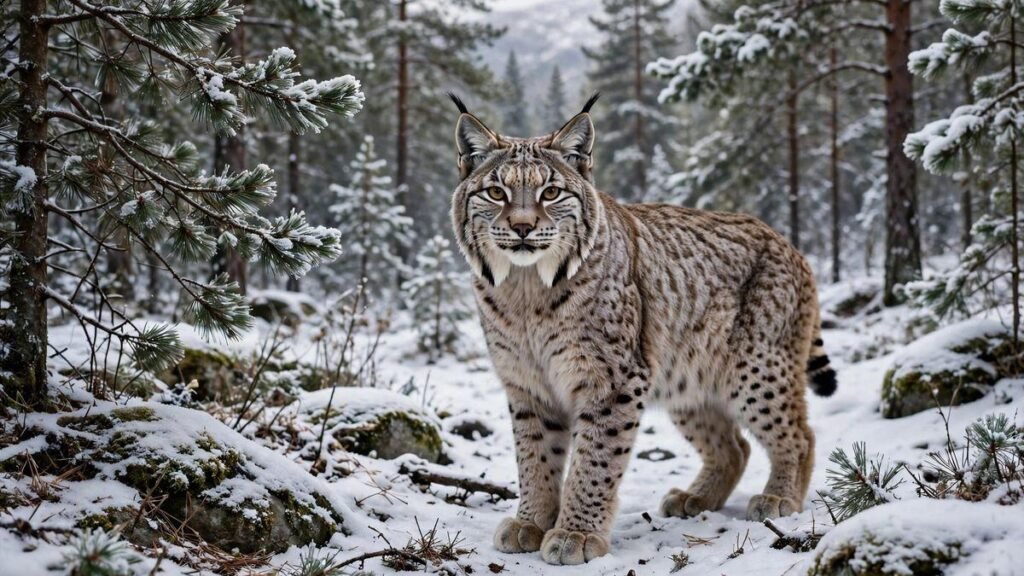
The Eurasian lynx is Europe’s largest wild cat, a shy, spotted hunter with ear tufts and a short tail that lives in the forests of Norway and across northern Europe and Asia. If you are wondering what a Eurasian lynx is, where it lives and what it eats, the short answer is this: it is a medium-sized wild cat that hunts roe deer in the forest, it is most active at dawn and dusk, and it is so secretive that most people never see one in the wild.
In Norway the lynx is the most widespread of the large predators, yet it is rarely seen and often only known by its tracks in the snow. This guide covers its appearance, habitat, hunting, family life and the uneasy balance between lynx, deer and people.
Key takeaways
- The Eurasian lynx is Europe’s largest wild cat, weighing 18 to 30 kg.
- It is recognised by its ear tufts, spotted coat, short tail and large paws.
- Roe deer are its main prey in Norway, and a lynx kills roughly one deer a week.
- Lynx are solitary, nocturnal hunters with home ranges of hundreds of square kilometres.
- Norway holds a small, managed population, and the lynx is strictly protected.
What is a Eurasian lynx?
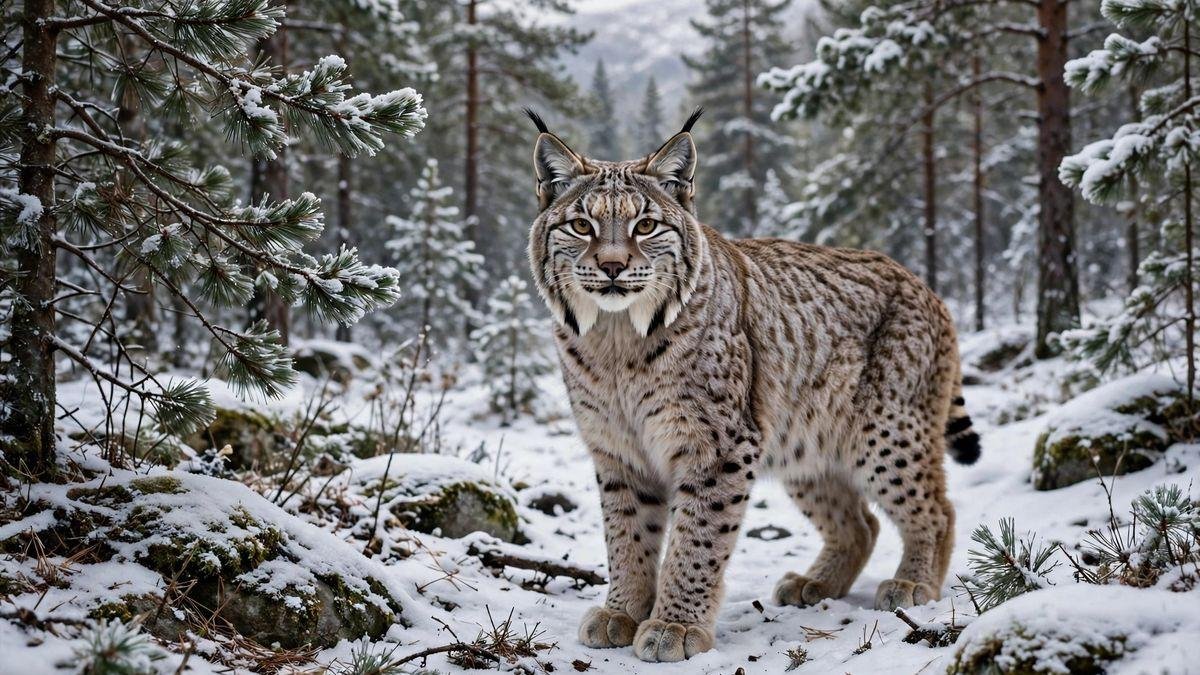
The Eurasian lynx (Lynx lynx) is one of four lynx species in the world, and the largest of them. Adults stand 60 to 70 cm at the shoulder and weigh 18 to 30 kg, with males larger than females. The coat is reddish-brown to grey in summer and paler in winter, marked with dark spots that vary from animal to animal, so each lynx can be recognised by its own pattern, like a fingerprint.
The lynx is easy to recognise. It has long legs, large paws that work like snowshoes, a short tail with a black tip, and pointed ears with black tufts that may help it hear. The lynx is a strong climber and a good swimmer, though it usually stays on the ground, moving silently through the forest on its padded feet.
Like other predator animals, the lynx is an obligate carnivore: it eats only meat, and it needs large prey to survive. It is not dangerous to people. Lynx avoid humans, and there are no recorded attacks on people in Norway. They are, however, a serious predator of roe deer and of sheep, which is why they are at the centre of a long-running debate between conservation and farming.
Habitat and range
Eurasian lynx live in the forests of Europe and Asia, from Norway and Sweden through Finland and Russia to Siberia and Central Asia. They need large areas of forest with good cover and plenty of roe deer, and they avoid open farmland and towns. In Norway they are found across the south and east, and in the forests of Trøndelag and the north, wherever there is enough forest and prey.
Each lynx holds a home range, or territory, that can cover 200 to 1,000 square kilometres for a male and 100 to 300 for a female, depending on how much prey is available. Males hold larger ranges that overlap the ranges of several females, and they mark their ground with scent, scrapes and droppings. Young lynx leave their mothers in spring and wander far to find their own range, and a dispersing lynx may travel hundreds of kilometres.
The lynx population in Norway is managed by the authorities, who set a target for the number of family groups, meaning a female with kittens, each year. The population is counted by tracking family groups in winter, when the tracks in the snow show where the females and kittens are. The number is kept low by design, because the lynx kills sheep, and the balance between the lynx and the sheep farmers is one of the most contested issues in Norwegian wildlife management.
What lynx eat and how they hunt
Roe deer are the main prey of the lynx in Norway, and a single lynx kills roughly one roe deer a week. The lynx is an ambush hunter: it stalks its prey silently through the forest, using cover and the wind, and then makes a short, fast rush, leaping onto the deer’s back and biting the throat. The hunt is usually over in seconds, and the lynx drags the kill into cover to eat it over several days, returning to the carcass again and again.
When roe deer are scarce, the lynx eats hares, grouse, small rodents and, in the mountains, young reindeer. It also kills sheep, especially lambs, and a lynx that finds a flock may kill more than it can eat, which is why sheep farmers fear it.
The lynx hunts mainly at dawn and dusk, and at night, resting during the day in thick cover, in a rocky hollow or under a fallen tree. It is a patient hunter, and it may wait for hours beside a deer trail, listening and watching, before it moves. Its large paws let it move quietly in deep snow, and its spotted coat breaks up its outline in the dappled light of the forest, so prey often never sees it coming.
Breeding and kittens
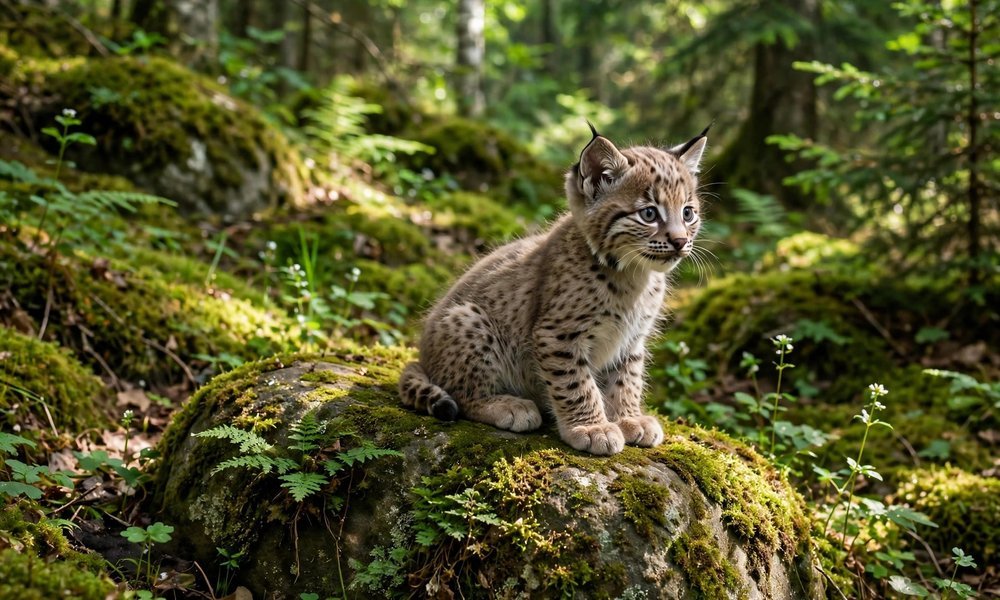
Lynx mate in late winter, usually in February and March, and the kittens are born in late spring, in May or June, after a pregnancy of about ten weeks. The female gives birth in a den, often in a rocky hollow, under a fallen tree or in a dense thicket, and the litter is usually two or three kittens, though one to five are possible.
The kittens are born blind and helpless, weighing around 300 grams, and they open their eyes after about ten days. They stay in the den for the first weeks, fed by their mother, and they emerge in early summer, spotted and playful, following their mother as she hunts. The mother teaches them to hunt by bringing them live prey, and by autumn they are catching small animals for themselves.
The kittens stay with their mother through the winter and leave in the following spring, when she is about to give birth again. They disperse to find their own territories, and many die in their first year, from hunger, disease, traffic and other lynx. A lynx that survives may live for 12 to 15 years in the wild, and the females breed from two years old, producing a litter most years if the food is good.
Lynx and people
The lynx was hunted to extinction in Norway in the early twentieth century, and it returned only in the 1950s, spreading back from Sweden. It is now strictly protected, and hunting is allowed only under a licence, with a quota set by the authorities each year. The quota is controversial: farmers want fewer lynx because of sheep losses, while conservationists argue that the population is already small and that the lynx is a natural part of the Norwegian forest.
Sheep are the heart of the conflict. Norway’s sheep graze freely in the forests and mountains in summer, and they are easy prey for a lynx. The state pays compensation for sheep killed by predators, and farmers are encouraged to use guard dogs, fencing and shepherding, but losses continue, and the lynx is often blamed. Research shows that lynx take far fewer sheep than the numbers claimed, and that most losses are from other causes, but the debate remains heated.
For visitors, the lynx is almost impossible to see. It is nocturnal, shy and superbly camouflaged, and even researchers who track them for years may see one only a handful of times. The best sign of a lynx is its track in fresh snow: a large, round paw print, wider than a dog’s, with no claw marks, because the lynx keeps its claws retracted. If you find one, you have found a lynx’s forest, even if the animal itself stays hidden.
Conservation and the future
The future of the lynx in Norway depends on the balance between the forest, the deer and the farms. The population is stable but small, and it is managed to a target that keeps it well below what the forest could support. Conservationists argue that a larger lynx population would control roe deer numbers and restore a more natural forest, while farmers argue that any increase means more sheep losses.
Research is helping. GPS collars have shown how lynx move, how much they eat and where they kill sheep, and the data is used to target protection where it is needed most. Compensation, guard dogs and better fencing are reducing losses, and the lynx is slowly becoming accepted as part of the Norwegian landscape. The species is not endangered in Europe as a whole, but in Norway its future will always depend on people choosing to live alongside it.
| Species | Weight | Where it lives | Main prey |
|---|---|---|---|
| Eurasian lynx | 18–30 kg | Forests of Europe and Asia | Roe deer |
| Canada lynx | 8–14 kg | Boreal forest of North America | Snowshoe hare |
| Iberian lynx | 9–13 kg | Spain and Portugal | Rabbit |
| Bobcat | 7–14 kg | North America | Rabbits and hares |
| Wildcat | 3–8 kg | Forests of Europe | Mice and voles |
Lynx watching checklist
- Look for lynx tracks in fresh snow in the forests of the south and east in winter.
- Go out at dawn or dusk, when lynx are hunting, and move quietly through the forest.
- Use binoculars and watch deer trails and forest edges, where lynx wait in ambush.
- Never try to call or lure a lynx, and never approach a den or a kill.
- Keep dogs on a lead in lynx country, and report tracks and sightings to the local wildlife authorities.
- Accept that you may never see one — the track in the snow is often the best you will get.
Frequently asked questions
Are lynx dangerous to people?
No. Eurasian lynx avoid people, and there are no recorded attacks on humans in Norway. They are shy, nocturnal hunters that prey on roe deer, and they will run from a person long before the person sees them.
How big is a Eurasian lynx?
Adults stand 60 to 70 cm at the shoulder and weigh 18 to 30 kg, with males larger than females. It is Europe’s largest wild cat, and much bigger than a domestic cat, though far smaller than a wolf.
What do lynx eat in Norway?
Roe deer are the main prey, and a lynx kills roughly one roe deer a week. They also eat hares, grouse, small rodents and young reindeer, and they sometimes kill sheep, which is the main source of conflict with farmers.
Where can I see a lynx in Norway?
Lynx live in the forests of the south, east and Trøndelag, but they are extremely hard to see. Your best chance is to look for tracks in fresh snow in winter, or to join a guided tracking walk with a local wildlife guide.
How many lynx are there in Norway?
The population is small and managed to a target set by the authorities, counted in family groups each winter. The exact number changes year to year, but it is in the low hundreds, far below what the forest could support.
Why do lynx have ear tufts?
The black tufts on the ears are one of the lynx’s most distinctive features, and they are thought to help the animal hear. They may also play a role in communication, making the ears more visible to other lynx.
Conclusion
The lynx is the ghost of the Norwegian forest: widespread, rarely seen, known mostly by its tracks in snow. That is how it should stay. The next step is simple: walk a forest trail in fresh snow, learn its round, clawless print, and report it to wildlife authorities.